The short answer
- What does it cost?
- RepairPal lists $625–$807 on average for a Camry, rising to $836–$1,052 for 2025–2026 cars. A V6 lands at the top of any range.
- Why the spread?
- The four-cylinder pump bolts to the front of the engine. The 3.5 V6 pump is buried; Toyota’s manual starts that job by removing the engine.
- Any free fix?
- No recall replaces a Camry water pump, 2007–2022. A 2018 bulletin fixes an electric-pump fault code with a software update.
$625–$807
RepairPal Camry average
Labor $313–$460, as listed Oct 2026
6 of 15
Years ENGINE made the top five
2008–2022 NHTSA complaints
P26CB71
Electric water pump code
2018 Camry four, Toyota T-SB-0323-17
0
Water pump recalls
Camry and Camry Hybrid, MY2007–2022
What the estimators say, and whose numbers they are
We decode VINs; we do not fix cooling systems. Every dollar figure in this section belongs to the company named next to it, and each was read on October 25, 2026.
| Source | What it lists for a Camry water pump |
|---|---|
| RepairPal estimator | $625 to $807 average; labor $313 to $460, parts $311 to $347 (page dated September 3, 2026) |
| RepairPal, by model year | $781 to $981 for 2022–2023; $836 to $1,052 for 2025–2026 |
| Kelley Blue Book | $375 to $787 including parts and labor, as a general figure when no ZIP code is entered |
| Haynes repair guide | About $150 to $1,200, and 1 hour 30 minutes to 12 hours of work |
Two cautions about reading that table. KBB’s $375 to $787 appears word for word on its pages for Camrys decades apart, which suggests a site-wide default rather than a Camry estimate; its own page says a local Fair Repair Range needs a ZIP code. Haynes’s range is wide for the honest reason that it covers engines from a 1980s four to the 3.5-liter V6, and its 12-hour ceiling belongs to the deep end of that list.
RepairPal’s figures are the most specific, and its parts line is the clue: roughly $311 to $347 for the part, with labor carrying the rest. That ratio holds on a four-cylinder. On a V6 the labor line can be several times the part, which is why the question to settle first is which engine your car has.
Which water pump your Camry has
Between 2008 and 2022 the gas Camry used four engines, and the pump changed in design or location with three of them. The model year narrows it down; the VIN settles it.
| Model years and engine | Where the pump is and what drives it |
|---|---|
| 2008–2009, 2.4L four (2AZ-FE) | On the front of the engine, turned by the accessory belt |
| 2010–2017, 2.5L four (2AR-FE) | Same layout: front of the engine, accessory belt, reached once the belt and pulley are off |
| 2008–2017, 3.5L V6 (2GR-FE) | Accessory-belt driven, timing by chain, buried behind a mount bracket, idlers and tensioner |
| 2018–2022, 2.5L four (A25A-FKS) | Electric pump commanded by the engine computer, per Toyota bulletin T-SB-0323-17 |
| 2018–2022, 3.5L V6 (2GR-FKS) | Not confirmed from a Toyota document; ask the shop to name the part |
Older Camry V6 engines ran timing belts that turned the pump, which is where the habit of “do the water pump with the timing belt” comes from. It does not apply to any Camry engine covered here: the 2AZ, 2AR and 2GR all use timing chains. A quote that bundles a timing belt kit into a 2008-or-later Camry pump job is quoting the wrong car. Our engine size by VIN lookup reads the engine from the factory record, and the Toyota VIN decoder adds trim and plant.
The 2008–2017 four-cylinder: the cheap end of the range
Most Camrys in this span left the factory with a four-cylinder, and these are the cars the RepairPal average describes best. The pump bolts to the front of the block with a gasket, its pulley rides on the serpentine belt, and nothing has to come out of the car to reach it. The belt and pulley come off, the bolts come out, and the new pump goes on with a fresh gasket.
The real cost questions on these cars are about the parts around the pump rather than the pump. Coolant has to be drained and refilled, and Toyota’s factory fill is a specific long-life pink coolant; our coolant type by VIN page matches it to the car. The serpentine belt is already off, so replacing it during the job costs only the part. A thermostat is a fair add on a high-mileage car and an upsell on a low-mileage one.
On the 2008 and 2009 cars there is one more wrinkle. These are 2AZ-FE years, and Toyota ran a warranty enhancement, ZE7, for excessive oil consumption on 2007–2009 Camrys with that engine. It has nothing to do with the pump, but it explains a good part of what the complaint record shows for those years, covered below.
The 3.5 V6: belt-driven, but buried
The 2GR-FE is a timing-chain engine, and its water pump is turned by the same V-ribbed belt as the alternator. That sounds like an easy job. It is not, because the pump sits low on the end of a transverse V6 in a midsize engine bay, with an engine mounting bracket, two idler pulleys and the belt tensioner in the way.
Toyota’s repair manual for the 2008 Camry 2GR-FE, as reproduced by workshop-manuals.com, opens its water pump removal with a single blunt step: remove the engine assembly and transaxle. It then has the technician pull the No. 1 engine mounting bracket, the No. 2 idler pulleys and the belt tensioner, and hold the pump pulley with special tools while its four bolts come out. Owner repair write-ups describe a shorter route, supporting the engine and raising it a few inches instead of pulling it, which we have not checked against a Toyota procedure. Either way, the depth of the job is why the V6 sits at the top of every estimate.
Because the labor is the expensive part, a V6 pump is a job you want done once. Ask about the drive belt, the idler pulleys and the thermostat while the front of the engine is already apart, since each one is cheap in parts and expensive to reach later.
2018 and later: an electric pump and a software bulletin
The 2018 redesign brought the 2.5-liter A25A-FKS four, and with it a pump that is neither belt- nor chain-driven. The clearest proof is a Toyota service bulletin rather than a brochure. T-SB-0323-17, dated December 8, 2017 and hosted by NHTSA, covers some 2018 Camrys with four-cylinder engines that light the check-engine lamp with code P26CB71, which Toyota names “Electric Water Pump Speed Stuck.”
The bulletin’s fix is not a pump. Toyota modified the engine computer’s logic and tells dealers to reflash it, a 0.4-hour operation, and notes that the computer itself should not be replaced. The repair is covered under Toyota’s federal emission warranty, which the bulletin gives as 96 months or 80,000 miles from the in-service date, and it applies only to cars built before the production change listed by plant and trim. A 2018 Camry with that code is the case where the cheapest answer is a dealer visit, not a parts order. Our TSB vs recall explainer covers why a bulletin, unlike a recall, is only paid for while a warranty applies.
KBB’s Camry page makes the general point that belt-driven pumps are not that expensive while electric ones can get pricey. RepairPal’s per-year figures for the 2022 and newer Camry, all A25A-era cars, sit above its nameplate average, though its listing does not say why. We could not confirm from a Toyota document whether the 2018-and-later V6 kept a belt-driven pump, so a V6 owner in those years should ask the shop to name the part number on the quote.
Camry Hybrid: more than one coolant pump
A hybrid Camry has to keep coolant moving when the gas engine is off at a light, and its inverter, the electronics that drive the motors, has its own cooling loop. Continental’s aftermarket data on hybrid coolant pumps describes this general arrangement: an electrically driven pump, often called an inverter coolant pump, that runs independently of the engine. The technical notes on the A25A engine family describe an electric engine pump as well, and the 2018-and-later Camry Hybrid uses that family’s hybrid version.
What we could not do is confirm from a Toyota document which pump each earlier Camry Hybrid generation uses on its engine, so we will not print a hybrid price. The practical rule: a hybrid quote should say whether it replaces the engine pump or the inverter pump, since they are different parts in different places. For the more expensive hybrid repair, see our Camry Hybrid battery replacement cost post.
What the ENGINE count holds, and what it does not
NHTSA’s complaint file has no “water pump” category. A pump complaint gets filed under the engine and cooling heading along with oil burning, stalling, cracked blocks and everything else under the hood. So the number below is an upper bound on pump trouble at best, and mostly a measure of something else.
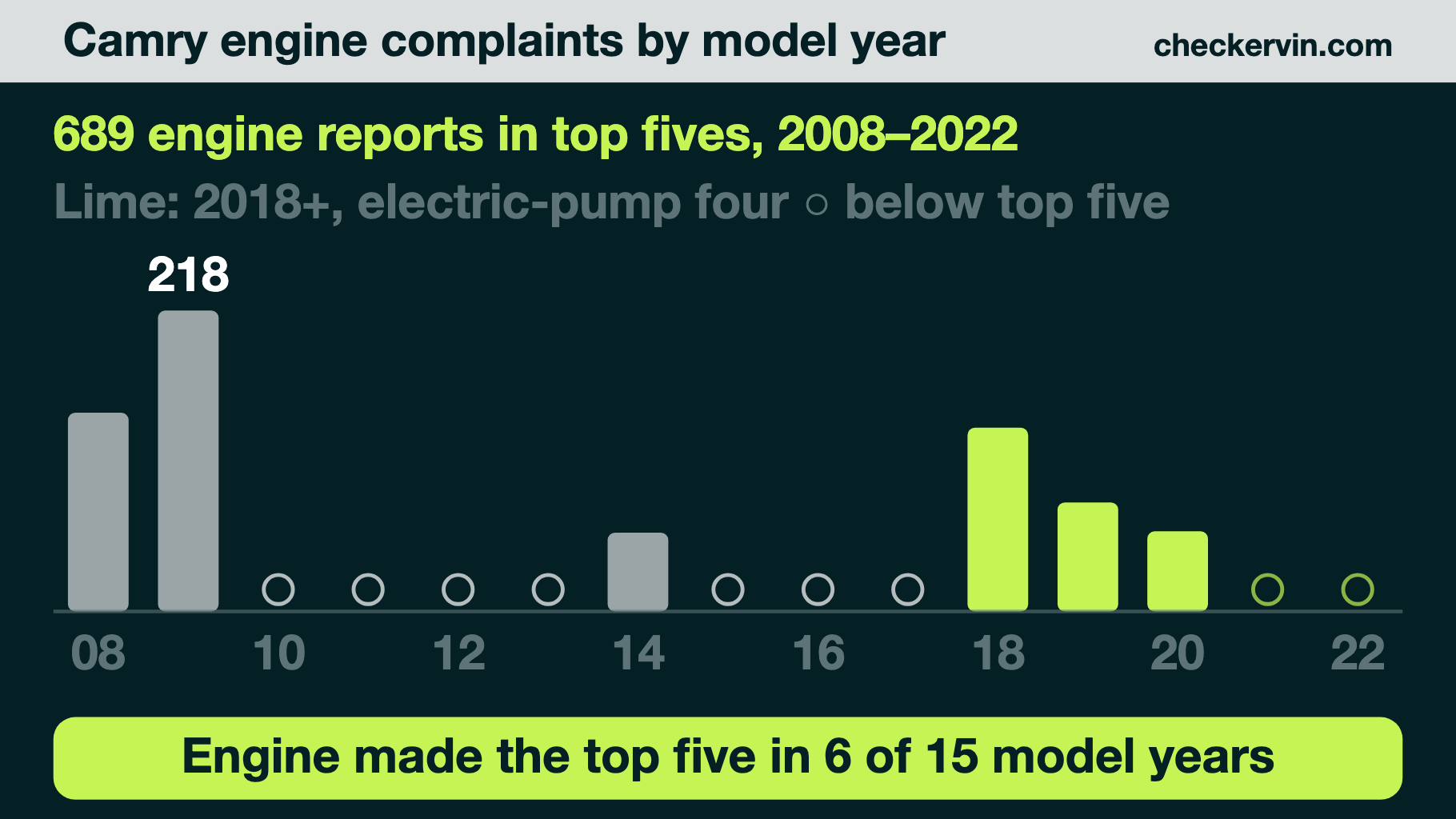
Our corpus holds 7,521 complaints against the 2008–2022 Camry. The engine category reaches a model year’s five most-reported components in 6 of 15 years (2008, 2009, 2014, 2018, 2019, 2020), for 689 reports in all. That is 11.8% of the top-five reports and ranks 4 of 13 categories, well behind vehicle speed control at 998. Its peak is 2009 with 218 reports, 15% of that year’s complaints.
The shape tracks the engines, not the pumps. The two 2AZ-FE years, 2008 and 2009, hold 362 engine reports, 53% of the total, and those are exactly the years Toyota’s ZE7 oil consumption program covered. The eight 2AR-FE years from 2010 to 2017 contribute only 57, all of it in 2014. The A25A years from 2018 add 270 (39%), and 191 of those sit in 2018 and 2020, the two years with 2.5-liter engine recalls described below.
In the 9years where the engine category misses the top five, it is not zero; it is smaller than that year’s fifth-place component, which never exceeds 68 reports (in 2012). The fair summary is that no Camry year shows an engine-complaint pattern that points at the water pump, and the years with the most engine complaints have better-documented explanations. Our Toyota Camry years-to-avoid breakdown scores each year on its whole record.
Recalls that touch the cooling system, and none for the pump
A recall is the only route where a pump would be replaced free regardless of age, so it deserved a real check. On October 25, 2026 we queried NHTSA’s recall API for the “Camry” and “Camry Hybrid” models in every year from 2007 through 2022 and read every summary. None mentions a water pump.
An empty result only counts if the query could have found a hit. The same pass does return two campaigns filed under engine and engine cooling. Campaign 20V064000 covers certain 2020 Camry and Camry Hybrid cars with 2.5-liter engines whose block castings may have porosity that lets coolant leak internally or externally; dealers inspect and replace the engine as necessary. Campaign 18V200000 covers certain 2018 Camry 2.5-liter cars with oversized pistons that may cause a stall, also remedied by engine replacement where affected.
The first one matters for anyone chasing a coolant leak on a 2020 car: a leak there could be the recalled block rather than the pump, and the recall repair costs nothing. Check that before paying for a pump. Our Toyota recalls by VIN page runs the open-recall check, and buying a car with an open recall covers what to do if one turns up on a car you are shopping.
Confirm the pump is the problem before you pay for one
Plenty of coolant leaks are not pumps. Hoses, the radiator, the reservoir cap and, on 2020 cars, a recalled block can all leave the same puddle. A good shop proves the source first.
- Wet coolant or crusted residue at the pump’s weep area, not just somewhere near the front of the engine.
- A pressure test of the cooling system, which shows where coolant escapes under load.
- Bearing play or a growl at the pump pulley on a belt-driven pump, felt with the belt off.
- On a 2018 or later four-cylinder, the stored code read out and checked against T-SB-0323-17 before any part is ordered.
- On a 2020 2.5-liter car, the VIN checked for campaign 20V064000 first.
A trace of dried coolant at a pump seal is common on high-mileage engines and does not on its own prove failure. An active drip, a dropping reservoir or a rough bearing does.
Reading a Camry water pump quote
The useful comparison between two quotes is what each one includes, because on this car the extras are where prices diverge.
- Does the quote name the engine, and does the part number match it?
- Is the pump Toyota or Aisin original equipment, or an aftermarket unit, and what is its warranty?
- Is Toyota-specification coolant included, and how much?
- Is a timing belt listed? On a 2008–2022 Camry it should not be.
- On a V6, how many labor hours, and does the plan keep the engine in the car?
Ask both shops the same questions and the gap between quotes usually comes down to one or two line items. If the car is still young enough for factory coverage, our Toyota warranty check by VIN explains how to find the in-service date that starts every Toyota warranty clock.
If you are shopping a used Camry
A water pump is a wear item, and on a Camry past 100,000 miles a seller who can show a receipt for one has saved you a few hundred dollars on a four-cylinder and more on a V6. Ask which engine the car has before you weigh that receipt; a V6 pump done recently is worth more than the same line on a four.
For a 2018 car, ask whether the engine computer update has been done and look for the authorized modification label the bulletin tells dealers to apply. For a 2020, confirm the block recall is closed. Our 2018 Toyota Camry recordcollects that model year’s complaints and recalls in one place.
Where this information comes from
- Toyota T-SB-0323-17 — MIL ON DTC P26CB71, 2018 Camry (NHTSA-hosted)Names the A25A-FKS electric water pump, gives the software fix and the 96-month/80,000-mile coverage.
- NHTSA — recalls API, 2020 CamryReturns 20V064000, the 2.5-liter block porosity coolant-leak campaign. Queried with 2007–2022 on October 25, 2026.
- NHTSA — recalls API, 2018 CamryReturns 18V200000, the 2.5-liter piston campaign filed under engine and engine cooling.
- Toyota Warranty Enhancement Program ZE7 memo (NHTSA-hosted)Covers 2AZ oil consumption on certain 2007–2009 Camrys, the years that dominate the engine complaint count.
- NHTSA — recall lookup by VINRun your own car; campaigns are added after our snapshot. Also the source of the complaint records computed above.
- Toyota repair manual, 2008 Camry 2GR-FE water pump (workshop-manuals.com)The factory removal sequence, beginning with engine and transaxle removal.
- Toyota-club.net — Dynamic Force A25/M20 engine technical notesDescribes the A25A family’s electric pump and cooling system; corroborates the Toyota bulletin.
- RepairPal — Toyota Camry water pump replacement estimateThe $625–$807 average and per-year ranges quoted above, as listed October 25, 2026.
- Kelley Blue Book — Camry water pump replacementThe general $375–$787 figure and the note on electric pumps, retrieved October 25, 2026.
- Haynes — change the water pump, Toyota CamryThe 1.5-to-12-hour and $150–$1,200 ranges across Camry engines, retrieved October 25, 2026.
Keep reading
Frequently asked questions
How much does it cost to replace a water pump on a Toyota Camry?
RepairPal's Camry estimator, as listed on October 25, 2026, puts the average at $625 to $807, with labor of $313 to $460 and parts of $311 to $347. Its listing shows $781 to $981 for the 2022 and 2023 Camry and $836 to $1,052 for 2025 and 2026. Kelley Blue Book's Camry pages give a general $375 to $787 without a ZIP code. Those are their figures, not ours. A V6 car usually sits at the top of any range because of how deep the pump is buried.
Why does a V6 Camry water pump cost more than a four-cylinder?
Access, not the part. On the 3.5-liter 2GR-FE V6 the pump is driven by the accessory belt, but it is buried behind an engine mounting bracket, idler pulleys and the belt tensioner, and Toyota's repair manual for the 2008 Camry begins the water pump procedure by removing the engine and transaxle. Even with a shorter shop method, the labor runs well past a four-cylinder pump, which bolts to the front of the engine behind the belt.
Does the Toyota Camry have an electric water pump?
The 2018-and-later gas Camry with the 2.5-liter A25A-FKS four does. Toyota bulletin T-SB-0323-17 covers some 2018 Camry four-cylinders that set code P26CB71, which Toyota names as Electric Water Pump Speed Stuck, and fixes it with an engine computer update rather than a new pump. Camrys from 2008 through 2017 use a conventional belt-driven pump. We could not confirm the pump type on the 2018-and-later V6 from a Toyota document.
Is there a recall or warranty extension for Camry water pumps?
Not that we could find. NHTSA's recall API, queried October 25, 2026 for every Camry and Camry Hybrid model year from 2007 through 2022, returns no campaign that mentions a water pump. The same search does find cooling-related campaigns, including 20V064000, a 2020 Camry 2.5-liter recall for engine block porosity that can leak coolant, so the query can see such campaigns. The only pump-related Toyota document we found is the 2018 software bulletin, covered for 96 months or 80,000 miles under the federal emission warranty.
How do I know if my Camry water pump is failing?
Look for wet coolant or crusted residue around the pump at the front of the engine, a coolant reservoir that keeps dropping, a temperature gauge climbing, or a growl that changes with engine speed from a worn bearing. On a 2018-or-newer four-cylinder, a check-engine light with code P26CB71 points at the electric pump circuit, but Toyota's first step for that code on early 2018 cars is a software update. Have a shop pressure-test the cooling system before agreeing to a pump.
Know the engine before you price the pump
A free CheckerVIN report shows the factory engine, specifications and open recalls for any VIN, so the quote you compare is for the Camry you own.
Run a free VIN check