The short answer
- What do Camry brake pads cost?
- RepairPal lists $304–$368 on average; KBB's 2022 Camry page shows $276–$346 per axle for one ZIP code. Rotors cost extra.
- Do Camrys have brake defects?
- Some years do. Defect complaints cluster in 2008–2010 (hybrid brake actuator) and 2018–2019 (vacuum pump recall).
- What should I check first?
- Open recalls on the VIN. A 2018–2019 car with a hard pedal or a low braking power warning may need a free pump, not pads.
$304–$368
RepairPal Camry pad average
Updated Sept 2026, before tax
9 of 15
Years brakes make the top five
2008–2022 Camry, defect complaints
87%
Counted reports in two clusters
2008–2010 and 2018–2019
21V-890
Vacuum pump recall, 2018–2019
Sudden loss of brake assist
The numbers, and whose numbers they are
RepairPal’s Toyota Camry brake pad estimator puts the average job at $304 to $368, roughly $122 to $179 of labor and $182 to $189 of parts, before taxes and fees and without adjusting for where you live. The page is marked as last updated September 3, 2026, and its per-year table shows $304 to $361 for a 2023 Camry. Kelley Blue Book’s 2022 Camry page, priced for ZIP code 20146 in northern Virginia, shows $276 to $346, split into about $96 to $113 of parts and $179 to $210 of labor. KBB says plainly that its “pricing shown is for either front brakes or rear brakes,” so a car that needs both axles costs roughly twice that.
YourMechanic’s example for a 2016 Camry with the 2.5-liter four, front pads only, is $316.12 through its own mechanics against $360.00 to $483.54 at a shop or dealer. Its average for replacing Camry rotors is about $377, of which about $209 is parts. All three were retrieved in October 2026. We sell VIN checks, not brake jobs, and print no price of our own. What we can add is which Camrys came from years where the brake system, rather than the friction material, was the problem, and what Toyota did about it.
Pads wear out. That is not what the complaint file counts
Every Camry eats brake pads, and how fast depends on the driver, the commute and the pad compound far more than on the model year. Nobody files a federal safety complaint because pads wore out at 40,000 miles. NHTSA’s service-brakes category collects something else: owners reporting an ABS or brake warning light that will not clear, a pedal that sinks or turns rock hard, a car that takes too long to stop, a part that failed long before it should have.
So the complaint count tells you nothing about how often you will buy pads. It tells you which model years had a brake fault worth knowing about before you hand the car to a shop for routine pads, because a shop quoting pads on a car with a failing actuator or vacuum pump is fixing the wrong thing, and a recall may already pay for the right one.
Where 679 counted brake-defect reports sit
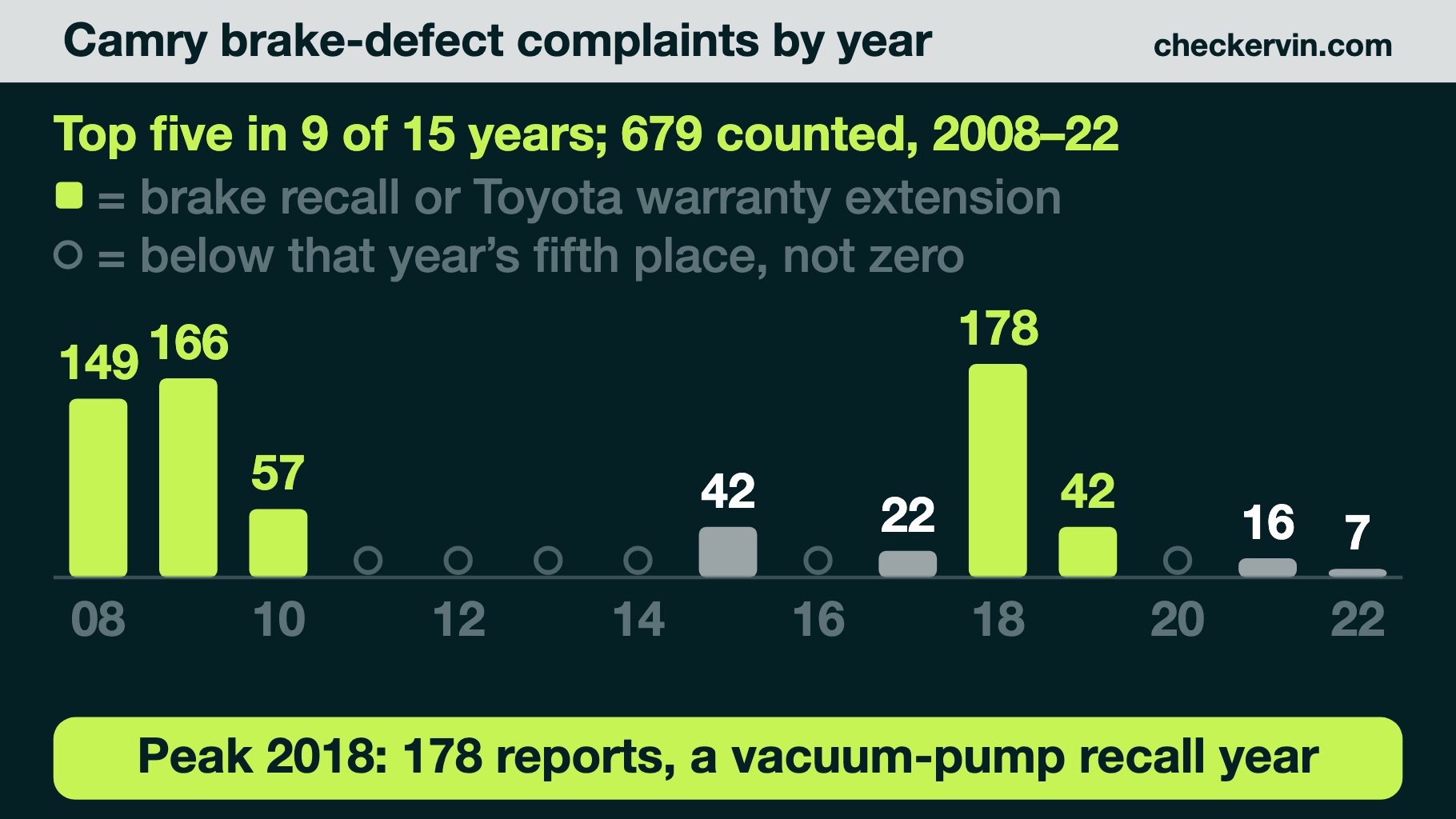
Our corpus holds 7,521 NHTSA owner complaints against the 2008–2022 Camry, and each model year keeps its five most-reported components. Service brakes make that list in 9 of 15 years, adding up to at least 679 reports, about 9% of the nameplate’s complaints. Because only five components are kept per year, that is a counted minimum, not a total. In 2011, 2012, 2013, 2014, 2016 and 2020 brakes fall below a fifth-place component carrying between 20 and 68reports, which means “below that line,” not zero.
The counted reports are not spread evenly. The 2008–2010 model years hold 372 of them (55%), and 2018–2019 hold 220 (32%). The single biggest year is 2018, with 178 reports, second among that year’s components. The 2020–2022 cars add only 23 counted reports between them, though those years are also younger and have had less time to collect complaints.
Two data notes, because NHTSA’s own filing is not consistent. Through 2013, and again for 2015–2017, the federal file pools the gas Camry and the Camry Hybrid, so hybrid brake reports are inside our counts for those years. For 2014NHTSA now files most reports under a separate “Camry HV” name; our pulled figure of 478 complaints predates that split, and brakes sit below fifth place in it. From 2018on, the hybrid has its own “Camry Hybrid” listing with few complaints, so our figures for those years are essentially the gas car.
2008–2010: the Camry Hybrid brake actuator
The first cluster belongs mostly to the first Camry Hybrid. Reading the service-brake complaints for 2008 and 2009, the same story repeats: ABS, VSC and brake warning lights, a beeping alarm, a pedal that needs much more force, and a dealer quote for a new brake actuator that owners describe as running into the thousands. The 2007 model year, which our file does not cover, carries an even heavier brake record in NHTSA’s live database.
NHTSA opened Preliminary Evaluation PE14001 into it in January 2014. Toyota answered in June 2014 with Warranty Enhancement Program ZE1 for about 177,500 Camry Hybrids from 2007 through 2011, covering internal malfunctions of the brake actuator and “overly sensitive monitoring logic” for the brake pedal stroke sensor, plus a separate service campaign, E0U, to replace a brake fluid reservoir whose internal filter could clog. NHTSA closed the evaluation that August, noting that repair expense came up in many complaints, “especially those related to the Brake Actuator, which had repair costs exceeding $3,000 according to some complaints.”
The coverage has run out. ZE1’s secondary coverage lasted 10 years from first use or 150,000 miles, whichever came first, so even a late-sold 2011 car is past it. On a 2007–2011 Camry Hybrid today, an actuator failure is an owner-paid repair, and a brake warning light on the dash is a reason to price that before you price pads.
The gas cars of those years have their own, smaller items. Recall 10V-040 covered 2010 Camrys with the 2.5-liter four, where the power steering pressure hose could rub through the left rear brake tube and leak fluid. The 2009–2011brake files also carry a run of stories about cars that kept moving with the brake pressed, from the period of Toyota’s accelerator pedal and floor-mat recalls, which are about the throttle, not the brakes.
2015: a brake booster bulletin, not a recall
The 2015 Camry is the quiet exception. Its 42 service-brake reports are 15% of that year’s complaints, enough to rank second. The narratives describe a red brake light or a “Check Brake System” message, a pedal that went to the floor, and dealers replacing the brake booster and master cylinder, in a few cases after brake fluid leaked into the booster.
Toyota’s bulletin T-SB-0010-15 matches that: some 2015 Camrys with the 2.5-liter four could set trouble code C1441 with an intermittent brake warning light, and some drivers felt something like ABS activating in normal stops. The fix was an updated brake booster, booked at 2.5 labor hours. A later bulletin, T-SB-0037-19, reprogrammed the skid control computer on 2015–2017 cars so the startup message stops appearing, and says outright that it “does NOT prevent DTC C1441.” Both repairs fell under the 36-month or 36,000-mile basic warranty. There is no recall, so on a 2015 car with that warning light today, a booster is an owner-paid job.
2018–2019: the vacuum pump recall
The 2018 Camry is the peak of the whole file: 178 service-brake reports, second among that year’s components and 23% of its complaints. 2019 adds 42more. The narratives explain why. Owners describe a “Low braking power” warning, a pedal that turns hard, a car that will not start with the message showing, and dealer diagnoses of a failed brake vacuum pump.
Toyota filed recall 21V-890 in November 2021 for about 227,490 2018–2019 Camrys built between January 2017 and September 2018. The vacuum pump that feeds the brake booster has caps on its vane made of a material that can wear prematurely with frequent braking or long idling; a worn cap can jam and break the vane, the pump stops supplying vacuum, and the driver may see “increased braking effort and an audible and visual warning,” though Toyota’s report adds that brake performance “could be suddenly reduced prior to any warnings.” Dealers inspect the pump and repair or replace it free. A smaller recall, 18V-211, had already covered a batch of 2018 Camrys whose pump rotor oil passage was mis-machined.
Many of the 2018 complaints were filed by owners who had been notified of the recall and were told the part was not yet available, and the filings peak in 2022, the year the owner letters went out. Toyota’s report also says that “Toyota or Lexus hybrid vehicles sold in the U.S. are not equipped with a vacuum pump,” so this recall is a gas-Camry issue.
2018 Camry Hybrid: grabby brakes, and a software fix
The 2018 Camry Hybrid sits outside our counts, under its own NHTSA listing, but its handful of brake complaints tell one consistent story: brakes that grab hard at parking-lot speeds, especially in the first minutes after the car has been sitting, and then feel normal at road speed. The hybrid’s pedal works through an electronically controlled brake system that blends regenerative braking with the friction brakes, so the feel is set partly by software.
Toyota’s bulletin T-SB-0033-20 names the condition on the 2018 Camry Hybrid, brakes owners describe as “grabby” or “touchy” when backing out of or pulling into a parking spot after the engine has been off two minutes or more, and fixes it by reprogramming the brake control computer in half a labor hour. If a 2018 Hybrid you are looking at stops abruptly in the lot, ask whether that update was done. New pads will not change it. For the bigger hybrid-only cost on these cars, see the Camry Hybrid battery cost post.
Rear brakes and the electric parking brake
Estimators price front and rear pads as separate jobs, and the Camry has disc brakes at the rear as well as the front in every source we checked, though we did not confirm that against a Toyota specification sheet for every trim and year. Rear pads usually wear more slowly than fronts, so a quote for both axles at once deserves a measurement for each.
From 2018 some Camrys have an electric parking brake, a switch on the console instead of a pedal or lever, with motors on the rear calipers. Not all of them do. Toyota’s bulletin T-SB-0168-19, which reprograms the skid control computer for a “Parking Brake Malfunction” message and trouble code C13B0 on 2018–2020 Camrys, states that it “ONLY applies to” cars “equipped with Electronic Parking Brakes.” We could not confirm from a Toyota document which trims carry it.
| What you have | What it means for a rear pad job |
|---|---|
| Parking brake pedal or lever | Conventional rear pad job; the parking brake is mechanical |
| Console switch (electric parking brake) | Rear calipers are motor-driven and must be retracted before pads go in |
| Parking Brake Malfunction message, 2018–2020 | Toyota bulletin T-SB-0168-19: a computer update, not new pads |
Scan-tool maker Innova says an electric parking brake is put into a service mode that retracts the calipers before pad work, and sells tools that do it. We did not read Toyota’s own Camry rear-pad procedure, so we will not tell you whether a switch sequence can substitute for a scan tool. Ask the shop how it retracts the calipers and whether that time is in the quote.
Squeal on 2018–2022 cars: a bulletin with a part number
The other common brake gripe on the current-shape Camry is noise, and Toyota has a fix on paper. T-SB-0088-22 covers 2018–2022 Camry and Camry Hybrid cars with front brake squeal. Early 2018 cars got new front calipers; later cars get a revised front fitting kit, part 04947-06130, the clips and shims the pads sit in, booked at 0.7 labor hours for both sides. That repair was covered only under the 36-month or 36,000-mile basic warranty, but the part number is still useful. If your 2018–2022 Camry squeals and is due for pads anyway, ask the shop to fit that kit with them rather than reusing the old hardware.
Toyota also has a general bulletin, T-SB-0313-17, for 2015–2018 Toyotas that shimmy under braking because lug nuts were torqued improperly. A rotor that seems warped after a tire change may be a torque problem first.
Reading a Camry brake quote
- Front, rear or both: KBB and RepairPal price one axle
- Pad thickness and rotor thickness measured, against the minimum stamped on the rotor
- Whether rotors are being replaced or resurfaced, and why
- On 2018–2022 cars, the updated front fitting kit if the old pads squealed
- On an electric-parking-brake car, how the rear calipers are retracted and reset
- Brake fluid condition, and whether a flush is recommended or required
- Any warning light on the dash, and the trouble code behind it
The last line matters most on this car. A warning light changes the job from routine wear to diagnosis, and on a 2007–2011 hybrid, a 2015 or a 2018–2019 Camry there is a documented Toyota explanation to check first. If the shop recommends a fluid service, our brake fluid by VINpage reads the specified fluid from the car’s build. The TSB vs. recall guide explains why a bulletin is only free inside warranty while a recall is free for the life of the car.
If you are buying the Camry, not servicing it
Brakes are easy to test on a short drive and expensive to ignore. Watch the dash at startup for a brake, ABS or VSC light; on a 2007–2011 Camry Hybrid, a light that comes back after clearing points at the actuator, whose extended coverage has ended. On a 2018–2019 car, ask for proof the 21V-890 pump work was done, or run the VIN yourself; the Toyota VIN decoderconfirms the build and whether it is a hybrid. On a 2018 Hybrid, ease into a parking space and feel for the grab Toyota’s bulletin describes.
The Toyota Camry years-to-avoid breakdown scores every model year on the whole complaint record, where power train, airbags and speed control lead in most years. The Camry water pump cost post and the Camry alternator cost post cover the other repairs that show up on these cars, and a Toyota warranty check by VIN shows whether any factory coverage is left on a newer one.
Where this information comes from
- NHTSA complaints API — 2018 Toyota CamryThe live owner complaints behind the vacuum pump cluster; other years and the Camry HV and Camry Hybrid listings use the same endpoint.
- NHTSA recalls API — 2018 Toyota CamryReturns 21V890000 and 18V211000, both filed under service brakes, power assist, vacuum.
- Toyota Part 573 Safety Recall Report 21V-890 (NHTSA)Population, production dates, the vane-cap defect, and the statement that U.S. Toyota hybrids have no vacuum pump.
- Toyota Warranty Enhancement Program ZE1 dealer letter (NHTSA copy)2007–2011 Camry Hybrid brake actuator and stroke sensor coverage terms, and the size of the covered fleet.
- NHTSA Preliminary Evaluation PE14001 — brake actuator malfunctionNHTSA's closing summary of the Camry Hybrid brake investigation, including the repair-cost observation quoted above.
- Toyota T-SB-0010-15 (NHTSA copy) — brake warning light, DTC C1441The 2015 Camry brake booster replacement and its 2.5-hour labor time.
- Toyota T-SB-0037-19 (NHTSA copy) — Check Brake System message2015–2017 skid control ECU update; states it does not prevent C1441.
- Toyota T-SB-0033-20 (NHTSA copy) — sensitive brakes at low speedThe 2018 Camry Hybrid grabby-brake software update.
- Toyota T-SB-0168-19 (NHTSA copy) — electric parking brake DTC C13B0Shows that only some 2018–2020 Camrys have an electric parking brake.
- Toyota T-SB-0088-22 (NHTSA copy) — front brake squeal2018–2022 Camry and Camry Hybrid calipers and fitting kit 04947-06130.
- RepairPal — Toyota Camry brake pad replacement estimateThe $304–$368 average quoted above, page updated September 3, 2026, retrieved October 2026.
- Kelley Blue Book — 2022 Toyota Camry brake repair pricesThe $276–$346 range for ZIP 20146 and the note that prices are per axle; retrieved October 2026.
- YourMechanic — Toyota Camry brake pad replacementThe 2016 Camry front-pad example and, on its rotor page, the $377 rotor average; retrieved October 2026.
Keep reading
Frequently asked questions
How much does it cost to replace brake pads on a Toyota Camry?
RepairPal's Camry brake pad estimator lists an average of $304 to $368, with labor at about $122 to $179 and parts at about $182 to $189, before taxes and without adjusting for location; the page is marked as updated September 3, 2026. Kelley Blue Book's 2022 Camry page, priced for ZIP 20146, shows $276 to $346 and notes the price is for either the front or the rear brakes, not both. Rotors, calipers or hardware raise the bill.
Should I replace the rotors when I replace the pads on my Camry?
Only if they need it. Rotors are measured against the minimum thickness stamped on them and checked for runout and scoring; a rotor within spec can take new pads. If they are replaced, it should be in pairs on the same axle. YourMechanic lists an average of about $377 for a Camry rotor replacement, about $209 of it parts. Toyota's own bulletin on front brake vibration in 2015–2018 Toyotas blames improperly torqued lug nuts, so ask how the wheels were tightened before blaming the rotors.
Which Toyota Camry years have brake problems?
In our NHTSA corpus, service-brake defect complaints reach a model year's five most-reported components in 9 of 15 Camry years from 2008 to 2022. Two clusters stand out: 2008–2010, when the file includes the Camry Hybrid and Toyota extended warranty coverage on the hybrid's brake actuator, and 2018–2019, the years of Toyota's vacuum pump recall 21V-890. These are defect reports, not pad wear.
Is there a brake recall on the Toyota Camry?
Yes, for some years. Recall 21V-890 covers about 227,000 2018–2019 Camrys whose brake vacuum pump can break and cause a sudden loss of brake assist; dealers inspect and repair or replace the pump free. A smaller 2018 recall, 18V-211, covers vacuum pumps with a mis-machined oil passage, and 10V-040 covers 2010 four-cylinder cars where a power steering hose can rub through a rear brake tube. Run the VIN through a recall lookup before paying for any brake work.
Do 2018 and newer Camrys need a scan tool for rear brake pads?
Possibly, if the car has an electric parking brake. Toyota's own bulletin on electric parking brake faults applies only to 2018–2020 Camrys equipped with one, so not every car has it. Scan-tool maker Innova says electric parking brakes are put into a service mode before pad work; we did not read Toyota's own Camry procedure, so ask the shop how it retracts the rear calipers and whether that is in the labor price.
Run the recall check before the brake job
A free CheckerVIN report shows the factory build, specifications and open recalls for any VIN, so you know whether a Camry brake fault is a free recall repair or an ordinary pad job.
Run a free VIN check