The short answer
- What does it cost?
- RepairPal lists $566–$876 on average for a Camry alternator, most of it parts. The 3.5L V6 takes far more labor than the four-cylinder.
- Is it really the alternator?
- Often not. The whole electrical category makes the Camry's top five in 6 of 15 model years, and owners mostly describe batteries, keys and wiring.
- What about the hybrid?
- A Camry Hybrid has no conventional alternator. Toyota uses a DC-DC converter to charge the 12-volt battery from the hybrid pack.
$566–$876
RepairPal Camry alternator average
Retrieved Oct 2026, before tax
6 of 15
Years electrical makes the top five
2008–2022 Camry, federal complaints
26 steps
Toyota's 2GR-FE V6 removal procedure
Bumper, radiator and coolant come out first
0.8 hr
Toyota's 2020 battery-drain fix
A module firmware update, T-SB-0095-20
The numbers, and whose numbers they are
The most specific published figure for this car is RepairPal’s. Its Toyota Camry alternator estimator puts the average job at $566 to $876, splitting it into roughly $165 to $241 of labor and $402 to $635 of parts, before taxes and fees and without adjusting for where you live. The page is marked as last updated September 3, 2026 and was retrieved in October 2026. RepairPal’s Los Angeles page for a 2023 Camry shows $773 to $882, which is what a high-rate metro does to the same job.
Notice the split. On most Camrys the alternator is a parts-heavy repair, the reverse of a timing or transmission job where labor dominates. That makes the choice of unit the biggest lever on the bill: a new Toyota alternator, a new aftermarket one and a remanufactured one can differ by more than the whole labor charge. We sell VIN checks, not repairs, and publish no price of our own. What we can add is which Camrys need the expensive version of the job, which need none at all, and what the complaint record says the problem usually turns out to be.
Which Camry has an alternator, and which one
Between 2008 and 2022 the gas Camry used three engine families, and the hybrid used its own. The model year narrows it; the VIN settles it.
| Model years and engine | Alternator |
|---|---|
| 2008–2009, 2.4L four (2AZ-FE) | Belt-driven alternator; Toyota's removal is belt, wire, two bolts |
| 2010–2017, 2.5L four (2AR-FE) | Belt-driven alternator; factory procedure not reviewed here |
| 2008–2017, 3.5L V6 (2GR-FE) | Belt-driven, but Toyota removes bumper, radiator and coolant to reach it |
| 2018–2022, 2.5L four (A25A-FKS) | Belt-driven alternator; factory procedure not reviewed here |
| 2018–2022, 3.5L V6 (2GR-FKS) | Factory procedure not reviewed here; ask the shop for its labor time |
| Camry Hybrid, every year | No conventional alternator; a DC-DC converter charges the 12-volt battery |
Our engine size by VIN lookup reads the engine from the factory record, and the Toyota VIN decoder adds trim and plant. That one lookup tells you whether you are pricing a two-bolt job, a bumper-off job, or a part the car does not have.
Camry Hybrid: there is no alternator to replace
A Camry Hybrid still has a gasoline engine and still has an ordinary 12-volt battery, so it is easy to assume it has an alternator charging that battery. It does not. Toyota’s own emergency response guide for the 2007 Camry Hybrid lists a “12 Volt DC-DC Converter” that “converts (steps down) 245 Volts DC from the HV battery pack to 12 Volts DC for low voltage vehicle power.” The engine charges the hybrid pack through the generator; the pack, through the converter, keeps the 12-volt side topped up.
The newest cars work the same way in practice. Toyota’s storage bulletin T-SB-0006-19, which lists the 2020 Camry Hybrid, tells dealers to keep the hybrid system on for 30 minutes in Park every two months “in order to charge the HV battery and the auxiliary battery.” Nothing about that needs an alternator. We read the first-generation guide in full; Toyota’s official host for the later guides requires a login, so for 2012-and-newer cars we rely on the bulletin rather than a parts diagram.
The 12-volt battery itself is still a wear item on the hybrid, and the Camry Hybrid battery cost post covers why it is worth testing before anyone talks about the big pack.
Four-cylinder vs. V6: Toyota's manual shows the gap
RepairPal’s labor band is narrow, and that hides a real split between engines. Toyota’s repair manual procedure for removing the generator on the 2008 Camry’s 3.5-liter V6 runs to 26 numbered steps. Before the belt comes off, it has the technician remove the right front wheel and splash shields, drain the engine coolant, take off the air cleaner ducting, remove the front bumper and its energy absorber, separate the radiator and oil-cooler hoses, and lift out the fan shroud and the radiator. Only then does the V-ribbed belt come off, followed by the alternator.
The same manual’s entry for the 2.4-liter four is close to the opposite: remove the drive belt, disconnect the wire, take out two bolts. We did not read the factory procedures for the 2.5-liter fours or the 2018-and-newer V6, so we will not tell you they are easy or hard. Ask the shop what labor time it is quoting and from which engine’s procedure. On a V6 car, a quote with four-cylinder labor in it is either optimistic or about to grow, and the coolant drained on the way in should be on the invoice going out.
What 7,521 federal complaints say about the electrical system
Our corpus holds 7,521 NHTSA owner complaints against the 2008–2022 Camry, and each model year keeps its five most-reported components. NHTSA has no alternator category. The closest is the electrical system, which also takes in the 12-volt battery, wiring, lighting, switches and the growing list of electronic modules, so it is a ceiling on alternator trouble, not a measure of it.
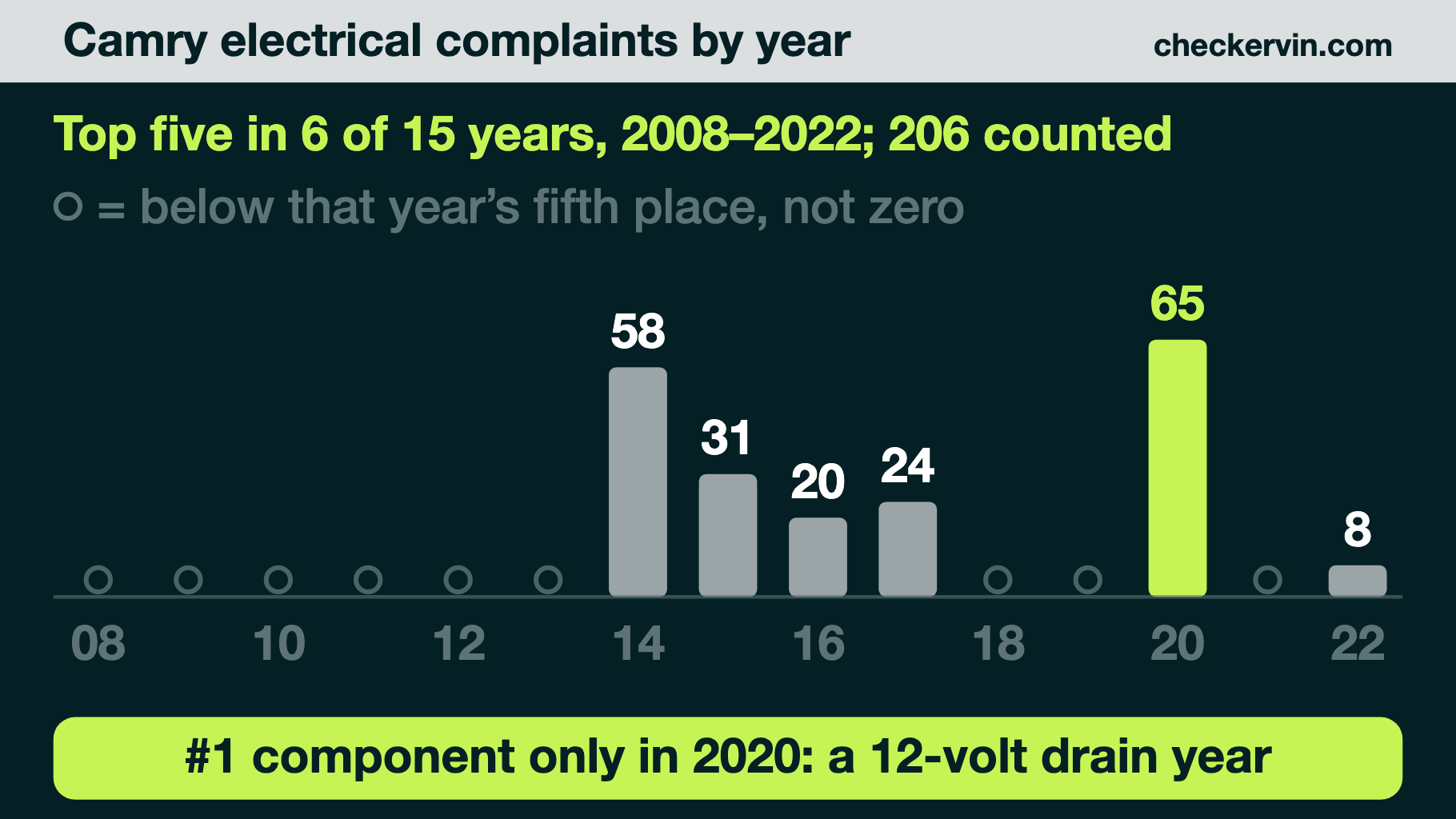
Even that ceiling is low. The electrical system makes the Camry’s top five in only 6 of 15 model years (2014, 2015, 2016, 2017, 2020 and 2022), adding up to at least 206 counted reports, about 2.7% of all complaints on the nameplate. It never reaches the top five in any of the 6 model years from 2008 through 2013, which together hold 63% of the Camry’s complaints, nor in 2018 or 2019. In the years it misses, it ranks below a fifth-place component carrying between 10 and 166reports. That means “below that line,” not zero.
It leads a model year exactly once: 2020, with 65 reports, 23% of that year’s complaints and 32% of every electrical report counted across the fifteen years. One data note: NHTSA’s live database now files most 2014 Camry complaints under a separate “Camry HV” model name, so a fresh query for the plain Camry returns far fewer than the 478 our August pull holds. We use our pulled figure as it stands and treat it as a minimum.
What owners actually describe
The counts say the electrical system is a minor part of the Camry’s record. The narratives behind them say what that minor part is made of. Reading the electrical complaints year by year, the recurring stories are batteries that go flat, keys and push-button start that misbehave, radios and screens that freeze or reboot, power windows, blown fuses, and wiring chewed by rodents. The alternator itself is named rarely, and when it is, it is often in a list of parts an owner already replaced without curing the problem.
A small group of 2015–2017 narratives describes something more serious: a “check charging system” message arriving together with a stall or a loss of power steering. That is a symptom of the charging circuit losing voltage, and the alternator is one possible cause, but owners in those reports also describe sensors, batteries and modules being replaced. They are a reason to take a charging warning seriously, not proof of a pattern in the part.
2020: the one year electrical leads, and it is software
The 2020spike has a documented cause, and it is not an alternator. The electrical narratives for that year are dominated by dead batteries and overnight drain, often after a new battery and an alternator test that came back clean. Toyota’s bulletin T-SB-0095-20 names the condition directly for 2020–2021 Camry and Camry Hybrid cars: a “depleted 12V vehicle battery when in IG-OFF,” meaning with the car switched off. The cause is the data communication module, the cellular box behind the car’s app and SOS features, and the fix is a reset and firmware update booked at 0.8 labor hours.
The bulletin repair was covered under Toyota’s basic warranty, 36 months or 36,000 miles from the in-service date, which most 2020 cars have now passed. One owner complaint describes exactly that: a car past 36,000 miles, a clean battery and alternator test, and a bill for the update. Toyota’s companion tech tip, T-TT-0625-20, adds two cheaper suspects technicians are told to rule out first: aftermarket chargers and plug-in insurance monitors in the diagnostic port, which it says “can keep the CAN bus awake,” and cars that are simply not driven enough to stay charged.
What the recall record covers, and what it doesn't
We queried NHTSA’s recall database for every Camry model year from 2008 through 2022 and filtered for the electrical system, alternators, batteries and charging. One campaign filed under the electrical system came back, which shows the search can see them: 13V442000, for 2012–2013 Camry and Camry Hybrid cars, where a clogged air conditioning drain can let water onto the airbag control module and short it. Dealers seal the housing and fit a cover. It is an airbag recall in an electrical wrapper and has nothing to do with charging.
No campaign in those fifteen years names the alternator or the charging system, so no recall pays for this part. Most Camry years carry other open campaigns, and the Toyota recall lookup by VIN shows which ones are still unrepaired on a specific car. If one turns up on a car you are buying, read buying a car with an open recall before you negotiate.
Test before you buy the part
Because the alternator is the expensive guess and the battery is the likely culprit, the order of operations matters. Each step below is cheap or free, and each one can end the hunt before a part is ordered.
- Load-test the 12-volt battery after a full charge; a weak battery fails here and the alternator is off the hook
- Run a charging-system test with the engine on; parts stores and dealers do it in minutes
- Look at the accessory belt and listen for squeal: a glazed belt or tired tensioner can under-charge a healthy alternator
- If the car dies only after sitting, test for a parasitic drain before touching the charging side
- Unplug aftermarket chargers and any insurance dongle in the diagnostic port, as Toyota's tech tip advises
- On a 2020–2021 car, ask whether the T-SB-0095-20 module update is on record for the VIN
Battery fit matters too. A replacement of the wrong group size or capacity can shorten its own life, and our battery size by VINpage reads the right one from the car’s build.
Reading a Camry alternator quote
- Which engine the labor time is for, and whether it matches the VIN
- New Toyota, new aftermarket or remanufactured unit, and the warranty on each
- Core charge, and whether it is refunded when the old unit is returned
- Whether the belt is being replaced, and the tensioner inspected, while it is off
- On a 3.5L V6, coolant refill and the bumper and radiator work listed as part of the job
- The test result that justified the part: battery, charging output, or drain
The last item is the one most often missing. A quote that cannot say which test the alternator failed is a quote for a guess, and on this car the federal record suggests the guess is usually wrong.
If you are buying the Camry, not repairing it
A charging problem is one of the cheaper things to find on a used Camry, and one of the easier to test for on the lot. Ask the seller for a cold start, watch the dash for a battery or charging warning once the engine is running, and ask when the battery was last replaced. A seller who has replaced batteries more than once on a 2020–2021 car may have been fighting the module drain rather than bad batteries.
The Toyota Camry years-to-avoid breakdown scores each model year on the whole complaint record, where power train, airbags and speed control outrank the electrical system in most years. A Toyota warranty check by VIN settles whether any factory coverage is left on a newer car. If you are already budgeting front-of-engine work on a four-cylinder, the Camry water pump cost post covers the other belt-area part with an engine-dependent bill.
Where this information comes from
- Toyota T-SB-0095-20 Rev2 (NHTSA copy) — DCM reset and firmware updateNames the depleted 12-volt battery on 2020–2021 Camry and Camry Hybrid; 0.8 labor hours; basic-warranty coverage.
- Toyota T-TT-0625-20 (NHTSA copy) — 12-volt battery discharge diagnosisToyota's checklist for 2020 Camry drains: aftermarket devices, driving habits, battery testing, then the module update.
- Toyota T-SB-0006-19 (NHTSA copy) — HV and auxiliary battery maintenanceShows the 2020 Camry Hybrid's hybrid system charging its 12-volt battery, with no alternator involved.
- NHTSA recalls API — 2012 CamryReturns 13V442000, the electrical-system airbag-module campaign; our 2008–2022 query found none for the alternator.
- NHTSA — recalls by VINThe official lookup for open campaigns on a specific Camry.
- Toyota repair manual, 2008 Camry 2GR-FE generator removal (workshop-manuals.com)The 26-step V6 procedure: coolant, bumper and radiator out before the alternator.
- RepairPal — Toyota Camry alternator replacement estimateThe $566–$876 average quoted above, page updated September 3, 2026, retrieved October 2026.
Keep reading
Frequently asked questions
How much does it cost to replace the alternator on a Toyota Camry?
RepairPal's Camry alternator estimator lists an average of $566 to $876, with labor at about $165 to $241 and parts at about $402 to $635, before taxes and without adjusting for location. That is its figure, from a page marked as updated September 3, 2026 and retrieved in October 2026. Its Los Angeles page for a 2023 Camry shows $773 to $882. Engine matters more than year: Toyota's own removal procedure for the 2008 Camry's 3.5-liter V6 runs to 26 steps, including taking off the front bumper and radiator, while the 2.4-liter four comes out after the belt and two bolts.
Does the Toyota Camry Hybrid have an alternator?
No conventional one. Toyota's emergency response guide for the 2007 Camry Hybrid lists a 12-volt DC-DC converter that steps the high-voltage pack down to 12 volts for the car's low-voltage system, and Toyota's 2019 storage bulletin, which covers the 2020 Camry Hybrid, tells dealers to leave the hybrid system on for 30 minutes to charge both the hybrid battery and the 12-volt battery. If a shop quotes an alternator for a Camry Hybrid, ask for the part number, because it is pricing some other part.
Are alternator problems common on the Toyota Camry?
The federal record does not suggest it. NHTSA has no alternator category; the nearest is the electrical system, which also covers the battery, wiring, lighting and modules. On the 2008–2022 Camry that whole category reaches a model year's five most-reported components in only 6 of 15 years and leads only 2020. Reading the complaint narratives, owners name dead batteries, key and push-button start faults, radios and wiring far more often than alternators.
Why does my 2020 Toyota Camry battery keep dying?
Toyota issued a service bulletin for it. T-SB-0095-20 covers 2020–2021 Camry and Camry Hybrid cars with a depleted 12-volt battery when the car is off, and the fix is a reset and firmware update of the telematics module, booked at 0.8 labor hours. Toyota's companion tech tip also tells technicians to look for aftermarket chargers and plug-in insurance monitors that keep the car's network awake. The bulletin repair was covered under the 36-month or 36,000-mile basic warranty, so on most 2020 cars today it is paid by the owner, but it is still software, not an alternator.
How do I know if it is the alternator or the battery on my Camry?
Have both tested before anything is replaced. A battery that tests weak after a full charge is the battery. A good battery that goes flat overnight points to a drain, which on a 2020–2021 Camry may be the telematics module Toyota's bulletin covers. A battery that drains while you drive, a charging-system warning that stays on with the engine running, or a squealing or glazed accessory belt points toward the alternator or its belt and tensioner. Parts stores and dealers can run a charging-system test in a few minutes.
Know the engine before you price the alternator
A free CheckerVIN report shows the factory build, engine, specifications and open recalls for any VIN, so you know whether you are pricing a two-bolt job, a bumper-off job, or a hybrid with no alternator at all.
Run a free VIN check