The short answer
- What does it cost?
- RepairPal lists $1,128–$1,272 for the Ram 1500. KBB's 2019 Crew Cab estimate for one Iowa ZIP was $1,038–$1,156, most of it labor.
- Is it really the pump?
- Check first. Stellantis has told dealers that pumps were replaced when a pinched bypass O-ring was leaking, and the Ram's 3-way coolant valves are a second suspect.
- Which years carry the risk?
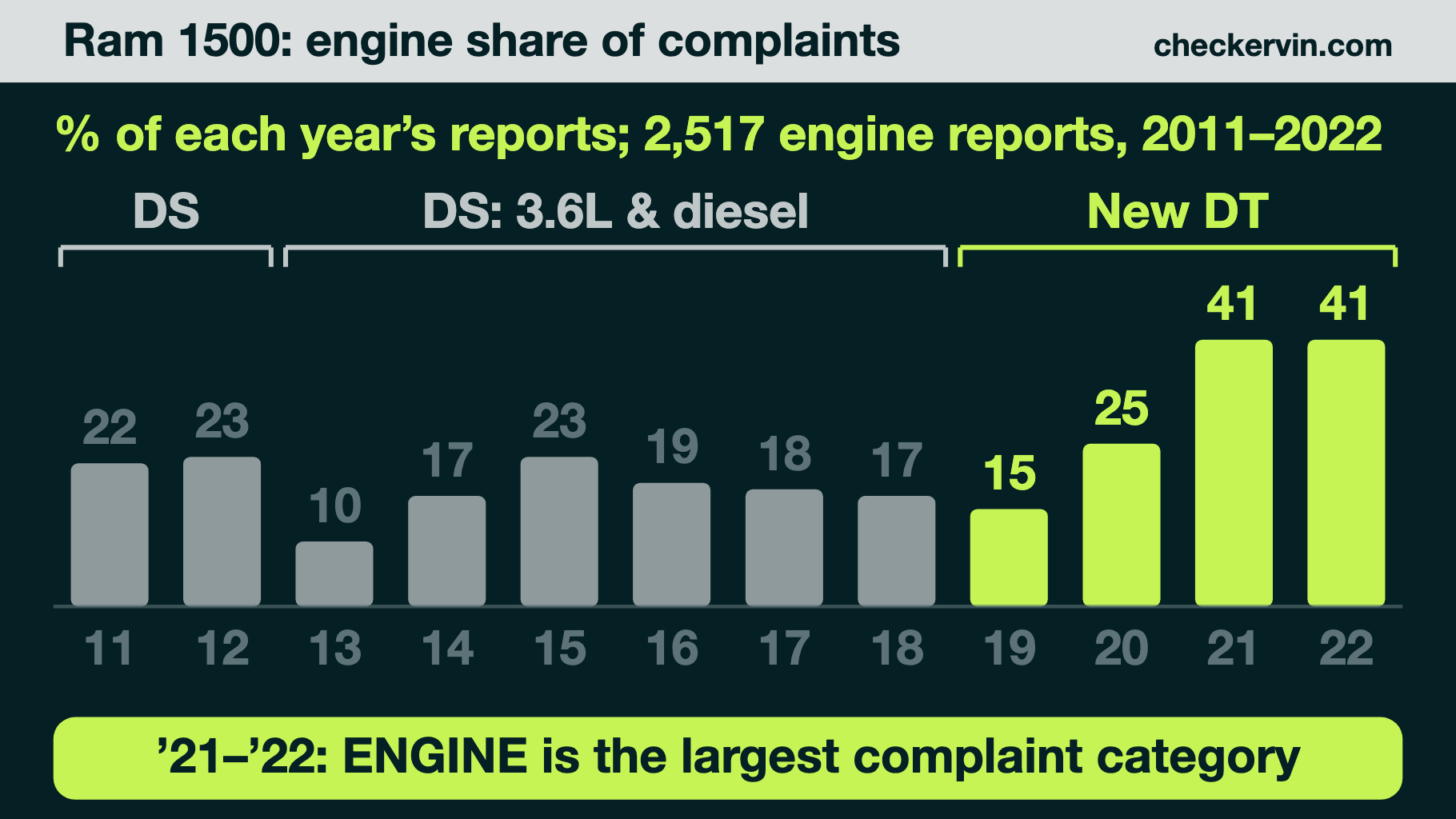
- The new DT body. ENGINE is 27% of complaints against 2019–2022 trucks and the largest category for 2021 and 2022.
$1,128–$1,272
RepairPal Ram 1500 range
Retrieved October 2026
2,517
ENGINE complaints on record
2011–2022, all engines
27%
Engine share, 2019–2022
vs 18% for 2013–2018
0
Water pump recalls found
NHTSA, every model year
The estimates, and who published them
RepairPal’s Ram 1500 page lists water pump replacement at $1,128 to $1,272. Its separate 2023 Ram 1500 page lists $1,046 to $1,201. Both were retrieved in October 2026 from the pages’ own listings. Kelley Blue Book’s 2019 Ram 1500 Crew Cab page, as served for ZIP 52001 in eastern Iowa, showed a fair repair range of $1,038 to $1,156, split into $413 to $465 for parts and $625 to $691 for labor. Open that KBB page without a ZIP and it shows no pricing at all, only an FAQ line quoting $375 to $787. That lower range is printed on every model’s page, so treat it as a generic water pump figure, not a Ram number.
The Ram figures sit noticeably above the Grand Cherokee’s, even though both are sold with the same 3.6L V6 and 5.7L V8. Our Grand Cherokee water pump post quotes RepairPal at $761 to $940 for the Jeep. Neither estimator says why the truck costs more, and we will not guess at their methods. We sell VIN checks, not repairs, and publish no price of our own. What we can add is the record: the complaint data for the truck, and the dealer documents Stellantis filed with NHTSA that point at parts other than the pump.
What 2,517 engine complaints say about the Ram 1500
Our corpus of federal NHTSA complaints holds 12,186 reports against the 2011–2022 Ram 1500, and 2,517 of them, about 21%, are filed under ENGINE. Raw counts mislead on this truck, because some years are swamped by other faults. The 2013 model drew 1,260 complaints, and its leading category was steering, so its 123 engine reports amount to only 10% of the year, the lowest share in the run. That is why the chart below plots the engine’s share of each year rather than its count.
Read that way, the pattern is plain. The 2011–2012 trucks put 23% of their complaints under ENGINE. The 2013–2018 trucks, the same DS body with the 3.6L V6 and later the EcoDiesel, put 18% there, 1,311 reports in all. The new DT body, 2019–2022, puts 27% there, 892 reports. In 2021 and 2022, ENGINE is the single largest category in the record, at 41% and 41%of those years’ complaints. The 2019 launch year is the exception inside the DT group: ENGINE ranks only fourth there, at 15%, behind electrical, steering and unclassified reports.
Three limits, stated plainly. First, ENGINE covers every engine Ram sold that year and every kind of engine fault, so it is context and an upper bound, never a count of water pumps. NHTSA has no water pump category, and its ENGINE AND ENGINE COOLING category never reaches a Ram 1500 year’s top five in our data, which stores only the top five. Second, from 2019 NHTSA files the carried-over Ram 1500 Classic as a separate model, so the 2019–2022 rows describe the new truck only. Third, the counts come from our August 2026 pull; the live NHTSA database has grown slightly since, so read every year as a minimum.
Which engine, which year
A Ram 1500 water pump quote depends on the engine, and the truck has had several. The earliest Stellantis document for a Ram 1500 with the 3.6L Pentastar V6 that we found is a 2013 recall notice, which identifies the engine by sales code ERB. The 3.0L EcoDiesel appears from 2014: recall 19V757 covers 2014–2019 Ram 1500 and 1500 Classic trucks with it. The 5.7L Hemi V8 runs through the whole period, and Stellantis bulletins refer to it on both the old DS and the new DT.
The new DT added eTorque, a 48-volt mild-hybrid system. Stellantis bulletins name the 3.6L version “3.6L V6 24V VVT E-torque Engine Upgrade I” with sales code ERG, and a dealer notice on its belt tensioner covers DT trucks from 2019 through 2024. We did not verify how eTorque is laid out on the Hemi, so the belt details below apply to the 3.6L only. Confirm the engine with a Ram VIN decode before comparing quotes; a shop pricing a Hemi job for a V6 truck, or the reverse, is pricing a different repair.
| Ram 1500 engine | What the documents establish |
|---|---|
| 3.6L V6 (ERB) | In the 2013 DS; 3-way coolant valve recall N25 / 13V177 |
| 3.6L eTorque (ERG) | DT from 2019; MGU on the belt, hydraulic tensioner (09-008-20, W21, 9100247) |
| 3.0L EcoDiesel | 2014–2019 DS and Classic; EGR cooler recall 19V757 |
| 5.7L Hemi V8 | Offered across the run; no pump or belt document found for it |
The Pentastar notice, briefly
The Ram shares Stellantis’s best-known pump document with the Grand Cherokee. Dealer notice 9100337, dated May 2, 2024, covers the 3.6L Pentastar Upgrade and lists 2019–2024 DT Ram 1500s among the vehicles. It requires an inspection and photos of the leak before any pump replacement, and notes that residue at the weep-hole plug can be normal while dripping is not. An earlier version, 9100212, dated September 7, 2023, says the same.
We walked through that notice, and the oil filter housing that sits in the same engine’s valley, in the Grand Cherokee post, so we will not repeat it here. On a 3.6L Ram the point carries over unchanged: ask for the proof Stellantis demands of its own dealers. The rest of this post covers what is specific to the truck.
The bypass O-ring Stellantis says gets mistaken for the pump
The most direct Ram document is a short dealer notice, number 9003633, dated November 16, 2016. Its header reads “MY 14, 15, 16, 17 DS, WK,” meaning the 2014–2017 Ram 1500 and the Grand Cherokee of the same years. It tells technicians that dealers were replacing water pumps for coolant leaks, the returned pumps tested with no fault found, and the real cause was a pinched water pump bypass O-ring, “resulting in a coolant leak that looks like a failed pump.” The O-ring, it adds, is sold separately.
That is the cheapest possible outcome of a pump diagnosis: a seal instead of a pump. The notice gives a part number but does not name the engine it applies to, so we cannot say which Ram engines are affected. The practical question for a 2014–2017 owner is simple. Ask the shop whether it checked the bypass O-ring before condemning the pump, and if the pump was replaced recently and the leak came back, ask whether the O-ring was seated correctly.
The 3-way coolant valve, a Ram part with its own recall
The Ram 1500 carries a part the Grand Cherokee posts do not cover: an electrically controlled 3-way coolant valve. A May 8, 2013 recall notice to dealers, N25050813, explains what it does. On 2013 DS Ram 1500s with the 3.6L, the valve “controls the flow of engine coolant to the heater core and transmission heater.” On some trucks it could stick because of an improperly soldered circuit board, cutting coolant to the heater core. NHTSA lists the campaign as 13V177, covering trucks built from June 25 through December 12, 2012, because a truck that cannot defrost its windshield fails federal standard 103. Dealers replaced the valve and recalibrated the engine computer free.
The valve did not disappear with the old body. A Stellantis dealer notice dated June 9, 2026, number 9100839, covers DT Ram 1500s from 2019 onward and says there are two different 3-way valves. A high temperature valve sits at the rear of the engine near the bulkhead; a low temperature valve sits at the front, between the engine and the radiator. Fitting the wrong one, the notice says, “may lead to improper thermal system operation and repeat repairs.”
Two lessons follow. A Ram with no cabin heat, or a temperature complaint that survives a new pump, may have a valve problem rather than a pump problem. And any shop working on the cooling system of a 2019-or-later Ram should know which valve sits where, because the manufacturer has had to warn its own dealers about mixing them up.
eTorque: what the mild hybrid changes at the front of the engine
On an eTorque truck the alternator is replaced by a motor generator unit, which Stellantis abbreviates MGU, on the serpentine belt. Two documents show what that means for anyone taking the belt off. Bulletin 09-008-20, dated May 8, 2020, covers 2020 DT Ram 1500s with the 3.6L eTorque built between December 13, 2019 and January 25, 2020. Hydraulic belt tensioners stamped with the date code 15.08.19 could let the belt slip, set starter-generator fault codes and leave a dead battery. The repair is filed in the service manual under cooling and accessory drive, and it is booked at 0.6 hours.
A companion customer satisfaction notification, W21, covers about 747 eTorque Wranglers and Ram 1500s with the same tensioner. Its Ram procedure is the revealing part. The technician raises the truck, rotates the MGU’s mechanical tensioner to its stop and pins it, then compresses a hydraulic tensioner that the document warns “requires high effort,” working partly through the wheel well. That is more involved than releasing a single spring tensioner on a conventional belt.
What the documents do not say is whether this belt drives the water pump. We looked for a Stellantis statement of the pump drive on any Ram 1500 engine and did not find one, so we will not claim it. A third notice, 9100247 from October 2023, covering 2019–2024 DT trucks, tells dealers to check the belt layout “as per the engine sales code” before replacing any belt-drive parts, which confirms the layouts differ by engine. Two practical points follow. A squeal or chirp on an eTorque truck may be the tensioner, which is far cheaper than a pump. And if a pump quote includes belt work, ask whether the labor time reflects the eTorque layout.
The 2026 parts return, and what it does and doesn't say
One recent document is worth knowing about without overreading it. A Stellantis parts communication published January 21, 2026, titled “Water Pump & Chain Case Cover,” told dealers to return all stock of a list of part numbers by February 11, 2026, and named newer revisions as the replacements. Two of the returned numbers, 04893941AC and 04893942AC, share their base numbers with the water pumps listed in the Pentastar notice 9100337.
The notice gives no reason, names no vehicles in its text and is not a recall. It could reflect a quality change, a supersession or a logistics decision, and we cannot tell which. Its use to an owner is narrow: if your 3.6L Ram gets a new pump, it is reasonable to ask which revision is being installed.
What the recall record covers, and what it doesn't
We queried NHTSA’s recall database for every Ram 1500 model year from 2011 through 2022. Each year’s count matched our corpus; the 2019 model, for example, returned the same 30 campaigns our data records. No campaign names the water pump, the radiator or the thermostat.
Two campaigns do touch coolant. 13V177 is the 3-way valve recall above. 19V757 covers 2014–2019 Ram 1500 and 1500 Classic trucks with the 3.0L EcoDiesel, whose EGR cooler “may crack and allow pre-heated vaporized coolant to enter the EGR system,” which can lead to combustion in the intake manifold and a fire. Dealers replace the cooler free and inspect the intake manifold. A diesel that loses coolant with no visible leak should be checked against that recall before anyone prices a pump. Recalls 20V475 and 23V411 also sit under NHTSA’s engine-and-cooling heading, but they cover a crankshaft sensor tone wheel, not coolant. The Ram recall check shows which campaigns are still open on a specific VIN, and our TSB versus recall explainer covers why the dealer notices above are not free repairs.
Before you authorize the repair
- Confirm the engine by VIN: 3.6L, 3.6L eTorque, 5.7L Hemi or 3.0L EcoDiesel
- Ask for a pressure test with dye and a photo of where the coolant is actually coming from
- On a 2014–2017 truck, ask whether the pump bypass O-ring was checked first
- No cabin heat or erratic temperature: have the 3-way coolant valve checked
- On an eTorque truck with belt noise, rule out the hydraulic tensioner and MGU
- On a 2014–2019 EcoDiesel losing coolant, check recall 19V757 first
Then read the quote line by line. Coolant, a belt and a thermostat often ride along with a pump, and each is a separate decision. Use the coolant the factory specified when the system is refilled; a coolant type lookup by VIN lists it. If the truck is new enough, a Ram warranty check tells you whether the powertrain coverage might pay for the repair instead of you.
If you are buying the Ram, not repairing it
For a shopper the record reads differently. The 2019–2022 trucks are newer and generally drew fewer total complaints per year than the busiest DS years, but a larger share of what owners did report concerns the engine, with 2021 and 2022 led by it outright. On any Ram, look at the coolant level cold, check under the front of the engine for crusted or wet coolant, and listen for a belt chirp at idle. On an eTorque truck, ask whether the W21 tensioner campaign or bulletin 09-008-20 applies and was done.
A pre-purchase inspection with a cooling-system pressure test costs a fraction of any repair on this page. The Ram 1500 years-to-avoid breakdown covers the rest of the record, including the steering complaints that dominate several DS years. If you are cross-shopping, our F-150 timing chain post covers the costliest engine repair on Ford’s rival truck.
Where this information comes from
- Stellantis notice 9003633 (NHTSA copy): water pump bypass O-ring2014–2017 Ram 1500 and Grand Cherokee: pumps replaced with no fault found; the pinched O-ring leaked instead.
- Recall advance communication N25050813 (NHTSA copy): 3-way coolant valve2013 Ram 1500 3.6L; the valve feeds the heater core and transmission heater. NHTSA campaign 13V177.
- Stellantis notice 9100839 (NHTSA copy): high and low temperature 3-way valves2019-and-later DT: two valves, two locations; the wrong one causes repeat repairs.
- Stellantis TSB 09-008-20 (NHTSA copy): eTorque hydraulic belt tensioner2020 DT 3.6L eTorque: date code 15.08.19, belt slip, dead battery, 0.6-hour repair.
- Stellantis CSN W21 (NHTSA copy): serpentine belt tensionerThe Ram procedure for the MGU belt and its mechanical and hydraulic tensioners.
- Stellantis notice 9100337 (NHTSA copy): 3.6L water pump inspectionLists 2019–2024 DT Ram 1500: inspect and photograph before any pump replacement.
- NHTSA: recalls by VINThe official lookup, including 13V177 and the EcoDiesel EGR cooler recall 19V757.
- RepairPal: Ram 1500 repair costsThe $1,128–$1,272 water pump figure quoted above, retrieved October 2026.
- Kelley Blue Book: 2019 Ram 1500 Crew Cab water pump replacementThe ZIP 52001 range and parts and labor split quoted above, retrieved October 2026.
Keep reading
Frequently asked questions
How much does it cost to replace a water pump on a Ram 1500?
RepairPal's Ram 1500 page lists water pump replacement at $1,128 to $1,272, and its 2023 Ram 1500 page lists $1,046 to $1,201, both retrieved October 2026. Kelley Blue Book's 2019 Ram 1500 Crew Cab page, as served for ZIP 52001, showed a fair repair range of $1,038 to $1,156: $413 to $465 in parts and $625 to $691 in labor. Coolant, a belt and a thermostat are often added to the invoice.
Does eTorque make a Ram 1500 water pump job more expensive?
It changes the front of the engine. Stellantis documents for the 3.6L eTorque (sales code ERG) show a motor generator unit on the serpentine belt with both a mechanical and a hydraulic tensioner, and a 2020 service campaign has technicians raise the truck, pin one tensioner and compress the other through the wheel well. We found no Stellantis document stating that the eTorque belt drives the water pump, so ask the shop whether its labor time assumes the eTorque belt layout.
What else leaks coolant like a bad water pump on a Ram 1500?
Stellantis names one directly: a 2016 dealer notice for 2014-2017 Ram 1500 and Grand Cherokee says pumps were being replaced when the real leak was a pinched bypass O-ring, which is sold separately. The Ram's 3-way coolant valves are another suspect, and on the 3.6L the oil filter housing and thermostat housing leak nearby. A pressure test with dye identifies the source.
Is there a recall for the Ram 1500 water pump?
Not that we found. We queried NHTSA's recall database for every Ram 1500 model year from 2011 through 2022. No campaign names the water pump, radiator or thermostat. The cooling-related campaigns are 13V177, a 3-way coolant valve on certain 2013 trucks with the 3.6L, and 19V757, which replaces the EGR cooler on 2014-2019 EcoDiesel trucks free of charge.
Which Ram 1500 years have the most engine complaints?
By count, the 2015 model, with 334 ENGINE complaints in our federal record. By share, the new DT body stands out: ENGINE is 27% of all complaints against the 2019-2022 trucks, against 18% for 2013-2018, and it is the single largest category for the 2021 and 2022 models. Those counts cover every engine and every engine fault, not water pumps alone.
Confirm the engine before you price the repair
A free CheckerVIN report shows the factory build, engine, specifications and open recalls for any VIN, so you know which Stellantis notice or recall applies.
Run a free VIN check