The short answer
- What does it cost?
- RepairPal lists $2,163–$2,853 for a Pathfinder timing chain tensioner job, mostly labor. Owner-reported bills run from about $1,200 to over $6,000.
- Chain or belt?
- Chain, on every 2008–2022 Pathfinder V6 and V8. A 'timing belt' quote for these engines names the wrong part.
- Which years should I watch?
- 2017–2020, the direct-injection years: 32% of their complaints name the engine, versus 15% elsewhere, and that is where owners report loose chains.
The numbers, and whose numbers they are
RepairPal publishes the most specific Pathfinder figure, and it is for a narrower job than most people mean. Its estimate for a Pathfinder timing chain tensioner replacement reads $2,163 to $2,853, split into $1,475 to $2,164 of labor and roughly $688 of parts, as retrieved in October 2026. A full chain job adds the chains and guides themselves, and on these engines it means the same teardown, so treat RepairPal’s range as a floor for the complete set rather than a ceiling.
Owner numbers spread wider. CarComplaints’ page for premature timing chain shoe wear on the 2008 Pathfinder lists seven reports with a typical repair cost of $1,240 at an average of 104,850 miles. On the high side, the owner of a 2020 Pathfinder told NHTSA that a Nissan dealer estimated the repair “in excess of $6000” because the engine had to come out. Those are single owners, not surveys, but together they mark the range a quote can land in.
Kelley Blue Book’s current Pathfinder page is titled timing belt replacement and gives a generic $409 to $919. That figure prices a belt, and no Pathfinder in these model years has one. We sell VIN checks, not repairs, and publish no price of our own; what we can add is which engine you are paying to open up, and what the federal record says about it.
Four engines, all of them chain-driven
The Pathfinder changed engines three times in the span our data covers, and fueleconomy.gov’s per-year listings show exactly where:
| Model years | Engine and transmission |
|---|---|
| 2008–2012 (R51) | 4.0L V6 with a five-speed automatic, or a 5.6L V8 (4WD only from 2010) |
| 2013–2016 (R52) | 3.5L V6, port fuel injection, CVT (plus a 2014–2015 hybrid with a supercharged 2.5L four) |
| 2017–2020 (R52 update) | 3.5L V6 listed as direct injection (SIDI), CVT |
| 2022 (R53) | 3.5L V6 direct injection, nine-speed automatic |
All four V6 and V8 engines drive their camshafts with chains; the short-lived hybrid is a different powertrain that this post does not price. Nissan’s own bulletin index names the older families as VQ40 and VK56, and reviewers identify the 2017 engine as the VQ35DD, the direct-injection version of the long-running 3.5. The VIN tells you which one is in the truck; the engine size lookup by VIN or the timing belt or chain check settles it before anyone starts pricing.
What 503 engine complaints say, split by engine
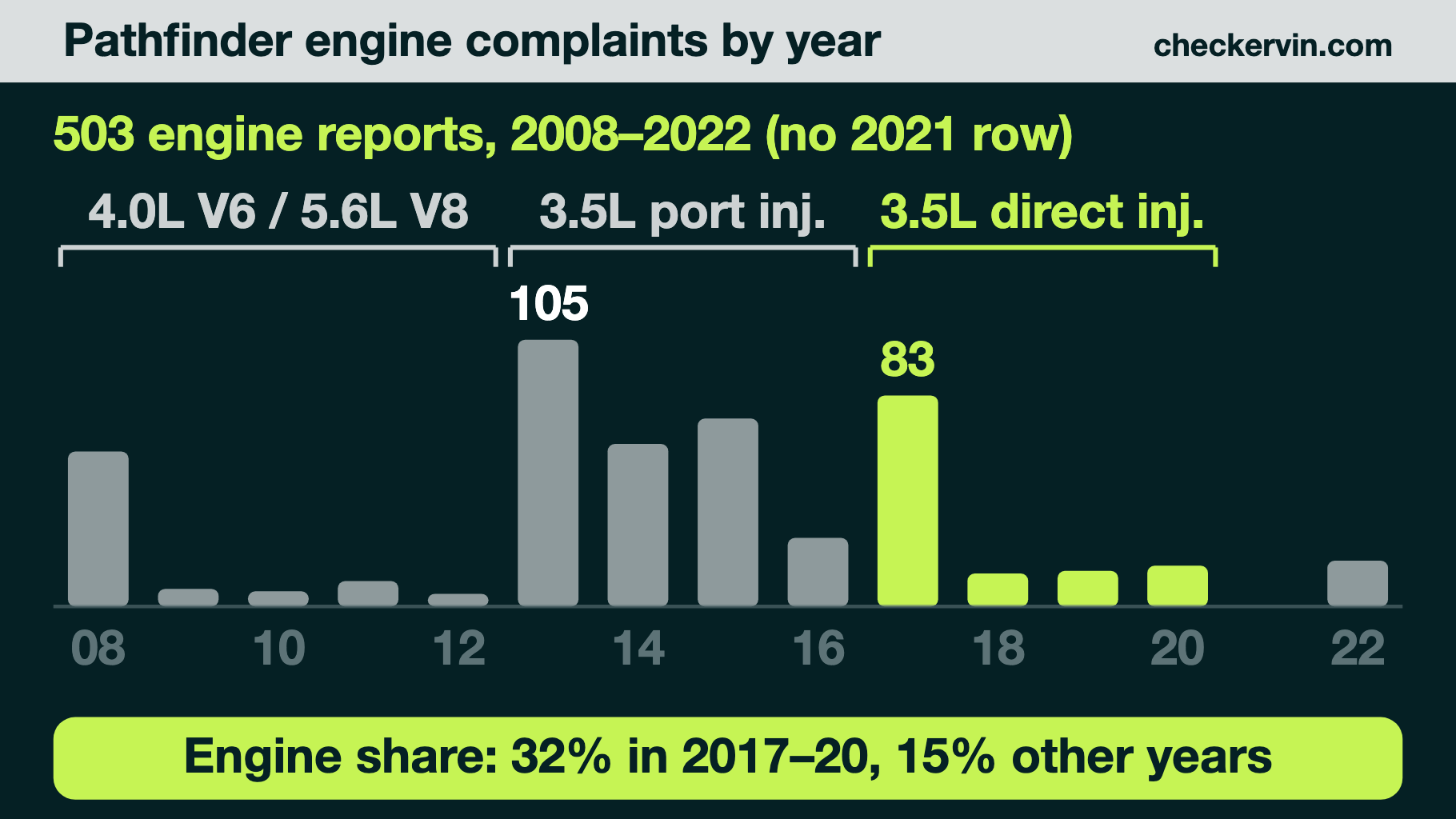
Our corpus of NHTSA complaints holds 2,893 reports against the 2008–2022 Pathfinder, and 503 of them are filed under ENGINE. ENGINE sits inside the five most-reported components in every model year we hold, so none of the bars below is a guess. NHTSA has no timing-chain category: ENGINE covers every engine fault, from a dead cooling fan to a misfire, so treat it as the ceiling on chain complaints, not a count of them.
Split by engine, the numbers lean one way. The 2008–2012 trucks file 89 engine reports, the 2013–2016 port-injected trucks 270, and the 2017–2020 direct-injection trucks 126. Raw totals favor the years Nissan sold the most Pathfinders, so the fairer measure is share: in the direct-injection years, 32% of all complaints are engine complaints. In every other year combined it is 15%. ENGINE is the single most-reported component for 2016, 2017, 2020, all of them late R52 years.
One gap: our data has no 2021 row. NHTSA returns zero complaints for a 2021 Pathfinder, so the chart leaves that slot empty rather than drawing a zero we cannot vouch for.
2008–2012: the 4.0-liter whine, documented a year too early
The VQ40 V6 that powers most R51 Pathfinders has a known chain story, and Nissan documented it. Bulletin 07042, dated July 17, 2007, is summarized in NHTSA’s index as “buzzing/whining noise from timing chain area,” and NHTSA lists it against the 2005–2007 Pathfinder along with the Frontier, Xterra, Altima, Maxima and Quest of those years. It does not list any 2008 or later Pathfinder. Search-served summaries describe a later bulletin, NTB09-128, that extends the secondary-chain whine to 2005–2010 trucks with new secondary chains and tensioner shoes as the fix. We could not open a primary copy of it, so whether it covers a 2008–2010 Pathfinder is unverified here.
The complaint record for these years is thin on chains. The 2008 truck has the largest engine count of the era at 61, but reading the narratives, most of those describe the radiator and transmission-cooler failure that sent coolant into the gearbox, which our Pathfinder transmission cost post covers. A handful of 2008 and 2009 owners describe exactly what the bulletins describe: tensioner shoes and guides worn early, a whine or buzz that rises with engine speed, and one dealer quote of $2,300. If an R51 is whining from the front of the engine, that is the job to price, and the shoes are the part to ask about.
2013–2016: the tallest bar is not a chain
The peak of the whole series is the 2013 Pathfinder, with 105 engine reports. That year was the first of the new R52 body and the first with a CVT, and many of its engine complaints describe hesitation, surging or stalling on acceleration, often in the same breath as the transmission. We read no 2013 narrative that blamed the timing chain. The tall bar belongs to the CVT story, and the transmission post covers the bulletins and extended coverage for those years.
The one timing-system document for this era is minor and is shared across Nissan’s V6 lineup. NTB17-008b, revised August 16, 2017, covers oil leaking around the valve timing control solenoid on 2013–2017 Pathfinders, and the same bulletin applies to the V6 Altima sedan, Maxima, Quest and the 2015–2017 Murano (the Murano alternator cost post reads that sibling’s record). The fix is a new O-ring on the solenoid, not a chain. If a shop finds oil at the front of the engine on one of these trucks, ask whether this bulletin applies before accepting a front-cover job.
2017–2020: where the chain reports actually are
The direct-injection years are where the 32% share comes from, and they need two honest qualifications. First, the 2017 truck alone files 83engine reports, and most of those narratives are about the radiator cooling fan, not the timing drive. Nissan even published a shroud-and-fan replacement procedure for 2013–2017 Pathfinders (NTB17-100). Take 2017 out and the 2018–2020 trucks still file 21% of their complaints under ENGINE, against 15% for the years outside this era.
Second, the chain reports themselves are few, but they are the most specific in the whole record. Owners of 2017 trucks describe a timing chain failure at 88,000 miles and worn guides blamed on a clogged crankcase ventilation hose. Owners of 2020 trucks describe a timing chain found loose at 110,000 miles, a cold-start rattle that worsened over time, misfires traced by an independent shop to the chains, and metal in the oil. More than one says the dealer recommended a replacement engine rather than a chain repair. None of that is a measured failure rate, and NHTSA complaints are unverified. It is still the pattern a buyer should know about: on this engine, the reports describe chains wearing out around six figures, not at 200,000 miles.
Timing codes that are not the chain
By 2018 the direct-injection engine’s intake cam phasing ran through an electric actuator with its own control module, and that module produced the only Pathfinder-specific timing bulletins in this era. NTB18-016, dated February 27, 2018, covers 2018 trucks built before December 18, 2017 that set codes P34A5 or P34A9 when the outside temperature was near or below freezing. Nissan’s fix is a new electric intake valve timing control module. Then, on October 24, 2018, Nissan opened voluntary service campaign PC661 to reprogram that module on certain 2018 Pathfinders at no charge, because the old software could light the check-engine lamp after certain cold starts “with no driveability concerns.”
That matters for a quote. A check-engine light with a timing-related code on a 2017–2020 truck is not automatically a chain. NTB18-016 itself tells technicians to diagnose P0011 or P0021, the codes for intake cam timing out of range on each bank, before touching the module. Those are the codes a stretched chain tends to set, and the ones to ask about.
2022: a new truck, and too new to judge
The 2022 Pathfinder moved to the R53 body and a nine-speed automatic, keeping a direct-injection 3.5-liter V6. It carries 18 engine reports in our data, out of 133complaints in total, and none of the narratives we read describes a chain. Four years in, most of these trucks are inside or near the end of Nissan’s powertrain coverage; the Nissan warranty check by VIN shows where a specific one stands, and a chain fault inside that window is Nissan’s bill, not yours.
What recalls and bulletins cover, and what they don't
We queried NHTSA’s recall records for every Pathfinder model year from 2008 through 2022, after confirming the query returned a known result for another truck. No campaign names the timing chain, a tensioner or a guide. The one engine recall in the span is 11V592000: certain 2011–2012 Pathfinders got new oil cooler and oil filter connector bolts because some were made below specification strength and could break and leak oil. It is adjacent, not a chain fix, though an engine that lost oil through that bolt is one where you would want the chain checked.
| Document | What it actually pays for |
|---|---|
| Recall 11V592000 (2011–2012) | New oil cooler connector bolts, free at any dealer |
| Campaign PC661 (2018) | Reprogram the electric intake valve timing module, free |
| NTB18-016 (2018) | Module replacement instructions; paid only under warranty |
| NTB17-008b (2013–2017) | Solenoid O-ring instructions; paid only under warranty |
| Bulletin 07042 (2005–2007) | Timing chain whine; predates the trucks on this page |
Bulletins are repair instructions. Outside the factory warranty they pay nothing, which is why the Nissan recall check is worth running first: it tells you whether PC661 or 11V592000 is still open on the truck, and both are free.
Before you authorize the repair
- Confirm the engine by VIN: the 4.0L, 5.6L and two 3.5L versions are different jobs
- Get the codes in writing; P0011 or P0021 points at cam timing, P34A5 or P34A9 at the 2018 module
- On a 2018, ask whether campaign PC661 was done before anyone diagnoses a chain
- Ask whether the quote is tensioner only, or chains, guides and tensioners together
- If the dealer recommends a whole engine, get the teardown findings before agreeing
The fourth item is where most quote spread comes from. RepairPal prices a tensioner; a shop quoting the full set is pricing more parts with mostly the same labor, which is usually the better buy once the engine is open. The fifth item matters on the 2017– 2020 trucks in particular, because several owners say they were steered to an engine replacement before anyone measured the chain.
If you are buying the Pathfinder, not repairing it
Read the record as a shopping list. On a 2017–2020 truck past about 80,000 miles, ask for oil-change records and listen to a cold start after it has sat overnight; a rattle that lasts beyond the first few seconds is worth a mechanic’s opinion before you pay. On an R51, listen for a whine that climbs with revs. The Nissan VIN decoder confirms the engine and build, and the Pathfinder years-to-avoid breakdown covers the rest of the complaint record by year. For a three-row SUV with a documented chain bulletin and labor time, compare the Traverse timing chain cost post; for a truck where the manufacturer itself named the years, the F-150 timing chain post.
Where this information comes from
- NHTSA — 2017 Nissan Pathfinder complaints and manufacturer communicationsExample of the per-year query run for every model year 2008–2022; the source of the owner narratives and bulletin index summaries quoted above.
- Nissan NTB18-016 (NHTSA copy) — 2018 Pathfinder P34A5/P34A9Cold-weather module codes on trucks built before December 18, 2017, and the instruction to diagnose P0011/P0021 first.
- Nissan NTB18-072 / campaign PC661 (NHTSA copy)Free reprogramming of the electric intake valve timing module on certain 2018 Pathfinders.
- Nissan NTB17-008b (NHTSA copy) — VTC solenoid oil leakThe O-ring fix shared by 2013–2017 Pathfinder, Altima, Murano, Maxima and Quest V6 engines.
- NHTSA — 2011 Pathfinder recalls, including 11V592000The oil cooler connector bolt recall; our year-by-year query found no recall naming the timing chain.
- fueleconomy.gov — Pathfinder engines by yearConfirms the 4.0L/5.6L, 3.5L, 3.5L SIDI and nine-speed changeovers used to split the record.
- RepairPal — Pathfinder timing chain tensioner estimateThe $2,163–$2,853 figure quoted above, retrieved October 2026.
- CarComplaints — 2008 Pathfinder timing chain shoe wearSeven owner reports, typical cost $1,240 at an average of 104,850 miles.
Keep reading
Frequently asked questions
How much does it cost to replace the timing chain on a Nissan Pathfinder?
RepairPal's Pathfinder estimate for a timing chain tensioner replacement is $2,163 to $2,853, of which $1,475 to $2,164 is labor and about $688 is parts, as its page read in October 2026. A full job with both chains, guides and tensioners usually runs higher because the front of the engine has to come apart either way. Owner reports run wide: CarComplaints lists a typical $1,240 across seven 2008 Pathfinder reports, and one 2020 owner told NHTSA a Nissan dealer quoted more than $6,000. Get the quote itemized before you compare.
Does the Nissan Pathfinder have a timing belt or a timing chain?
Every V6 and V8 Pathfinder engine from 2008 through 2022 uses timing chains: the 4.0-liter V6 and 5.6-liter V8 of 2008-2012, the port-injected 3.5-liter V6 of 2013-2016, and the direct-injection 3.5-liter V6 from 2017 on. There is no timing belt to replace on those engines, so a 'timing belt' price for one of them is pricing the wrong part.
Which Nissan Pathfinder years have timing chain problems?
No Nissan document we found names a timing chain repair for any 2008-2022 Pathfinder. Owner complaints to NHTSA that describe loose, stretched or failed chains cluster on 2017 and 2020 trucks, the direct-injection years, which also file 32% of their complaints under the engine category against 15% for other years. A handful describe chain or tensioner-shoe noise on 2008-2009 trucks with the 4.0-liter V6. Nissan's bulletin on timing chain whine covers 2005-2007 Pathfinders.
Is there a recall or extended warranty for the Pathfinder timing chain?
No. We queried NHTSA's recall records for every Pathfinder model year from 2008 through 2022 and none names the timing chain, tensioner or guides. The closest engine recall is 11V592000, which replaced oil cooler connector bolts on 2011-2012 Pathfinders because a weak bolt could break and leak oil. Nissan's 2018 campaign PC661 reprogrammed the electric intake valve timing control module on certain 2018 trucks, which is software, not a chain. A newer truck may still be inside Nissan's powertrain warranty, which a VIN check settles.
What does code P34A5 mean on a 2018 Pathfinder?
Nissan's bulletin NTB18-016 describes P34A5 and P34A9 as intake camshaft position actuator temperature sensor codes on 2018 Pathfinders built before December 18, 2017, set when the outside temperature was near or below freezing. The fix it prescribes is replacing the electric intake valve timing control module, not the chain. The bulletin tells technicians to diagnose any other valve timing codes first, such as P0011 or P0021, which point at cam timing itself and are where a worn chain would show up.
Confirm the engine before you price the repair
A free CheckerVIN report shows the factory build, engine, specifications and open recalls for any VIN, so you know which Pathfinder engine, and which Nissan campaign, applies.
Run a free VIN check