The short answer
- What does it cost?
- RepairPal's Murano pages list $1,003-$1,516 (2014 and 2023 models) and $974-$1,496 (2017 and 2021). YourMechanic's average is $612. Those are their figures, not ours.
- Which Muranos have the problem?
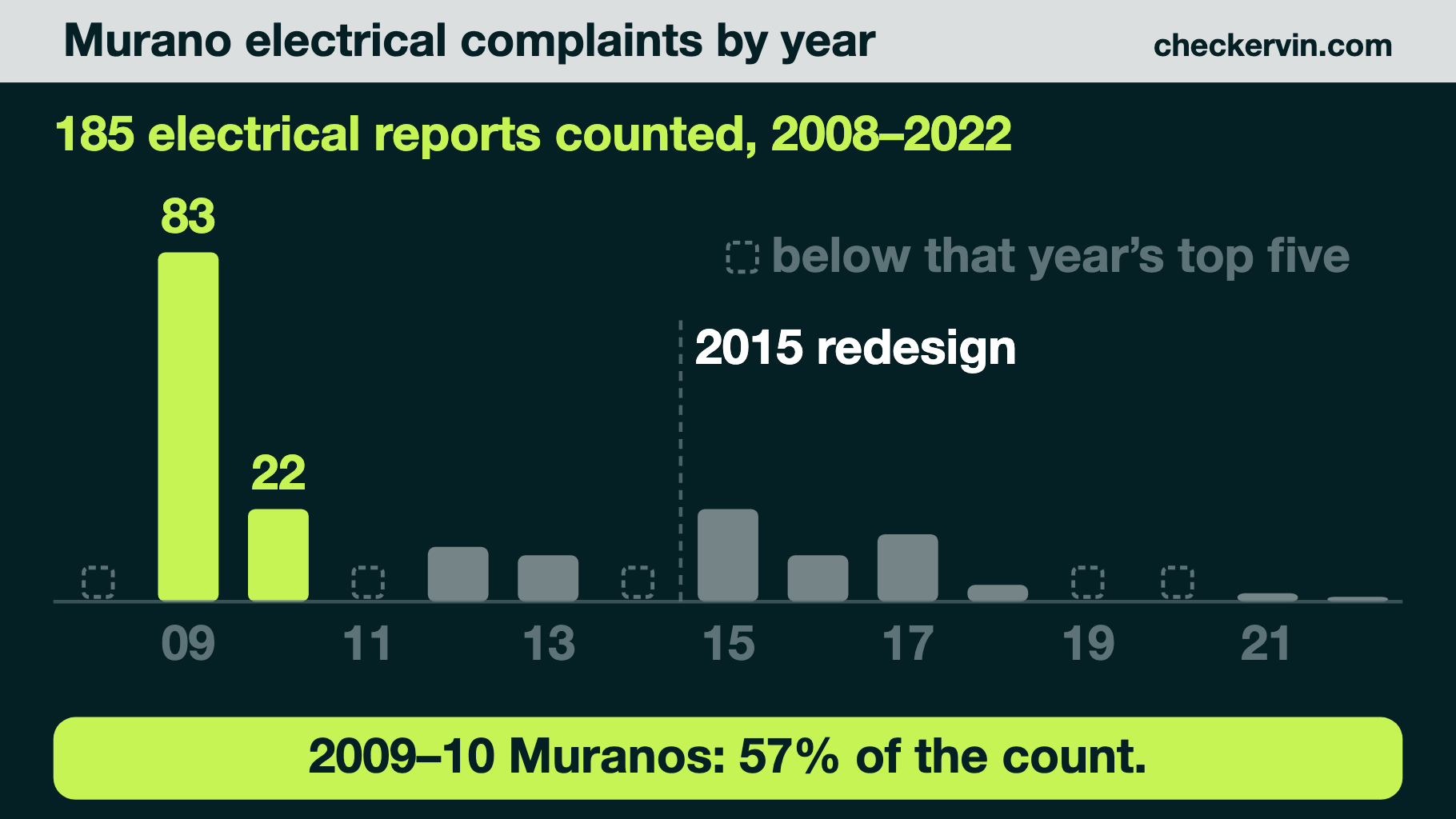
- The 2009-2010 cars hold 57% of the Murano's counted electrical complaints, and many describe an in-motion stall with the charge and brake lights on.
- Is it recalled?
- No. Nissan recalled alternators on the 2003-2005 Murano (05V319000). Nothing covers 2008-2022, and no Nissan bulletin for those years addresses the alternator.
The estimate, and whose it is
RepairPal publishes alternator prices on its Murano model-year pages. The 2014 and 2023 pages list alternator replacement at $1,003 to $1,516; the 2017 and 2021 pages list $974 to $1,496. RepairPal says its ranges leave out taxes and fees and do not reflect your location. We read those figures on October 26, 2026 from the text that search engines serve for each page, because RepairPal answers a direct fetch with a block. We could not confirm a labor-and-parts split from that text, so we print none.
YourMechanic, a mobile-repair service, publishes a much lower Murano average: $612, with $276 for parts and $336 for labor, read the same way on the same date. Those two numbers are hundreds of dollars apart for the same job on the same SUV, which tells you more about how estimates are built than about the Murano. Kelley Blue Book surfaced no Murano alternator range for us, and AAA’s repair estimator says it has no data for the 2013 Murano. We sell VIN checks, not repairs, and publish no price of our own.
One comparison is worth making. RepairPal’s range for the same job on the Altima, quoted in our Altima alternator post, is several hundred dollars lower. The Murano is a heavier V6 crossover, and a quote that lands near the top of RepairPal’s range is not by itself a sign of padding.
What 185 counted electrical complaints hold
Our corpus of federal NHTSA complaints holds 1,868 owner reports against the 2008–2022 Murano. For each model year it keeps the five most-reported components. ELECTRICAL SYSTEM makes that top five in 10 of the 15 rows and totals 185 reports across them. That is a floor. In 2011, 2014, 2019, 2020electrical complaints exist but rank below that year’s fifth category, so our data does not count them; in 2011, for example, the fifth-ranked category, STRUCTURE, has 13 reports, so electrical sits at or below that. The chart draws those years as hollow outlines, not zeros.
The 2008 row needs a word of its own. It holds 5complaints and no electrical entry, and EPA’s fuel-economy listings show no 2008 Murano at all; they resume with the 2009 model year, and a recall filed on that row names the 2009 Murano. Treat it as stray filings.
The bigger caveat is the category itself. NHTSA’s ELECTRICAL SYSTEM bucket takes in the 12-volt battery, cables and grounds, door locks, lighting, body and control modules, key fobs and the charging system. An electrical complaint says an owner had electrical trouble. It does not say the alternator failed. Read the counts as context and as a ceiling on charging faults, never as a count of alternator jobs.
2009-2010: the stall with two warning lights
The 2009 Murano carries 83 counted electrical complaints, 45% of everything counted across the range and 13.1% of that year’s own complaints. It is not even the year’s biggest category: SERVICE BRAKES (269) and AIR BAGS (91) rank above it. Add 2010’s 22 and the first two years of the second-generation Murano hold 57% of the electrical count.
We read the 2009 and 2010electrical narratives in NHTSA’s complaint file. They are a mix. Door-lock actuators that quit, a passenger air-bag light tied to the seat sensor, radio knobs that jump to full volume, dead key fobs. Running through them is one story told again and again: the battery or charge light comes on, often with the brake light, the lights flicker, the SUV stops accelerating and crawls in a reduced-power mode, and then the engine dies in traffic. Many of those owners had already replaced the alternator, the battery, or both, some more than once, and the fault came back.
That last detail is the useful one for anyone holding a quote. On these cars a new alternator is a frequent first repair in the narratives, and it is not always the last. One 2010 owner reports a dealer quote of $1,100 for an alternator and battery together; a 2009 owner describes a charging test that read about 14 volts, then fell away after twenty minutes of driving. A test that passes in the bay does not clear a charging fault that appears when the system is hot.
The recall that stopped at 2005
Owners of 2009 and 2010 Muranos keep referring to an older recall, and the record backs them on the facts. In July 2005 Nissan filed recall 05V319000, linked in NHTSA’s file to engineering analysis EA05006, covering 125,466 Muranos from the 2003, 2004 and 2005 model years. The defect: a wire breaking inside the alternator could stop the battery from charging. NHTSA’s summary of the consequence reads almost exactly like the later complaints. The charge and brake warning lamps come on, the battery discharges, the engine drops into a fail-safe condition that limits speed, and then it stops running. Dealers replaced the alternator with a version modified to stop the coil from moving.
No bulletin, no recall, no investigation since
We queried NHTSA’s recall database for every Murano model year from 2008 through 2022. No campaign names the alternator or the charging system. The same query on the 2003–2005 Murano does return 05V319000, so the instrument works. We also read every manufacturer communication NHTSA indexes for those years for alternator, generator and charging language. Nissan wrote nothing on the Murano’s alternator. The battery-related hits are dealer instructions for keeping new-car batteries charged on the lot, Intelligent Key battery checks, and voltage checks inside unrelated diagnostics. The identical search on the 2013 Altima finds that car’s alternator bulletin, so a Murano one would have surfaced.
The two NHTSA investigations listed for the 2009 Murano concern its anti-lock brake hydraulic unit, not its electrical system. That is the contrast with the Altima, where our Altima alternator post found the electrical spike was mostly a steering-lock no-start and the one alternator bulletin described a groan mistaken for the CVT. On the Murano, the complaints point at charging more directly, and there is no paperwork at all.
Alternator, battery, cable or brakes
The Murano’s warning lights overlap in a way that makes guessing expensive. On the 2005 recall, a charging failure lit the brake lamp. On the 2009 Murano, recall 18V916000 addressed anti-lock brake valves that could stick open, and Nissan’s later campaign P0A08 offered a brake-fluid change and ABS actuator inspection on 2010–2014 Muranos and CrossCabriolets for a related gel-forming condition. A brake light on a 2009–2014 Murano can belong to either system.
- A charging-system test with the engine running, repeated after a long drive, not just a cold check in the bay
- A separate battery load test, so a weak battery is not blamed on the alternator or the reverse
- The battery cables, terminals and main ground: one 2016 owner's dealer found corroded battery terminals after an in-motion power loss
- If the brake light is on with no battery light, ask about recall 18V916000 (2009) or campaign P0A08 (2010-2014) first
- A written result of each test before any part is ordered
Many parts stores test a battery and alternator free. A shop that wants to replace the alternator on a Murano that has already had one, without a written charging result, is guessing with your money.
V6, CrossCabriolet, Hybrid: which Murano you have
The alternator has to match the engine, and the Murano is simpler here than most. EPA’s listings show a 3.5-liter V6 in every front- and all-wheel-drive Murano from 2009 through 2022, paired with a CVT. Nissan’s own bulletins call the 2010–2014 car the Z51 and the 2015-on car the Z52. Give the parts counter the VIN, not just the year, so the unit matches the generation.
| Murano version | What EPA lists |
|---|---|
| 2009-2014 Murano (FWD, AWD) | 3.5L V6, CVT |
| 2011-2014 Murano CrossCabriolet | 3.5L V6, CVT |
| 2015-2022 Murano (FWD, AWD) | 3.5L V6, CVT |
| 2016 Murano Hybrid (FWD, AWD) | 2.5L four-cylinder, 144V lithium-ion hybrid battery |
The CrossCabriolet, the two-door convertible sold from 2011 through 2014, shares the V6 and is named alongside the Murano in Nissan’s 2021 brake campaign. The Hybrid is the outlier. EPA lists it for the 2016 model year only. Many hybrids charge the 12-volt battery through a converter fed by the high-voltage pack rather than a belt-driven alternator, but we found no Nissan document that says which arrangement this one uses, so we make no claim. On a Hybrid, let the VIN decide what gets ordered.
Why a Murano quote runs higher than you expect
The gap between RepairPal’s Murano range and its Altima range suggests the Murano job costs more, but we could not verify the reason from a primary or named source. We found no Nissan procedure or published labor guide we could read that shows where the alternator sits on the Murano V6 or what has to come off to reach it, so we print no labor hours and make no claim about access.
What you can do is ask. Every shop quotes from an estimating guide that lists a labor time for your exact model, drive type and engine. Ask for that number in hours, ask whether the quote is for front-wheel or all-wheel drive, and compare quotes hour to hour rather than dollar to dollar. A big gap between two shops on the hours, not the rate, is worth a question.
New, remanufactured or used, and what belongs on the invoice
Owners in the complaint file who replaced a Murano alternator more than once are a reason to care where the part comes from and what warranty it carries.
- New from Nissan: highest parts price; usually what a dealer quotes by default
- Remanufactured: a rebuilt unit with a core charge refunded when the old one is returned; ask whether the core is netted out of the quote
- Used from a salvage yard: cheapest, with mileage you cannot check, which is a poor bet on a car with a repeat-failure history
- Match the part to the generation and drive type the VIN decodes to, not the model year alone
- The accessory belt and tensioner, checked and priced with the job
- Warranty on part and labor in months and miles, and a written charging-test result after the repair
The 2015-2022 Murano: smaller numbers, same rules
The third-generation Murano draws fewer electrical complaints. From 2015 through 2017 ELECTRICAL SYSTEM is in the top five each year, with 49 counted reports across those 3 model years, and after that the whole record shrinks: the 5 model years from 2018 on hold 124 complaints of every kind, and 7 counted electrical ones. Alternator mentions in the narratives thin out sharply after 2010, though a handful of 2015 and 2016 owners describe a stall that a roadside or dealer test traced to the alternator.
On a newer Murano, check coverage before paying for anything. A Nissan warranty check by VIN settles whether factory or extended coverage is left, and the Nissan recall check lists any open campaign so it can be done in the same visit at no cost. Our explainer on how a service bulletin differs from a recall covers why a known fault without a recall leaves the bill with the owner.
If you are buying the Murano, not repairing it
A fresh alternator receipt on a 2009 or 2010 Murano is worth a question, not a walk-away. Ask why it was replaced and whether the stall came back afterward. A second alternator in the paperwork suggests the fault was never found. A Nissan VIN decode confirms the model year, plant and drive type, which settles which alternator the car takes. The engine lookup by VIN tells a 2016 Hybrid from a V6, and the battery size lookup helps when the real culprit turns out to be the battery.
For the full picture, see which Murano model years draw the most complaints overall; on the 2009 car, brakes outrank electrical by a wide margin. If you are weighing a Murano against Nissan’s three-row V6 crossover from the same era, our Pathfinder transmission cost post walks through the CVT years Nissan covered on that SUV.
Where this information comes from
- NHTSA — Murano complaint databaseThe federal complaint record this page's figures are computed from, and whose 2009-2010 narratives we read.
- NHTSA recall 05V319000 — 2003-2005 Murano alternatorThe first-generation alternator recall: broken internal wire, charge and brake lamps, fail-safe speed limit, stall.
- NHTSA recalls API — Murano by model yearQueried for every model year 2008-2022; no alternator or charging campaign, checked against 05V319000 on the 2003-2005 cars.
- NHTSA — Murano manufacturer communications and investigationsSearched for every model year; no alternator bulletin, and the 2009 investigations (PE17002, EA18001) concern ABS braking.
- NHTSA recall 18V916000 — 2009 Murano ABS valvesA brake-warning cause that can be confused with a charging fault on the 2009 car.
- NHTSA-hosted Nissan campaign P0A08 — 2010-2014 Murano ABS actuatorNames the 2010-2014 Murano (Z51) and the 2011-2014 CrossCabriolet; brake-fluid change and ABS actuator inspection.
- EPA fueleconomy.gov — Murano listings by yearQueried for 2008-2022: V6 every year, CrossCabriolet 2011-2014, Hybrid 2016 only, no 2008 Murano.
- RepairPal — Nissan Murano repair costs by model yearThe $1,003-$1,516 (2014, 2023) and $974-$1,496 (2017, 2021) alternator ranges, read from search-served page text on October 26, 2026.
- YourMechanic — Nissan Murano alternator replacement estimateThe $612 average ($276 parts, $336 labor), read from search-served page text on October 26, 2026.
Keep reading
Frequently asked questions
How much does it cost to replace the alternator on a Nissan Murano?
RepairPal's Murano model-year pages list alternator replacement at $1,003 to $1,516 for the 2014 and 2023 Murano and $974 to $1,496 for the 2017 and 2021 Murano. We read those figures on October 26, 2026 from the text search engines serve for those pages, because RepairPal blocks automated fetches. YourMechanic's page gives a lower average of $612, with $276 for parts and $336 for labor. The gap between the two is wide enough that a written local quote matters more than either. We sell VIN checks, not repairs, and publish no price of our own.
Is there a recall on the Nissan Murano alternator?
Only on the first-generation car. Recall 05V319000 covered 2003-2005 Muranos, where a wire breaking inside the alternator could stop the battery from charging and eventually stall the engine. We queried NHTSA's recall database for every Murano model year from 2008 through 2022 and found no alternator or charging-system campaign, after confirming the same database does return 05V319000 for the 2003-2005 cars. Nissan's service bulletins for 2009-2022 contain no alternator repair either.
Which Nissan Murano years have the most electrical problems?
2009, then 2010. Computed from our NHTSA corpus, the ELECTRICAL SYSTEM category reaches a model year's top five in 10 of the 15 Murano rows, for at least 185 counted reports, and 2009 alone holds 83 of them, 13.1% of that year's complaints. Together 2009 and 2010 hold 57% of the count. The category covers the battery, wiring, locks, lighting and modules as well as the alternator, so it is an upper bound on charging trouble, not a tally of it.
What are the signs of a bad alternator on a Nissan Murano?
The pattern owners of 2009-2010 Muranos describe in the federal complaint file is a battery or charge warning light, often with the brake warning light, followed by flickering lights, a loss of acceleration as the engine drops into a reduced-power mode, and then a stall. That matches how Nissan's 2005 recall described an alternator that stopped charging on the earlier Murano. A charging-system test with the engine running is the only way to confirm it, because a weak battery, a corroded cable or an ABS fault can light some of the same lamps.
Does the Murano Hybrid have an alternator?
We could not confirm it from a Nissan source. EPA's fuel-economy listings show a Murano Hybrid only for the 2016 model year, with a 2.5-liter four-cylinder and a 144-volt lithium-ion battery. Many hybrids keep the 12-volt battery charged through a converter fed by the high-voltage pack instead of a belt-driven alternator, but we found no Nissan document saying which arrangement this one uses. Give the parts counter the VIN before ordering anything for a Hybrid.
Confirm the Murano before you price the alternator
A free CheckerVIN report shows the factory build, engine, specifications and open recalls for any VIN, so the part you order matches the Murano you have.
Run a free VIN check