The short answer
- What does it cost?
- KBB's fair range for a 2017 CX-5 pad job is $240-$308 in ZIP 45401; for a 2019 it is $421-$506 in ZIP 98055. Each is one axle, pads only. KBB's numbers, not ours.
- Which years have brake defect reports?
- 50% of the 138 counted CX-5 brake complaints are 2016, the first year with an electric parking brake. The record is small, so read it as a pointer, not a rate.
- Is there a recall?
- No brake or parking-brake recall on any 2013-2022 CX-5. Mazda handled its rear-brake problems through service bulletins, which are not free repairs.
The numbers, and whose numbers they are
Kelley Blue Book publishes a fair repair range for CX-5 brake work by model year and ZIP code. For a 2017 CX-5 in ZIP 45401, Dayton, Ohio, it lists $240 to $308, parts and labor included. For a 2019 CX-5 in ZIP 98055, Renton, Washington, it lists $421 to $506. Two details on KBB’s own page decide what those numbers mean. The service it prices by default is “Brakes – Replace Pads,” not pads and rotors, and it states that pricing covers either the front brakes or the rear brakes. So each range is one axle, pads only.
RepairPal, quoted the same way, lists a CX-5 brake pad replacement at $318 to $367 for the 2015 model and $305 to $355 for the 2022. We read all of these on October 26, 2026 from the text search engines serve for those pages. KBB loads its prices in the browser, and when we opened its CX-5 page directly it showed a blank ZIP and no range; RepairPal answered with a bot check. We sell VIN checks, not repairs, and publish no price of our own.
Mazda’s own paperwork adds a number the estimators do not show: time. In its bulletin on grooved rear rotors, Mazda pays its dealers 0.5 hours to replace the rear pads and one rotor on a 2016 CX-5 and 0.7 hours for both sides. That is a warranty labor allowance, not a retail book time, but it tells you a rear pad and rotor job on this car is under an hour of a technician’s time when nothing is seized.
What a small brake record can tell you
Our corpus of federal NHTSA complaints holds 2,054 owner reports against the 2013–2022CX-5. The SERVICE BRAKES category reaches a model year’s five most-reported categories in 5 of those 10 years, for 138 counted complaints, about 6.7% of the record. That is a small number for a vehicle sold in these volumes, and it is a floor: in the other 5years the category ranked below fifth, so we know only that it sat under that year’s fifth-place count.
It also does not measure how often pads wear out. Pads and rotors are consumables. Nobody files a federal safety complaint because their CX-5 needed brakes at 40,000 miles. The owners in this category are describing something they believe is a defect: a parking brake that will not release, a rear wheel that smokes, a pad worn to the backing plate on one side only, a pedal that did not stop the car. Use the count to find which model years had those reports and which bulletins to ask about before a routine pad job, not to forecast your own brake bill.
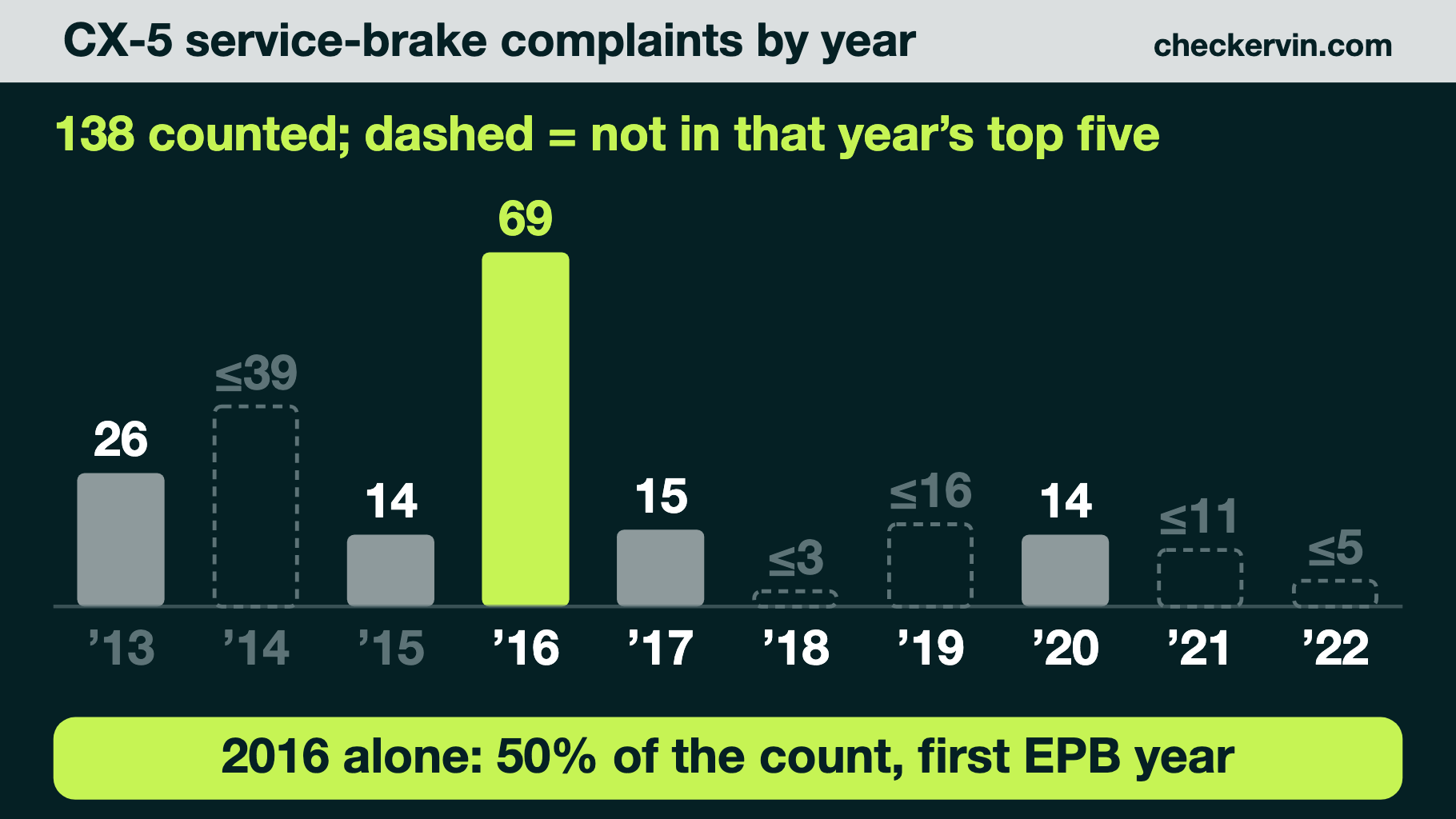
Brakes against the CX-5's other complaints, year by year
Set against everything else owners reported, brakes are never the CX-5’s headline problem. SERVICE BRAKES is not the first or second category in any model year; its best showing is third, in 2016. The categories that lead the record are Electrical system (4 years), Engine (3 years), Exterior lighting (2 years). The table shows where the brakes sit in each year.
| Model year | SERVICE BRAKES in that year's record |
|---|---|
| 2013 | 26 reports, ranked fifth of 194 complaints; #1 is Electrical system |
| 2014 | Below the top five (at most 39); #1 is Electrical system |
| 2015 | 14 reports, ranked fourth of 133 complaints; #1 is Structure |
| 2016 | 69 reports, ranked third of 510 complaints; #1 is Exterior lighting |
| 2017 | 15 reports, ranked fourth of 148 complaints; #1 is Electrical system |
| 2018 | Below the top five (at most 3); #1 is Engine |
| 2019 | Below the top five (at most 16); #1 is Engine |
| 2020 | 14 reports, ranked fourth of 106 complaints; #1 is Electrical system |
| 2021 | Below the top five (at most 11); #1 is Engine |
| 2022 | Below the top five (at most 5); #1 is Exterior lighting |
Two patterns stand out. The first-generation car, 2013 through 2016, holds 109 of the counted brake complaints; the redesigned car from 2017 on holds 29, appearing in the top five only in 2017 and 2020. And 2016 alone carries 69 reports, 13.5% of everything owners filed against that model year. At the other end, the 2018 car’s fifth-ranked category has just 3 complaints, so its brake count can be no higher than that.
2016: the first CX-5 with an electric parking brake
Mazda’s February 9, 2015 pricing release for the 2016 CX-5 lists “an electronic parking brake” as new standard equipment. The lever went away, and a motor on each rear caliper took over the parking function. The complaint record changes with it. Reading the 2016 SERVICE BRAKES narratives, most of them describe the rear brakes and the parking brake: a warning light flashing at start-up, a brake that will not release, a rear wheel dragging hot enough to smoke, an outer pad worn to metal while the inner pad looks fine.
Mazda’s bulletins describe the same thing in its own words. We read each one on NHTSA’s servers:
| Mazda bulletin | What it says about the 2016 CX-5 |
|---|---|
| 04-002/15 | Built before June 9, 2015: EPB warning light, will not release at roughly -4 to 14°F |
| 04-005/16 | Built before Feb. 22, 2016: rear drag and outer-pad wear when the EPB does not fully release; new control module |
| 04-001/18 | Built before Sept. 9, 2016: same drag; replaces the 2016 fix with modified rear calipers |
The last of those matters for cost. Its diagnosis tells technicians to start from a stop with the parking brake set and see whether the car rolls to one side, then to check whether each rear rotor turns freely by hand. If a caliper fails those checks, the repair is a modified caliper, with new pads and rotors only if the old ones are damaged. Mazda covered it under the New Vehicle Limited Warranty, which on this car ran 36 months or 36,000 miles. Every 2016 CX-5 is now well past that. On an older car, the bulletin is still the useful part: if a 2016 rear brake is chewing through outer pads, new pads alone may only reset the clock.
2013-2014: the rear pad that rusted in place
The first-generation CX-5 had its own rear-brake bulletin before the electric parking brake existed. Mazda bulletin 04-005/15 covers 2013 and 2014 CX-5s with VINs below a set serial, built before October 9, 2013. Where road salt is used, it says, the outer rear pad can stick from corrosion, dragging the brake and wearing only that pad. The noise owners hear is the wear indicator. Mazda changed the treatment of the pad backing plate, and the repair adds a wire-brush cleaning of the caliper support, grease, new retainers and modified pads.
The 2013 record fits that bulletin. SERVICE BRAKES is the fifth category that year at 26 reports, and most of the narratives describe rear grinding, rear pads gone early, and repeat rear jobs. The 2014 car, also named in the bulletin, does not have brakes in its top five; with 39complaints in fifth place, its brake count is no higher than that. For a pad-and-rotor quote on a 2013–2014, the practical question is whether the car ever got the modified pads, and whether the caliper brackets were cleaned and greased rather than just fitted with new friction.
2016-2021: grinding, grooves and uneven wear
Mazda kept issuing rear-brake bulletins after the redesign. None is a recall, and each applies to cars built before a stated date, but together they explain most of what a technician may find on a later CX-5.
| Mazda bulletin | CX-5 years and what changed |
|---|---|
| 04-003/20 | 2016-2020: grooves in new rear rotors from metal particles; rotor surface honing changed |
| 04-002/21 | 2016 built before Dec. 21, 2016 and 2017-2020 built before Mar. 18, 2020: rear grinding from hard black rust; pad material changed |
| 04-004/21 | 2017-2020 and some 2021: vibration on EPB auto-release and uneven rear pad wear; control-module logic changed |
The grinding bulletin is the one most owners will meet. Mazda explains that the original rear pads could not scrub rust off the rotors, the rust baked hard under braking, and the pads then could not remove it at all. The fix is new rear pads in a revised compound and new rear rotors. If you are paying for a rear job on a CX-5 built inside those dates, ask whether the shop is fitting Mazda’s revised pad or an aftermarket pad, because the bulletin’s point is that the friction material was the cause.
Automatic braking is a different system, filed in the same place
The CX-5 offered Smart City Brake Support and Smart Brake Support, systems that can brake the car without the driver. NHTSA tracks that under FORWARD COLLISION AVOIDANCE, and the category appears in the CX-5’s top five in 2018, 2019, 2020, 2021. It is not part of a pad job and has nothing to do with rotor wear.
The line is blurrier than the categories suggest. Mazda’s own tip sheet on Smart City Brake Support operating unintentionally is indexed by NHTSA under SERVICE BRAKES, and some owners file automatic-braking events there too: the 2020brake narratives include sudden stops by the car’s own system. Mazda attributes some false activations to the sensor’s view, such as rain or fog on the windshield, and its 2017 service alert tells dealers that a dirty windshield or grille emblem can light the warning. A warning light for that system is not a reason to replace pads, and a pad quote should not include it.
No brake recall, checked
We queried NHTSA’s recall database for every CX-5 model year from 2013 through 2022. No campaign covers the service brakes or the parking brake. To make sure the query can find one, we ran it first on the 2014 Mazda6 and Mazda3, which return a parking-brake recall, 17V393000. The CX-5’s recalls are on other systems: a fuel filler pipe, front strut bolts, daytime running lights, an engine-control software error and a fuel pump among them, depending on the year.
That distinction is money. A recall is repaired free on any eligible car regardless of age. A technical service bulletin is a repair procedure; Mazda paid for the bulletin repairs above only inside the New Vehicle Limited Warranty. Outside it, a bulletin is still worth naming at the service desk, because it tells the shop what to look for and which revised part to fit.
Why the rear job is not a simple swap on a 2016-or-newer CX-5
On a CX-5 with the electric parking brake, each rear caliper carries a parking-brake motor gear unit, and the job has to go through that system rather than around it. Mazda’s 2016 service alert lists the rear pads, rear rotors and rear calipers and states, for each, that maintenance mode is required before and after service. It also warns that a car returned with incomplete parking-brake service may not operate correctly.
A 2018 Mazda service alert for the 2017–2018 CX-5 adds a sharper warning for the manual release used when the system will not respond: turn the spindle one turn and only one, or the caliper may be damaged and need replacing. A shop that does many Mazdas will know this. A shop that treats the CX-5 like a 2013–2015 car with a lever can turn a pad job into a caliper job.
What a fair quote should list
- Which axle, and whether the price is pads only or pads and rotors
- Inner and outer rear pad thickness, measured separately; a lopsided pair suggests drag
- Whether each rear rotor turns freely by hand with the parking brake released
- Mazda-revised rear pads, or the aftermarket pad being substituted
- Electric parking brake maintenance mode, on 2016-and-newer cars, as a stated step
- Caliper bracket cleaning and lubrication on 2013-2014 cars from salt states
- Brake fluid condition, which is a separate service and should be priced as one
If the shop recommends calipers, ask what failed the inspection. On a 2016 CX-5 that answer may line up with Mazda’s own caliper bulletin. On a car outside the stated build dates, it is a diagnosis to see, not a part to accept on faith.
If you are buying the CX-5, not repairing it
A test drive can catch most of this. Set the parking brake, pull away gently, and feel whether the car tugs to one side as it releases. After a short drive, a rear wheel that is much hotter than the other is a drag warning. A Mazda VIN decode confirms the model year and build, which tells you which bulletins could apply. The safety features lookup by VIN shows whether the car has the automatic-braking system that sometimes gets confused with a brake fault.
Run the Mazda recall check for the recalls this model does carry, and check the brake fluid specification by VIN if the seller has no record of a fluid change. Read which CX-5 model years draw the most complaints overall rather than judging the car on brakes alone; the record is led by other systems. Our CX-5 transmission fluid post covers the other service owners most often ask about.
Where this information comes from
- NHTSA — CX-5 complaint and recall databaseThe federal complaint record this page's figures are computed from, browsable by model year.
- NHTSA recalls API — CX-5 by model yearQueried for every model year 2013-2022; no brake or parking-brake campaign, checked against a known-positive Mazda first.
- NHTSA-hosted Mazda bulletin 04-001/18 — 2016 CX-5 rear brake dragRead in full: build-date cutoff, roll test and rotor check, modified calipers, warranty terms.
- NHTSA-hosted Mazda bulletin 04-005/15 — 2013-2014 CX-5 rear brake noiseRead in full: corrosion-stuck outer pad, Oct. 9, 2013 build cutoff, revised pads, 36-month/36,000-mile coverage.
- NHTSA-hosted Mazda bulletin 04-002/21 — grinding noise from rear brakesRead in full: hard rust on EPB-car rotors, revised pad material, CX-5 build-date cutoffs.
- NHTSA-hosted Mazda service alert SA130 — 2016 CX-5 EPB service cautionStates maintenance mode is required before and after rear pad, rotor and caliper service.
- Mazda USA — 2016 CX-5 pricing announced (Feb. 9, 2015)Source for the electronic parking brake as new standard equipment for 2016.
- Kelley Blue Book — 2017 CX-5 brake repairThe $240-$308 range for ZIP 45401, read from search-served page text on October 26, 2026; the 2019 page gives $421-$506 for ZIP 98055.
Keep reading
Frequently asked questions
How much does it cost to replace brake pads and rotors on a Mazda CX-5?
Kelley Blue Book's fair repair range for a 2017 CX-5 is $240 to $308 in ZIP 45401 (Dayton, Ohio), and for a 2019 CX-5 it is $421 to $506 in ZIP 98055 (Renton, Washington). Those ranges come from KBB's default brake service, pad replacement, and KBB says its pricing covers either the front or the rear brakes, not both. New rotors add parts and labor on top of that, and doing both axles roughly doubles the job. The figures are KBB's, read from search-served page text on October 26, 2026; we sell VIN checks, not repairs, and price none of this ourselves.
Does the Mazda CX-5 have an electric parking brake?
From the 2016 model year, yes. Mazda's February 2015 pricing release for the 2016 CX-5 lists an electronic parking brake as new standard equipment, and Mazda's own service bulletins for the 2016 and later CX-5 refer to it throughout. The 2013 to 2015 CX-5 used a conventional lever. On an electric-parking-brake car, Mazda's service alert for the 2016 CX-5 says rear pad, rotor and caliper work requires putting the system into maintenance mode before and after the job.
Which Mazda CX-5 years have the most brake complaints?
The 2016. Computed from our NHTSA corpus, SERVICE BRAKES reaches a model year's top five in 5 of the CX-5's 10 years, for 138 counted complaints, and 2016 alone holds 69 of them (50%). That is the first CX-5 with an electric parking brake, and Mazda issued bulletins on 2016 rear-brake drag caused by the parking brake not fully releasing. In the other 5 years the category sits below the fifth-ranked complaint, so the counted figure is a floor, not a total.
Is there a recall on Mazda CX-5 brakes?
No. We queried NHTSA's recall database for every CX-5 model year from 2013 through 2022 and found no campaign covering the service brakes or the parking brake, after confirming the same query does return a parking-brake recall (17V393000) for the 2014 Mazda6 and Mazda3. Mazda's brake fixes on the CX-5 came as technical service bulletins, which are repair instructions for dealers, not free recalls. Check the specific VIN anyway, since CX-5s of this era carry recalls on other systems.
Why do CX-5 rear brakes wear out before the fronts?
Mazda has published two different explanations, depending on the year. Its bulletin for 2013 and 2014 CX-5s built before October 9, 2013 says the outer rear pad can stick from corrosion where roads are salted, which drags the brake and wears that pad early. For the 2016 CX-5, Mazda's bulletins blame rear drag on the electric parking brake not releasing completely, fixed first with a new control module and later with modified calipers. A later bulletin on 2017 to 2021 CX-5s links uneven rear pad wear to the parking brake's automatic-release timing. Ask a shop to measure inner and outer pads separately; a lopsided pair points to drag, not normal wear.
Confirm the build before you price the rear brakes
A free CheckerVIN report shows the factory build, specifications and open recalls for any VIN, so you know which CX-5 and which bulletins you are pricing against.
Run a free VIN check