The short answer
- What does it cost?
- KBB's fair-repair ranges run roughly $275-$382 depending on the model year, trim and ZIP code.
- Does the Sonata have a transmission problem?
- No concentration shows up in the federal record: power train never exceeds 22.8% of any single model year's complaints.
- What's the real signal on this nameplate?
- The engine, not the gearbox: ENGINE is the #1 complaint category in 9 of 15 model years, tied to two named NHTSA recalls.
What the service actually costs
Kelley Blue Book publishes a fair-repair range for a Sonata transmission fluid change on a per-year, per-trim, per-ZIP-code basis. The figures move with all three: roughly $275 to $382 for a 2023 Sonata in the Columbus, OH ZIP code, $281 to $347 for a 2021 in Kerrville, TX, and $299 to $372 for a 2023 Sonata Hybrid in Harlingen, TX. A full replacement, by contrast, runs far higher — getjerry.com’s reader Q&A on a 2011 Sonata transmission replacement discusses a quote well above the fluid service’s range. None of these numbers is ours — we sell VIN checks, not repairs, and price nothing here ourselves — so treat every figure on this page as attributed to whoever published it.
A flat estimator price also does not tell you which of two generations’ transmissions is actually under the car, or whether the transmission is even the thing worth worrying about. The next section shows it mostly isn’t.
What 13,246 complaints say about the Sonata's transmission
Our corpus of federal NHTSA complaints holds 13,246 reports against the 2008–2022 Hyundai Sonata. POWER TRAIN names only 429 of them — 3.2% of the entire record — and it cracks the model year’s own top-5 most-reported categories in just 8of the nameplate’s 15 years. In every one of those years, power train never rises above fourth place among that year’s own complaint categories, and its single highest share of any model year’s total is 2022, at 22.8% — on a year with a comparatively small complaint count overall, not a genuine concentration spike.
The longest unbroken run with zero power-train representation in the top-5 is 2011–2014, 4 straight model years. That span is not a quiet stretch for the Sonata overall — it is, as the next section shows, the loudest stretch on record for a different component entirely.
The louder number sits next door
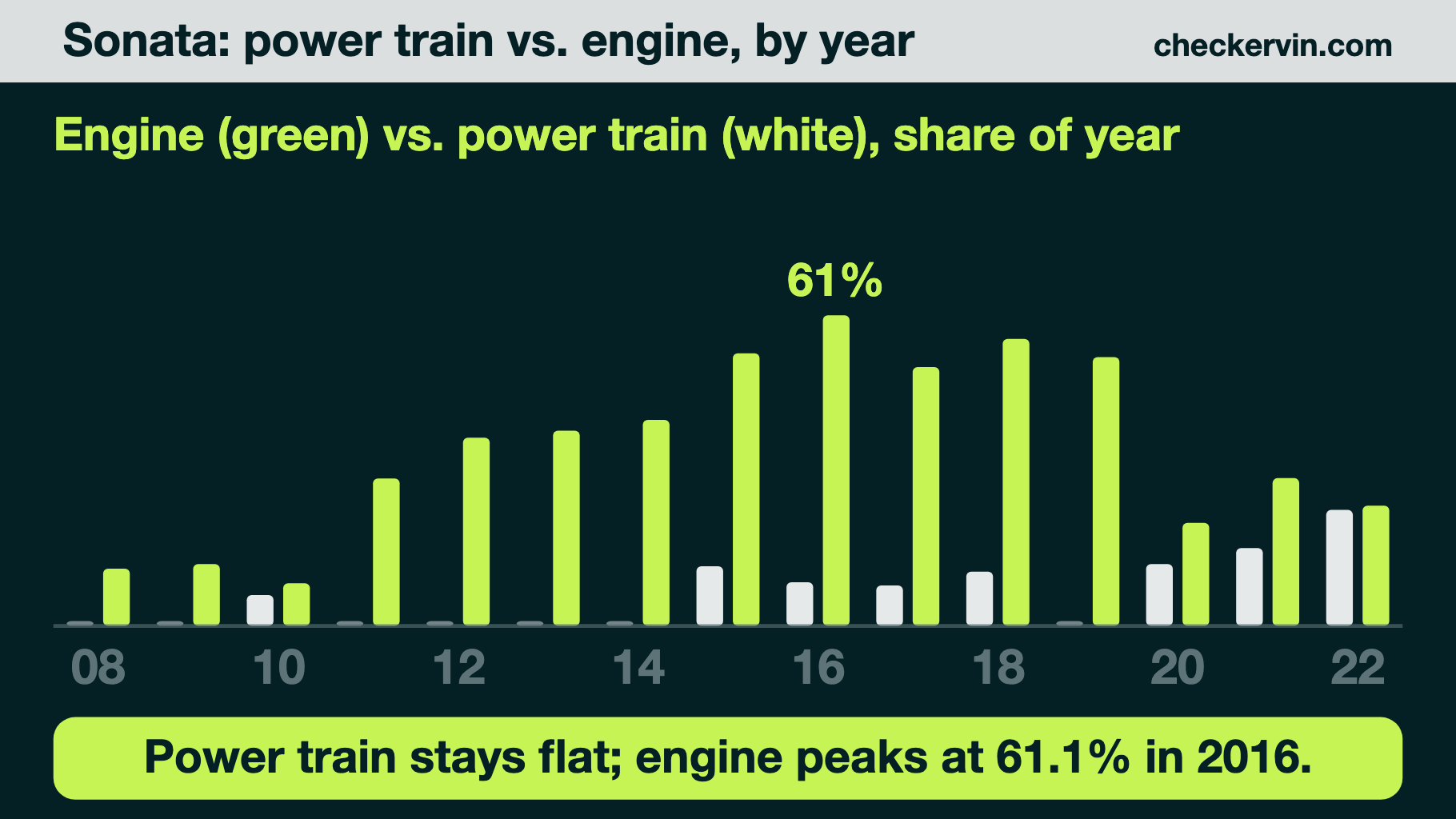
ENGINE is the Sonata’s #1 complaint category in 9 of its 15 model years, and accounts for 4,937 of 13,246total complaints across the whole span — 37.3% all-time, roughly 12times power train’s share. By raw volume, the three heaviest complaint years in the entire corpus are 2011 (3,474 complaints, 1,008 of them ENGINE — second only to STEERING that year), 2012 (1,713 complaints, 635 of them ENGINE) and 2013 (2,023 complaints, 778 of them ENGINE) — all inside the 2011–2014window the previous section found to be power train’s quietest stretch.
A second, separate measure tells a complementary story and is worth naming honestly rather than folding into the first: ENGINE’s share of each year’s own total complaints does not peak alongside that raw-volume spike. It keeps climbing afterward, reaching its single highest share in 2016 at 61.1% — even as the Sonata’s total complaint volume had already fallen to a fraction of its 2011 peak. Raw complaints and complaint share are two different measures and they do not move together here: the loudest single year by count is 2011; the loudest year by the engine’s share of that year’s own record is 2016. Either way, power train is not the category doing the talking, and a generic “transmission fluid change” estimator cannot surface either fact.
Two recalls with names and numbers
That engine concentration is not unexplained. NHTSA campaign 15V-568, reported by Hyundai Motor America in September 2015, covers roughly 470,000 2011–2012 Sonatas built at Hyundai’s Alabama plant between December 2009 and April 2012 with a 2.0L or 2.4L gasoline direct-injection (Theta II) engine. Per NHTSA’s own recall filing, excess metal debris generated during factory machining could restrict oil flow to the connecting rod bearings; a worn bearing produces a knocking noise that can lead the engine to stall while the car is moving. Hyundai’s remedy was inspection and, where needed, engine replacement, plus an extended engine warranty to 10 years or 120,000 miles for affected vehicles.
A second campaign, 17V-226, filed in March 2017, extended the same bearing-wear finding to roughly 572,000 2013–2014 Sonata and Santa Fe Sport vehicles with the same 2.0L/2.4L GDI engines, built the same way. Both recalls were filed several years after the 2011–2013complaint spike they ultimately cover — consistent with how an NHTSA investigation typically trails the owner complaints that open it, not a sign the problem was new. Both campaigns name the engine specifically, not the transmission, and sit inside the same 2011–2014window this corpus’s own record flags as power train’s quietest stretch. Separately, Hyundai and Kia were fined a combined $210 million by NHTSA in November 2020 over findings that related recalls across both brands were untimely or inaccurately reported — a penalty about the recall process, not a new defect finding, and already covered in full on our cross-nameplate look at Theta II engine failures.
SP-III and SP-IV are not interchangeable
A Hyundai technical service bulletin, surfaced via NHTSA’s public TSB archive, states plainly that SP-III, SP4-M (SP-IV) and SPH-IV-RR automatic transmission fluids are not interchangeable, and lists both the 2011–2014 Sonata (internally “YF”) and the 2015-and-later Sonata (“LF”) among the affected vehicles. A separate Hyundai bulletin on the automatic transaxle fluid-level check for the 6-speed unit used across those same generations specifies SP-IV and warns against SP-III, which it says can hurt shift quality and transaxle durability if used in the wrong application.
| Fluid | Where it applies |
|---|---|
| SP-IV (SP4-M) | The specification Hyundai's bulletins call for on 2011-and-later (YF/LF) Sonatas |
| SP-III | An earlier specification; Hyundai's own bulletins warn it is not interchangeable with SP-IV |
| SPH-IV-RR / generic “universal” ATF | Named as a separate, non-interchangeable spec in the same bulletin; not confirmed as a safe substitute |
What we could not confirm
What an actual transmission problem looks like, if it shows up
- A shudder, flare or harsh clunk between gears, especially at low speed
- Delayed or hesitant engagement when shifting from park into drive
- The transmission slipping or hunting between gears without a clear reason
- A burnt smell from the fluid, or fluid that has darkened well past its original color
None of these symptoms are specific to the Sonata — they are the general signs any automatic transmission gives before a repair gets expensive. Given this corpus’s own finding, a knocking or stalling symptom on a 2011–2014 Sonata is more likely to be the named engine-bearing issue above than a transmission fault; the order that matters either way is cheap first — confirm the exact model year and any open recall by VIN before anyone prices a repair.
Before you authorize the service
- Confirm the exact model year by VIN — the fluid spec and generation both change with it
- Confirm the shop is using SP-IV, not SP-III or an unverified 'universal' substitute
- Pull the VIN's open recalls before paying for anything else, especially on a 2011-2014 car
- Ask which service schedule — normal or severe — your driving actually falls under, and get the interval in writing
- Get the quote itemized — fluid brand, quantity and labor — not a single flat-rate line
If you're buying a Sonata, not maintaining one
The same record reads as a reassurance with one real caveat. A Hyundai VIN decodeconfirms the exact model year and generation — worth knowing because a 2011–2014 car falls inside the two named engine recalls above, which is a materially different risk than this corpus’s transmission-specific finding. The complaint record gives you no reason to discount a Sonata for transmission risk specifically, in any of its 15 model years — but it gives you a clear, named reason to check the engine recall history on exactly the years this page flags.
Run the recall lookupon any candidate VIN before you negotiate — recalls run on their own schedule, independent of the complaint patterns above — and check why transmission fluid is the one fluid the VIN matters most for generally, since the same nameplate can ship with different fluid specifications depending on the exact generation, exactly as this post found on the Sonata itself.
Where this information comes from
- NHTSA — Sonata complaint databaseThe federal complaint record this page's figures are computed from, browsable by model year.
- NHTSA — recalls by VINThe official lookup to confirm any open recall on a specific Sonata VIN, independent of the complaint figures above.
- NHTSA recall 15V-568 — Sonata connecting rod bearing wearThe filing covering the 2011-2012 Sonata engine recall discussed above, hosted on NHTSA's own recall archive.
- NHTSA recall 17V-226 — Sonata/Santa Fe Sport bearing wearThe 2013-2014 extension of the same engine-bearing finding, hosted on NHTSA's own recall archive.
- Hyundai technical bulletin — SP-III/SP-IV fluid interchangeabilityThe bulletin stating SP-III, SP-IV and SPH-IV-RR are not interchangeable, hosted on NHTSA's TSB archive.
- Kelley Blue Book — Sonata transmission fluid change estimateThe per-model-year fair-repair-range figures quoted above, retrieved via search November 2026.
Keep reading
Frequently asked questions
How much does it cost to change the transmission fluid in a Hyundai Sonata?
Kelley Blue Book's fair-repair-range figures vary by model year, trim and ZIP code: roughly $275-$382 for a 2023 Sonata (Columbus, OH), $281-$347 for a 2021 (Kerrville, TX), and $299-$372 for a 2023 Sonata Hybrid (Harlingen, TX). A full replacement runs far higher — getjerry.com discusses a 2011 Sonata transmission replacement quote well into four figures. None of these figures is ours; we sell VIN checks, not repairs.
Does the Hyundai Sonata have transmission problems?
Not according to its own federal complaint record. POWER TRAIN complaints never exceed 22.8% of any single model year's total, cracking that year's own top-5 categories in only 8 of the Sonata's 15 model years, and never ranking higher than 4th when they do. The longest unbroken run with zero power-train representation in the top-5 is 2011-2014 (4 straight model years) — which, as the next section shows, is precisely when a different component was dominating the record instead.
What transmission fluid does a Hyundai Sonata take?
Hyundai's own technical bulletins, surfaced via NHTSA's public TSB archive, state that SP-III and SP-IV automatic transmission fluid are not interchangeable, and that using the wrong one can degrade shift quality and transaxle durability. Secondary sourcing (not a manual opened directly in this session) associates SP-III with earlier Sonatas and SP-IV with the 2011-and-later YF and LF generations — confirm the exact spec against your own VIN's owner's manual before any shop tops off or flushes the fluid.
Why did Hyundai recall the Sonata's engine, not its transmission?
Two separate NHTSA campaigns cover the model years this corpus's own record flags as heaviest: 15V-568 (2011-2012 Sonata, about 470,000 vehicles) and 17V-226 (2013-2014 Sonata and Santa Fe Sport, about 572,000 vehicles), both tracing to metal debris left during engine machining at Hyundai's Alabama plant, which restricted oil flow to the connecting rod bearings and could cause a stall. Both recalls target the engine, not the transmission — consistent with this corpus's own finding that 2011, 2012 and 2013 are the three heaviest complaint-count years on record (3,474, 1,713 and 2,023 complaints), all inside the same 2011-2014 window power train stays quietest. 2012 and 2013 are led by ENGINE; 2011 is led by STEERING, yet still carries the most ENGINE complaints of any Sonata year (1,008).
Which Hyundai Sonata model years show the most power-train complaints?
Computed from src/data/models/hyundai-sonata.json: POWER TRAIN cracks that year's own top-5 complaint categories in just 8 of the Sonata's 15 model years and accounts for only 429 of 13,246 total complaints across the whole span (3.2%). The single highest share is 2022, at 22.8% of that year's own complaints, on a comparatively small base. ENGINE, by contrast, is the #1 complaint category in 9 of the same 15 years and accounts for 37.3% of all complaints — the far louder signal on this nameplate.
Confirm the generation before you price the service
A free CheckerVIN report shows the factory build, specifications and open recalls for any VIN — confirm what you're actually pricing.
Run a free VIN check