The short answer
- What does it cost?
- RepairPal lists $804–$1,130 on average for a CR-V starter, about four-fifths of it parts. Honda books the swap at 0.7 hours on a 2010.
- Is it really the starter?
- Often not. Honda has one CR-V starter bulletin (2010). Its no-start fixes for 2012, 2017 and 2019 are battery-drain software.
- What about the cold-start grind?
- On 2012–2014 CR-Vs, a two-second rattle at cold start is a valve-timing actuator per Honda bulletins, not the starter.
$804–$1,130
RepairPal CR-V starter average
Retrieved Oct. 2026, before tax
0.7 hr
Honda's CR-V starter swap time
Bulletin 12-018, 2010 CR-V
1,663
Electrical reports counted
2008–2022, federal record
1 of 15
Model years with a Honda starter bulletin
2010 only, in Honda's NHTSA filings
The numbers, and whose numbers they are
We sell no repairs and publish no price of our own, so the dollar figures here belong to someone else, with the date we read them. RepairPal’s CR-V starter estimator lists an average of $804 to $1,130, made of roughly $161 to $237 in labor and $643 to $893 in parts, on a page marked as updated September 3, 2026. We read it in October 2026 through its search listing, because RepairPal refuses direct requests from our tools, and two separate searches returned the same figures. The range excludes tax and does not adjust for your area.
Honda’s own labor figure explains why labor is the small part. The one CR-V starter bulletin Honda filed with federal regulators books “CR-V: Replace the starter motor” at 0.7 hours on the 2010 model, and the part it specifies is a Honda remanufactured unit. That is the only Honda flat-rate time for a CR-V starter we could verify; we did not find a published figure for the 2.4-liter in later bodies or for the 1.5-liter turbo. Kelley Blue Book surfaced no CR-V starter estimate, so none is quoted.
So the bill is mostly the part, and the choices on the part are new Honda, Honda remanufactured or aftermarket remanufactured. The larger risk is buying a starter the CR-V never needed, and the rest of this page is about how often Honda’s own paperwork finds something else behind the symptom.
What 1,663 counted electrical complaints say, and don't
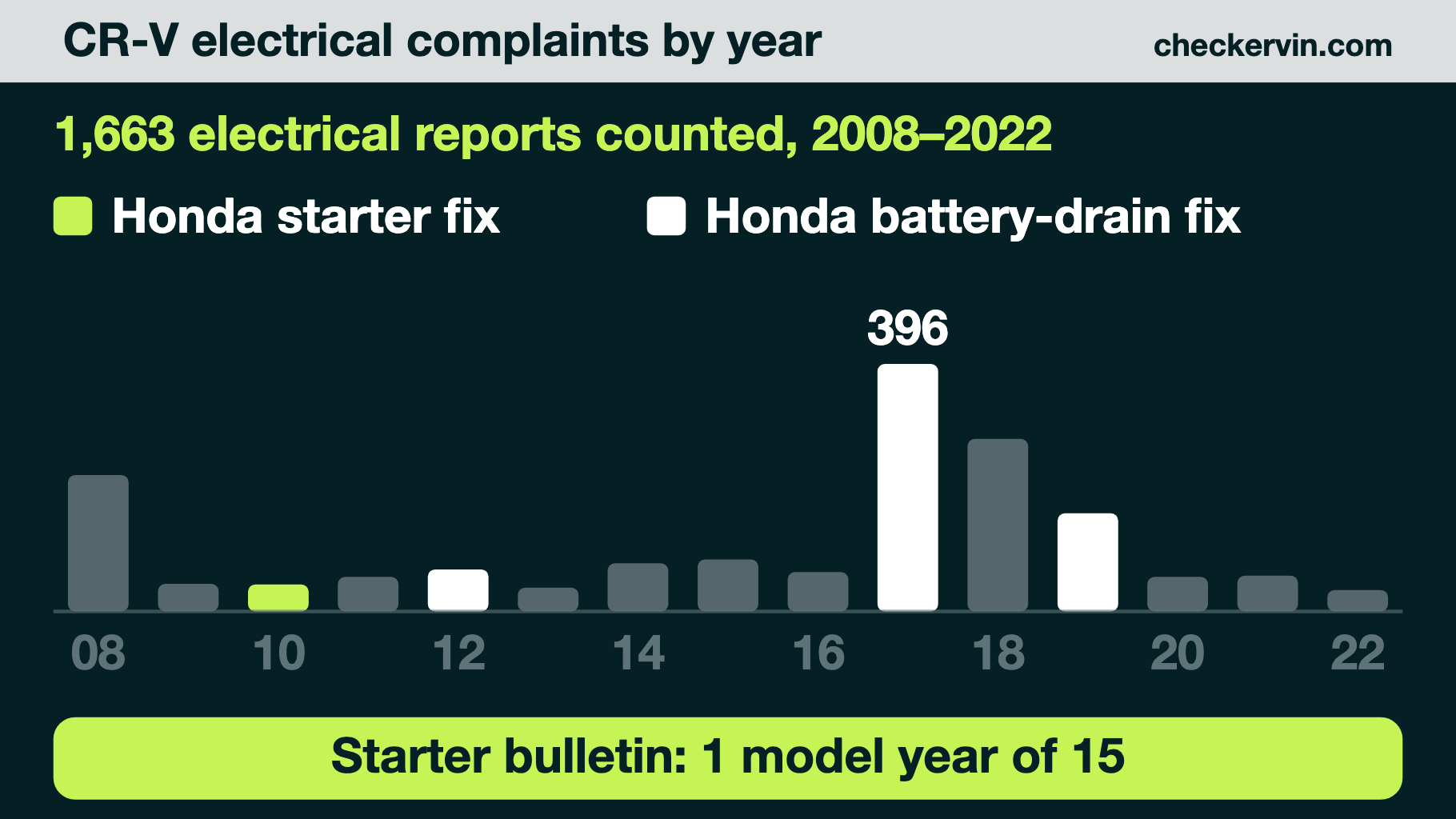
Our corpus of federal NHTSA complaints holds 10,899 reports against the 2008–2022 CR-V. NHTSA has no starter category. The closest is ELECTRICAL SYSTEM, which takes in the 12-volt battery, wiring, lighting, modules and whatever else an owner files as electrical; the starter is a small slice of it. The category ranks among the five most-reported components in every model year here, and it adds up to 1,663 reports, about 15% of the total.
The 2017 CR-V is the peak at 396, about 23% of that year’s complaints, and 2017–2018 together hold 40% of every electrical report counted. That is the parasitic-drain era our CR-V hybrid battery post separates from the hybrid pack; most CR-V “battery” grief is the 12-volt kind, and a dead 12-volt battery is the classic starter misdiagnosis. The 2010 model, the one year with a Honda starter bulletin, logs 43 electrical reports, about 9% of its complaints, and ranks fifth among its components.
NHTSA’s live database keeps moving. When we checked it in October 2026, electrical counts for 2008–2019 matched or ran slightly above our snapshot, while 2020–2022 ran lower, because NHTSA now files some of those reports under a separate CR-V Hybrid model name. Our pulled figures are used as they are.
2010: the one starter bulletin Honda filed
We pulled every manufacturer communication NHTSA holds for the CR-V from the 2008 through 2024 model years and read the ones that touch starting. Exactly one is about the starter itself. Honda Service Bulletin 12-018, first issued in March 2012 and revised in April 2014, covers 2010 CR-Vs in specific VIN ranges, both 2WD and 4WD, along with some 2010 Accords and Elements.
The symptom is narrow: the starter intermittently grinds in cold weather, typically 45°F or colder. Honda’s stated cause is a starter clutch housing that may be out of specification, loading the clutch roller and pinion unevenly. The fix is a new starter, a Honda remanufactured unit for the CR-V, booked at 0.7 hours under normal warranty. On the chart the 2010 bar is one of the shortest, which fits: a grinding noise on cold mornings is something owners tolerate and rarely report.
The cold-start grind that is not the starter
Read the federal complaints that mention the starter on 2012 to 2014 CR-Vs and one story repeats: a loud grinding on cold mornings, a starter or “starter actuator” replaced, and the noise unchanged. One 2014 owner was quoted $863 for a starter to cure a rattle lasting one to three seconds. Another writes that the dealer told them it was not the starter at all but a part in the engine that controls valve timing.
Honda’s bulletins agree with that dealer. Service Bulletin 09-010 covers every 2012 CR-V and early 2013s by VIN; 16-012 covers later 2013s and every 2014. Both describe the same thing: at cold start-up the engine rattles loudly for about two seconds, worst below 40°F, because the variable valve timing control (VTC) actuator is defective. The fix is a new actuator, booked at 2.0 hours under normal warranty. Honda’s test is simple: leave the engine off at least six hours so oil drains from the actuator, start it and listen for the two-second rattle.
The difference you can hear is timing. A starter grind happens while the starter is turning the engine, before it fires, or lingers as a whine if the pinion hangs on. The VTC rattle starts the moment the engine catches and stops once oil pressure arrives. For 2015–2016 CR-Vs, a January 2018 Honda ServiceNews article describes a similar one-to-three-second start-up rattle from the actuator’s lock pin and told technicians not to replace the actuator yet, because no countermeasure existed. In the federal record, ENGINE rather than ELECTRICAL leads the complaint count for 2012, 2013, 2014, 2015 and 2016, which fits a noise owners hear from under the hood. Our CR-V timing chain post covers the rest of the front of that engine.
Clicks on a dead battery: the 2012 software fix
The other starter suspect is a CR-V that only clicks. A starter draws more current than anything else in the car, so a weak battery shows up first as a click, a slow crank or a flickering dash. On the 2012 CR-V, Honda found a reason the battery went flat that had nothing to do with either part.
In November 2014 Honda announced a product update for 116,272 2012 CR-Vs. Its dealer message says the battery management system “may misinterpret state-of-charge (SOC) information if the vehicle is left sitting for an extended period of time,” so the system fails to charge the battery until it can no longer start the engine. Service Bulletin 14-071 fixes it with an engine computer software update booked at 0.3 hours. The same bulletin lists the other causes a technician has to rule out: a faulty alternator, a faulty or sulfated battery, a parasitic draw or loose battery cables. The starter is not on the list. The 2012 model logs 67 counted electrical reports, ranking second among its components.
On a 2012, ask a Honda dealer whether the update shows as done for the VIN before buying a starter. If the battery has been flattened repeatedly it may be sulfated and need replacing too; the battery size lookup by VINshows which one the car should carry. Honda’s alternator tester rule, laid out in our Civic alternator post, applies across these years too: a printed charging test beats a guess.
2017 and 2019: software that would not go to sleep
The 2017peak has its own Honda document, and again it is not the starter. Service Bulletin 17-032, issued in June 2017, covers 2017 CR-Vs with both the 1.5-liter turbo and the 2.4-liter in early VIN ranges. The symptom: the car does not start because the battery is low, with an intermittent 350-milliamp draw after shut-off. The stability control (VSA) unit may not go to sleep if the electric parking brake is set within three to four seconds of shutting the car off. Honda’s fix is a VSA software update with sensor and tire-pressure recalibration, 0.4 hours under normal warranty. Before the fix existed, a March 2017 Honda tech line article told dealers the draw could be avoided by setting the parking brake before turning the ignition off.
The 2019 CR-V got a different version of the same problem. Honda announced a product update in March 2019, and Service Bulletin 19-039 describes a CR-V that “fails to start after being parked for an extended period.” The engine computer runs an evaporative-emissions leak check five hours after shutdown and, under certain conditions, does not go back to sleep, draining the battery. The bulletin covers 2019 EX, EX-L and Touring models by VIN and pairs the software update with a battery test, charging or replacing it on the result. The 2019 model holds 157 counted electrical reports.
Together 2012, 2017 and 2019 account for 37% of the CR-V’s counted electrical reports, and Honda’s fix for each was software and a battery test. One more 2017–2019 document is worth knowing: a 2018 Honda ServiceNews article says a brake pedal that kicks back during engine start comes from a low battery resetting the electronic brake booster. A start-up oddity on these cars should send you to the battery first.
Idle-stop on 2020 and later: more starts, same rules
Honda’s feature guide for the 2020CR-V calls idle-stop “new to the CR-V for 2020” and says all trims have it: brake to a stop for at least two seconds and the engine shuts off, release the brake and it starts back up by itself. A button near the shifter marked with an A inside a circular arrow turns it off for that drive. Every one of those restarts is a starting event the earlier CR-Vs never made.
What we could not find is a Honda document about CR-V idle-stop starters or batteries. None of the communication summaries Honda filed for 2020 through 2024 CR-Vs mentions idle-stop, and we verified no claim that these cars use a heavier-duty starter or a special battery, so this page makes none. The federal record for 2020–2022 is also quiet so far, averaging 49 counted electrical reports a year. The practical point is the same as on older CR-Vs: a slow or failed restart gets a battery test before anyone prices a starter.
CR-V Hybrid: the engine is started differently
The CR-V Hybrid arrived for 2020, and Honda describes its engine start differently. The two-motor system’s feature guide says the motor/generator “only acts as a motor to start the engine; it becomes a powerful generator the rest of the time.” We found no Honda document describing a separate 12-volt starting motor on the hybrid, and we did not confirm one either way, so treat a hybrid starter quote with care and ask what part, exactly, is being replaced.
The more likely culprit when a hybrid CR-V will not wake up is the small battery. The 12-volt battery boots the computers and closes the high-voltage relay; when it is flat, the car does nothing, no matter how healthy the high-voltage pack is. Our hybrid battery post walks through telling the two batteries apart.
Recalls, bulletins and who pays
We queried NHTSA’s recall database for every CR-V model year from 2008 through 2022. No campaign names the starter, starting or the battery. The one 2010 electrical recall replaced an ignition wiring harness connector that could cause misfires or a stall, a running problem rather than a starting one. The rest cover airbags, fuel pumps, transmissions, seat belts, steering and structure, among others.
| Honda document | What it covers on the CR-V |
|---|---|
| SB 12-018 (2012, rev. 2014) | 2010 by VIN: starter grinds in cold; new starter, 0.7 hr |
| SB 09-010 and 16-012 | 2012–2014: two-second cold-start rattle; VTC actuator, 2.0 hr |
| SB 14-071 (2014) | 2012: battery management software; 0.3 hr |
| SB 17-032 (2017) | 2017 by VIN: VSA parasitic draw; software, 0.4 hr |
| SB 19-039 (2019) | 2019 EX and up by VIN: EVAP check drains battery; software |
Bulletins are not recalls. 12-018, 09-010, 16-012 and 17-032 say the normal warranty applies, so out of warranty the repair is your bill; 14-071 and 19-039 were product updates Honda ran by VIN. The difference between a bulletin and a recall matters when a shop cites one. The Honda recall check is still worth a minute, since older CR-Vs carry open airbag and fuel-pump campaigns, and a Honda warranty check by VIN shows whether any factory coverage still applies.
Before you authorize the starter
- Charge and load-test the battery first; Honda's 2017 and 2019 no-start fixes include that test
- Note whether the noise comes while cranking (starter) or just after the engine fires (VTC rattle on 2012–2016)
- On a 2012, 2017 or 2019, ask a dealer whether the battery-drain software update is done for the VIN
- On a 2010 that grinds in the cold, ask whether the VIN falls in bulletin 12-018
- On a 2020 or later, test the battery before blaming the starter for idle-stop or start complaints
- Ask whether the quote is new Honda, Honda reman or aftermarket reman, and about the core charge
The first two items cost almost nothing and settle most cases. A car that starts fine after a jump has a battery or drain problem, and a car that drains a good battery overnight needs a parasitic-draw test, which on a 2017 or 2019 may lead straight to a software update. Only a starter that fails a current-draw test, or clicks loudly with a fully charged battery and bright lights, justifies the part.
Give the shop the pattern, not just the last failure. Cold mornings only, after the car sat for days, after a short trip, or after setting the parking brake right at shut-off are each different diagnoses. Owners in the federal record who replaced batteries, starters and push-start buttons in turn were often describing a pattern nobody wrote down.
If you are buying the CR-V, not repairing it
A recent starter receipt on a used CR-V is not proof of a fixed car. On a 2012–2014, ask whether the cold-start rattle is still there; a car that had a starter replaced and still rattles for two seconds on a cold morning needs the VTC actuator. On a 2012, 2017 or 2019, ask whether the battery-drain update was done. The Honda CR-V years-to-avoid breakdown scores each year’s whole complaint record, and our 2017 Honda CR-V record collects the peak year’s data on one page.
Engine matters for parts: 2008–2016 CR-Vs and the 2017–2019 LX use a 2.4-liter, and the other 2017–2019 trims and all 2020–2022 gas models use the 1.5-liter turbo. A Honda VIN decode or the engine size by VINlookup settles it. What CheckerVIN’s free report gives you is the factory build, engine, specifications and open recalls. It does not include accident, title or odometer history, and it cannot tell you whether a battery is sulfated. Only a test does that.
Where this information comes from
- Honda Service Bulletin 12-018 (NHTSA copy) — starter motor grinds in cold weatherHonda's only CR-V starter bulletin: 2010 by VIN range, new starter, 0.7 hours.
- Honda Service Bulletin 16-012 (NHTSA copy) — engine rattles at cold start-upThe 2013–2014 VTC actuator rattle owners mistake for a starter; 09-010 covers 2012.
- Honda Service Bulletin 14-071 (NHTSA copy) — 2012 CR-V battery management softwareA no-start from a battery the software failed to charge; lists the causes to rule out.
- Honda Service Bulletin 17-032 (NHTSA copy) — parasitic draw from the VSA modulatorThe 2017 no-start: a 350 mA draw tied to setting the parking brake at shut-off.
- Honda Service Bulletin 19-039 (NHTSA copy) — 2019 CR-V EVAP softwareThe 2019 no-start after parking: an emissions check that keeps the computer awake.
- NHTSA — recalls by VINThe official lookup; our year-by-year query found no CR-V recall naming the starter or battery.
- Honda Info Center — 2020 CR-V idle-stop systemHonda's statement that idle-stop was new for 2020 and standard on all trims.
- RepairPal — Honda CR-V starter replacement estimatorThe $804–$1,130 average quoted above, retrieved October 2026.
Keep reading
Frequently asked questions
How much does it cost to replace the starter on a Honda CR-V?
RepairPal's CR-V starter estimator lists an average of $804 to $1,130, with labor at about $161 to $237 and parts at about $643 to $893, on a page marked as updated September 3, 2026 and read in October 2026. The part is most of the bill. Honda's own warranty time for swapping the starter on a 2010 CR-V is 0.7 hours, which is why labor stays small; remanufactured starters cut the parts side.
How do I know if my CR-V needs a starter or just a battery?
A single click or rapid clicking with dim dash lights usually means the 12-volt battery cannot supply the current, and a jump start that fixes it points the same way. A loud click with bright lights and no crank, or a grinding while the key is held, points toward the starter. Honda's no-start bulletins for 2012, 2017 and 2019 CR-Vs all fix a battery that was drained by software, and the 2017 and 2019 fixes include a battery test.
Why does my CR-V grind or rattle for a couple of seconds on cold starts?
On 2012 to 2014 CR-Vs, Honda's bulletins 09-010 and 16-012 trace a loud two-second rattle at cold start-up to a defective variable valve timing (VTC) actuator, not the starter. Honda's test is to leave the engine off for at least six hours, start it and listen. A starter grind happens while the engine is cranking; the VTC rattle comes just after it fires. On 2010 CR-Vs in a VIN range, bulletin 12-018 covers a genuine starter grind in cold weather.
Does the Honda CR-V Hybrid have a starter?
Honda describes engine starting on the CR-V Hybrid as a job for the motor/generator: its feature guide says the motor/generator only acts as a motor to start the engine and works as a generator the rest of the time. A hybrid CR-V that will not power up is far more often a flat 12-volt battery, which boots the computers and closes the high-voltage relay, than a starting-motor failure.
Is there a recall on the Honda CR-V starter?
No. We queried NHTSA's recall database for every CR-V model year from 2008 through 2022, and no campaign names the starter, starting or the battery. Honda's starting-related fixes are service bulletins and product updates: a starter replacement for some 2010 CR-Vs under normal warranty, and software updates for 2012, 2017 and 2019 battery drains. Out of warranty, a bulletin does not make the repair free.
Know which CR-V you are dealing with
A free CheckerVIN report shows the factory build, engine, trim and open recalls for any VIN, so you know which starter fits and which Honda bulletin applies.
Run a free VIN check