The short answer
- What does it cost?
- RepairPal lists $4,003–$4,231 installed for the CR-V Hybrid pack, and labor is only $488–$716 of that — the part is the bill.
- Will I ever pay it?
- Often no. Honda covers the pack for 8 years/100,000 miles — 10 years/150,000 in CARB states — and the hybrid-era complaint record is quiet.
- What is the catch?
- Most "CR-V battery problems" in the federal complaint record are the gas model's 12-volt drain era, peaking in 2017 — a different battery costing a tenth as much.
The number, and whose number it is
Price pages for this query converge on the same territory, so start with the one that itemizes. RepairPal’s estimator for a Honda CR-V Hybrid high-voltage battery replacement lists a range of $4,003 to $4,231 installed, with labor at $488 to $716 of it — retrieved September 2026, and quoted here with attribution because it is their estimate, not ours. We sell VIN checks, not repairs, and this page publishes no price of its own.
Read the split rather than the total. When labor is barely a sixth of the bill, calling three shops for a better hourly rate moves the final number by lunch money. What moves it by thousands is the part strategy — new pack from the dealer, remanufactured pack with a warranty, or a used pack pulled from a wreck — and that decision is worth more of your attention than any coupon.
Two batteries, one confused search result
A hybrid CR-V carries two batteries. The high-voltage lithium-ion pack drives the hybrid system and is the four-figure item this query asks about. Next to it sits an ordinary 12-volt battery that boots the computers and closes the main relay — a couple hundred dollars at any parts counter, and the thing that actually strands most hybrid owners on a cold morning.
The confusion is not hypothetical; it is on the results page itself. When we pulled this query’s live SERP in September 2026, the ninth result answered with 12-volt pricing — $45 to $250 — against a high-voltage question. If the search engine blends the two batteries, a service advisor quoting a worried owner can manage it too. Before any pack conversation, establish which battery is actually dead: a CR-V Hybrid that cranks nothing and shows a dark dash almost always has a 12-volt problem, not a pack problem.
What 15 years of complaints actually say
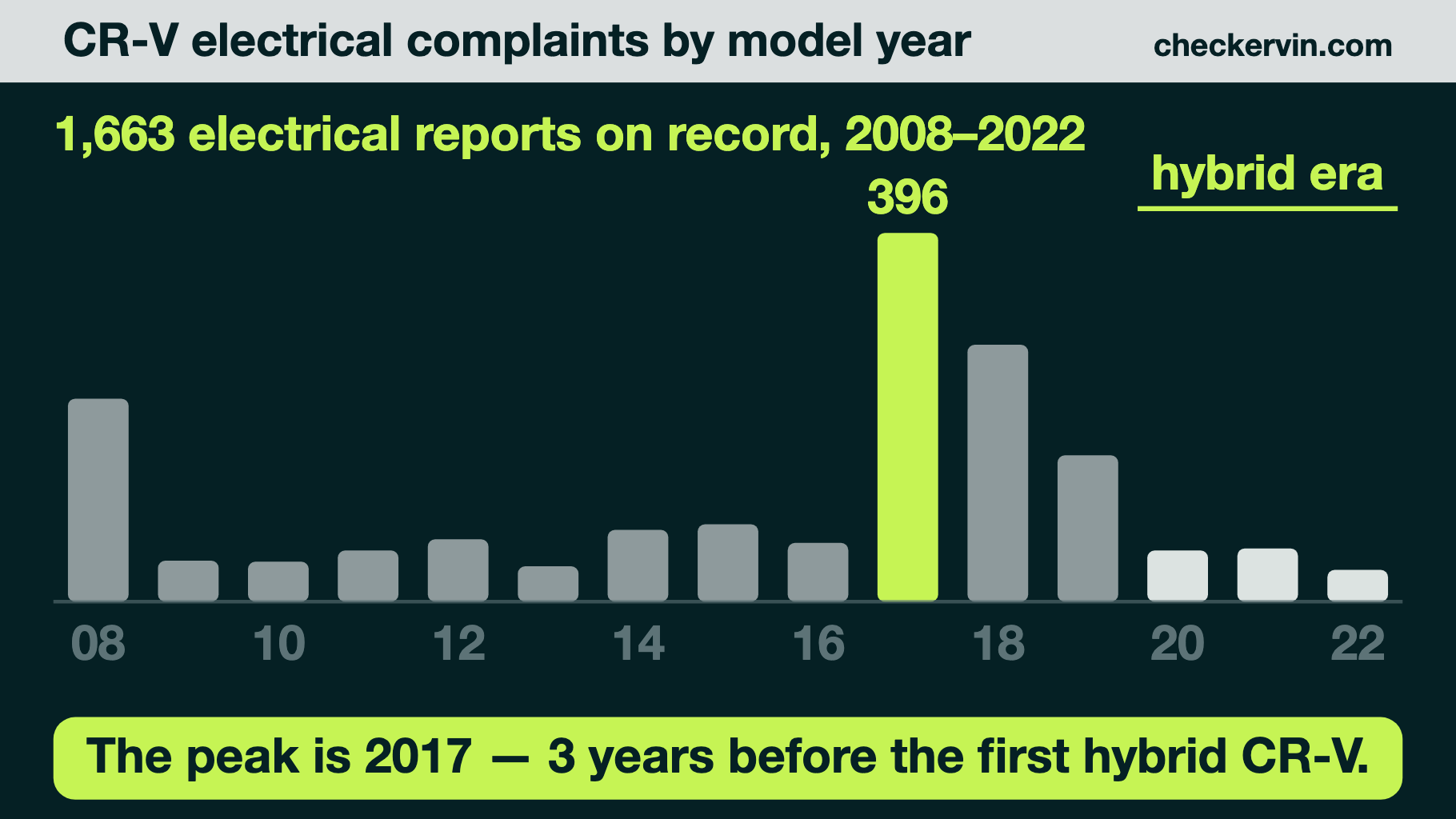
Here is the part no estimator page carries. Our corpus of federal NHTSA complaints holds 10,899 reports against the 2008–2022 CR-V, and 1,663 of them are filed against the electrical system. They are not spread evenly. They pile up in two model years — 2017 above all, with 396electrical complaints, the height of the widely reported parasitic-drain problem in the gas car’s 12-volt system.
That spike is what feeds the phrase “CR-V battery problems” into every forum thread a shopper reads. But it predates the hybrid: Honda did not put a hybrid CR-V in US driveways until the 2020 model year. The reputation and the four-figure repair belong to different batteries in different cars, and the record is unambiguous about which years generated the noise.
The hybrid years, isolated
Take 2020 through 2022 on their own — the model years in which a US CR-V could actually be a hybrid — and the electrical column averages 49 complaints per year. The 2017 peak alone runs about 8 times that average. Even those hybrid-era reports are a mixed bag: reading them, the recurring subjects are 12-volt batteries going flat, infotainment glitches and sensor faults, with genuine high-voltage pack failures rare in the set.
An honest caveat, stated rather than buried: complaints are unverified owner reports, not failure rates. They tell you what owners bothered to report, not the probability your pack dies. But as the only public, model-specific signal that exists at this scale, the shape is worth more than any forum anecdote — and the shape says the hybrid pack is not where the CR-V’s electrical grief has lived.
The warranty that actually applies
The coverage stack matters more than the price, because it decides whether the price is yours to pay. Honda’s high-voltage battery limited warranty runs 8 years or 100,000 miles from the in-service date. Register the car in a state following California emissions rules and the pack coverage extends to 10 years or 150,000 miles. Those clocks start when the first owner took delivery — a point that decides real claims on second-owner cars.
What federal law itself guarantees is narrower than most pages imply. The federal emission warranty’s 8-year/80,000-mile tier covers exactly three things: the catalytic converter, the engine control unit and the onboard diagnostic computer. The hybrid pack’s 8-year coverage is Honda’s own promise layered on top, plus CARB’s rules where they apply. The full whose-warranty-pays framework — federal floor, manufacturer promise, CARB extension — is laid out on our hybrid battery replacement cost guide; what belongs here is the CR-V-specific fact that a 2020 pack in a CARB state is covered into 2030.
Degradation against failure — what a claim needs
Honda’s pack warranty is written against failure and against “greater than normal” degradation — with the dealer making that determination. Gradual capacity loss is expected chemistry and is not a warranty event. The practical consequence: a CR-V Hybrid that has lost a little range but throws no codes is probably not a claim, while one showing hybrid-system warnings or a stored high-voltage fault is worth a dealer visit while the clock still runs.
| Situation | What it means for the bill |
|---|---|
| Pack fault codes / hybrid warning | Warranty claim territory — document and visit a dealer |
| Noticeably weaker assist, no codes | Likely normal degradation — not a covered event |
| Car dead, dash dark, no crank | 12-volt battery first — a $200 problem, not a pack |
| Out of warranty, confirmed pack failure | Price new, remanufactured and used packs before deciding |
Where the money goes
The pack dominates the bill because it is a large lithium-ion assembly with its own cooling, contactors and management electronics, swapped as a unit. Labor is modest by comparison — the RepairPal split above prices it under $720 at the top — because the job is well-documented removal and replacement, not diagnosis-heavy surgery. That economics is why the aftermarket exists: remanufactured packs, rebuilt with tested modules and sold with their own warranty, routinely undercut a new-pack quote by a wide margin, and used packs from salvage cars undercut both with more risk attached.
It is also why a second quote is worth more here than on almost any other repair. Two shops quoting the same labor hours can land thousands apart purely on pack sourcing, and a dealer is contractually bound to new parts in a way an independent hybrid specialist is not.
Before you authorize a four-figure repair
- Confirm which battery failed — a 12-volt test takes minutes and reverses most hybrid no-start stories
- Compute the warranty clock from the in-service date, not the model year — and remember the CARB-state extension
- Pull the VIN's open recalls before paying for anything a campaign might cover
- Get one quote with a remanufactured pack in it, so the new-pack number has something to argue with
- Read the model year's wider complaint record before investing pack money in a car with other baggage
If you are buying the CR-V, not repairing it
Flip the same facts around and they become a purchase checklist. A used CR-V Hybrid inside the 8-year window carries pack coverage the seller rarely mentions and the price rarely reflects — in a CARB state, a 2020 car is covered to 2030. Ask for the in-service date, run the Honda warranty check by VIN, and treat a fresh 12-volt battery in the service records as the routine item it is rather than evidence of pack trouble.
Then read the year, not the nameplate. The complaint record above separates the CR-V’s loud years from its quiet ones, and our CR-V years-to-avoid breakdown scores every model year against the nameplate’s own median. Five minutes with a Honda VIN decode and the recall list is cheap diligence against a four-figure surprise — the point of checking the record is that the expensive reputation and the actual risk are not always attached to the same battery.
Where this information comes from
- EPA — vehicle emission warranty FAQThe federal 8-year/80,000-mile coverage names exactly three components — the hybrid pack is not one of them.
- Honda — CR-V limited warrantyThe 8-year/100,000-mile high-voltage battery warranty and its CARB-state extension, from the manufacturer's own page.
- RepairPal — CR-V Hybrid HV battery estimateThe $4,003–$4,231 installed range and labor split quoted above, attributed to its estimator as retrieved September 2026.
- NHTSA — recalls by VINThe federal recall lookup — check it before paying for anything a campaign might cover free.
Keep reading
Frequently asked questions
How much does a Honda CR-V hybrid battery cost to replace?
RepairPal's estimator lists $4,003 to $4,231 installed for a CR-V Hybrid high-voltage battery, of which labor is only $488 to $716 — the pack itself is the bill. That is their estimate, not ours; dealer quotes vary with region and model year. The useful constant is the shape: parts dominate so heavily that shopping labor rates barely moves the total, while a remanufactured or used pack changes it a lot.
How long does a CR-V hybrid battery last?
Honda warrants the high-voltage battery for 8 years or 100,000 miles — 10 years or 150,000 in states that follow California emissions rules — which is the honest floor for expected life. Our NHTSA complaint corpus is consistent with packs mostly outliving that window: the hybrid-era CR-V years log a fraction of the electrical complaints the 2017-2018 gas cars did, and most of those reports describe the 12-volt battery, not the pack.
Is the CR-V hybrid battery covered under warranty?
Separately from the 3-year/36,000-mile basic warranty, Honda's high-voltage battery limited warranty runs 8 years/100,000 miles, extended to 10 years/150,000 miles in CARB states. Federal law is narrower than most pages imply: the 8-year/80,000-mile federal emission warranty covers only the catalytic converter, engine control unit and onboard diagnostics — the pack coverage is Honda's own promise, so check your in-service date before paying anything.
Is it worth replacing the hybrid battery on an older CR-V?
Run the arithmetic in one line: a roughly $4,000 installed pack against the vehicle's market value and everything else on its record. On a CR-V still under the 10-year CARB clock the answer is usually moot — file the warranty claim. Outside warranty, a strong car around it can justify the spend, but price a remanufactured pack, and check the model year's wider complaint record before putting pack money into a year with engine or fuel-system baggage.
Are the CR-V battery problems people mention the hybrid pack?
Mostly not. In our NHTSA corpus the CR-V's electrical-system complaints peak at the 2017 model year with 396 reports — the widely covered parasitic-drain era of the gas car's 12-volt system, before the hybrid existed in the line. The hybrid-era years from 2020 on average 49 electrical complaints each. A dead 12-volt costs a couple hundred dollars and strands a hybrid just as thoroughly, which is exactly why the two get conflated.
Read the record before you pay for the reputation
A free CheckerVIN report shows the factory build, specifications and open recalls for any VIN — the five-minute check that separates a quiet year from a loud one.
Run a free VIN check