The short answer
- What does it cost?
- RepairPal's per-year tensioner-replacement figures run roughly $367-$1,024 depending on model year. That prices a tensioner job, not the cover reseal most 2017+ CR-Vs actually need.
- Is this really a timing-chain problem?
- Mostly not. The 2017-2018 ENGINE complaint spike is driven by Honda's documented 1.5L-turbo oil-dilution issue — a different, class-action-covered problem, not the chain.
- Is there any real chain issue?
- Yes, narrower: a case-cover oil leak (service bulletin 25-077, 2017-2026 CR-V 1.5T) from a sealant problem — a reseal, not a chain or tensioner replacement.
The numbers, and whose numbers they are
RepairPal prices this repair as “Timing Chain Tensioner Replacement,” and its own per-year figures for the CR-V spread widely: roughly $367 to $452 on a 2012, $442 to $494 on a 2018, and as high as $672 to $1,024 on older 2007–2008 models. Every figure here is attributed to whoever published it; we sell VIN checks, not repairs, and price none of this ourselves.
That estimator prices one specific job — replacing the tensioner, sometimes as a set on engines with more than one. It is not the same job as the reseal most recent CR-Vs actually need, and it is a different job again from a full chain-and-guide replacement. Which one a specific car needs depends on what is actually wrong with it, and the record below says that is usually not the chain at all.
What 10,899 complaints say about two model years
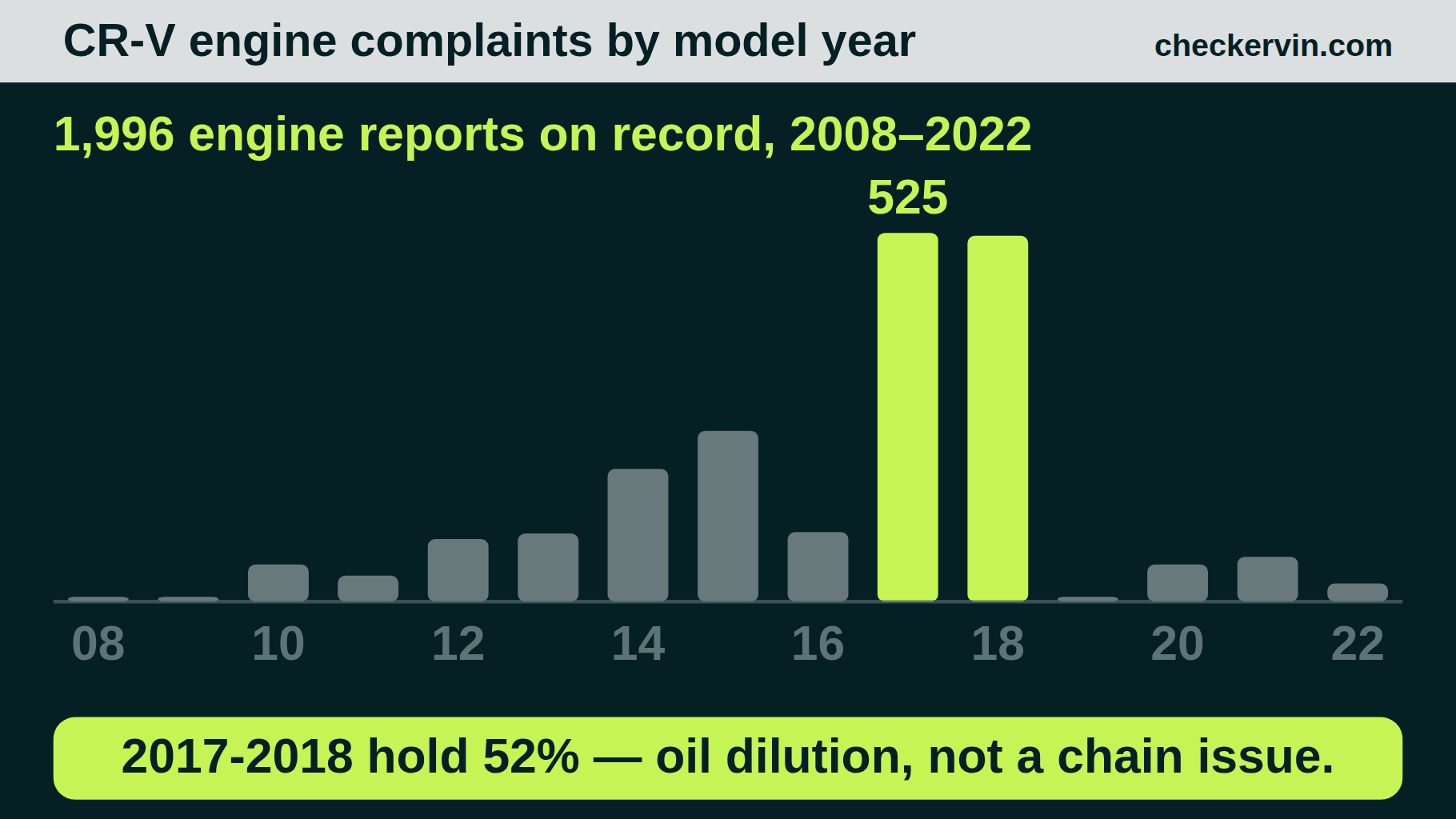
Our corpus of federal NHTSA complaints holds 10,899 reports against the 2008–2022 CR-V. ENGINE names 1,996 of them — 18.3% of the whole record. What stands out is not the share itself but where it concentrates: 52.4% of every ENGINE complaint on file — 1046 of 1,996 — sits in just 2017 and 2018, two consecutive model years out of fifteen. Those same two years are also, by a wide margin, the nameplate’s two largest total-complaint years: 1752 complaints in 2017 and 2112 in 2018, against a median of 418 across the other thirteen model years.
Inside the window, ENGINE accounts for 30% of 2017’s own total complaints and 24.7% of 2018’s. Complaints are unverified owner reports, not a measured failure rate — but a concentration this sharp, on the model year’s own worst two years, is not noise. The question the rest of this page answers is what that concentration is actually made of.
The real driver: oil dilution, not a chain
2017 and 2018 are not an arbitrary pair of years. They are exactly the model years named in Honda’s own 1.5-liter turbocharged engine oil-dilution issue — gasoline seeping into the engine oil under certain driving and climate conditions, reducing oil viscosity — which became the subject of a class-action settlement and led Honda to extend warranty coverage on more than one million CR-V and Civic vehicles in the United States.
| Issue | What it actually is |
|---|---|
| Oil dilution (2017-2018 1.5T) | Fuel seeping into engine oil — a fuel-system and combustion condition, extended-warranty covered |
| Timing chain case-cover leak | A sealant/gasket leak at the inspection cover — see below |
| Timing chain (worn/stretched) | The failure a generic 'timing chain replacement' search implies — not documented here as elevated |
NHTSA’s complaint categories file all three under the single “ENGINE” component code, which is exactly why a raw ENGINE-complaint count cannot be read as evidence of a timing-chain problem without checking what is actually driving it. Here, the well-documented driver is oil dilution — a different condition, with its own warranty remedy, that has nothing to do with the chain itself.
The one genuine chain-adjacent finding
There is a real, narrower issue that does involve the timing chain hardware. American Honda opened an investigation in April 2018 into customer complaints on 2017 Civic and CR-V models of an oil leak from the timing chain case cover. That investigation was later formalized into service bulletin 25-077, which identifies a potential oil leak from the timing chain tensioner inspection cover on 2017 through 2026 CR-V models with the 1.5L turbo engine.
Honda’s stated root cause is insufficient sealant adhesion on the cover itself — the fix is removing the cover, cleaning the old sealant, applying a fresh bead of the specified silicone gasket sealant and reinstalling and torquing it within a defined window. That is a reseal job. It is not a worn or stretched chain, and it is not the tensioner-replacement job RepairPal’s generic estimator prices.
Why this matters before you pay
Someone searching “Honda CR-V timing chain replacement cost” on a 2017 or 2018 car is very likely dealing with one of two things that are not a chain replacement at all: an oil-dilution issue that may already be covered under Honda’s extended warranty, or a case-cover oil leak that service bulletin 25-077 treats as a reseal. A shop that quotes a full tensioner-and-chain job off a generic estimator, without checking which of these two documented issues is actually present, is quoting the wrong repair — and likely the more expensive one.
A VIN decode does not diagnose the specific fault, but it does confirm the exact model year and engine, which settles whether the car falls inside the 2017-2018 oil-dilution window and the 2017-2026 bulletin’s scope before anyone prices a repair on it.
How Honda actually treats this chain
Honda’s timing chains, like most manufacturers’ chain (as opposed to belt) designs, are not on a fixed replacement schedule the way a timing belt is — they are designed to last the life of the engine under normal operation and are serviced on-condition, when a specific symptom or inspection finding calls for it, not at a mileage interval published in a maintenance schedule.
That is one more reason a search estimator pricing a routine “replacement” by year alone does not match how this component is actually serviced in practice: the two real, documented issues on this nameplate are event-driven (an oil leak, an oil-dilution symptom), not scheduled maintenance.
What an engine problem sounds like before it costs anything
- A gasoline smell in the oil, or oil that looks unusually thin or overfilled on the dipstick — the reported symptom behind the 2017-2018 oil-dilution issue
- A wet oil stain or visible leak near the front of the engine, at the timing chain cover — the symptom addressed by service bulletin 25-077
- A rattle or knocking sound at cold start-up that clears once the engine warms — more consistent with a genuine tensioner or chain issue than either documented finding above
- Any illuminated check-engine or oil-pressure warning light — worth a diagnostic before any repair is priced
The order matters because the cheap check comes first: confirm the model year and engine by VIN, check whether the extended oil-dilution warranty or service bulletin 25-077 already applies, and pull the car’s open recalls — before anyone prices a chain or tensioner job.
Before you authorize the repair
- Confirm the model year and engine (1.5L turbo vs 2.4L) by VIN before accepting any quote tied to these issues
- Ask whether Honda's extended oil-dilution warranty (2017-2018 CR-V/Civic 1.5T) already covers this specific vehicle
- Ask specifically whether the diagnosis is a case-cover reseal (bulletin 25-077) or a full tensioner/chain replacement — they are different jobs
- Pull the VIN's open recalls before paying for anything that might already be covered
- Get the quote itemized by part and labor rather than accepting one flat 'timing chain replacement' line
If you are buying the CR-V, not maintaining it
The same record reads as a shopping map. A 2017 or 2018 CR-V with the 1.5L turbo engine should show either a documented oil-dilution repair or warranty claim, or a clean oil-consumption and oil-condition history, before its engine record is treated as a non-issue — and a timing chain case-cover leak, if present, is a comparatively minor reseal rather than a reason to walk away. A Honda VIN decode confirms the exact model year and engine before you price anything, and checking what factory or extended coverage remains by VIN settles whether an oil-dilution repair is still covered.
On any candidate car, run the recall lookup before you negotiate, and check which CR-V model years show the most complaints overall rather than judging the nameplate by the engine figure alone. Thirteen of the CR-V’s fifteen model years carry a small fraction of the ENGINE complaints concentrated in 2017-2018, and confirming which two years a car falls into is worth more than negotiating around a vague “timing chain” concern.
Where this information comes from
- NHTSA — CR-V complaint databaseThe federal complaint record this page's figures are computed from, browsable by model year.
- NHTSA — recalls by VINThe official lookup that settles whether a specific CR-V has open safety campaigns.
- Consumer Reports — Honda's turbo-engine warranty extensionCoverage of Honda extending warranty on the 1.5L turbo oil-dilution issue across more than a million CR-V and Civic vehicles.
- RepairPal — CR-V timing chain tensioner replacement estimateThe per-year cost figures quoted above, for the tensioner-replacement job specifically, retrieved September 2026.
- Honda service bulletin 25-077 — CR-V timing chain cover oil leakSecondary aggregation of the bulletin describing the sealant-adhesion root cause and reseal repair for 2017-2026 CR-V 1.5T models.
Keep reading
Frequently asked questions
How much does it cost to replace the timing chain in a Honda CR-V?
RepairPal's per-year 'Timing Chain Tensioner Replacement' estimates run from about $367-$452 on a 2012 up to $672-$1,024 on 2007-2008 models, with recent years like 2015 and 2018 sitting around $442-$513. That prices a tensioner job, not a cover reseal or a full chain-and-guide replacement, and none of it is our figure — we sell VIN checks, not repairs.
Do Honda CR-Vs have a timing chain problem?
Not clearly, on the evidence available. ENGINE complaints spike sharply in 2017-2018 — 52.4% of every ENGINE complaint the nameplate has ever recorded, computed from src/data/models/honda-cr-v.json — but those two years are also exactly the years named in Honda's own 1.5L-turbo oil-dilution class-action settlement, a documented issue with gasoline seeping into the engine oil, unrelated to the timing chain itself. NHTSA files both under the same "ENGINE" component code, which is why the raw complaint count alone cannot be read as a chain-specific problem.
Is there a real timing-chain issue on the Honda CR-V?
A narrower one, yes, but it is not a worn or stretched chain. American Honda opened an investigation in April 2018 (NHTSA ID 10136420) into 2017 Civic and CR-V complaints of an oil leak from the timing chain case cover, later formalized as service bulletin 25-077 covering 2017-2026 CR-V 1.5T models. Honda's stated root cause is insufficient sealant adhesion on the inspection cover — a reseal, not a chain or tensioner replacement.
Which Honda CR-V model years had the oil-dilution problem?
2017 and 2018 CR-Vs with the 1.5L turbocharged engine, per class-action coverage and Honda's own extended-warranty announcement covering more than one million CR-V and Civic vehicles. Those are the same two years that hold 1,046 of the CR-V's all-time 1,996 ENGINE complaints in our corpus — and also the nameplate's two largest total-complaint years by a wide margin.
What should I check before paying for CR-V timing chain work?
Confirm by VIN whether the car is a 2017-2018 1.5T CR-V covered by the oil-dilution extended warranty before paying for any engine work out of pocket, ask specifically whether the quote is for a case-cover reseal (service bulletin 25-077) or a full chain-and-tensioner replacement — they are different jobs at very different prices — and pull the VIN's open recalls first. A shop quoting the larger job from a generic estimator may be pricing a repair the car doesn't actually need.
Confirm the model year and engine before you pay
A free CheckerVIN report shows the factory build, specifications and open recalls for any VIN — confirm what you're actually pricing.
Run a free VIN check