The short answer
- What does it cost?
- RepairPal lists $770–$1,220 on average for a Civic alternator, about three-quarters of it parts. A Honda reman unit cuts the parts side.
- Is it really the alternator?
- Prove it first. Honda refuses its own dealers' alternator warranty claims without a tester printout reading REPLACE ALTERNATOR.
- Which Civics fool the test?
- 2012 cars can pick the wrong charge mode (Honda bulletin 12-041, a software fix). A Civic Hybrid's charging light points to its inverter.
$770–$1,220
RepairPal Civic alternator average
Retrieved Oct. 2026, before tax
0.2 hr
Honda's alternator test time
Bulletin 12-002
502
Electrical reports counted
2008–2022, a minimum
15 yr / 150k
2012–15 Civic Hybrid inverter coverage
Honda warranty extension, 2020
The numbers, and whose numbers they are
We do not sell repairs and publish no price of our own, so every dollar figure here is someone else’s, with the date we read it. RepairPal’s Civic alternator estimator lists an average of $770 to $1,220, split into roughly $207 to $303 of labor and $563 to $917 of parts, on a page marked as updated September 3, 2026. Its 2021 Civic page lists $734 to $1,148. Both were read in October 2026 from the pages’ search listings, because RepairPal refuses direct requests from our tools. The estimator’s range excludes taxes and local pricing.
The shape of that estimate is the useful part. Labor is the small share of RepairPal’s range, so the bill is mostly the part, and the part is where you have choices: new Honda, Honda remanufactured, or aftermarket remanufactured. Kelley Blue Book publishes no Civic-specific alternator figure that we could find, so none is quoted.
The bigger risk is not overpaying for the alternator. It is paying for one the car did not need. Honda wrote a rule for exactly that, and the Civic’s federal complaint record includes owners who learned it the expensive way.
What 502 counted electrical complaints say, and don't
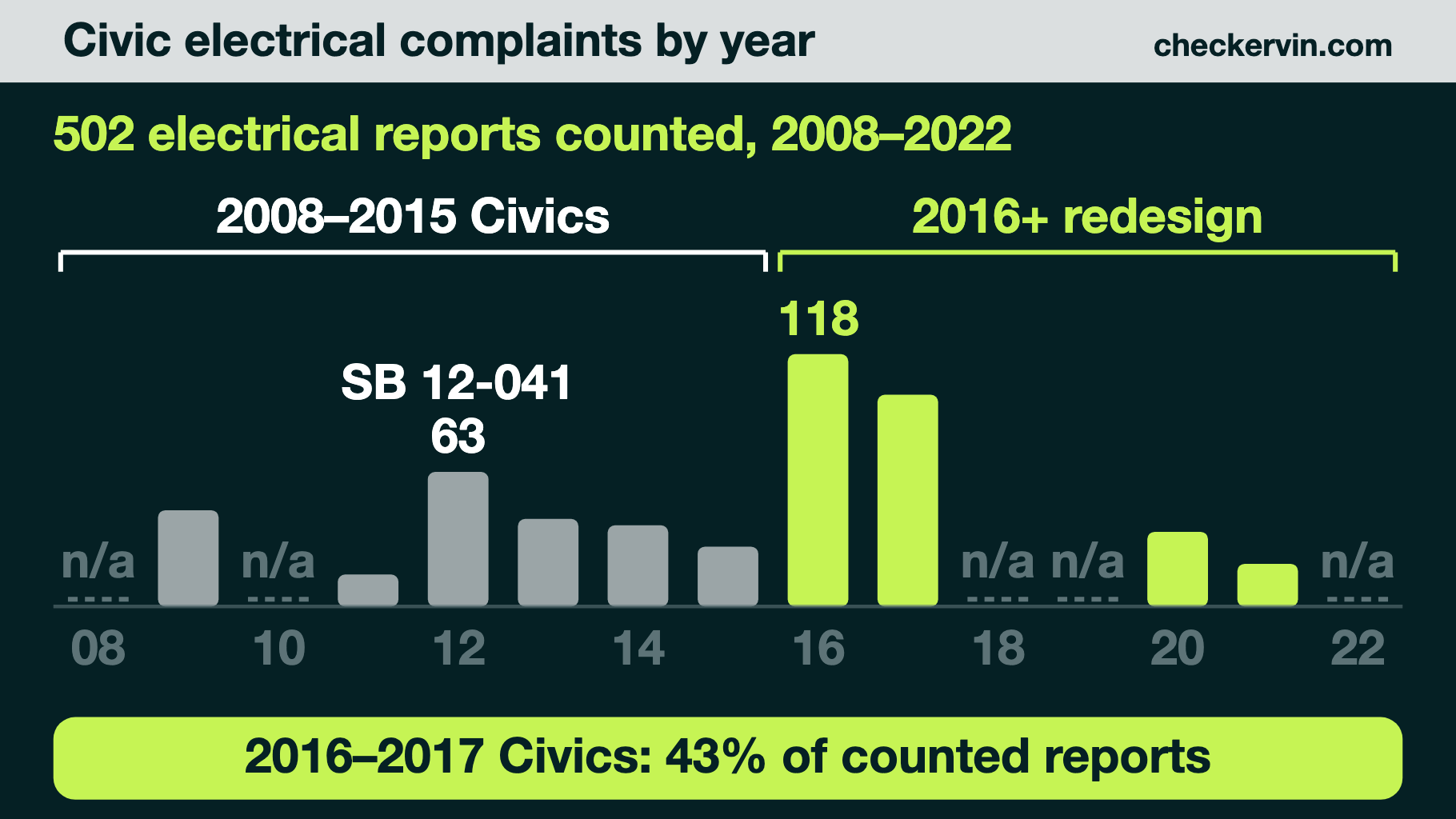
Our corpus of federal NHTSA complaints holds 7,501 reports against the 2008–2022Civic. NHTSA has no alternator category. The closest is ELECTRICAL SYSTEM, which takes in the 12-volt battery, wiring, lighting, body modules, audio units and anything else an owner files as electrical. Where it ranks among a year’s five most-reported components it adds up to at least 502 reports, about 7% of the total. The alternator is a small slice of that.
The category never leads a Civic model year; its best showing is second place, in 2013 and 2020. The tall bars sit in two places. The 2012 Civic carries 63, about 13% of its complaints, and the 2012–2015 cars together hold 170 of the 230 counted before the redesign. The 2016 car is the peak at 118, roughly 11% of its complaints, and 2016–2017 Civics together hold 43% of every counted electrical report.
Two limits. For 2008, 2010, 2018, 2019 and 2022, ELECTRICAL is not among that year’s top five, so its count sits below the fifth-ranked category (89 in 2008, 35 in 2010, 70 in 2018, 56 in 2019, 42 in 2022) and the chart marks it n/a rather than zero. And NHTSA’s live database keeps moving: when we checked it in October 2026, its electrical counts for counted years sat within a handful of our snapshot, while total complaints for some years ran lower because NHTSA files certain Civic variants under separate model names.
Honda's own rule: no printout, no alternator
In January 2012 Honda sent its dealers Service Bulletin 12-002, covering every 2005–2012 Honda. It made a Midtronics GR8 alternator/starter tester mandatory for warranty work and set a blunt condition: alternator claims “will not be accepted without the 15-digit test code” from that tester, and the printout attached to the repair order must say REPLACE ALTERNATOR. A claim with any other verdict comes back unpaid.
The bulletin explains why before it explains how. Its first test step tells technicians to ask what led up to the problem, because many charging complaints come from headlights or interior lights left on, normal headlight flicker, or aftermarket accessories with a high parasitic draw. The test clamps an amp probe on the alternator’s output cable within three inches of the alternator, to keep the rest of the car’s wiring out of the reading. Honda pays 0.2 hours for it.
2012: the alternator was fine, the software wasn't
On the 2012 Civic, software decides how the alternator charges. A battery sensor reports the battery’s condition, and the engine computer picks the charging mode. Honda’s Service Bulletin 12-041, in its 2014 revisions, explains what went wrong: based on the battery’s sulfation and the owner’s driving habits, “the PCM may not select the correct charge mode.” The symptom Honda lists is a car that will not start because the battery is low.
The bulletin covers 2012 Civic coupes and sedans, HF, Si, Natural Gas and Hybrid models by VIN range, plus 2012–2014 CR-Vs. The fix is a battery check on the GR8 station, a new battery if it fails, and an engine-computer software update, booked at 0.4 hours under normal warranty. A July 2014 revision reissued the software so cars already updated once could get the newer version. The bulletin itself lists the alternatives a technician must rule out: a faulty alternator, a sulfated battery, a parasitic draw or loose cables. Only the first of those is an alternator.
For a 2012 owner, the order of operations is the whole point. A sulfated battery plus old software produces jump-start after jump-start, and a new alternator fixes neither. Ask a Honda dealer whether 12-041’s update is on the car before buying anything; out of warranty it is a short paid software job, far cheaper than the part.
What owners describe
We read every 2008–2022 Civic complaint narrative that mentions the alternator. On 2012–2015 cars a pattern repeats: the car will not start every week or two, a jump gets it going, and the battery and alternator “tested good.” Some owners replaced the battery twice and the alternator more than once without curing it. One 2012 owner writes that a Honda software update made the no-starts more frequent; another found rodents had chewed the cables between battery and alternator. Those are exactly the causes 12-041 tells technicians to sort out first.
The reports that do describe a dead alternator read differently, and they are worth knowing. A 2019 owner describes a “12 volt battery charging system problem” message, then a cascade of brake, tire-pressure and power-steering warnings, then power steering and wipers quitting in a downpour. A roadside test found the alternator dead. That is the real failure: the car runs on battery until voltage drops far enough to shut down electrically assisted systems.
2016 and later: no-starts that are not the charging system
The 2016redesign is the peak of the chart, and Honda’s documents for that car point away from the alternator. Bulletin 17-012 covers every 2016 Civic with a CVT and early 2017s: the car will not come out of park and will not crank or start, with communication codes stored, because the transmission control module has an internal fault. The fix is a new module, booked at 0.4 hours, plus a 0.2-hour software match on 2016 cars, under normal warranty. To an owner on a cold morning, that looks like a charging problem. It is not one.
The rest of the 2016–2017 electrical bulletins are mostly audio and display software: units that boot silent, Bluetooth that skips, screens that flicker. Owners file those as electrical too, which is a large part of why those two model years dominate the chart without being alternator years.
On the newest cars, the battery itself can trigger warnings that look like a failing charging system. Honda’s Service Bulletin 24-006 covers a range of 2022 Civics, plus 2023 ranges and all 2024s, where a degraded 12-volt battery lets voltage dip during start-up and the power-steering warning lights. Honda’s fix is steering software, 0.3 hours with the calibration. Test the battery on these cars before blaming the alternator; the battery size lookup by VIN shows which battery the car should carry.
Civic Hybrid: the charging light points somewhere else
On a Civic Hybrid, Honda’s own documents trace the 12-volt supply to the integrated motor assist electronics, not to an alternator. Recall 11V106000 replaced the voltage converter that “relays power from the integrated motor assist (IMA) system to the vehicle’s electrical components” on 2006–2007 cars; when it failed, the headlights went out and the engine stalled. One 2013 Civic Hybrid owner puts it plainly in a federal complaint: the car “does not have a traditional alternator.”
On 2012–2015 Civic Hybrids, Honda’s December 2020 warranty extension (bulletin 20-030) covers the intelligent inverter unit, which can fail at a cracked solder joint. Honda says the failure turns on the charging system, engine and IMA warning lights and cuts the power supply to the 12-volt battery. Coverage runs 15 years from the original purchase date or 150,000 miles, and Honda offers reimbursement to owners who paid for the repair earlier. For a 2012 car that window is closing now. Our Civic Hybrid battery cost post covers the hybrid pack itself.
Which alternator a Civic takes, and what it lists for
Gas Civics in this range use three engine families: a 1.8-liter on 2008–2015 cars (with larger engines in the Si), and from 2016 a 2.0-liter or a 1.5-liter turbo. Our Civic water pump post lays out which engine went in which year and trim, and the engine size by VIN lookup settles it for a specific car.
| 2018 Civic listing (HondaPartsNow) | What it shows, read Oct. 2026 |
|---|---|
| 31100-5BA-A01, new | LX, Sport, EX and SE trims; $769.88 list price |
| 31100-5PA-A01, new | EX-T, Si and Touring trims; $742.81 list price |
| 31100-5BA-A01RM, Honda reman | $643.85 list price plus a $75.00 core charge |
The trim split follows the engine: the first unit lists against the 2.0-liter trims, the second against the turbo trims and the Si. Parts sites sell below list, and aftermarket remanufactured units sell for a fraction of either. Whatever you buy, match it by VIN; a Honda VIN decode gives the year, trim and engine in one step.
We could not verify Honda’s own labor time for alternator replacement on each Civic engine. Bulletin 12-002 refers technicians to Honda’s flat-rate table, which is not public, and we did not obtain a factory removal procedure for the 1.8, 2.0 or 1.5 turbo. RepairPal’s labor range above is the only labor figure on this page.
Recalls, bulletins and who pays
We queried NHTSA’s recall database for every Civic model year from 2008 through 2022. No campaign names the alternator, the charging system or the battery. The Civic’s recalls in these years are airbag inflators, fuel pumps, driveshafts, steering and brake parts, among others, and one lighting campaign on 2016 coupes. None replaces an alternator.
Every gas-Civic bulletin on this page says “the normal warranty applies.” Out of warranty, a 12-041 software update or a 17-012 module swap is your bill, which is why the difference between a bulletin and a recall matters when a shop cites one. The Honda recall check is still worth a minute, since many of these years carry open airbag and fuel-pump campaigns, and a Honda warranty check by VIN shows whether any factory coverage, including the hybrid inverter extension, still applies.
Before you authorize the alternator
- Ask for the charging-system test printout; Honda requires one from its own dealers
- Charge and load-test the battery first; a sulfated battery fails long before the alternator
- On a 2012 Civic, ask whether Honda bulletin 12-041's software update has been done
- On a 2016 or early 2017 CVT car that will not crank or leave park, ask about bulletin 17-012
- On a Civic Hybrid, check the inverter warranty extension before paying for anything
- Ask whether the quote is new Honda, Honda reman or aftermarket reman, and what happens to the core
The first two items cost almost nothing and decide whether the rest matter. A failed battery is the cheapest fix in the charging system, and a car that keeps draining a good battery overnight needs a parasitic-draw test, not an alternator. Only a printed verdict against the alternator itself justifies the part.
The symptoms help sort the cases before anyone picks up a wrench. A battery that is flat in the morning but charges fine on a drive points to a drain or a tired battery. A charging warning that stays lit with the engine running, dimming lights at idle, or a car that dies while moving points toward the alternator or the belt that drives it. A Civic that will not crank but has bright dash lights, especially a 2016, may be neither. Give the shop the pattern, not just the last no-start, and the test will mean more.
If you are buying the Civic, not repairing it
A recent alternator receipt on a used Civic is not proof of a fixed car. On a 2012–2015 car, ask whether the battery was tested at the same visit and, on a 2012, whether the 12-041 update was done; a car that has had two alternators and two batteries has a fault nobody found. On a 2016 or 2017, ask about any no-start history. The Honda Civic years-to-avoid breakdown scores each year’s whole complaint record, and our 2016 Honda Civic record collects the peak year’s data on one page.
The Odyssey alternator post shows how differently the same question plays out on a Honda V6. What CheckerVIN’s free report gives you is the factory build, engine, specifications and open recalls. It does not include accident, title or odometer history, and it cannot tell you whether the battery is sulfated. Only a charging test does that.
Where this information comes from
- Honda Service Bulletin 12-002 (NHTSA copy) — alternator testing with the GR8 testerHonda's rule: no alternator warranty claim without a tester code and a REPLACE ALTERNATOR printout.
- Honda Service Bulletin 12-041, July 2014 (NHTSA copy) — vehicle will not start, low state of charge2012 Civic battery sensor and PCM charge-mode software; 0.4 hours, normal warranty.
- Honda Service Bulletin 17-012 (NHTSA copy) — 2016–17 Civic will not start, TCM faultA no-start on the peak complaint year that is a transmission module, not the charging system.
- Honda Service Bulletin 24-006 (NHTSA copy) — EPS light from low battery voltageShows a degraded 12-volt battery triggering warnings on 2022 and later Civics.
- Honda dealer message, Dec. 2020 (NHTSA copy) — 2012–15 Civic Hybrid inverter warranty extension15 years or 150,000 miles; failure cuts power to the 12-volt battery and lights the charging warning.
- NHTSA — recalls by VINThe official lookup; our year-by-year query found no Civic recall naming the alternator or charging system.
- RepairPal — Honda Civic alternator replacement estimatorThe $770–$1,220 average quoted above, retrieved October 2026.
Keep reading
Frequently asked questions
How much does it cost to replace the alternator on a Honda Civic?
RepairPal's Civic alternator estimator lists an average of $770 to $1,220, with labor at about $207 to $303 and parts at about $563 to $917, from a page marked as updated September 3, 2026 and read in October 2026. Its 2021 Civic page shows $734 to $1,148. Parts drive most of the spread: on a 2018 Civic, HondaPartsNow lists new Honda units at $742.81 and $769.88 list price depending on trim, and a Honda remanufactured unit at $643.85 plus a $75 core charge. Aftermarket remanufactured units cost less.
How do I know if my Civic needs an alternator or just a battery?
Ask for the test Honda requires of its own dealers. Honda Service Bulletin 12-002 says an alternator warranty claim will not be paid without a GR8 alternator tester code and a printout that reads REPLACE ALTERNATOR, and Honda books that test at 0.2 hours. The same bulletin says many charging complaints come from lights left on, normal headlight flicker or aftermarket accessories draining the battery. If the battery fails a test after a full charge, replace the battery first.
Does the Honda Civic Hybrid have an alternator?
Not one you would replace for a charging fault. Honda's documents describe the Civic Hybrid's 12-volt supply coming through its integrated motor assist electronics: recall 11V106000 replaced the voltage converter that relays IMA power to the electrical system on 2006-2007 cars, and Honda's 2020 warranty extension on the 2012-2015 Civic Hybrid's inverter unit says its failure cuts power to the 12-volt battery and lights the charging warning. That extension runs 15 years from original purchase or 150,000 miles.
Is there a recall on the Honda Civic alternator?
No. We queried NHTSA's recall database for every Civic model year from 2008 through 2022, and no campaign names the alternator, the charging system or the battery. Honda's charging-related fixes are service bulletins, such as 12-041's software update for 2012 Civics, and they were paid under normal warranty only. The 2012-2015 Civic Hybrid inverter extension is the exception that still covers some cars, and it is a warranty extension rather than a recall.
How long does a Honda Civic alternator last?
Honda publishes no replacement interval for the alternator; it is replaced when a test shows it has failed. The federal complaint record is less about worn-out alternators than about batteries, software and wiring that make a healthy alternator look guilty, which is why a proper charging-system test matters more than the odometer.
Know which Civic you are dealing with
A free CheckerVIN report shows the factory build, engine, trim and open recalls for any VIN, so you know which alternator fits and which Honda bulletin applies.
Run a free VIN check