The short answer
- What does it cost?
- RepairPal lists $547–$966 on average for a Civic starter, with parts the larger share. A Honda reman unit trims the parts side.
- Is my year one Honda flagged?
- 2012: bulletin 14-003 replaces starters that whine and don't crank. 2013: Honda asked dealers in 2016 to hold such cars for inspection.
- Who pays?
- You, almost certainly. No Civic recall covers the starter, and both Honda documents carried normal warranty or none at all.
$547–$966
RepairPal Civic starter average
Retrieved Oct. 2026, before tax
0.9 hr
Honda's time for a 2012 starter swap
Bulletin 14-003
#2
Electrical's rank on the 2013 Civic
13% of that year's complaints
5
Times Honda sent the 2013 inspection call
Sept.–Nov. 2016
2013: Honda wanted to see the car before anyone fixed it
On September 21, 2016, Honda’s Technical Research & Support group sent every Honda service manager a message headed “Request for Visit: 2013 Civic Starter Intermittent No Start.” Honda said it was investigating certain 2013 Civics whose owners reported the starter intermittently failing to start the car, and that it wanted to inspect such a car “prior to you attempting a repair of any kind.” It sent the same text again on October 6, October 21, November 2 and November 8, each copy with a short expiry date.
The message was narrow on purpose. Honda wanted only a 2013 Civic that was not an Si, a Hybrid or a natural-gas model, and that had never had its starter replaced. In other words, it wanted cars still wearing the factory starter, with the fault still present. Dealers were told to phone Honda’s technical line for instructions.
What the message did not contain matters as much. It names no cause, no replacement part and no repair procedure, and it says nothing about extended coverage. We searched NHTSA’s file of Honda communications for the 2013, 2014 and 2015 Civic and found no later starter bulletin closing the investigation. The 2013 Civic also carries no recall campaigns at all in NHTSA’s file. A 2013 owner with an intermittent no-start therefore has Honda’s acknowledgment that the complaint was being investigated, and no published fix or free repair to go with it.
The price, and whose price it is
We sell no repairs and publish no price of our own, so the dollar figures here belong to the sites named, with the date we read them. RepairPal’s Civic starter estimator lists an average of $547 to $966, split into roughly $176 to $258 of labor and $371 to $708 of parts, on a page marked as updated September 3, 2026. We read it in October 2026 from the page’s search listing, because RepairPal refuses direct requests from our tools. Kelley Blue Book publishes no Civic-specific starter figure that we could find, so none is quoted.
The split says the part is the bigger lever. AutoNation Parts lists Honda’s remanufactured starter 31200-5BA-A52RM, which its listing fits to 2018–2021 Civics, at $616.03 list plus a $75.00 core charge you get back when the old unit is returned. New Honda starters list higher, and aftermarket remanufactured units much lower. We saw conflicting list prices for new Honda starters across parts-site listings, so we quote none.
Labor is the smaller part of the bill. The one labor time Honda itself published for a Civic starter is in its 2012 bulletin, covered below: 0.9 hours of dealer time. Shops bill their own rates against their own guides, so treat that as a reference point, not a quote.
Where electrical complaints rank, year by year
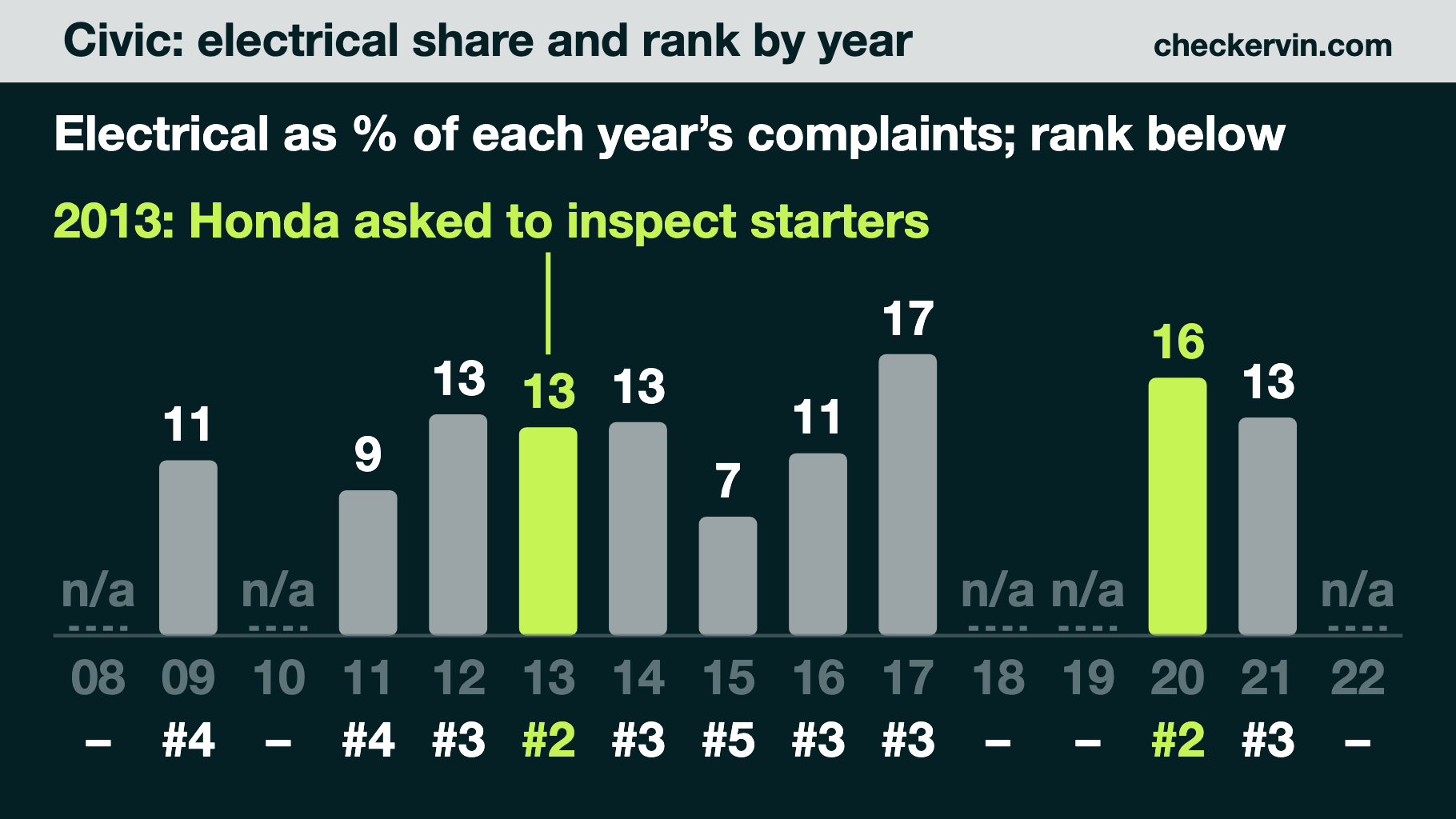
NHTSA has no starter category. Owners file a dead starter under ELECTRICAL SYSTEM, which also takes the 12-volt battery, wiring, lighting, body modules and audio units, so the starter is a small slice of whatever that category shows. Rather than count those reports by year, which our Civic alternator cost post already does, this chart asks two different questions: how big a share of each model year’s complaints is electrical, and where does it rank among that year’s five most-reported components?
Electrical never leads a Civic model year. Its best placing is #2, reached in 2013 and 2020. In 2013, the year Honda later asked to inspect, it sits second only to air bags, at about 13% of that year’s complaints. The share itself is ordinary for this car: it ranges from about 7% in 2015 to about 17% in 2017, and 2012, 2014, 2016, 2017 and 2021 all place it third. 2012, the year with the starter bulletin, sits at #3 and roughly 13%.
So the record does not single out 2013 as a starter year. What stands out about 2013 is how little else went wrong: with fewer complaints in other categories, electrical climbs the table. That is consistent with Honda chasing a specific intermittent fault, and it is not proof of a widespread one.
2012: the one Civic starter Honda simply replaced
Honda’s Service Bulletin 14-003, dated February 4, 2014, is titled “Starter Intermittently Whines and Does Not Crank the Engine.” It covers every 2012 Civic except the Si and the Hybrid, plus the 2012 Civic natural-gas model, with no VIN limits. Honda’s explanation is mechanical: the starter pinion “does not extend far enough to properly engage the engine flywheel,” so the motor spins without turning the engine.
The bulletin gives technicians a quick test before any part is ordered. With the engine undercover off, they read a two-digit number on the starter’s label. If it is 89, the bulletin does not apply and normal diagnosis continues. Any other number means the starter is replaced with part 31200-R1A-A11, booked at 0.9 hours, and “the normal warranty applies.”
That last line is why the bulletin is a diagnostic aid now, not a free repair. A 2012 Civic is long past Honda’s new-car coverage, so a bulletin starter is billed like any other. What it still gives you is a named symptom and a two-minute label check. If your 2012 whines without cranking and its starter label is not 89, the bulletin’s symptom and condition both match. If the label reads 89, Honda says the bulletin does not apply, and the shop has to find the cause the ordinary way.
Starter symptoms Honda traced to something else
Two other Honda bulletins use the word starter and are not about a bad one. Bulletin 15-048 covers 2014–2015 Civic Si and 2-door EX cars with a manual transmission that show a CHECK SYSTEM message, the check-engine light and code P16F7, which Honda describes as “starter inhibitor relay stuck on.” The cause is a clutch pedal held partly down being misread; the fix is engine-computer software, 0.2 hours. No starter, no relay.
Bulletin 17-003 covers 2016 Civics with the 1.5-liter turbo and CVT, plus early 2017 hatchbacks: a grinding or pump noise for about two seconds on a hot restart that, in Honda’s words, “some may also describe” as a starter noise. It comes from a vibrating valve in the CVT, Honda says it does not affect function or reliability, and the cure is an updated valve body, not a starter. On 2016–2017 CVT cars that will not crank at all, Honda’s documents point to the transmission module instead, which the alternator post linked above covers.
Where the starter sits, and what we could not verify
Gas Civics in this span use a 1.8-liter four from 2008 to 2015, larger engines in the Si, and from 2016 a 2.0-liter or a 1.5-liter turbo. Our Civic water pump post lays out which engine went in which year and trim, and the engine size by VIN lookup settles it for one car.
| Civic | What Honda's documents show |
|---|---|
| 2012, 1.8L (non-Si, non-Hybrid) | Bulletin 14-003: right front wheel off, intake manifold bracket and connector cover removed, two mounting bolts; 0.9 hr |
| 2012 starter part | 31200-R1A-A11 fitted; failed part listed as 31200-R1A-A01 |
| 2016 and later, 2.0L | Part 31200-5BA-A52 in parts listings and an owner's complaint; reman 31200-5BA-A52RM |
| 1.5L turbo and Si | No Honda starter procedure or labor time obtained |
The 2012 procedure shows why a Civic starter is a mid-sized job rather than a quick swap: the battery is disconnected, the right front wheel comes off, and the intake manifold bracket and a wiring connector cover are removed before the two mounting bolts can be reached. We did not obtain Honda’s procedure or flat-rate time for the 2.0-liter, the 1.5-liter turbo or any Si engine, so the table leaves those blank rather than guess. RepairPal’s labor range is the only other labor figure on this page. Match any replacement part by VIN; a Honda VIN decode gives year, trim and engine in one step.
Civic Hybrid: the motor normally starts the engine
On a Civic Hybrid the engine is normally cranked by the integrated motor assist motor sandwiched between engine and transmission. Honda’s powertrain material for the first Civic Hybrid puts it in one line: “The system uses the electric motor to re-start the engine.” Both Honda starter documents above, the 2012 bulletin and the 2013 inspection call, exclude the Hybrid.
It does not mean the car has no starter. A 2012 Civic Hybrid owner told NHTSA that when the hybrid system failed, “when starting the engine it switches to using the starter instead of the EV motor,” and the 12-volt battery then stopped charging. We did not find a Honda document describing the 2012–2015 car’s backup starter, so we take the owner’s account as a report, not a specification. The practical point holds either way: a Civic Hybrid that will not start is an IMA and 12-volt battery question first, and a dealer should check the VIN against Honda’s inverter warranty extension for 2012–2015 cars before anyone prices a starter.
What owners describe
We read every 2008–2022 Civic complaint narrative that names the starter. There are few of them, which fits a part that fails one car at a time rather than in a pattern. The ones that exist sort into two groups.
The first group is starters replaced without curing anything. A 2009 owner had a dealer replace the starter under warranty, then watched the no-start return weeks later. A 2016 owner had the starter swapped for a grinding noise at start-up that kept coming back, the kind of noise Honda’s CVT bulletin describes. An older car had a starter and battery fitted before anyone found a circuit draining the battery overnight.
The second group reads like the 2013 message: an intermittent no-crank with no click and a dealer who cannot reproduce it. One 2012 owner reports being told of a Honda technical reference to occasional starter issues; a 2013 owner paid for a starter at 43,000 miles; a 2019 owner’s dealer diagnosed a failed starter at 29,000. Those are early failures, but they are single reports.
Two limits on the numbers behind this page. For 2008, 2010, 2018, 2019 and 2022, electrical is outside the top five, so its count sits below the fifth-ranked category (89 in 2008, 35 in 2010, 70 in 2018, 56 in 2019, 42 in 2022) and the chart marks it n/a rather than zero. And NHTSA’s live database keeps moving: in October 2026 it showed slightly fewer 2013 Civic complaints than our snapshot, so treat every figure here as a snapshot.
Recalls, bulletins and who pays
We queried NHTSA’s recall database for every Civic model year from 2008 through 2022. No campaign names the starter, the starting system or the ignition switch. The recalls in these years are airbag inflators, fuel pumps, fuel lines and a handful of others, and none of them replaces a starter.
Honda’s starter-related documents carry either “the normal warranty applies” or no warranty language at all, so out of warranty the bill is yours. That is the difference between a bulletin and a recall in practice. The Honda recall check is still worth a minute, since many of these years carry open airbag and fuel-pump campaigns, and a Honda warranty check by VIN shows whether any factory coverage, including the hybrid inverter extension, still applies.
Before you authorize the starter
- Load-test the battery and clean the cable ends; a weak battery mimics a bad starter
- Note the sound: one click or a whine with bright dash lights is starter-like, slow cranking is not
- On a 2012 Civic, ask the shop to read the starter label; 89 means bulletin 14-003 does not apply
- On a 2014–2015 manual Si or EX coupe with code P16F7, ask about bulletin 15-048's software update
- On a 2016 turbo CVT with a brief hot-restart grind, ask about bulletin 17-003
- On a Civic Hybrid, check the IMA system and the inverter warranty extension first
- Ask whether the quote is new Honda, Honda reman or aftermarket reman, and what happens to the core
The first two items cost almost nothing and settle most cases. A starter tester can confirm the verdict; Honda’s dealer tester checks starters as well as alternators. Ask for the result in writing before you approve a part.
If you are buying a used Civic rather than repairing one, a recent starter receipt is neutral news. On a 2012, ask whether the label check was done; on a 2013, ask whether no-starts continued after the repair. The Honda Civic years-to-avoid breakdown scores each year’s whole complaint record, and the Civic head gasket post covers the costlier engine question on 1.5-liter turbo cars. CheckerVIN’s free report gives the factory build, engine, specifications and open recalls. It does not include accident, title or odometer history, and it cannot test a starter.
Where this information comes from
- Honda iN message, Sept. 21, 2016 (NHTSA copy) — Request for Visit: 2013 Civic starter intermittent no startHonda's inspection call for non-Si, non-Hybrid, non-NGV 2013 Civics with the original starter; no fix or coverage stated.
- Honda iN message, Nov. 8, 2016 (NHTSA copy) — the same request, re-sentThe fifth sending, text unchanged, showing the investigation ran into November 2016.
- Honda Service Bulletin 14-003 (NHTSA copy) — starter whines and does not crank2012 Civic starter replacement, label check for 89, part 31200-R1A-A11, 0.9 hours, normal warranty.
- Honda Service Bulletin 15-048 (NHTSA copy) — DTC P16F7, starter inhibitor relayA starter-relay code on 2014–15 manual Civics that is fixed with software.
- Honda Service Bulletin 17-003 (NHTSA copy) — CVT grinding noise on hot restartA noise Honda says owners may mistake for the starter; the cure is a CVT valve body.
- NHTSA — recalls by VINThe official lookup; our year-by-year query found no Civic recall naming the starter.
- RepairPal — Honda Civic starter replacement estimatorThe $547–$966 average quoted above, retrieved October 2026.
Keep reading
Frequently asked questions
How much does it cost to replace the starter on a Honda Civic?
RepairPal's Civic starter estimator lists an average of $547 to $966, with labor at about $176 to $258 and parts at about $371 to $708, before taxes and fees, on a page marked as updated September 3, 2026 and read in October 2026. A Honda remanufactured starter for 2018-2021 Civics, part 31200-5BA-A52RM, shows a $616.03 list price plus a $75 core charge at AutoNation Parts. Aftermarket remanufactured starters cost less.
Is there a recall on the Honda Civic starter?
No. We queried NHTSA's recall database for every Civic model year from 2008 through 2022 and no campaign names the starter or the starting system. Honda's starter fix for 2012 Civics is Service Bulletin 14-003, which replaced the starter under the normal warranty only. For 2013 Civics, Honda sent dealers a request to inspect cars with intermittent starter no-starts in 2016, but that message offered no repair and no extended coverage.
What was Honda's 2013 Civic starter investigation?
Between September and November 2016, Honda sent its dealers the same message five times: it was investigating certain 2013 Civics whose starters intermittently failed to start the car and wanted to inspect them before any repair. It wanted only cars that were not an Si, Hybrid or natural-gas model and had never had a starter replaced. The message named no cause, no part and no warranty extension, and we found no later Honda bulletin for the 2013 starter in NHTSA's file.
Does the Honda Civic Hybrid have a starter?
Its integrated motor assist motor normally starts the engine; Honda's Civic Hybrid powertrain material says the system uses the electric motor to restart it. A 2012 Civic Hybrid owner's federal complaint describes the car switching to a conventional starter after the hybrid system failed, so do not assume there is no starter. A hybrid that will not start is a reason to check the IMA system and the 12-volt battery before buying a starter.
How do I know if my Civic needs a starter or just a battery?
A single click or a whine with no cranking and bright dash lights points toward the starter; slow cranking or dim lights point toward the battery or cables. On a 2012 Civic, Honda's bulletin 14-003 describes the starter whining without cranking and tells technicians to read a two-digit number on the starter label: if it is 89, the bulletin does not apply. Ask for a battery and starter test before approving the part.
Know which Civic you are dealing with
A free CheckerVIN report shows the factory build, engine, trim and open recalls for any VIN, so you know which starter fits and which Honda bulletin applies.
Run a free VIN check