The short answer
- What does it cost?
- RepairPal lists $641–$807 on average for a Civic, with $334–$356 of that in parts. KBB gives $375–$787 without a ZIP code.
- Why is it cheaper than many cars?
- The 1.8 and 2.0 pumps ride on the accessory belt, and every 2006–2022 Civic engine is chain-timed. No timing belt job comes with it.
- The catch?
- On 2006–2009 cars a coolant leak is often a cracked block, covered by Honda bulletin 10-048. That warranty window has closed.
$641–$807
RepairPal Civic average
Labor $307–$451, as listed Oct 2026
5 of 15
Years ENGINE made the top five
2008–2022 NHTSA complaints
10-048
Honda block warranty bulletin
2006–2009 Civic, 10 years from purchase
0
Water pump recalls
Civic, MY2006–2022
What the estimators say, and whose numbers they are
We decode VINs; we do not repair cooling systems. Each dollar figure below belongs to the company named beside it, and each was read on October 25, 2026.
| Source | What it lists for a Civic water pump |
|---|---|
| RepairPal estimator | $641 to $807 average; labor $307 to $451, parts $334 to $356, before taxes and fees (updated September 3, 2026) |
| Kelley Blue Book | $375 to $787 including parts and labor, shown when no ZIP code is entered |
| Haynes repair guide | About $50 to $600, and 30 minutes to 6 hours of work |
The three disagree less than they seem to. RepairPal’s parts line is close to half its total, which is the signature of a pump that is not hard to reach: on cars where the pump hides behind a timing cover, labor swamps the part. KBB’s $375 to $787 is the figure it prints across Civic model years when it has no location to work with, and its own page says a Fair Repair Range is not available without a ZIP code. Haynes spans Civic generations back to the 1980s and recommends pairing the pump with the timing belt wherever the belt drives it, so its six-hour ceiling is not a figure for any car in this post.
KBB adds one line worth keeping: belt-driven pumps are not that expensive, while electric ones can get pricey, and labor rises the more of the engine has to come apart. On a Civic, the second half of that sentence matters more for the block than for the pump.
Which water pump your Civic has
The gas Civic used three engine families between 2006 and 2022, plus larger engines in the Si. The model year narrows it down; the VIN settles it. Displacements below come from the EPA’s fueleconomy.gov listings for each year.
| Model years and engine | Pump drive, and how sure we are |
|---|---|
| 2006–2011, 1.8L four (R18A) | Accessory belt. Honda sells a separate water pump pulley for this engine |
| 2012–2015, 1.8L four (R18Z) | Accessory belt. Its own water pump pulley, 19224-R1A-A01, is a Honda part |
| 2016–2022, 2.0L four | Same pump part number as Acura’s 2.4L, which Honda services from the belt side |
| 2016–2022, 1.5L turbo four | Different pump part; drive layout not confirmed from a Honda document |
| Si: 2.0L (2008 checked), 2.4L (2013 checked), 1.5L turbo (2018 checked) | The 2018 Si shares the 1.5L turbo pump part number; earlier Si pumps not checked |
What every engine in that table shares is a timing chain. The habit of replacing the water pump with the timing belt comes from older Hondas whose belt did turn the pump, and Haynes’s Civic timing-belt guide lists engines only up to the D17 of the generation that ended in 2005. None of the engines above appears on it. A quote that lists a timing belt kit for a 2006-or-later Civic is quoting the wrong car. Our engine size by VIN lookup reads the engine from the factory record, and the Honda VIN decoder adds trim and plant.
The 1.8-liter: a belt-driven pump at the easy end
Most Civics in this span left the factory with a 1.8-liter, and these are the cars the RepairPal average describes best. The proof that the pump hangs on the accessory belt is in Honda’s own parts catalog: a dedicated “pulley, water pump” is listed for the 2006–2011 engine (19224-RNA-A02) and for the 2012–2015 engine (19224-R1A-A01). A chain-driven pump has no pulley to sell. One 2008 owner’s complaint to NHTSA describes the failure that layout allows: the pump seized, its pulley and the serpentine belt came off, and the power steering and air conditioning went with them.
We did not obtain Honda’s service-manual procedure for this engine, so we will not print labor hours for it. What the layout tells you is the order of work: drain the coolant, release the belt tensioner, take the belt off, unbolt the pump, and refit with a new seal. Since the belt is already off, it is the moment to replace it, and the tensioner if it is noisy or weak. Honda’s factory fill is its Type 2 long-life coolant, which the block bulletin below lists by part number; our coolant type by VIN page matches the refill to the car.
2006–2009: the coolant leak that is not the pump
Here is the Civic-specific trap. Honda Service Bulletin 10-048, titled “Warranty Extension: Engine Block,” says that on some 2006–2008 and early-production 2009 Civics the engine block may leak engine coolant, resulting in overheating. The leak comes from cracks in the block casting, which the bulletin tells technicians to find, photograph and measure. The symptoms an owner sees, a falling reservoir, a wet engine, a gauge that climbs, are exactly the ones that send people shopping for a water pump.
The remedy was generous and is now history. Honda extended the block warranty to 10 years from the original date of purchase with no mileage limit, after first telling owners it would be eight. The bulletin excludes any car ever declared a total loss, sold for salvage or carrying a branded title. Even a 2009 bought new in late 2009 aged out in 2019, so a leak found on one of these cars today is paid for by the owner.
That is why the size of the repair matters. Honda’s procedure removes the engine and transmission together, and the flat-rate time it pays dealers for a new block is 12.6 hours. Against a belt-driven pump, that is a different order of bill, and on a car of this age it can decide whether the car is worth fixing.
The complaint narratives show how often the two get confused. Reading the 2008 Civic’s engine complaints in NHTSA’s file, cracked blocks are the dominant story. Several owners describe a shop quoting a water pump, or replacing one along with the thermostat, before a second look found the crack. One owner bought a 2008 whose seller said Honda had already replaced the engine under the program, and the gauge went to hot three days later. A pump diagnosis on one of these Civics should come with a pressure test and a look at the block, not just at the pump.
2016 and later: the 2.0-liter and the 1.5 turbo
The 2016 redesign brought two engines, a 2.0-liter and a 1.5-liter turbo, and the 2022 redesign kept both displacements. Honda’s parts catalog gives them different pumps: 19200-RDF-A01 for the 2.0-liter LX and EX trims, and 19200-59B-003 for the turbo trims and the Si.
The 2.0-liter’s part number is the more informative one, because it also appears in an Acura bulletin. Acura Service Bulletin 17-030, dated September 15, 2017, covers 2.4-liter ILX and TLX cars whose water pump bearing was out of specification, so the pump could seize or shred the drive belt, and it replaces 19200-RDF-A01. Its outline procedure is drain the coolant, remove the drive belt, the belt tensioner and the alternator, then the pump, and Honda pays 1.2 to 1.4 hours for it. That bulletin does not name the Civic, and we are not suggesting the Civic pump shares the defect. It shows where a pump with that part number sits and roughly how long Honda thinks the swap takes.
The turbo engine is where we stop short. We could not find a Honda document that shows how its pump is driven or how deep it sits, so we will not guess at labor. Ask the shop to put the part number and the labor hours on the quote; if the part is not 19200-59B-003 or its superseding number on a turbo car, ask why. For the other cooling item on these cars, see the 2017 hatchback product update in the recalls section below.
What the ENGINE count holds, and what it does not
NHTSA’s complaint file has no water pump category. A pump complaint is filed under the engine and engine cooling heading along with cracked blocks, oil consumption, stalls and everything else under the hood. So the figures here are context and an upper bound on pump trouble, never a count of it.
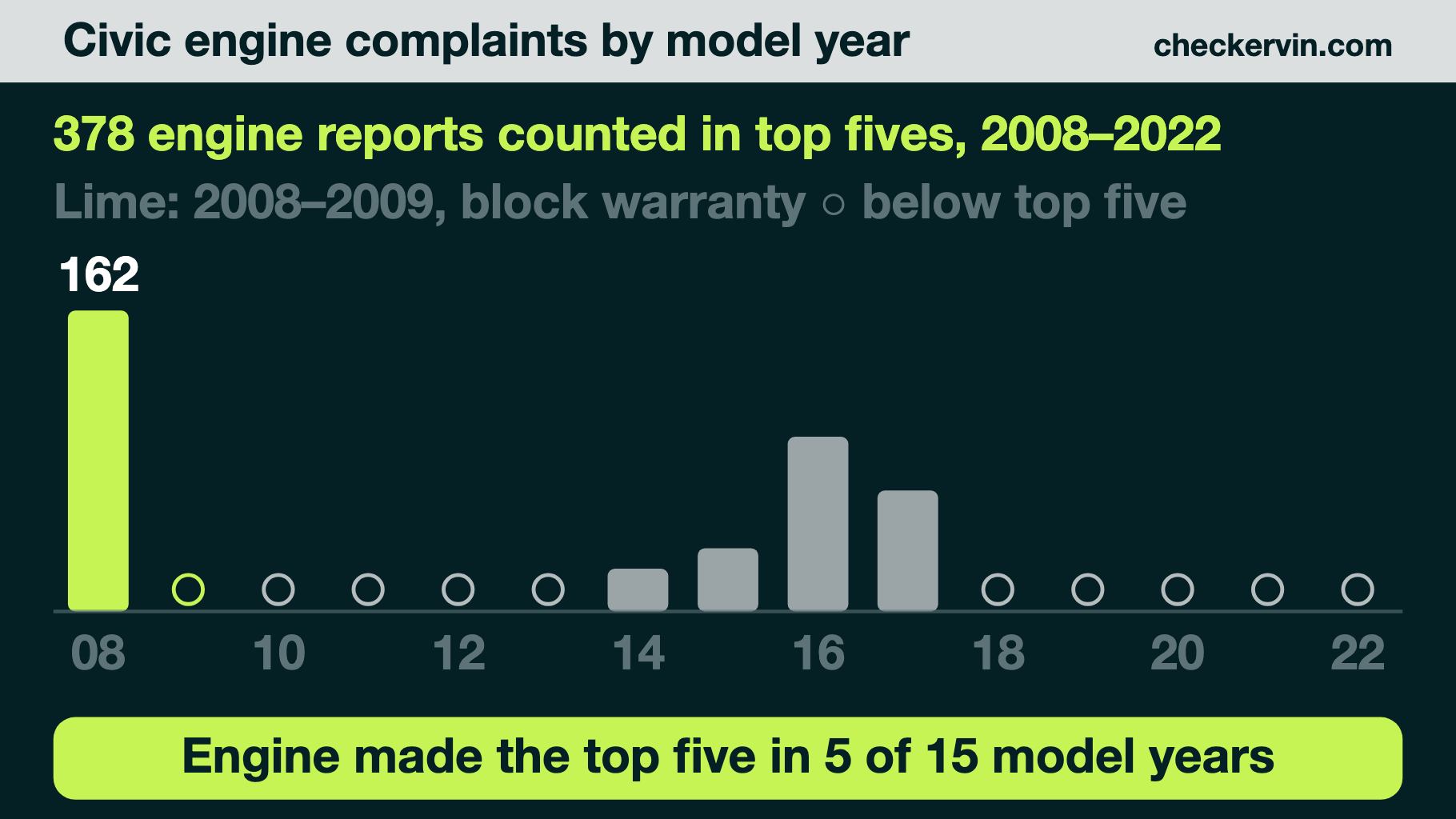
Our corpus holds 7,501 complaints against the 2008–2022 Civic. The engine category reaches a model year’s five most-reported components in 5 of 15 years (2008, 2014, 2015, 2016, 2017), for at least 378 reports counted across those years. That is 5.9% of the top-five reports, ranking 6 of 17 categories, far behind steering at 1,937.
The shape follows the block, not the pump. The peak is 2008, with 162 engine reports, 16% of everything filed against that model year, and 43% of all the engine reports we can count. That year sits inside the 10-048 window. In 2009, the other bulletin year in our span, the engine category is below the fifth-place component of 37 reports, which fits a bulletin that names only early-production 2009 cars. Across the 1.8-liter years from 2008 to 2015 we count 219 engine reports; the 2016-and-later cars add 159, all of it in 2016 and 2017.
The 2016 figure of 94 has its own explanations, and the pump is not among them as far as the narratives go. That model year carries a 2.0-liter piston recall, covered below, and the engine complaints we read for it are about oil and pistons; none we read named the water pump. In the 10 years where the engine category misses the top five, it is not zero; it is below a fifth-place count that never exceeds 70 reports (in 2018). Our Honda Civic years-to-avoid breakdown scores each year on its whole record.
Recalls and bulletins that touch the cooling system
A recall is the one route where a pump would be replaced free regardless of age, so we checked properly. On October 25, 2026 we queried NHTSA’s recall API for the Civic in every model year from 2006 through 2022 and read each campaign. None mentions a water pump, coolant loss or overheating.
An empty result only counts if the query could have found a hit. The same pass returns campaign 16V074000, filed under engine and engine cooling: certain 2016 Civics with 2.0-liter engines built between September 22, 2015 and February 3, 2016 may have piston wrist pin circlips missing or misinstalled, and dealers inspect and replace damaged engine parts free. It has nothing to do with the pump, but it is a reason to run the VIN before paying for any engine work on a 2016.
Two Honda documents sit closer to the cooling system. Bulletin 10-048, the block warranty, is covered above. Product update 17-020, announced April 5, 2017, covers all 2017 Civic 5-Door cars: the three-way coolant joint between the radiator, the expansion tank and the engine may have been made incorrectly and blocked inside, so the cooling system could not be filled properly during service. Dealers replace the joint. On a 2017 hatchback that will not take a full fill after a pump job, that joint is worth asking about. Honda’s own pump bulletins, 17-063 and Acura’s 17-030, cover the Accord, CR-V, ILX and TLX; we found none that names the Civic. Our Honda recall check runs the open-recall lookup, and the TSB vs recall explainer covers why a bulletin, unlike a recall, is paid for only while a warranty applies.
Confirm the pump is the problem before you pay for one
Hoses, the radiator, the reservoir cap, a heater core and, on older cars, the block can all leave the same puddle. A good shop proves the source before ordering a part.
- Wet coolant or crusted residue at the pump itself, not just somewhere at the front of the engine.
- A pressure test of the cooling system, which shows where coolant escapes under load.
- Play or roughness at the pump pulley with the belt off; a growl that follows engine speed.
- On a 2006–2009 car, a look along the block for the cracks bulletin 10-048 describes before any pump is ordered.
- On a 2016, the VIN checked for campaign 16V074000; on a 2017 hatchback, for product update 17-020.
A trace of dried coolant at a pump weep hole is common on a high-mileage engine and does not prove failure on its own. An active drip, a dropping reservoir or a rough bearing does.
Reading a Civic water pump quote
Two quotes for the same Civic usually differ in one or two line items. These are the ones to compare.
- Does the quote name the engine, and does the pump part number match it?
- Is a timing belt listed? On any 2006–2022 Civic it should not be.
- Is the drive belt included, and the tensioner if it is worn?
- Is Honda Type 2 coolant, or an equivalent, included, and how much?
- On a 2006–2009 car, did the diagnosis rule out the block in writing?
If the car is still young enough for factory coverage, our Honda warranty check by VIN explains how to find the in-service date that starts every Honda warranty clock.
If you are shopping a used Civic
A water pump is a wear item, and on a Civic past 100,000 miles a receipt for one is worth having but does not change the price much. On a 2006–2009 car the more valuable receipt is a Honda block replacement under 10-048, because that is the expensive repair and the warranty that paid for it is gone. Ask for it by name.
Look for the signs that send owners the wrong way: coolant stains down the back of the block, a reservoir that is low on a cold engine, or a seller who mentions a recent pump and thermostat on a car that still runs hot. For a 2016, confirm the piston recall is closed. Our 2016 Honda Civic recordcollects that model year’s complaints and recalls in one place.
For the other Civic repairs owners price most often, see our Civic transmission fluid change post, and the Civic Hybrid battery replacement cost breakdown if the car is a hybrid.
Where this information comes from
- Honda Service Bulletin 10-048 — Warranty Extension: Engine Block, July 2017 (NHTSA-hosted)2006–2009 Civic block coolant leaks; 10 years from purchase, no mileage limit; 12.6-hour flat rate with engine and transmission removal.
- Honda product update 17-020 — 2017 Civic 3-way coolant joint (NHTSA-hosted)All 2017 Civic 5-Door cars; a blocked joint prevents a proper coolant fill.
- Acura Service Bulletin 17-030 — Water Pump Seizes or the Drive Belt Is Shredded (NHTSA-hosted)Replaces pump 19200-RDF-A01, the part listed for the 2.0-liter Civic; shows a belt-side procedure and 1.2–1.4 hours. Does not cover the Civic.
- Honda Service Bulletin 17-063 — 2013–16 Accord L4 and CR-V water pumps (NHTSA-hosted)Honda's pump bulletin for its other four-cylinders; the Civic is not listed.
- NHTSA — recalls API, 2016 CivicReturns 16V074000, the 2.0-liter piston circlip campaign. Queried for 2006–2022 on October 25, 2026; no pump or coolant campaign found.
- NHTSA — recall lookup by VINRun your own car; campaigns are added after our snapshot. Also the source of the complaint records computed above.
- EPA fueleconomy.gov — Civic engine listings by yearConfirms the 1.8 L, 2.0 L, 2.4 L and 1.5 L turbo engines by model year; queried for 2008, 2013, 2018 and 2022.
- HondaPartsNow — Civic water pump pulley catalogLists the separate pump pulleys for the 2006–2015 1.8-liter engines, retrieved October 25, 2026.
- HondaPartsNow — 2018 Civic water pumpsPart numbers by trim: 19200-RDF-A01 (2.0 L), 19200-59B-003 (1.5 L turbo and Si), retrieved October 25, 2026.
- RepairPal — Honda Civic water pump replacement estimateThe $641–$807 average quoted above, as listed October 25, 2026.
- Kelley Blue Book — Civic water pump replacementThe general $375–$787 figure and the note on belt-driven versus electric pumps, retrieved October 25, 2026.
- Haynes — change the water pump, Honda CivicThe 30-minute-to-6-hour and $50–$600 ranges across Civic generations, retrieved October 25, 2026.
Keep reading
Frequently asked questions
How much does it cost to replace a water pump on a Honda Civic?
RepairPal's Civic estimator, as listed on October 25, 2026, puts the average at $641 to $807, with labor of $307 to $451 and parts of $334 to $356, before taxes and fees. Kelley Blue Book's Civic pages give a general $375 to $787 when no ZIP code is entered. Those are their figures, not ours. On the 1.8-liter and 2.0-liter Civics the pump sits on the accessory belt, so the job should land inside those ranges rather than above them.
Is the Honda Civic water pump driven by the timing belt?
No. Every gas Civic engine from 2006 through 2022 uses a timing chain, so there is no timing belt to replace alongside the pump. On the 1.8-liter engines from 2006 to 2015, Honda sells a separate water pump pulley, which means the pump is turned by the accessory belt. The 2016-and-later 2.0-liter uses the same pump part number as Acura's 2.4-liter, which Honda's bulletin shows being replaced after removing the drive belt, tensioner and alternator. We could not confirm the 1.5-liter turbo layout from a Honda document.
Why does my 2006–2009 Civic keep losing coolant if the water pump is fine?
Check the engine block. Honda Service Bulletin 10-048 says some 2006 to 2008 and early-production 2009 Civics have blocks that may leak engine coolant and overheat. Honda extended the block warranty to 10 years from the original purchase date with no mileage limit, but that window has now closed for every eligible car. Several 2008 owners told NHTSA they were quoted, or paid for, a water pump before a shop found the crack.
Is there a recall for Honda Civic water pumps?
Not that we could find. NHTSA's recall API, queried October 25, 2026 for every Civic model year from 2006 through 2022, returns no campaign that mentions a water pump, coolant or overheating. The same search does return 16V074000, a 2016 Civic 2.0-liter piston recall filed under engine and engine cooling, so the query can see campaigns of that kind. The pump bulletins Honda did issue, 17-063 and Acura's 17-030, cover the Accord, CR-V, ILX and TLX, not the Civic.
What are the signs of a bad water pump on a Honda Civic?
Coolant weeping from the pump at the front of the engine, a reservoir that drops between top-ups, a temperature gauge that climbs, or a growl or squeal from the accessory belt area that changes with engine speed. A pump bearing that seizes can also throw or shred the drive belt, which takes the alternator with it. On a 2006 to 2009 car, rule out a cracked block with a pressure test before paying for a pump.
Know the engine before you price the pump
A free CheckerVIN report shows the factory engine, specifications and open recalls for any VIN, so the quote you compare is for the Civic you own.
Run a free VIN check