The short answer
- What does it cost?
- KBB shows a generic $375–$787 when no ZIP code is entered, not an Accord-specific price. Honda pays its dealers 1.4 hours for the 2013–2016 four-cylinder pump.
- Why do quotes differ so much?
- Honda pairs the 2008–2017 V6 pump with the timing belt, so it is priced with it. The 2013–2016 four-cylinder pump comes off the belt side.
- The catch?
- On 2018–2022 cars, coolant loss is a listed symptom of Honda's head gasket extensions. Rule that out before buying a pump.
1.4 hrs
Honda flat rate, 2013–16 L4 pump
Service Bulletin 17-063
$375–$787
KBB generic range
No ZIP entered; not Accord-specific, Nov 2026
15 of 15
Years ENGINE made the top five
2008–2022 NHTSA complaints
0
Water pump recalls
Accord, MY2008–2022
What the estimators say, and whose numbers they are
We decode VINs; we do not repair cooling systems. Each dollar figure below belongs to the company named beside it, and each was read on November 22, 2026. The one labor figure that comes from Honda itself is in the last row.
| Source | What it lists for an Accord water pump |
|---|---|
| Kelley Blue Book | $375 to $787 including parts and labor, shown when no ZIP code is entered |
| Haynes repair guide | About $150 to $500, and 1.5 to 5 hours of work, across Accord generations |
| Honda Service Bulletin 17-063 | 1.4 hours flat rate, 2013–2016 Accord four-cylinder, pump with or without the drive belt |
KBB’s page states plainly that a fair repair range is not yet available without a location, so its $375 to $787 is a broad band rather than a quote for your car. It adds a line that explains most of the Accord spread: the more of the engine that has to come apart to reach the pump, the higher the labor. Haynes lists Accords from the 1980s through the 2008–2015 2.4-liter, and several of those older engines drive the pump with the timing belt, which is where its five-hour ceiling comes from.
The Honda figure is the useful one. A flat rate is the time Honda pays a dealer for a repair, and 1.4 hours on the 2013–2016 four-cylinder says that pump is not buried. We did not print RepairPal’s Accord numbers: its page blocked our direct fetch, and the per-year figures that search engines serve from it could not be matched to the page itself.
Which water pump your Accord has
Between 2008 and 2022 the Accord used a 2.4-liter four and a 3.5-liter V6 through 2017, then a 1.5-liter turbo and a 2.0-liter turbo from 2018, with hybrids alongside. The displacements come from the EPA’s fueleconomy.gov listings for each year. Here is what Honda’s documents establish about each pump, and where they go quiet.
| Model years and engine | Pump drive, and how sure we are |
|---|---|
| 2008–2012, 2.4L four | Not confirmed from a Honda document; sources disagree |
| 2013–2017, 2.4L four | Removed from the drive-belt side after the belt, tensioner and alternator (bulletin 17-063, 2013–2016) |
| 2008–2017, 3.5L V6 | Serviced with the timing belt: Honda lists “replace timing belt and inspect water pump” for V6 models |
| 2018–2022, 1.5L and 2.0L turbo | Drive layout not confirmed from a Honda document |
| 2018–2022 Hybrid | Engine pump layout not confirmed; a separate inverter coolant loop is dealer-serviced |
The VIN settles which row is yours. Our engine size by VIN lookup reads the factory engine, and the Honda VIN decoderadds trim and transmission, which matters on 2013–2016 cars because bulletin 17-063 lists a different drive belt for the CVT and the manual.
2013–2016 four-cylinder: Honda's pump bulletin
Honda Service Bulletin 17-063, dated September 15, 2017, is titled “Water Pump Seizes or the Drive Belt Is Shredded.” It applies to every 2013–2016 Accord with the four-cylinder, no VIN range, and to the 2013–2016 CR-V. The cause it gives is a water pump bearing that is out of specification. The fix is a new pump, part 19200-5A2-A01 for the Accord, plus a new drive belt if the old one is damaged, and a fill of Honda Type 2 coolant.
The bulletin’s outline procedure for the Accord is short: drain the coolant, disconnect the 12-volt battery if required, take off the drive belt and its auto-tensioner, remove the alternator if required, unbolt the pump, and reverse the steps. There is no timing chain step anywhere in it. That is why the flat rate is 1.4 hours whether or not the belt is replaced, and why this car should land at the lower end of the KBB band, not above it.
One line in the bulletin matters more than the rest: “The normal warranty applies.” This is not a warranty extension. Honda told dealers how to fix the failure, but it did not add years of coverage, so on a 2013–2016 Accord today the owner pays. Two owner complaints to NHTSA, one on a 2013 and one on a 2014, describe the failure the bulletin names: a pump that seized and took the belt with it, and in the 2014 case, thick smoke from under the hood and a loud pop before the car was towed.
The V6: a pump that comes with the timing belt
On the 2008–2017 Accord V6 the question changes. Honda’s owner’s manuals put the pump on the same Maintenance Minder line as the belt: the 2009 sedan manual reads “Replace timing belt and inspect water pump (V6 engine only),” and the 2017 manual carries the same item footnoted to six-cylinder models. The 2018 manual, the first with no V6 on offer, has no timing belt item at all.
For pricing, that means a V6 pump is rarely a standalone job. The labor to reach it is the labor of a belt replacement, so the sensible quote is belt, tensioner, idler and pump together, and a pump-only quote on a V6 that has not had its belt done recently is worth questioning. Our Accord timing belt replacement cost post covers what that combined job runs and when Honda says to do it.
The trap runs the other way too. A V6 owner whose belt was replaced without a pump has paid for most of the labor twice if the pump fails a year later. When you buy a V6 Accord, the receipt you want is a belt job that lists the pump by part number.
2008–2012 four-cylinder: what we could not confirm
The 2.4-liter in the 2008–2012 Accord is the one engine in this span where we could not find a Honda document showing how its pump is driven. Parts sellers bundle that pump with timing chain kits, which suggests it sits near the chain; at least one catalog lists it as driven by the accessory belt. We will not guess, and we will not print labor hours for it.
We did check whether Honda issued anything about it. NHTSA keeps an index of the service bulletins and dealer notices manufacturers file, and for the 2008–2012 Accord, and for the CR-V, Element and Crosstour that shared related engines, it lists no water pump communication. The same index does list bulletin 17-063 for every 2013–2016 Accord, which is how we know it can find one. So on an early four-cylinder, ask the shop for the book labor time and the pump part number in writing, and compare two quotes on those lines.
2018 and later: rule out the head gasket first
On 2018–2022 Accords the cooling story is dominated by a different part. In August 2026 Honda issued head gasket warranty extensions for the 2018–2022 Accord with the CVT (26-003), the 2018–2020 manual (26-004) and the 2018–2022 Hybrid (26-006), and the symptoms they list include overheating and coolant loss, the same signs that send an owner shopping for a pump. Our Accord head gasket replacement cost post covers the terms and the dealer inspection.
The owner complaints show how the two get confused. Among the 2018–2020 narratives that mention a water pump at all, most mention it next to a head gasket diagnosis, and several come from owners who paid for a pump, and in one case a turbocharger, before a dealer found the gasket. One 2018 owner reports the car overheated the day after a dealer fixed the water pump. On these cars, a pump quote for coolant loss should come after a gasket check, not before it.
The Hybrid adds a second circuit. Honda’s 2022 Accord Hybrid manual describes a separate inverter coolant reservoir, tells owners to have a dealer replace that coolant, and says a low level needs dealer service. A falling inverter reservoir is not the engine pump. We could not confirm from a Honda document how the hybrid’s engine pump is driven, or how the 1.5-liter and 2.0-liter turbo pumps are, so we print no labor estimate for them.
What the complaint data holds, and what it does not
NHTSA’s complaint file has no water pump category. A pump complaint lands under the engine and engine cooling heading with misfires, oil burning, head gaskets and everything else under the hood. So the figures here are context and an upper bound on pump trouble, never a count of it. The words “water pump” are rare in the narratives in every year we read.
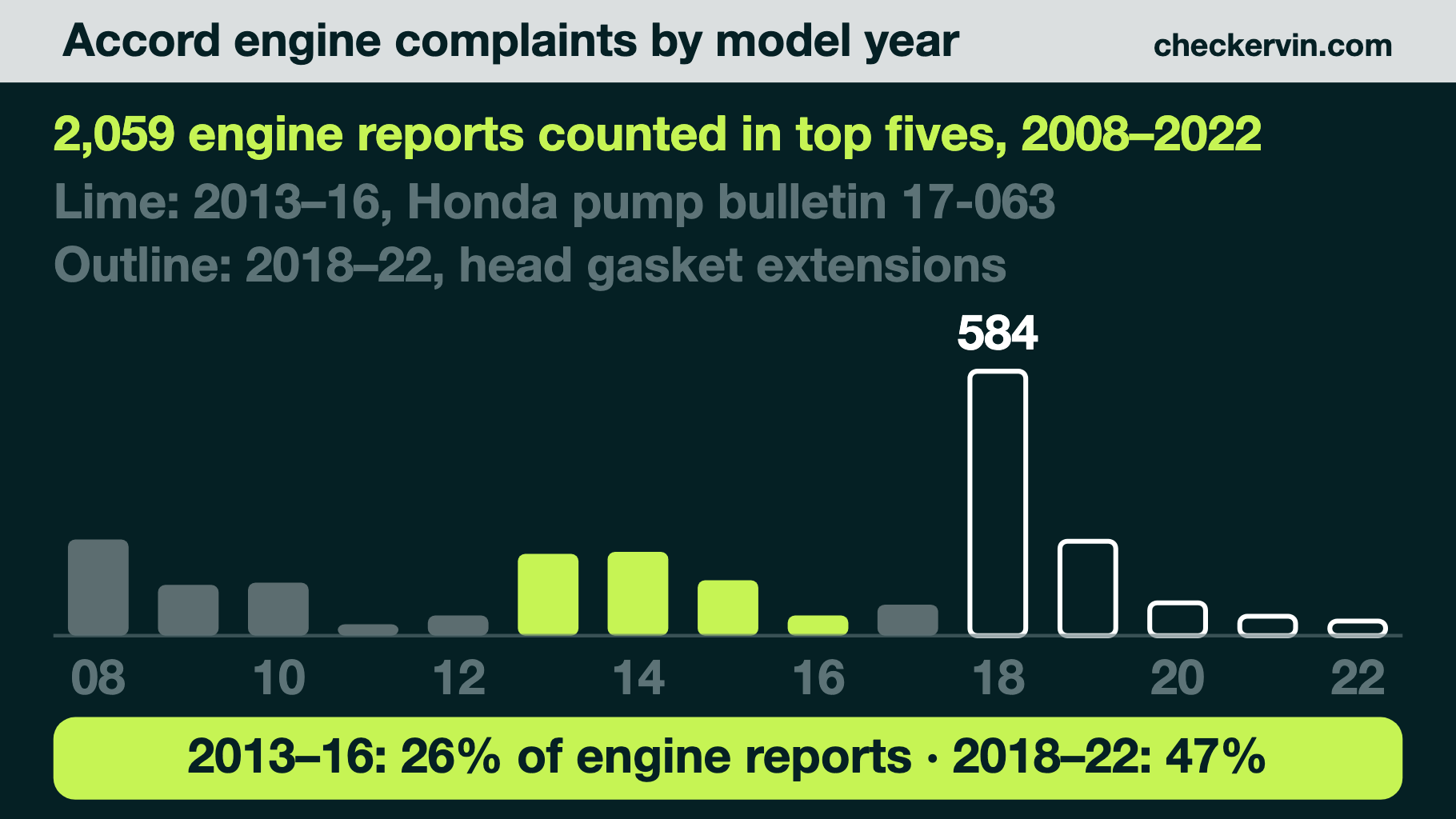
Our corpus holds 11,594 complaints against the 2008–2022 Accord. The engine category makes a model year’s five most-reported components in 15 of 15 years, for at least 2,059 reports counted, and ranks first in 2018 and 2019. The four pump-bulletin years account for 527 of those, 26%; the engine ranks 2013 #3, 2014 #2, 2015 #2, 2016 #4 in those years, falling from 183 reports in 2014 to 44 in 2016. The 2008–2012 cars add 506 (25%), much of it oil consumption and misfires in the narratives we read, not cooling.
The 2018–2022 cars hold 958, 47% of everything we can count. The single tallest year is 2018, with 584 engine reports, 29% of all complaints filed against that model year, and it sits inside the head gasket extension window. The shape follows the gasket, not the pump. Our Honda Accord years-to-avoid breakdown scores each year on its whole record.
Recalls and bulletins that touch the cooling system
A recall is the one route where a pump would be replaced free regardless of age, so we checked it properly. On November 22, 2026 we queried NHTSA’s recall database for the Accord in every model year from 2008 through 2022 and read each campaign. None mentions a water pump, coolant loss or overheating.
An empty result counts only if the query could have found a hit. The same pass returns campaign 15V121000, filed under engine and engine cooling, which covers certain 2014 and 2015 Accord four-cylinders built in narrow production windows. It concerns the engine internals, not the pump, but it is a reason to run the VIN before paying for any engine work on those years.
Bulletin 17-063 is the Accord’s only pump document we found, and the 2026 head gasket extensions are the only cooling-related coverage. Our Honda recall check runs the open-recall lookup, and the TSB vs recall explainer covers why a bulletin, unlike a recall, is free only while a warranty applies.
Confirm the pump is the problem before you pay for one
Hoses, the radiator, the reservoir cap, the thermostat and, on 2018-and-later cars, the head gasket can all leave the same symptoms. A good shop proves the source before ordering a part.
- Wet coolant or crusted residue at the pump itself, not somewhere at the front of the engine.
- A pressure test of the cooling system, which shows where coolant escapes under load.
- On a 2013–2016 four-cylinder, play or roughness at the pump pulley with the belt off, or a belt that has frayed or thrown.
- On a 2018–2022 car losing coolant with no visible leak, the head gasket inspection Honda's extensions describe before any pump is ordered.
- On a Hybrid, which reservoir is low: engine coolant or inverter coolant.
A trace of dried coolant at a pump weep hole is common on a high-mileage engine and does not prove failure on its own. An active drip, a dropping reservoir or a rough bearing does.
Reading an Accord water pump quote
Two quotes for the same Accord usually differ in a line or two. These are the ones to compare.
- Does the quote name the engine, and does the pump part number match it? On a 2013–2016 four-cylinder, Honda's is 19200-5A2-A01 or its replacement.
- On a V6, is the timing belt, tensioner and idler on the same ticket? It should be.
- On a four-cylinder of any year, is a timing belt listed? It should not be.
- Is the drive belt included where the old one is damaged, and Honda Type 2 coolant or an equivalent?
- On a 2018–2022 car, did the diagnosis rule out the head gasket in writing?
Honda specifies its Type 2 long-life coolant across these cars; our coolant type by VIN page matches the refill to the car. If yours may still be inside a factory or extended warranty, the Honda warranty check by VIN explains how to find the in-service date that starts every Honda warranty clock.
If you are shopping a used Accord
A water pump is a wear item, and on an Accord past 100,000 miles a receipt for one is worth having but rarely moves the price. The receipts that matter depend on the engine. On a V6, it is a timing belt job that names the pump. On a 2013–2016 four-cylinder, a pump and belt replaced under 17-063 or later closes the one documented pump failure. On a 2018–2022 car, the useful paper is a head gasket repair or a dealer note that the car was inspected under the extension.
Look for the signs that send owners the wrong way: coolant stains at the front of the engine, a reservoir low on a cold engine, a squeal or shredded belt on a 2013–2016 car, or a seller who mentions a recent pump on a turbo car that still runs hot. Our 2013 Honda Accord recordcollects that model year’s complaints and recalls in one place.
Where this information comes from
- Honda Service Bulletin 17-063 — Water Pump Seizes or the Drive Belt Is Shredded (NHTSA-hosted)2013–2016 Accord four-cylinder and CR-V; bearing out of specification; 1.4-hour Accord flat rate; normal warranty applies.
- NHTSA — recalls API, 2015 AccordReturns 15V121000, filed under engine and engine cooling. Queried for 2008–2022 on November 22, 2026; no pump or coolant campaign found.
- NHTSA — recall lookup by VINRun your own car; campaigns are added after our snapshot. Also the source of the complaint records computed above.
- EPA fueleconomy.gov — Accord engine listings by yearConfirms the 2.4 L, 3.5 L, 1.5 L turbo, 2.0 L turbo and hybrid engines; queried for 2010, 2015, 2018 and 2022.
- Honda — 2009 Accord Sedan Owner's ManualMaintenance Minder item 4: replace timing belt and inspect water pump, V6 engine only (p.313).
- Honda — 2017 Accord Sedan Owner's ManualThe same item footnoted to six-cylinder models (p.511).
- Honda — 2022 Accord Hybrid Owner's ManualSeparate inverter coolant reservoir, dealer-replaced; Type 2 coolant specified (pp.548–549).
- Kelley Blue Book — Accord water pump replacementThe general $375–$787 figure and the note on labor rising with disassembly, retrieved November 22, 2026.
- Haynes — change the water pump, Honda AccordThe 1.5-to-5-hour and $150–$500 ranges across Accord generations, retrieved November 22, 2026.
Keep reading
Frequently asked questions
How much should a water pump replacement be on a Honda Accord?
Kelley Blue Book's Accord pages give a general $375 to $787 including parts and labor when no ZIP code is entered; those are KBB's figures, read November 22, 2026. Where the Accord lands depends on the engine. Honda's own bulletin for the 2013 to 2016 four-cylinder pays dealers 1.4 hours to replace the pump, which puts that car near the low end. On a 2008 to 2017 V6 Honda pairs the pump with the timing belt, so it is priced as part of a belt job rather than on its own.
Is the Honda Accord water pump driven by the timing belt?
Only on the V6. Honda's owner's manuals for the 2008 to 2017 Accord list "Replace timing belt and inspect water pump" for V6 models only, and the 2018 manual drops the timing belt entirely. On the 2013 to 2016 four-cylinder, Honda's Service Bulletin 17-063 replaces the pump after removing the drive belt, its tensioner and, if needed, the alternator, with no timing step. We could not confirm the 2008 to 2012 four-cylinder or the 2018-and-later turbo layouts from a Honda document.
Is there a recall or bulletin for Honda Accord water pumps?
There is a bulletin, not a recall. Honda Service Bulletin 17-063, dated September 15, 2017, covers every 2013 to 2016 Accord four-cylinder whose water pump bearing is out of specification, so the pump seizes or shreds the drive belt. It says the normal warranty applies, so it is not a free repair on an older car. NHTSA's recall database, checked November 22, 2026 for every Accord from 2008 to 2022, lists no water pump campaign.
What is the most common problem with a 2014 Honda Accord?
In NHTSA's complaint file, the 2014 Accord's most-reported component is electrical system, with 386 of its 1,012 complaints in our snapshot, and most of those narratives describe trouble starting the car. The engine category ranks #2 that year with 183 reports. Among cooling items, the 2014 four-cylinder is one of the years Honda's water pump bulletin 17-063 names.
What is the biggest problem with the Honda Accord?
Across the 2008 to 2022 Accord, the component counted most often in each year's top five NHTSA complaint categories is electrical system, at 2,161 reports counted; the engine category ranks 2. That leader is not the same in every era, which is why the model year matters more than the nameplate. For the engine, the tallest year is 2018, inside the window Honda's 2026 head gasket extensions cover.
Know the engine before you price the pump
A free CheckerVIN report shows the factory engine, specifications and open recalls for any VIN, so the quote you compare is for the Accord you own.
Run a free VIN check