The short answer
- What does it cost?
- RepairPal lists $676–$959 on average for an Accord starter, before tax. Parts are about two-thirds of it.
- Which Accords have the problem?
- The 2013–2015 cars: 59% of the Accord's counted electrical complaints, and the years Honda investigated for no-starts and grinding.
- Will Honda pay?
- Not beyond the normal warranty. Honda's V6 bulletin 16-002 replaces the starter and turns the torque converter, but no recall or extension covers it.
$676–$959
RepairPal Accord starter average
Retrieved Oct. 2026, before tax
0.9 hr
Honda's V6 starter flat rate
Bulletin 16-002
1,797
Electrical reports counted
2008–2022, a minimum
59%
Share on 2013–2015 cars
Of counted electrical reports
The numbers, and whose numbers they are
CheckerVIN decodes VINs and lists open recalls; we do not fix cars, so the dollar figures here belong to other people, with the date we read them. RepairPal’s Honda Accord starter estimator lists an average of $676 to $959, split into about $206 to $302 of labor and $470 to $657 of parts, on a page marked as updated September 3, 2026. RepairPal refuses direct requests from our research tools, so that is the figure its own search listing showed on October 26, 2026, not one read on the page. The range excludes taxes, fees and your local labor rate.
Honda’s service bulletins give the labor side in hours. For a 2013–2016 Accord V6 with the automatic, Honda pays its dealers 0.9 hours to replace the starter and rotate the torque converter. For the 2010 four-cylinder covered by an older cold-weather bulletin, it pays 0.6 hours plus 0.2 for the four-cylinder. Those are warranty flat rates, not retail times, but they explain the shape of RepairPal’s range: an hour or so of labor and a part that costs more than the labor.
The more useful question is which Accord you have. A starter on a 2011 car is a routine replacement. A grinding starter on a 2014 V6 is a documented Honda condition with a specific two-part fix, and paying for half of it is how owners end up paying twice.
What 1,797 counted electrical complaints say
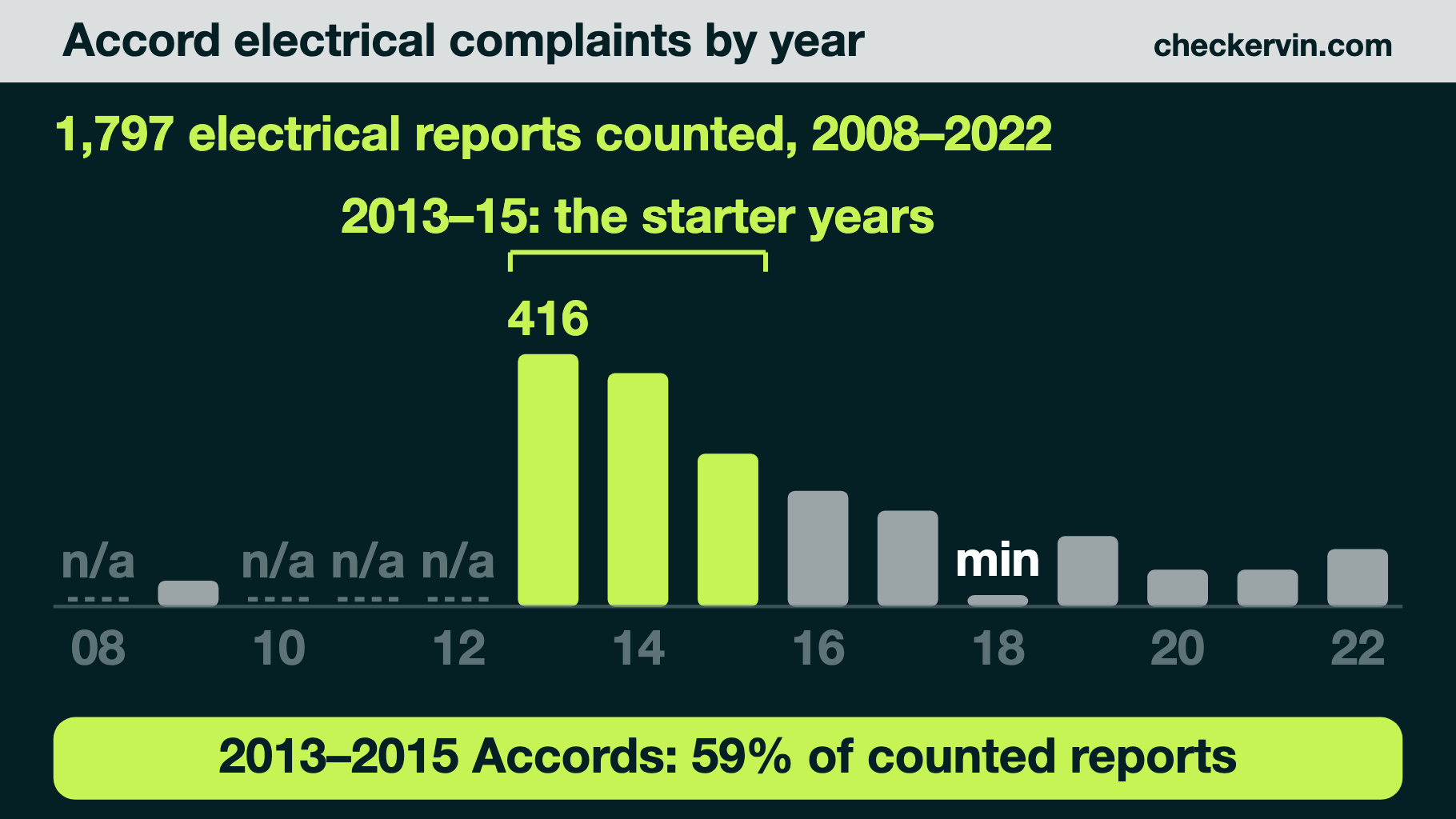
Our corpus of federal NHTSA complaints holds 9,607 reports against the 2008–2022Accord. NHTSA files nothing under “starter”; the closest category is ELECTRICAL SYSTEM, which also covers the battery, wiring, lighting and control modules, so it is an outer boundary on starter trouble, never a count of it. Our data keeps each year’s top five components only, and ELECTRICAL falls below fifth place in 2008, 2010, 2011 and 2012. Those years are not zero, only uncounted, so the 1,797 reports counted across the rest are a minimum.
The shape is lopsided. The 2013–2015 cars hold 1,053 of the counted electrical reports, or 59%, and electrical complaints make up 34% of everything owners filed against those three years. The 2013 Accord leads with 416, 29% of its own complaints. ELECTRICAL is the top category outright for 2014, 2015, 2016, 2017 and 2022. The 2017–2022 cars, by contrast, hold 28% of the counted total.
What 2013–2015 owners describe
A category count cannot tell a starter from a battery, so we read the narratives. Searching every Accord complaint from 2008 to 2022for the word “starter” turns up a heavy cluster on the 2013, 2014 and 2015 cars and very little on either side of them. A sizable minority of those reports sit under ENGINE rather than ELECTRICAL, which is why the head gasket analysis on the same car found the starter dominating the ninth generation’s engine narratives too.
The stories repeat. Push the start button, hear one click, see every dash light come on, and nothing turns. Or a grind and a whir. Some owners press the button three or four times before it catches; some are stranded. Several replaced the battery first, sometimes more than once, before a shop named the starter, and a few report a second starter that did not cure it. Owners quote dealer prices around $800 for the job. Those are owner statements, not verified prices, but they sit at the top of RepairPal’s range, which is where a dealer would.
The V6 fix: a starter and a quarter-turn of the torque converter
Honda’s explanation for the grinding is in Service Bulletin 16-002, “Starter Grinds or Spins at Startup,” first issued February 5, 2016 for the 2013–2015 Accord V6 with the automatic, and widened in August 2017 to the 2016 model. It says the clearance between the starter motor gear and the torque converter ring gear is “not optimal.” The corrective action is to replace the starter and rotate the torque converter clockwise by one bolt hole, so the starter meets fresh teeth.
Two details in that bulletin matter to anyone paying for the job. First, the technician marks the torque converter and flex plate and writes the bulletin number on the flex plate. If a later technician finds that mark, Honda says no further rotation can be done and a new torque converter has to be installed. A second grinding episode on a car that already had 16-002 is therefore a much bigger job than the first. Second, the warranty line reads “The normal warranty applies.” There is no extension, so on any car past its factory coverage the owner pays.
| Accord | Starter documents Honda published |
|---|---|
| 2010 L4 (VIN ranges) | SB 12-018: cold-weather grind, replace starter, normal warranty |
| 2013–2015 V6 automatic | SB 16-002: replace starter, rotate torque converter, 0.9 hr |
| 2016 V6 automatic | Added to SB 16-002 in August 2017 |
| 2013–2014 L4 | 2015 dealer request for no-start cars; no published fix found |
| 2017–2022, all engines | No starter bulletin found in NHTSA's lists |
The four-cylinder: investigated, no published fix
Bulletin 16-002 says “V6 with A/T only,” yet the four-cylinder cars were part of Honda’s inquiry too. On October 2, 2015 Honda sent dealers a request for 2013–2014 Accord four-cylinders with an engine no-start, asking them to call before attempting any repair. The car had to reproduce the no-start and still carry its original battery, alternator and starter. Parallel requests that year asked for 2013–2015 V6 cars that would not start or that ground at startup.
The V6 investigation ended in 16-002. We found no matching bulletin for the four-cylinder in the communications NHTSA lists for any 2013–2017 Accord, and the same search did return 16-002 and an older starter bulletin, so the search was seeing starter documents. For a 2013–2015 four-cylinder, then, the repair is an ordinary starter replacement, priced like one.
Older cars have their own small footnote. Bulletin 12-018 covers certain 2010 Accord four-cylinders, by VIN range, whose starters grind in cold weather (typically 45°F or colder) because the starter clutch housing may be out of specification. Its Accord parts list includes four intake gaskets alongside the starter.
When it cranks but won't start, it isn't the starter
A starter has one job: turn the engine. If the engine turns over at normal speed and never fires, the starter worked. Honda’s own documents describe several Accord faults that look like starting trouble and are not.
| What happens | Honda document worth asking about |
|---|---|
| Cranks, won't start; blank cluster; mirror won't dim (2013–16) | Tech Line ATS161003: blown B5 fuse, roof harness damage |
| Won't start or stalls (2013–2022, by VIN) | Fuel pump recalls 20V-314, 21V-215, 23V-858 |
| V6 stalls (2015–2017) | Fuel pump recall 19V-060 |
| Dead battery no-start, V6 (2016–17) | Honda engineering request AER17020B |
| Grinds or spins (2013–16 V6 automatic) | SB 16-002: this one is the starter |
The Tech Line article is the most specific. For 2013–2016 Accords (four-cylinder EX-L and above, and V6), the 2014–2015 Hybrid and the 2014 Plug-In, Honda lists a blown B5 (7.5 A) fuse with an engine that cranks but won’t start, and points to damage in the roof wire harness at the rearview mirror connector. A starter will not fix that. The fuel pump campaigns are recalls, so the repair is free; a Honda recall checkon the VIN shows whether one is still open. One more recall touches the same corner of the car: 17V-418 replaced the battery sensor on 2013–2016 Accords because water could get in and short it, a fire risk rather than a no-start.
No printout rule for starters
The Civic alternator post leans on Honda Service Bulletin 12-002, which refuses alternator warranty claims without a GR8 tester printout reading REPLACE ALTERNATOR. We checked whether the same rule covers starters. It does not. The tester is called an alternator/starter tester, but the 2012 bulletin says that once installed it “is capable of testing alternators” and that “the starter test function will be available in the future.” Every warranty requirement in it names the alternator. We found no later Honda starter-test rule among the documents NHTSA lists for these Accords.
So there is no Honda printout to demand. What you can ask for is the sequence a careful shop follows anyway: a charged battery that passes a load test, clean and tight cables and grounds, then a check of the voltage reaching the starter while someone presses the button. A starter that gets full voltage and still clicks, grinds or spins has failed. One that gets low voltage has a cable, ground or battery problem, which is cheaper. The battery size lookup by VIN tells you which battery the car takes before you buy one.
2018 and later, and why the 2018 bar is too short
The tenth-generation Accord, built from 2018 with turbocharged engines, all but drops the starter from the narratives. Its electrical complaints read differently: the 12-volt battery, the fuel pump on 2018 and 2019 cars, the backup camera, and on the newest years mostly the screen and infotainment unit. None of that is a starter repair.
One caution about the chart. Our 2018 row records 19 electrical reports out of 113complaints, and it is wrong. When we queried NHTSA’s live complaint database for the 2018 Accord on October 26, 2026, it returned many times both numbers; the other years matched our data within a few percent. We have not patched the row by hand, because every figure here recomputes from the same dataset. Read the 2018 bar as a floor. The narratives in the missing reports did not change the starter picture: they too rarely mention one.
Accord Hybrid: the engine is started another way
The two-motor Accord Hybrid does not crank its engine the way the gasoline car does. Honda’s feature guide for the 2018 Accord Hybrid describes a drive motor and a separate motor/generator, and says the motor/generator “only acts as a motor to start the engine; it becomes a powerful generator the rest of the time.”
Which starter your Accord takes, and what it lists for
Honda fits different starters by generation and engine, and parts sellers say to confirm by VIN. The list prices below come from the sellers’ search listings on October 26, 2026, because both refuse direct requests from our tools. Sale prices vary by seller and are not quoted.
| Accord | Honda part and listed price |
|---|---|
| 2013–2016 V6 automatic | 31200-5G0-A04 (the SB 16-002 part); HondaPartsNow shows $667.92 on its 2015–16 pages, $770.75 on another |
| 2013–2017 2.4L (reman) | 31200-5A2-A02RM; HondaPartsNow lists $488.67 plus a $75 core charge |
| 2018–2022 | 31200-6B2-A01; $727.48 list on HondaPartsNow and Honda Parts Connection |
The disagreement inside one seller’s own pages for the V6 part is a reminder that list price is a moving number. The bigger choice is new Honda, Honda remanufactured or aftermarket, and the remanufactured route is the one that moves the parts side of RepairPal’s range. A Honda VIN decode confirms the engine and transmission, which is what decides both the part and whether 16-002 applies.
Before you authorize the starter
- Confirm by VIN whether the car is a 2013–2016 V6 automatic, the one configuration SB 16-002 covers
- On those cars, ask whether the torque converter will be rotated, and whether the flex plate already carries a 16-002 mark
- Ask what the starter does when it fails: a click, a grind or a spin is the starter; normal cranking with no start is not
- Ask for the battery test result and the voltage at the starter before the part is ordered
- Run the VIN for open recalls, especially the fuel pump campaigns, before paying for any no-start repair
The second item is the one that saves money later. A V6 that gets a new starter without the converter rotation keeps the gear clearance Honda described as not optimal. A V6 that already had the rotation and grinds again needs a torque converter by Honda’s own instruction, which no starter-only quote will include.
If you are buying the Accord, not repairing it
On a 2013–2015 car, start it cold more than once on the test drive. One click, a grind, or a second press of the button is a starter in progress. Ask the seller whether the starter has been replaced and, on a V6 automatic, whether the 16-002 work was done. The repair order should say so, and the flex plate mark is there if it was. The Honda Accord years-to-avoid page lays out the rest of the complaint record by year, and the Honda warranty check by VIN helps estimate whether any factory coverage is left, which on these cars it almost certainly is not.
The same ninth-generation cars carry other documented engine trouble, covered in the Accord timing chain post and the Accord head gasket post. For a Honda where the charging system, not the starter, is the documented weak point, see the Odyssey alternator post. A free CheckerVIN report returns the factory build, engine, specifications and open safety recalls for any VIN. It does not include accident, title, odometer or repair history, so it cannot tell you whether a starter was replaced.
Where this information comes from
- Honda Service Bulletin 16-002 v3 (NHTSA copy): Starter grinds or spins at startup2013–2016 Accord V6 automatic; replace starter and rotate the torque converter; 0.9 hr; normal warranty.
- Honda Service Bulletin 16-002 v1 (NHTSA copy), February 2016The original 2013–2015 scope and the full removal procedure, including the flex plate mark rule.
- Honda dealer request, October 2015 (NHTSA copy): 2013–2014 Accord L4 no startShows Honda investigated the four-cylinder; no published fix followed in NHTSA's lists.
- Honda dealer request, 2015 (NHTSA copy): 2013–2015 Accord no start or grindingThe V6 investigation that preceded bulletin 16-002.
- Honda Service Bulletin 12-002 (NHTSA copy): GR8 alternator/starter testerThe printout rule covers alternators; the starter test is described as available in the future.
- Honda Service Bulletin 12-018 (NHTSA copy): starter grinds in cold weatherCertain 2010 Accord L4s by VIN range; 0.6 hr plus 0.2 for the L4.
- Honda Tech Line ATS161003 (NHTSA copy): blown B5 fuse, cranks but won't startA 2013–2016 Accord and Hybrid no-start that a starter will not fix.
- NHTSA: recalls by VINOur year-by-year query found no Accord recall naming the starter; fuel pump and battery sensor campaigns are listed.
- NHTSA: vehicle complaintsThe federal complaint database our electrical counts are computed from.
- Honda Info Center: 2018 Accord Hybrid two-motor systemHonda's statement that the motor/generator starts the hybrid's engine.
- RepairPal: Honda Accord starter replacement estimateThe $676–$959 average and its labor and parts split, from RepairPal's listing, October 2026.
Keep reading
Frequently asked questions
How much does it cost to replace the starter on a Honda Accord?
RepairPal's Accord starter estimator lists an average of $676 to $959, with about $206 to $302 of labor and $470 to $657 of parts, before taxes and local pricing, on a page marked as updated September 3, 2026. Honda's own warranty flat rate for the 2013–2016 V6 automatic job is 0.9 hours, and that includes turning the torque converter. Most of the bill is the part, so a remanufactured starter is where the savings are.
What are the signs of a failing starter on an Accord?
Honda's bulletins name two: the starter grinds, or it spins without turning the engine. Owners of 2013–2015 Accords also describe a single click with the dash lights on, a whir, and needing several presses of the start button. If the engine turns over normally but will not fire, the starter is doing its job; look at fuel delivery, a blown fuse or the battery instead.
How do I change the starter on a 2013 Honda Accord?
For the 2013–2016 V6 automatic, Honda's Service Bulletin 16-002 lists the steps: disconnect the battery, remove the battery, air cleaner, battery base and splash separator, unclip the lower radiator hose, disconnect the starter cable and S terminal, and remove the starter. Honda also rotates the torque converter one bolt hole and marks the flex plate, which is beyond a typical driveway job. We did not obtain Honda's procedure for the 2.4-liter four-cylinder.
Is there a recall or warranty extension for Honda Accord starters?
No. Our query of NHTSA's recall database for every Accord model year from 2008 to 2022 found no campaign naming the starter, and Honda's starter bulletins state that the normal warranty applies. Bulletin 16-002 covers the 2013–2016 V6 automatic; for the 2013–2014 four-cylinder, Honda asked dealers to report no-start cars in 2015 but we found no published fix.
Does the Honda Accord Hybrid have a starter?
Honda's feature guide for the two-motor Accord Hybrid says the motor/generator only acts as a motor to start the engine and is a generator the rest of the time. So a no-start on a hybrid points first at the 12-volt battery and the hybrid system, and a quote for a conventional starter motor deserves a question about which part, exactly, it is.
Know the engine before you price the starter
A free CheckerVIN report shows the factory build, engine, specifications and open recalls for any VIN, so you know whether Honda's V6 starter bulletin applies.
Run a free VIN check