The short answer
- Which Focus has a timing belt?
- Only the 2015–2018 1.0L EcoBoost three-cylinder. The 2.0L, the ST, the RS and the Electric do not.
- What does the job involve?
- Ford books 9.1 hours to replace the oil pump belt, its tensioner and the timing belt in the car. No reliable published price exists.
- Could it be free?
- On 2016–2018 1.0L automatics, recall 23S64 replaces those belts at no charge. Ford’s new interval is 100,000 miles or 6 years.
9.1 hr
Ford labor time, belts in car
Recall 23S64, Focus, June 2026
100k / 6 yr
New 1.0L belt interval
Was 10 yr / 150,000 mi
8 of 11
Years ENGINE is top five
2008–2018, not a belt count
$409–$919
KBB generic FAQ line
Same on 2012, 2016, 2018 pages
What the timing belt prices online are pricing
Kelley Blue Book publishes a timing belt page for every Focus model year. We opened the 2012, 2016 and 2018 pages in November 2026. None of them showed a fair repair range; each showed a placeholder location in place of a ZIP code, and each carried the same FAQ sentence putting the job at $409 to $919 with parts and labor. The 2012 car cannot have a belt, the 2016 and 2018 cars can, and the figure does not change. It is a template line for belt jobs on all cars, so read it as generic, not as a Focus estimate.
YourMechanic’s Focus page, as it appears in search results, gives an average of $661, about $227 in parts and $434 in labor. It does not say which model year or engine it priced, and the Focus name has covered several engines since 2000. Neither number describes the job a 1.0-liter owner actually faces, which is a two-belt, oil-pan-off repair Ford itself times at more than nine hours.
We sell VIN checks, not repairs, and publish no price of our own. What this page can do is tell you whether your car has a belt at all, show you the Ford documents that govern it, and give you the one hard number Ford publishes: the labor time.
Which Focus has a timing belt
The engine list comes from fueleconomy.gov, which records every Focus configuration certified for each model year. From 2008 to 2011 there was one engine, a 2.0-liter four. From 2012 the 2.0-liter switched to direct injection. The 1.0-liter three-cylinder EcoBoost arrived for 2015 with a six-speed manual only, and from 2016 it was also offered with a six-speed automatic. The Focus RS used a 2.3-liter turbo from 2016, and the Focus Electric ran from 2012.
| Focus engine and years | Timing drive |
|---|---|
| 2008–2011 2.0L Duratec | Chain parts in Ford’s catalog |
| 2012–2018 2.0L direct injection | Chain parts in Ford’s catalog |
| 2013–2018 Focus ST 2.0L EcoBoost | Chain (shared with the 2.3L) |
| 2016–2018 Focus RS 2.3L EcoBoost | Chain |
| 2015–2018 1.0L EcoBoost three-cylinder | Belt in engine oil, plus an oil pump belt |
| 2012–2018 Focus Electric | No engine, no timing drive |
The 1.0-liter row rests on Ford’s own documents, quoted below. The chain rows rest on Ford’s genuine-parts catalog as its dealer site appears in search results, which lists chain tensioners and guides under the 2.0-liter engines and one timing chain part number for both the ST’s 2.0-liter and the RS’s 2.3-liter. The site refused our direct requests, and one of its listings uses the word belt loosely, so we do not lean on it harder than that. What settles it for us is that Ford’s 2026 interval notice for timing belts names the 1.0-liter and nothing else. So most Focus owners searching this job have a chain, with no replacement interval at all. Our timing belt or chain lookup by VIN and engine size check by VIN confirm it for one car in a minute.
What the engine complaint record shows, and what it can’t
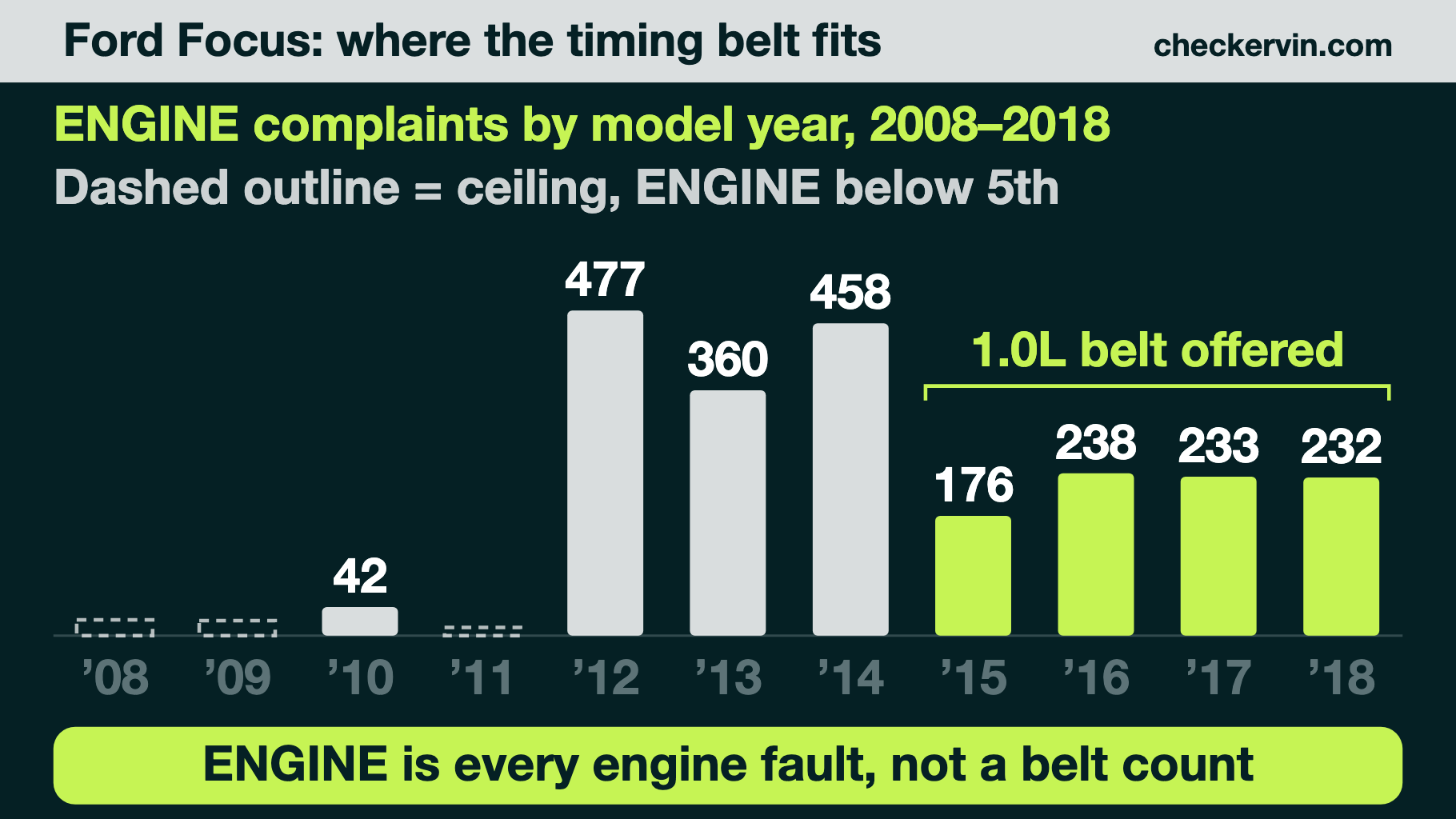
For 2008 to 2018 the federal record holds 13,494owner complaints against the Focus. ENGINE makes the model year’s five most-reported components in 8 of those 11 years. It ranks second in every year from 2013–2018, behind the power train, ranks third in 2012 and fourth in 2010. Across the years it makes the top five it accounts for at least 2,216 reports, peaking at 477 in 2012.
In 2008, 2009 and 2011ENGINE falls below fifth place, which means fewer reports than that year’s fifth component and never more than 23. That is not zero, which is why the chart draws those years as dashed outlines at the ceiling rather than as empty slots.
None of this is a belt count. ENGINE covers every engine fault an owner files, and the 2015–2018 years it reports also include every 2.0-liter car sold in them. The belt-engine years hold 40% of the engine reports we counted, against 1,337 counted in the chain-only years before them. One detail does point at the 1.0-liter: NHTSA files the oil pump belt recall under a separate category, ENGINE AND ENGINE COOLING, and that category reaches the top five only in 2017 and 2018, years the recall covers. The Focus years-to-avoid breakdown has the full record by year.
The one Focus belt, and why it runs in oil
The 1.0-liter’s belts are not behind a plastic cover at the front of the engine. Ford’s recall instructions for the job start by draining the oil and removing the oil pan, then the oil pump cover, and only later reach the engine timing belt and its tensioner. There are two belts: the timing belt that drives the camshafts, and a smaller oil pump drive belt with its own tensioner. Both live in oil, which is why Ford treats them together.
That layout explains the failure Ford describes. In its August 2026 notice, Ford says poor oil quality, a buildup of contaminants, rising oil acidity and irregular maintenance can damage the timing belt and speed its wear. When belt material delaminates, it can clog the oil pump pick-up screen, oil pressure falls, and the engine can seize. On a conventional dry belt, the classic risk is a snapped belt. On this one, the documented risk is the belt shedding into the oil first.
We could not find a Ford document saying whether the 1.0-liter is an interference engine, so we do not claim either way. The failure path Ford documents runs through oil starvation, and that alone can end an engine.
Ford shortened the belt interval in August 2026
Ford Customer Satisfaction Program 26L02, sent to dealers on August 25, 2026, covers 2015 to 2018 Focus cars built in Michigan with the 1.0-liter engine, along with Fiesta and EcoSport models. It changes the timing belt and oil pump belt interval from the original 10 years or 150,000 miles to 100,000 miles or 6 years, whichever comes first. The two belts share the interval, and if they were already replaced, the new clock starts from that repair.
Run the arithmetic on the age limit. The last 1.0-liter Focus left the line in May 2018, so every one of these cars is now past six years. Unless the belts have been replaced in that time, Ford’s own schedule says the job is due now, whatever the odometer reads. Owners are being mailed an amendment card for the maintenance schedule; a used car may never have received it.
The program does not pay for the belt service. What it does is refund past engine repairs tied to belt degradation, if the repair was dated before September 14, 2026, the car was under 10 years and 150,000 miles from its warranty start, the repair order shows an oil pressure problem or one of the codes P0016, P0017, P0018, P0019 or P033F, and the owner can document the last three oil changes on schedule with the correct oil. Requests are due within a year of the owner letter, and the program expires August 31, 2027.
The recall that replaces the belts for free
Separately, safety recall 23S64, NHTSA number 23V-905, covers 2016 to 2018 Focus cars built from March 24, 2015 to May 4, 2018 with the 1.0-liter engine and the 6F15 automatic transmission. Ford’s defect report says the oil pump drive belt tensioner arm may fracture or separate and the belt may lose teeth, cutting oil pressure, which can stall the engine and take away power brake assist. Owner letters were mailed in August 2025.
The final repair goes further than the name suggests. Ford’s June 2026 dealer supplement lists an oil pump drive belt, an oil pump belt tensioner, a timing belt kit and a timing belt tensioner among the parts for every car, and its labor operation for the Focus reads “replace oil pump drive belt/tensioner and timing belt on existing engine in-vehicle.” If an engine has already failed from a broken oil pump belt, the dealer installs a long-block engine under the recall.
The recall is free at any Ford dealer regardless of age or mileage. A manual-transmission 1.0-liter Focus, including every 2015 car with that engine, is outside it. The Ford recall lookup by VIN shows whether 23S64 is open on a given car. Counted model year by model year, the 2008–2018 Focus has 70 recall listings in NHTSA’s database, and this campaign is the only one naming a belt inside the engine.
What Ford’s 9.1 hours tells you about the bill
| Ford labor operation, recall 23S64 (Focus) | Hours |
|---|---|
| Replace oil pump belt, tensioner and timing belt, engine in car | 9.1 |
| Engine failed from oil pump belt: install long-block engine | 10.2 |
| Remove oil pan, inspect; failure not from the belt | 2.8 |
These are Ford’s warranty times from the June 2026 supplement, the hours Ford pays its own dealers. Independent shops use their own labor guides, but a quote far below nine hours for a 1.0-liter belt job should make you ask what is being skipped, and a quote that prices only the timing belt leaves out the oil pump belt Ford now schedules alongside it.
The parts list explains the time. Beyond the belts and tensioners, the recall kit includes oil pan and front cover bolts, a crankshaft pulley bolt, a valve cover gasket, a lower engine gasket kit, a high-pressure fuel pump seal, fuel injector seals, a turbo oil feed tube, coolant, oil and a filter. Ask any shop for a written estimate that lists the parts by name, and multiply the hours by its posted rate yourself.
Warning signs on a 1.0-liter Focus
- An oil pressure warning on the dash: Ford service message SSM 49918 tells technicians to test pressure, and below 10 psi at idle or metal in the oil means a replacement engine
- A check engine light with P0016 to P0019 or P033F: the codes Ford's refund program accepts as signs of belt degradation
- A loud mechanical noise with lost power: Ford's recall report says an engine failure from the oil pump belt is expected to be audible inside the car
- No receipt for a belt change and a car older than six years: due under Ford's new schedule regardless of symptoms
A warning light on this engine is a reason to stop and check, not to top up the oil and carry on. The documented failure involves oil pressure, and continuing to drive is what turns a belt job into an engine.
If your Focus has a chain, what a timing quote is for
A 2.0-liter Focus has no timing belt interval. If a shop quotes “timing” work on one, ask which part. One documented case: Ford bulletin 16-0031 covers some 2013–2014 Focus ST cars with a check engine light and code P2096, which Ford traces to oil migrating from the variable valve timing oil control solenoids through the engine wiring harness to a catalyst sensor, not to the chain.
The visible belt on any gasoline Focus is the accessory drive belt that turns the water pump, alternator and air-conditioning compressor. It is a separate, much smaller job; our Focus water pump cost post covers that front-of-engine work. A quote that says “belt” on a 2.0-liter car is almost certainly for it.
Before you pay for a Focus timing belt
- Confirm by VIN that the car has the 1.0L EcoBoost; any other Focus engine has no timing belt
- On a 2016–2018 automatic, check recall 23S64 first: the belts may be replaced free
- On a manual car, ask for both the timing belt and the oil pump belt, as Ford now schedules them together
- Ask for the parts by name and the labor hours; compare with Ford's 9.1
- Keep the repair order and your oil-change receipts in case Ford's refund rules apply
If you are buying a 1.0-liter Focus
The 1.0-liter car is usually cheap to buy and frugal to run, but the belt question now has a deadline attached. Ask the seller for a belt receipt dated within the last six years. Without one, price the job into your offer, using Ford’s 9.1 hours as the yardstick. If the car is a 2016–2018 automatic, run the Ford VIN decoderand recall check before you negotiate, because an open 23S64 recall means the belt work is Ford’s bill, not yours.
Ask for oil-change records too. Ford’s own explanation for the shorter interval is oil quality and irregular maintenance, so a thin service history on this engine is a real risk, not a paperwork gap. The TSB versus recall guide explains why a recall pays at any age while a service message pays nothing on its own. For a car with the automatic, our Focus transmission cost post covers the other big-ticket question.
Where this information comes from
- Ford CSP 26L02, August 2026 (NHTSA copy)1.0L timing belt and oil pump belt interval cut to 100,000 miles or 6 years; refund rules for past engine repairs.
- Ford recall 23S64 Supplement #4, June 2026 (NHTSA copy)Parts list includes a timing belt kit; 9.1 hours to replace both belts in a Focus.
- NHTSA Part 573 report, recall 23V-905Scope: 2016–2018 Focus 1.0L with the 6F15 automatic; defect, risk and cause in Ford's words.
- Ford SSM 49918 (NHTSA copy)Oil pressure below 10 psi or metal in the oil on a 1.0L Focus means a replacement engine.
- NHTSA — recalls by VINOur query of every Focus year 2008–2018 matched our corpus; only 23V-905 names an engine belt.
- fueleconomy.gov (DOE/EPA) — Focus engines by yearSource of the lineup: 1.0L from 2015 (manual only), automatic from 2016; 2.0L throughout.
- Kelley Blue Book — 2016 Focus timing belt pageNo fair repair range; the same generic $409–$919 line as its 2012 and 2018 pages, retrieved November 2026.
Keep reading
Frequently asked questions
How much does a Ford Focus timing belt replacement cost?
Only the 2015 to 2018 Focus with the 1.0-liter EcoBoost three-cylinder has a timing belt. We found no published price for that car we could stand behind: Kelley Blue Book's Focus timing belt pages show no fair repair range and repeat a generic $409 to $919 line, and YourMechanic's Focus average of $661 does not say which engine it priced (both retrieved November 2026). The firmer number is Ford's own labor time: 9.1 hours to replace the oil pump belt, its tensioner and the timing belt in the car under recall 23S64. Multiply that by your shop's posted hourly rate and add parts.
Does my Ford Focus have a timing belt or a timing chain?
If it is a 2008 to 2018 Focus with the 2.0-liter engine, including the ST, or a 2016 to 2018 Focus RS with the 2.3-liter, Ford's parts catalog files chain parts under those engines and Ford's 2026 belt notices do not mention them. The 2015 to 2018 1.0-liter EcoBoost has a belt that runs in engine oil, and the Focus Electric has no engine. Confirm the engine by VIN before you pay for anything.
How long does it take to replace a timing belt on a Ford Focus?
On the 1.0-liter EcoBoost, Ford allows its dealers 9.1 hours to replace the oil pump drive belt, its tensioner and the timing belt with the engine still in the car, according to the June 2026 supplement to safety recall 23S64. The oil pan and oil pump cover come off as part of the job. Plan on leaving the car for at least a full day.
What is the lifespan of a timing belt on a Ford Focus?
Ford originally set 10 years or 150,000 miles for the 1.0-liter EcoBoost belt. In August 2026, under Customer Satisfaction Program 26L02, Ford shortened it to 100,000 miles or 6 years, whichever comes first, for both the timing belt and the oil pump belt, citing poor oil quality, oil contaminants and irregular maintenance. Every 2015 to 2018 Focus with that engine is now more than six years old.
Is the Focus timing belt replaced free under a recall?
For some cars, yes. Safety recall 23S64 (NHTSA 23V-905) covers 2016 to 2018 Focus cars with the 1.0-liter engine and the 6F15 automatic transmission, and its repair replaces the oil pump belt, its tensioner and a timing belt kit at no charge. Manual-transmission 1.0-liter cars are not in that recall; for them, Ford's new interval applies but the owner pays. A free VIN recall check shows whether the recall is still open on a given car.
Find out whether that Focus has a belt at all
A free CheckerVIN report shows the model year, engine, specifications and open recalls for any Focus VIN, including whether recall 23S64 is still open.
Run a free VIN check