The short answer
- What does it cost?
- RepairPal lists $535–$673 for a 2012 Focus. YourMechanic's Focus average is about $339; AutoNation's is $537.
- Is the alternator a known Focus problem?
- We found no recall or Ford bulletin on it. The 2012–2014 electrical complaints are mostly transmission, stall, steering and module reports.
- What should I check first?
- Charging voltage with the engine running, a battery load test, stored codes, and the body module ground on a 2013–2014.
$535–$673
RepairPal, 2012 Focus alternator
Retrieved Nov. 2026
1,199
Electrical reports counted
2008–2018, federal record
19% → 10%
Electrical share of complaints
2008–11 car vs. 2012–18 counted years
None found
Alternator recalls or bulletins
NHTSA files, 2008–2018 Focus
The estimates, and whose they are
We don’t repair cars and publish no price of our own, so each figure here is someone else’s, with the date we read it. RepairPal’s page for the 2012 Focus lists alternator replacement at $535 to $673. YourMechanic’s Focus estimate averages $339, made of $199 in parts and $140 in labor, so the part is about 59% of the bill and labor 41%. AutoNation Mobile Service gives a Focus average of $537 and puts the work at about 2 hours. We read all three in November 2026 through their search listings, because the sites refused direct requests from our tools.
Why the spread? YourMechanic blends model years and engines into one number; RepairPal’s is one model year with the shop rates it samples. The part itself swings more than the labor: a remanufactured alternator, a new aftermarket one and a Motorcraft unit are three different prices for the same bolt holes. Ask the shop which of the three is on the quote, how long its warranty runs, and whether the old unit is a core return that knocks something off.
None of the pages we found splits the Focus by generation, and the search results for this question are mostly forum posts and parts listings. That split matters more than any average, so the next two sections do it.
Which Focus you have decides the job
The Focus has had three American generations, and they share little under the hood. The first, sold from the 2000 to 2007 model years, is outside our complaint record, which starts in 2008, and this post does not cover it. If a quote or video you find is for that car, check that it names your model year before you rely on it.
EPA’s fuel economy records list one engine for the 2008–2011 Focus, a 2.0-liter four. From 2012 the standard engine is a 2.0-liter four with direct injection. The Focus ST adds a 2.0-liter turbo from 2013, a 1.0-liter turbocharged three-cylinder appears from 2015, and the Focus RS carries a 2.3-liter turbo from 2016 to 2018. We verified the procedure only for the two non-turbo 2.0-liter engines; treat the others as separate jobs and price them by VIN. The Focus Electric, sold from 2012 to 2018, has no gasoline engine and therefore no belt-driven alternator at all.
| Model years and engine | What we could verify about the job |
|---|---|
| 2008–2011, 2.0L four | Full replacement video on a 2008 Focus SES 2.0L; TRQ estimates about 1 hr 48 min for a professional. |
| 2012–2018, 2.0L direct injection | Alternator sits low at the front and comes out from underneath (2015 Focus 2.0 video, embedded below). |
| 2013–2018 ST 2.0L turbo | Different engine and part; we did not verify the procedure. |
| 2015–2018 1.0L EcoBoost | Different engine and part; we did not verify the procedure. |
| 2016–2018 RS 2.3L turbo | Different engine and part; we did not verify the procedure. |
| 2012–2018 Focus Electric | No alternator. A dead 12-volt battery has its own Ford bulletins. |
The model year alone does not settle it on 2013 and later cars, which can carry any of several engines. Our free engine lookup by VIN reads the engine from the build record, which is what a parts counter will ask for.
Where it sits on the 2012–2018 2.0, and what the work involves
On the 2.0-liter direct-injection car, which is most Focus sedans and hatchbacks from 2012 on, the alternator sits low on the front of the engine. In the video below, filmed on a 2015 Focus with that engine, the belt comes off first and the belt tensioner is unbolted for room. A stud at the top is backed out with a 5 mm hex and its 13 mm nut removed, the two lower 13 mm bolts into the block come out from underneath, and the alternator drops out the bottom once its plug and the battery cable, held by a 13 mm nut under a rubber boot, are disconnected.
Two practical points follow from it. The car has to be raised safely, which is why mobile mechanics and shops quote similar hours. And the wiring is easier to connect before the alternator is fully seated, because the space is tight; a battery cable nut left loose or a boot left off is the kind of slip that brings a car back with a battery light. Disconnect the negative battery cable before any of it.
On the 2008–2011 car, TRQ’s video listing for its replacement on a 2008 Focus SES 2.0L estimates about 1 hour 48 minutes for a professional. We found no Ford factory labor time for the alternator on any Focus engine, so we print none. Ask for the hours on the written quote.
What 1,199 counted electrical complaints say
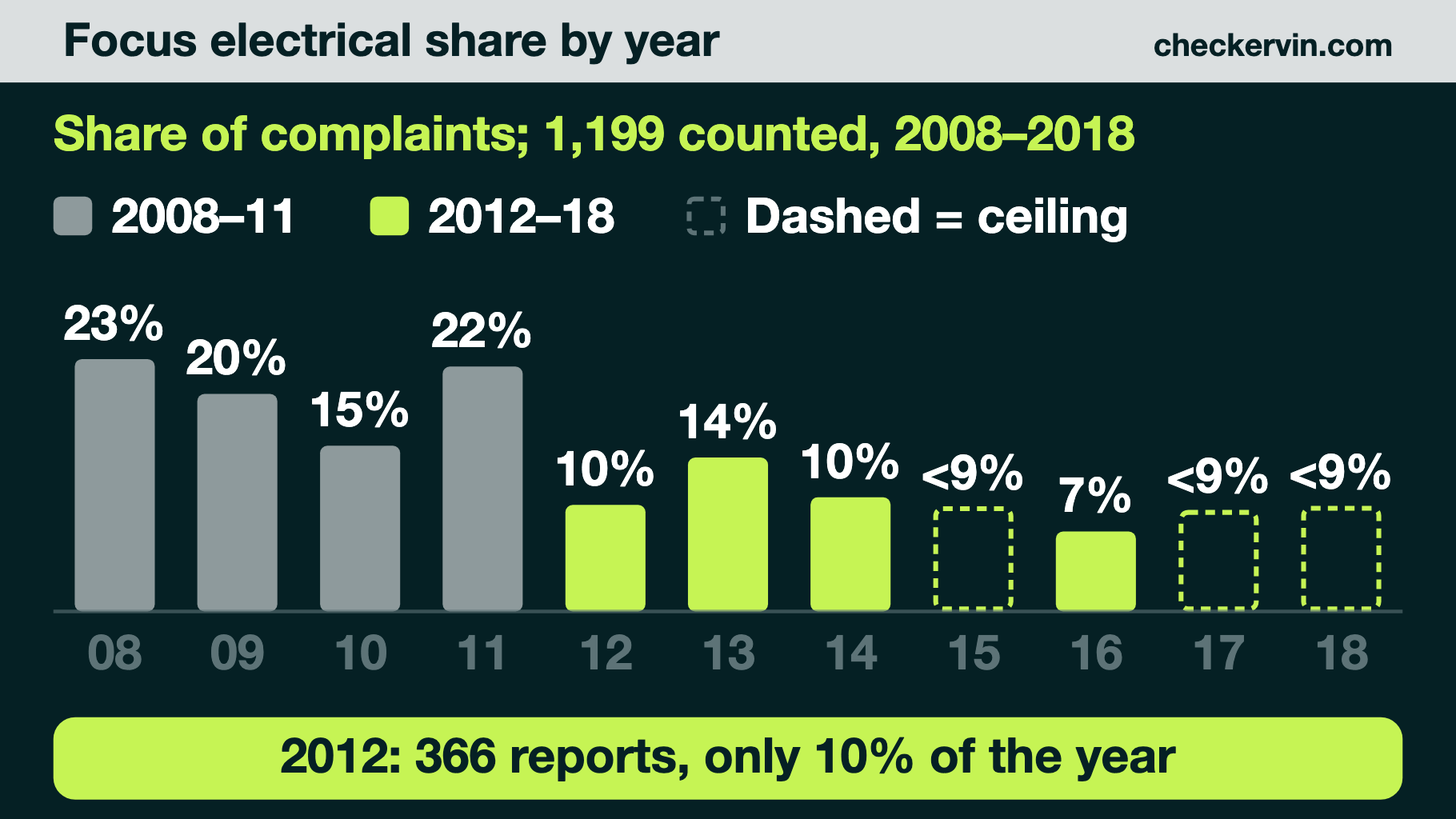
Our corpus of federal NHTSA complaints holds 13,494 reports against the 2008–2018 Focus. NHTSA has no alternator category. The closest is ELECTRICAL SYSTEM, which takes in the 12-volt battery, wiring, lighting, the body and powertrain modules and anything else an owner files as electrical. It reaches the five most-reported components in 8 of 11 model years and ranks first in 2008, 2009 and 2011. In 2015, 2017 and 2018it sits below that year’s fifth category, which is not zero: in 2015 it was under 96. Across the years it is counted, it adds up to 1,199 reports.
Raw counts make the 2012 car look like the electrical problem year, and our Focus starter post charts them that way. The chart above shows the other side. On the 2008–2011 car, electrical is 170 counted reports, about 19% of those years’ complaints; in 2008 it is 23% of the year. In the 2012-and-later years where it is counted (2012, 2013, 2014 and 2016), it is 1,029 reports but only about 10% of those years’ complaints. The electrical count rose because the total rose: 2012 brought roughly 34 times the complaints of 2011.
Complaints are unverified owner reports, not a failure rate. They are useful here for what owners describe, and that is the next section.
2012–2014: the electrical spike is not the alternator
2012 carries the most electrical complaints on the nameplate, 366, and still ranks only fourth that year, behind POWER TRAIN at 1,461, STEERING at 933 and ENGINE at 477. In 2013 electrical ranks third with 303; in 2014, fifth with 274. Those are the years of the DPS6 dual-clutch automatic, and the owners filing electrical complaints are mostly describing it.
We read every 2008–2018 Focus complaint whose text names the alternator. There are few in any year. The common pattern is an owner writing that the battery and alternator were tested and were fine, while the car would not start, stalled, flashed a transmission fault or lost steering assist. One 2012 owner traced an intermittent no-start to the transmission module not recognizing Park; another had a dealer repair a body control module connector after the transmission and alternator showed no fault; a third believed key fob programming, not the alternator others blamed, kept the car from turning over.
A few reports do describe the alternator itself, and they read differently: a 2012 owner whose alternator seized at under 21,000 miles, tore off its pulley and shredded the belt on the freeway with a metallic grinding sound. That is what a failed alternator sounds like in the record, and it is rare. The transmission module, the purge valve recall and the other no-start causes are in our starter post and the full PowerShift story is in our Focus transmission replacement cost post; neither is repeated here.
A ground fault Ford told dealers to fix before anything else
One Ford service article speaks directly to the “everything electrical is acting up” complaint. Ford’s online service information article 44287, from November 2013 and filed by NHTSA under the 2013 and 2014 Focus, covers the body control module ground on 2013 C-Max, 2013–2014 Escape and Focus models with code U3008:13. Ford says a poor ground can cause low voltage at the body module and erratic, intermittent operation of several electrical components, and that the ground issue must be given priority over other codes or symptoms.
On the Focus the article names ground circuits G107 and G301. The test is to load each circuit with a bulb, measure the voltage drop while moving the harness, and repair any circuit that drops more than 0.3 volts. Its last line is the useful one for anyone holding a quote: “BCM replacement will result in repeat repair if ground issue is left unresolved.” The same logic applies to an alternator. Flickering lights and odd warnings on a 2013 or 2014 Focus with code U3008:13 stored are a ground question first.
Battery light, then heavy steering
The Focus steers with an electric motor rather than a hydraulic pump; Ford’s service message SSM 46210 lists the 2012–2016 car among its electric power steering vehicles. That motor runs on the car’s 12-volt electrical system, so a charging fault can show up at the steering wheel. In the narratives, a 2013 owner describes a battery light that came and went for two days, then steering that grew heavy and locked once parked, with a transmission fault message on every start afterward.
It also runs the other way. One 2012 owner describes a dealer blaming a low battery with a bad cell for a steering lockup; the battery was replaced, the dealer later found the battery and alternator both good, and the steering assist failed again. If a Focus loses steering assist and the battery light was on first, have the charging voltage measured with the engine running. If the battery light never came on, the steering fault deserves its own diagnosis, and an alternator will not cure it.
Signs it really is the alternator
A failing alternator stops replacing what the car uses, so its symptoms show up while driving: a battery light, lights that dim or pulse with engine speed, accessories that cut out, and eventually a stall with a dash full of warnings once the battery is drained. Noise is the other clue. A whine that rises with engine speed, or the grinding that 2012 owner heard, comes from bearings or the pulley.
| What you notice | Where it points first |
|---|---|
| Battery light on while driving, lights dim with engine speed | Charging system: alternator, its plug, the battery cable nut, the belt. |
| Dead after sitting for days, alternator tests good | A key-off drain or a weak battery, not the alternator. |
| Flickering lights, odd warnings, U3008:13 stored (2013–2014) | Body module ground circuits G107 and G301 (Ford article 44287). |
| Steering assist lost with no battery light | Steering diagnosis; a charging fault would normally light the battery lamp. |
| FordPass says Deep Sleep Mode (2017–2018) | Car unused for 14 days or a low battery state of charge (SSM 50975). |
| Grinding or whine from the front of the engine | Alternator bearing or pulley, or the belt tensioner. |
For a 2017–2018 Focus with a connected modem, Ford’s SSM 50975 explains the Deep Sleep Mode message: the car enters it after 14 days without a start, at or below 9.5 volts, or when the body module sees the battery under half charged. Ford’s next step, if charging does not move the reading, is battery and battery monitoring sensor diagnosis. Confirm the battery is the right one for the car with our battery size by VIN page; corroded clamps are a separate, cheap fix covered in our starter post.
The serpentine belt, and a belt that is not the same thing
YourMechanic’s Focus estimate for the alternator belt alone is about $107: $12 in parts and $95 in labor. On an alternator job the belt is off anyway, so a new belt should cost little more than the part. Ask for it if the old one is cracked or glazed, and check the tensioner, since it comes off in the video above. Our Focus water pump postcovers that pump’s pulley drive, worth a word with the shop if the pump is also near due.
On the 1.0-liter EcoBoost, do not mix up the accessory belt with the oil pump drive belt inside the engine. Recall 23V-905 covers the oil pump drive belt or its tensioner on 2016–2018 Focus cars, and Ford’s program 26L02 changes the service interval for the 1.0-liter’s timing and oil pump belts. Neither is the belt that turns the alternator, and neither is a reason to replace it.
Is a new alternator worth it?
When the diagnosis is right, the arithmetic is simple. The estimates above sit between about $339 and $673, and a Focus that will not stay running is worth very little until it is fixed. The risk is paying for an alternator that was not the fault, which on the 2012–2014 car is exactly what the narratives describe. Spend the first money on a test.
- Ask for the charging voltage at idle and with loads on, in writing.
- Have the battery load-tested; an alternator cannot fix a failed battery.
- Ask for stored codes by number, including U3008:13 on a 2013–2014.
- Confirm the engine by VIN before ordering the part.
- Ask whether the alternator is new, remanufactured or Motorcraft, and its warranty.
- Ask for the labor hours on the quote, and whether the belt is included.
- Run the VIN for open recalls; the purge valve recall still reaches many cars.
Focus Electric: there is no alternator to replace
The battery-electric Focus has no engine, so there is no belt and no alternator. When one of these will not power up, Ford’s own bulletins point at the 12-volt side. TSB 15-0134, from August 2015, covers a discharged 12-volt battery on 2012–2015 Focus Electric cars: test it on a diagnostic charger, replace it if it fails, reset the battery monitoring system after a new battery, reprogram the powertrain and related modules, and on some early builds replace the telematics unit. Ford allows 0.7 to 1.4 hours.
An earlier bulletin, 13-9-19 from September 2013, covers 2012–2014 Focus Electric cars showing a red triangle, Stop Safely Now or a wrench lamp, with a 12-volt battery running low when the car sits unplugged for two or more days; the fix is a module reprogram. A shop quoting an alternator for a Focus Electric has the wrong car.
If you are buying a Focus, not fixing one
An alternator in a used Focus’s receipts is not a warning sign by itself; it is a wear part. Two replaced in a short span on a 2012–2016 automatic is different, because the narratives show shops reaching for the alternator while hunting a transmission or module fault. Ask what the original complaint was and whether it came back.
On the test drive, watch for the battery light, listen for a whine at idle, and switch on the headlights and blower at a stop to see whether the lights dim. Check the VIN for open recalls before you buy. The newest years are not exempt from electrical reports: in 2018 the category falls below the fifth, under 78 complaints, but it is still part of the record. The year-by-year picture for every component is on our Ford Focus problems page.
Where this information comes from
- NHTSA copy — Ford service article 44287, body control module ground, DTC U3008:13Grounds G107 and G301 on the Focus, the 0.3-volt limit and the repeat-repair warning.
- NHTSA copy — Ford TSB 15-0134, Focus Electric discharged 12-volt batteryWhy a Focus Electric dead-battery problem is a 12-volt and module question.
- NHTSA copy — Ford TSB 13-9-19, Focus Electric module reprogrammingWarning lamps with a low 12-volt battery after two days unplugged, 2012–2014.
- NHTSA copy — Ford SSM 50975, Deep Sleep ModeThe 14-day, 9.5-volt and 50% state-of-charge triggers, and the battery sensor next step.
- NHTSA — recalls by VINThe official lookup; our query found no alternator or charging campaign for 2008–2018.
- EPA — fueleconomy.gov vehicle recordsThe engines offered in each Focus model year.
- RepairPal — 2012 Ford Focus repair costsThe $535–$673 alternator replacement range, retrieved November 2026.
- YourMechanic — Ford Focus alternator replacement estimateThe $339 average with its parts and labor split, retrieved November 2026.
- YourMechanic — Ford Focus alternator belt replacement estimateThe $107 belt estimate, retrieved November 2026.
- AutoNation Mobile Service — Ford Focus alternator replacementThe $537 average and about two hours of work, retrieved November 2026.
- TRQ — How to Replace Alternator 2008-2011 Ford Focus (video listing)The 1 hour 48 minute professional estimate, filmed on a 2008 Focus SES 2.0L.
Keep reading
Frequently asked questions
Is a new alternator worth it?
If the alternator has actually failed, usually yes: the car will not stay running without one, and the estimates we found for a Focus run from about $339 (YourMechanic) to $535–$673 (RepairPal, 2012 Focus), well under what most running Focus cars are worth. The question is whether it has failed. Ask for the charging voltage with the engine running, a battery load test and any stored codes before you approve the part. A remanufactured unit with a warranty is a reasonable choice on an older car.
How much to replace serpentine belt on Ford Focus?
YourMechanic's Focus estimate for the alternator belt is about $107, with $12 for parts and $95 for labor. If the alternator is being replaced anyway, the belt is already off, so a new belt should add little more than the part. On the 2016–2018 1.0-liter EcoBoost, the separate oil pump belt is a different part with its own recall, 23V-905; do not confuse the two.
What are the symptoms of a bad alternator on a Ford?
A battery warning light while driving, headlights and dash lights that dim or flicker with engine speed, a battery that goes flat during or soon after a drive, a whine or grinding from the front of the engine, and a car that runs on battery for a while and then stalls with every warning light on. A battery that dies after sitting for days, with the alternator testing good, points at a drain instead.
How long does it take to replace a Ford Focus alternator?
AutoNation Mobile Service estimates about 2 hours for a Focus. TRQ's listing for its 2008–2011 Focus video estimates about 1 hour 48 minutes for a professional. On the 2012–2018 2.0-liter the alternator sits low and comes out from underneath, so the car has to be raised. We found no Ford labor time for the job to quote.
Is there a recall on the Ford Focus alternator?
Not that we found. Our query of NHTSA's recall database for every Focus model year from 2008 to 2018 returned no campaign that names the alternator or the charging system, and none of the 385 Ford service documents NHTSA lists for those years mentions the alternator. Run the VIN anyway: the purge valve recall 26V-369 and others still reach many Focus cars.
Check the VIN before the alternator
A free CheckerVIN report shows the factory build, engine and open recalls for any VIN, so the alternator you order fits the engine you have.
Run a free VIN check