The short answer
- What does it cost?
- RepairPal lists $506–$676 for a 2016 Focus in Houston. YourMechanic's Focus average is about $278.
- Is it really the starter?
- Often not. Ford documents no-starts from the DPS6 transmission module, the purge valve recall, a chafed harness and the body module.
- What should I check first?
- Open recalls on the VIN, stored trouble codes, the battery and its clamps, and whether the engine cranks at all.
$506–$676
RepairPal, 2016 Focus starter
Houston, retrieved Nov. 2026
1,199
Electrical reports counted
2008–2018, federal record
16-0129
Ford TCM no-start bulletin
2012–2016 DPS6 automatics
26V-369
Purge valve re-recall
2012–2018 2.0L; letters July 2026
The numbers, and whose numbers they are
We don’t repair cars and publish no price of our own, so every dollar figure here belongs to someone else and carries a date. RepairPal’s estimator for a 2016 Focus in Houston lists a starter replacement at $506 to $676, built from $239 to $350 in labor and $267 to $326in parts, before taxes and fees. YourMechanic’s estimate for the Focus is about $278: $138 in parts and $140 in labor, so labor is roughly 50% of it. AutoNation Mobile Service gives a Focus average of $465. We read all three in November 2026 through their search listings, because RepairPal and YourMechanic refused direct requests from our tools.
The spread is about labor rates and parts source more than the part itself. RepairPal’s figure is one city and one model year; YourMechanic’s blends years. We found no Ford labor time for the starter on the 2.0-liter Duratec, the 2.0-liter direct-injection engine or the 1.0-liter EcoBoost, so we print none. Ask for the hours in writing and whether the starter is new or remanufactured.
One factory labor figure we did find is telling. Ford’s bulletin 16-0129 allows 1.0 hour to replace and program the transmission control module on a 2012–2016 Focus automatic, one of the parts Ford names for an intermittent no-start. Paying for a starter when that module was the fault means paying for both.
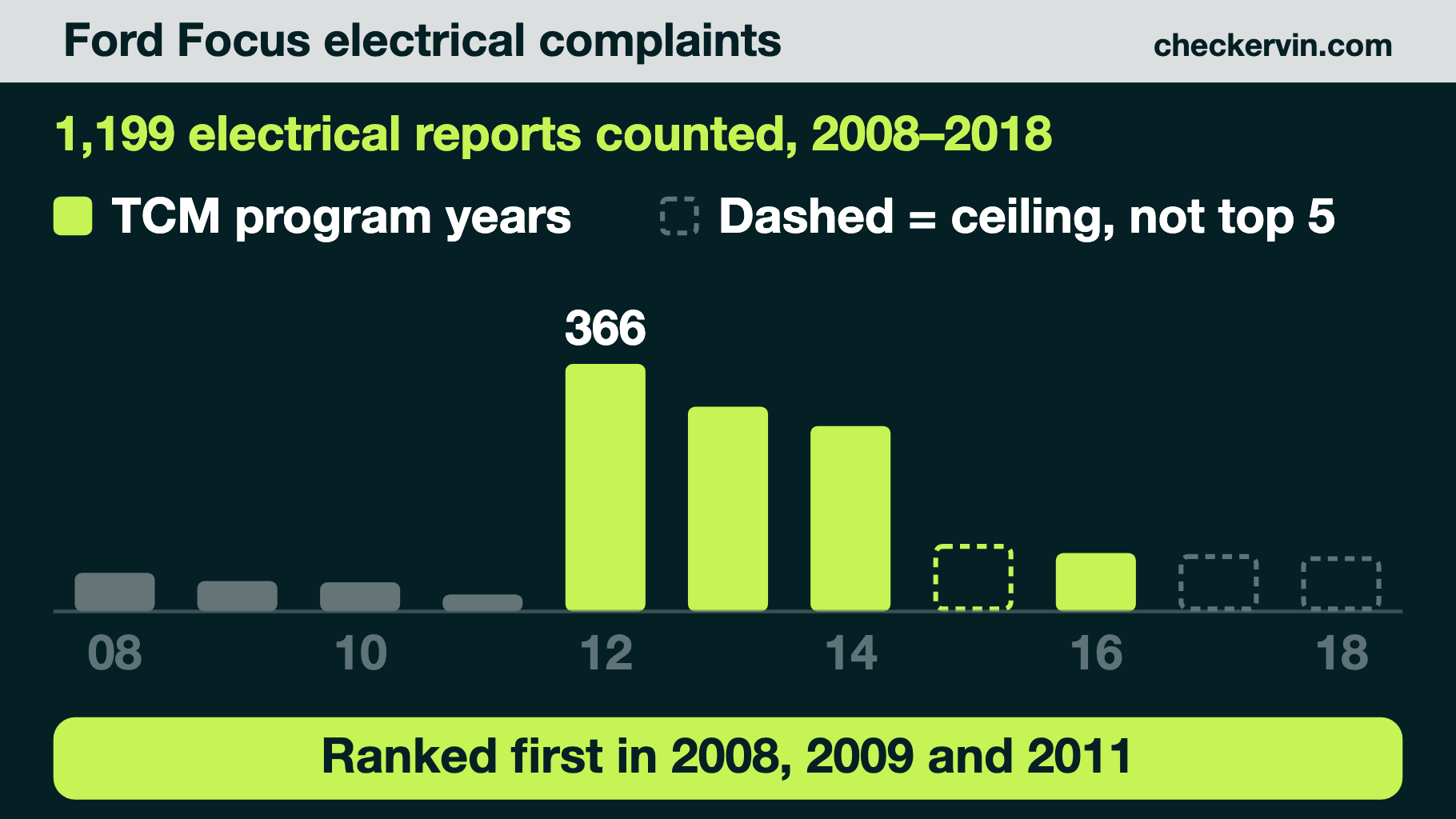
What 1,199 counted electrical complaints say
Our corpus of federal NHTSA complaints holds 13,494 reports against the 2008–2018 Focus, pooling every version NHTSA files under the Focus name. NHTSA has no starter category. The closest is ELECTRICAL SYSTEM, which takes in the battery, wiring, lighting, the body and powertrain modules, the ignition switch and anything else an owner files as electrical. It reaches the five most-reported components in 8 of 11 model years and ranks first in 2008, 2009 and 2011. In 2015, 2017 and 2018it sits below that year’s fifth category, which is not zero: in 2015, for example, it was under 96. Across the years it is counted, it adds up to 1,199 reports.
The shape matters more than the total. On the 2008–2011 car, electrical is a small number that still leads the field: 170 counted reports, about 19% of those years’ complaints. From 2012 the volume jumps. 2012 carries the most, 366, about 10% of that year’s complaints, and yet it ranks only fourth there, behind POWER TRAIN at 1,461. The 2012–2016 years hold 1,029 counted electrical reports, 86% of the nameplate’s counted total.
Two cautions. Complaints are unverified owner reports, not a failure rate. And the battery-electric Focus Electric, which has no starter at all, appears in some of the same Ford bulletin lists; a Focus Electric that will not power up is a 12-volt or high-voltage battery question, never a starter one.
2008–2011: the key that won’t turn
Reading the 2008 and 2009electrical narratives, the part owners name most is not the starter. It is the ignition: keys that will not turn, keys that have to be pushed in hard or wiggled with the steering wheel before anything happens, lock cylinders and switches replaced more than once, and owners who gave up and wired in a push-button bypass. Several describe a car that “won’t turn over” with the lights and battery fine, which is exactly how a dead starter is described too.
We found no Ford recall and no Ford bulletin on the 2008–2011 Focus ignition lock cylinder in NHTSA’s files for those years. That is a statement about what we found: the same lists do contain a 2009 Focus bulletin, TSB-20932, for a no-crank, no-start with code P1260 in the powertrain module and U0100 in the instrument cluster, so start-related bulletins do show up there. If yours stores those codes, the fault is the module conversation, not the starter.
2012–2016 automatics: the no-start Ford traced to the TCM
Ford bulletin 16-0129, published September 2016 and replacing 16-0044 from March of that year, covers 2012–2016 Focus cars with the DPS6 automatic. Its symptom list opens with loss of transmission engagement and includes an “intermittent no start,” usually with the check engine light on, sometimes with messages that hill start assist is unavailable or the parking aid needs service, and a gear indicator that may flash. With codes U0100, U0101, U1013 or P0606 stored, the instruction is to replace the transmission control module. One line in it is worth reading twice: “Always resolve any vehicle low voltage concerns before replacing a TCM.”
Ford’s program 14M02, in its seventh supplement from May 2023, extends coverage of that module to 10 years or 150,000 miles from the warranty start date, transfers with the car, and lists “no-start” among the covered symptoms. It applies to 2012–2016 Focus automatics built from August 1, 2010 through November 5, 2015. The one-time replacement for cars already past those limits ran out on June 30, 2025, and most Focus cars in the program are now past 10 years. A dealer can still look up whether a specific VIN has time left. The rest of the PowerShift story, the clutch programs and the settlement, is in our Focus transmission replacement cost post.
In practice: on a 2012–2016 automatic, a no-start that comes with a flashing gear indicator or a hill start assist message is a transmission module conversation first. 2016 electrical complaints rank fifth with 86 counted, and the earlier years of the program carry far more.
Cranks, will not fire: the purge valve recall, again
Recall 18V-735 covers 2012–2018 Focus cars with the 2.0-liter direct-injection or turbocharged engine. Ford told NHTSA the canister purge valve can fail and pull excessive vacuum in the fuel vapor system, which “may result in an engine stall while driving, without warning and without the ability to restart the vehicle.” The remedy reprograms the powertrain module and replaces the valve where needed, along with the canister, tank and fuel delivery module if they are damaged.
It has not gone smoothly. Recall 19V-515 caught 2012 and 2017 Focus cars and 2013–2014 Focus ST models whose module was not updated the first time. In 2026, recall 26V-369, Ford’s 26S40, added 2012–2018 Focus cars “previously repaired incorrectly under recall number 18V735,” with a software update and owner letters mailed July 29, 2026. A Focus that already had the 2019 fix can still be in the newest campaign.
The diagnostic point is the word “restart.” An engine that stalls and then cranks without catching has a working starter. Run the VIN; on these cars, the recall costs nothing.
2012–2014 2.0 GDI: a crank no-start from a chafed harness
Ford bulletin 18-2062, from February 2018, applies to 2012–2014 Focus cars with the 2.0-liter direct-injection engine built on or before February 4, 2014 with an automatic or February 19, 2014 with a manual. Its symptoms include rough running, loss of power and a crank no-start, with a long list of possible codes. The cause Ford names is the engine wiring harness rubbing through against the intake manifold near the throttle body.
The fix is splicing the damaged wires and wrapping the harness, with a factory allowance of 1.3 hours for up to four circuits. It is also a crank no-start: the starter turns the engine and something downstream never lets it fire. A starter replaced on one of these cars changes nothing.
No crank from the body module, and a remote start quirk
Ford’s service message SSM 47824 describes some 2015–2017 vehicles with “a no crank concern due to a security access key table error.” When a technician tries to program keys or reset parameters, the scan tool reports error 232, key table not allocated, and Ford says the body control module is internally faulted and must be replaced. NHTSA lists the message under the 2015–2018 Focus. If a shop is reprogramming keys before quoting a starter, that error message changes the repair.
On the 2013 Focus 2.0 with Intelligent Access remote start, built on or before April 1, 2013, bulletin 13-6-28 describes a crank no-start or stall shortly after driving when the remote start is used, with codes P025A, U0109 and P0103 all present. The fix is a body module reprogram. A crank no-start that only follows a remote start is not a starter problem.
Manual-transmission cars: check the clutch pedal first
A manual Focus will not crank unless the clutch pedal is pressed all the way down, because a switch at the pedal tells the car it is safe to start. A worn floor mat, a pedal that no longer travels fully or a failed switch looks like a dead starter from the driver’s seat. We found no Ford bulletin on the Focus clutch switch in NHTSA’s files, so treat this as a basic check rather than a documented pattern.
Owners of 2015–2018 manual cars with the 1.0-liter EcoBoost will see clutch recalls on their VIN, 18V-169, 18V-845 and 26V-376. Those concern a clutch that can fracture and leak transmission fluid, a fire risk, not starting. They are worth completing, but they do not explain a no-crank.
Starter, battery or something else?
The symptom narrows it more than any estimate. This table sorts common Focus no-start symptoms by where Ford’s own documents and basic starting-system logic point. It is a guide for the conversation with the shop, not a diagnosis.
| What you hear or see | Where the documents point |
|---|---|
| Single click or silence, dash lights bright | Starter or its circuit are real suspects; test the battery and clamps and read codes first. |
| Slow crank, dim lights | Battery or corroded clamps. Ford sells the clamps separately (SSM 48123). |
| Key hard to turn, works after pushing or wiggling (2008–2011) | Ignition lock cylinder or switch, per owner reports. |
| No start with flashing gear display or hill start message (2012–2016 automatic) | Transmission control module (TSB 16-0129, program 14M02). |
| Stalled while driving, cranks but won't restart (2.0L, 2012–2018) | Purge valve recalls 18V-735, 19V-515 and 26V-369; check the VIN. |
| Cranks, won't start, rough running codes (2.0 GDI, 2012–2014) | Chafed harness near the throttle body (TSB 18-2062). |
| No crank, key programming fails with error 232 (2015–2017) | Body control module (SSM 47824). |
Before you authorize a starter
Most of these checks cost little next to the labor on a starter, and a recall repair costs nothing. Bring the list to the shop.
- Run the VIN for open recalls, especially 26V-369 on a 2012–2018 2.0-liter.
- Ask for the stored trouble codes, by number, in writing.
- Have the battery load-tested and the terminal clamps inspected.
- On a 2012–2016 automatic, ask about U0100, U0101, U1013 or P0606 before a starter.
- On a 2008–2011, note whether the key turns freely.
- On a manual, confirm the car cranks with the clutch pressed fully.
- Get the starter part number and labor hours on the quote.
- Ask a Ford dealer whether 14M02 coverage remains on the VIN.
If you are buying a Focus, not fixing one
A seller who mentions a new starter on a 2012–2016 automatic has told you less than it sounds like. Ask whether the transmission control module was ever replaced, whether the no-start came back, and whether the car had the purge valve work under all three recall numbers. A Focus with a starter, a battery and a module in its receipts is more likely to have had a real hunt than a quick fix.
On the test drive, watch the gear display on startup and listen for a clean crank from cold. Check the VIN for open recalls. The newest years are not exempt: in 2018 electrical falls below the fifth category, under 78 complaints, but the purge valve and oil pump belt recalls still reach that model year.
Where this information comes from
- NHTSA copy — Ford TSB 16-0129, DPS6 no start / loss of engagementThe intermittent no-start, its codes, the low-voltage warning and the 1.0-hour TCM labor time.
- NHTSA copy — Ford program 14M02 Supplement #7, TCM extended coverage10 years or 150,000 miles, no-start as a covered symptom, and the June 30, 2025 cutoff.
- NHTSA — recalls by VINThe official lookup for 18V-735, 19V-515 and 26V-369, the purge valve campaigns.
- NHTSA copy — Ford TSB 18-2062, 2.0L GDI harness chafingCrank no-start on 2012–2014 Focus cars from a harness rubbing the intake.
- NHTSA copy — Ford SSM 47824, no crank from key table errorThe body control module fault behind a 2015–2017 no-crank.
- NHTSA copy — Ford TSB 13-6-28, remote start crank no-start2013 Focus 2.0 with Intelligent Access; fixed by a body module reprogram.
- NHTSA copy — Ford SSM 48123, battery cable clamp corrosionWhy a corroded clamp does not require a whole new cable.
- RepairPal — 2016 Ford Focus starter replacement cost, HoustonThe $506–$676 range and its parts and labor split, retrieved November 2026.
- YourMechanic — Ford Focus starter replacement estimateThe $278 average with its parts and labor split, retrieved November 2026.
- AutoNation Mobile Service — Ford Focus starter replacementThe $465 Focus average, retrieved November 2026.
Keep reading
Frequently asked questions
How much does it cost to replace the starter in a 2012 Ford Focus?
We found no estimator page for the 2012 specifically. YourMechanic's Focus-wide estimate is about $278, with $138 for parts and $140 for labor, and AutoNation Mobile Service gives a Focus average of $465. RepairPal's figure for a 2016 Focus in Houston is $506 to $676. Before paying, check whether a 2012 automatic's no-start is the transmission control module instead; Ford's bulletin 16-0129 names that fault.
Is replacing a starter easy?
On paper it is two bolts and two wires, but access decides the bill, and we found no Ford labor time for the Focus starter to quote. YourMechanic's estimate puts labor at about 50% of its total, which tells you most of the price is hands-on time. Disconnect the battery first, and confirm the starter is actually at fault, because a misdiagnosis is the expensive part.
Can I still drive my car with a bad starter?
Once the engine is running, a failing starter does not affect driving. The risk is being stranded the next time you shut it off. A push start can work on a manual Focus but not on an automatic. If the car stalled while driving and then would not restart, that points away from the starter, and on a 2012–2018 Focus with the 2.0-liter engine the purge valve recall is worth checking.
What are the first signs of a starter going bad?
A single click or silence when you turn the key or press the button while the dash lights stay bright, a slow or grinding crank, or a starter that only works after several tries. A Focus that cranks at normal speed but never fires has a working starter. On 2008–2011 cars, a key that has to be pushed in or wiggled before anything happens points at the ignition lock cylinder, not the starter.
Does Ford cover a Focus that won't start?
For one cause, it did. Ford's program 14M02 extended transmission control module coverage on 2012–2016 Focus automatics to 10 years or 150,000 miles from the warranty start date, and Ford names no-start as a covered symptom. The one-time replacement for cars past those limits ended June 30, 2025, and most cars are now past 10 years. Separately, recall 26V-369 is free on any covered 2012–2018 2.0-liter Focus.
Check the VIN before the starter
A free CheckerVIN report shows the factory build, engine and open recalls for any VIN, so you know whether a no-start recall is still open before you pay for a starter.
Run a free VIN check