The short answer
- What does it cost?
- RepairPal: $696–$828 for a Grand Caravan. KBB showed $874–$972 for a 2010 in one Ohio ZIP and $867–$965 for a 2017 in Pennsylvania.
- Is it a big job?
- Only on the 2008–2010 4.0L V6, whose pump runs off the timing belt. The 3.3L, 3.8L and 3.6L pumps are not timing jobs.
- Is it really the pump?
- Check first. A cracked heater hose Y-fitting on the rear heat loop and, on 2008–2009 vans, a leaky radiator cap both drip coolant like a failing pump.
13 of 13
Years ENGINE is in the top five
2008–2020 model years
#2
ENGINE's best rank in any year
2010, 2012–2014, behind Electrical System
4
V6 engines to tell apart
3.3, 3.8, 4.0 to 2010; 3.6 from 2011
0
Recalls naming the water pump
All years 2008–2020
The prices, and whose prices they are
CheckerVIN does not repair vans, so every dollar figure here belongs to the site that published it. RepairPal’s Grand Caravan estimator lists a water pump replacement at $696 to $828: $244 to $357 of labor and $452 to $471 of parts. The page says the range leaves out taxes and fees and does not adjust for location, and it covers the nameplate rather than a particular model year. Kelley Blue Book is more local. Its 2010 Grand Caravan page, served for ZIP 45014 in Fairfield, Ohio, showed a fair repair range of $874 to $972, and its 2017 page, served for an area near Boyers, Pennsylvania, showed $867 to $965. We retrieved all three on November 22, 2026, from the text the pages served to a search engine, because RepairPal refuses automated requests.
Opened without a ZIP code, KBB’s 2017 page shows no local range and falls back to an FAQ line that a Dodge water pump costs $375 to $787 including parts and labor. That line is not specific to the Grand Caravan, so treat it as a generic figure. The two KBB ranges sit about a hundred dollars apart even though seven model years and a different engine separate them, which says the local labor rate moves the bill more than the model year does. Engine choice matters more than either on one generation of this van, covered below.
What 922 engine complaints say, and what they cannot
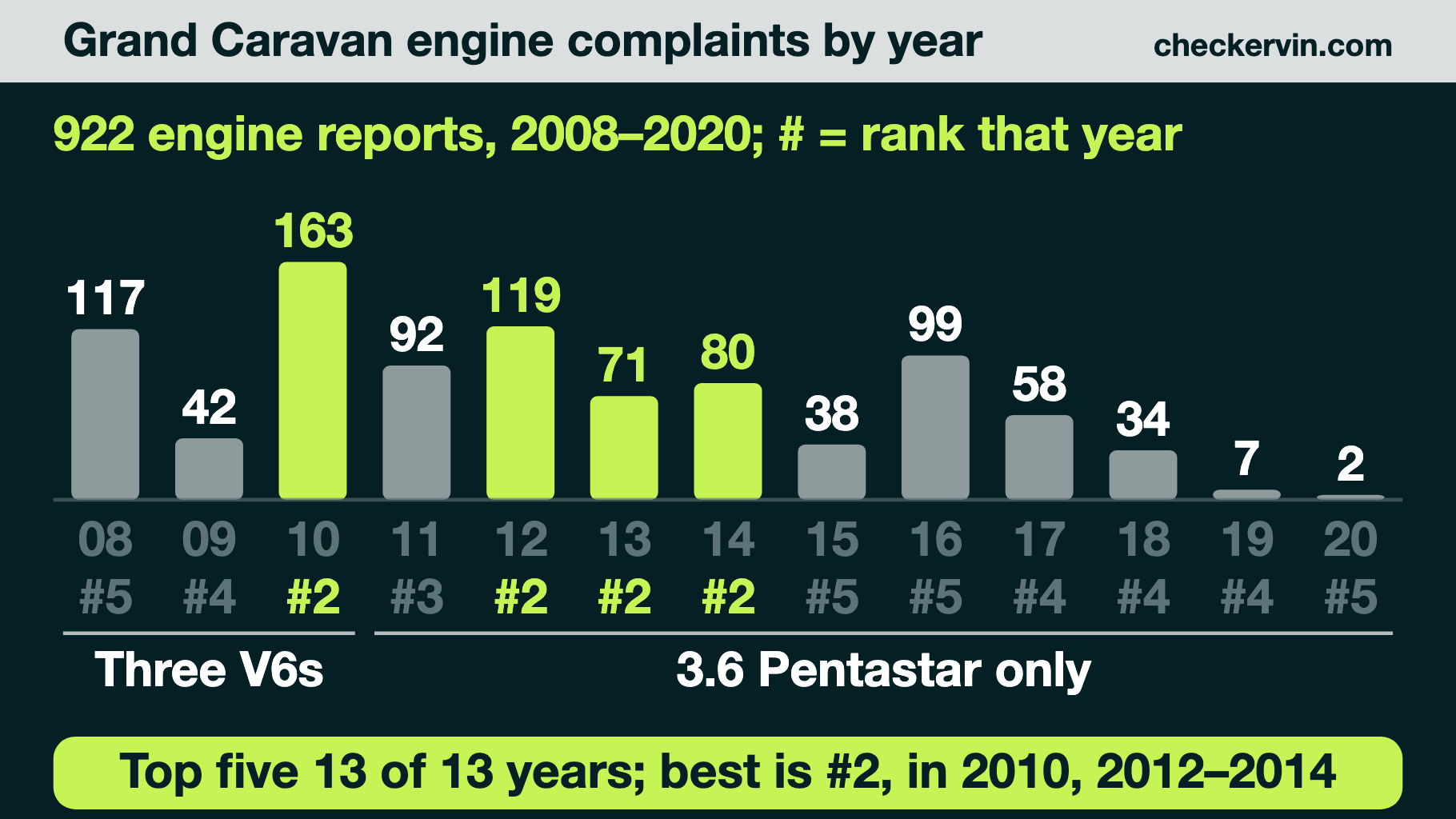
Our corpus of federal NHTSA complaints holds 7,015 reports against the 2008–2020 Grand Caravan, and 922 of them, about 13%, are filed under ENGINE. The category reaches the top five in every one of the 13 model years. It never ranks first. Its best placing is #2, in 2010, 2012–2014, each time behind Electrical System.
The split by engine generation is closer than the tallest bars suggest. The three years of three-engine vans, 2008 through 2010, carry 322 engine reports, 11% of their complaints. The Pentastar years from 2011 carry 600, 15% of theirs. The 2008 model has a large file overall, so its 117 engine reports rank only #5; 2010 has the most, 163, at 16% of that year’s reports.
Now the limit. NHTSA has no water pump category, and ENGINE takes in every engine fault on every engine Dodge fitted that year. The closer heading, ENGINE AND ENGINE COOLING, never reaches a Grand Caravan model year’s top five. We store only the top five, so its exact count is unknown, but it sits below each year’s fifth-place category: under 2 reports in 2020, and under 117 even in 2008. Read the chart as a map of where engine trouble was reported, not a count of failed pumps.
Four engines, and one VIN check to tell them apart
The 2008–2010 Grand Caravan came with a 3.3L, a 3.8L or a 4.0L V6. For 2011 Dodge replaced all three with the 3.6L Pentastar, which stayed until the van ended after 2020. On the VIN patterns we ran through NHTSA’s own decoder, the eighth character was H for a 2008 3.3L, P for the 3.8L, X for the 4.0L and G for the 3.6L. A Dodge VIN decode settles it in seconds.
| Engine | How the pump is driven, and how sure we are |
|---|---|
| 3.3L V6 (2008–2010) | Catalogs list the pump on its own, with no timing parts; no Stellantis document found |
| 3.8L V6 (2008–2010) | Same catalog picture as the 3.3L; no Stellantis document found |
| 4.0L V6 (2008–2010) | Catalogs sell the pump inside timing belt kits; no Stellantis document found |
| 3.6L Pentastar (2011–2020) | On the serpentine belt, per a Stellantis notice for the Pacifica hybrid's 3.6L |
The table is honest about its sources. Stellantis sells its service manuals by subscription, and none of the dealer documents filed with NHTSA for the Grand Caravan says how any of its pumps is driven. What we have is the aftermarket’s parts catalogs for the older engines, which a shop will order from anyway, and one Stellantis notice for the Pentastar.
The 4.0L is the one where the pump is a timing job
Parts sellers list timing belt kits for the 2008 Grand Caravan with the 4.0L, and those kits include a water pump. That pairing exists because the belt turns the pump, so replacing one means taking the other off. On the 3.3L and 3.8L, the pump is sold on its own and the catalogs list no timing parts with it. If the van in front of you has the 4.0L, expect a quote well above the published averages, and expect it to include a belt, tensioner and probably an idler.
The belt also changes the risk of waiting. A pump that seizes, or a leak that soaks the timing belt in coolant, can take the belt with it. If a 4.0L van is losing coolant and nobody knows when the belt was last changed, price both parts together rather than paying twice for the same labor.
The 3.6 Pentastar pump, briefly
Every Grand Caravan from 2011has the 3.6L, and the common fear is that its pump hides behind the timing cover. It bolts to the front of the engine against that cover, but it is turned by the accessory belt. The clearest Stellantis evidence is a 2023 customer satisfaction notification, 47A, for 2022–2023 Chrysler Pacifica and Voyager minivans with the 3.6L hybrid. Its belt procedure warns that if the serpentine belt is not routed correctly, “the engine may overheat due to the water pump rotating in the wrong direction.” That is a Pacifica document, and the hybrid’s belt layout differs, so treat it as strong inference for the Grand Caravan rather than a quotation about it.
We worked through that evidence, and the matching labor figures, in the Dodge Journey water pump post, which uses the same engine. What is different on the Grand Caravan is not the pump. It is the coolant plumbing that a seven-seat van with rear heat carries, which is where the next two sections go.
The rear heater loop, a leak only a minivan has
A Grand Caravan with rear heat sends engine coolant the length of the van. Owners describe the layout plainly in the federal complaint file: a heater hose assembly leaves the top of the engine, splits at a Y-fitting, and sends one branch through the firewall to the front heater core and the other under the van to the rear heater core. The fitting sits above the exhaust at the back of the engine. When it cracks, coolant drips or sprays onto hot metal.
The narratives repeat the same symptoms across 2008, 2009, 2010, 2013 and 2014 vans: a sweet hot-coolant smell inside the van, steam from under the hood, a temperature gauge that wanders, and coolant on the ground near the back of the engine, which is not where most people expect a pump leak. Owners call the Y-fitting thin plastic, and one says it burst at the seams on the highway. One 2013 owner reports replacing the one-piece metal and plastic assembly twice in about 50,000 miles. A 2016 owner describes a different rub point, where a transmission heater coolant line wore through the rear heater return line.
You can do a first check yourself with the engine cold. Look at the back of the engine, toward the windshield, where the heater hoses meet: dried crust or a damp shine on the Y-fitting or on the exhaust heat shield below it points to the heater loop. Then look under the van along the lines that run back to the rear heater, especially at their joints. A pump leak, by contrast, leaves its trace at the belt end of the engine, on the passenger side of the van, around the pump’s pulley and weep hole. None of this replaces a pressure test, but it tells you which question to ask the shop, and it can stop a hose problem from being billed as a pump.
The 2008–2009 radiator cap campaign
The cheapest coolant leak on this van has a campaign number. NHTSA records a Chrysler customer satisfaction campaign, J29, covering about 276,000 Grand Caravan and Town & Country minivans. Its summary says the radiator cap may let coolant weep or leak slowly, leaving the engine low on coolant, and that the cap must be replaced. NHTSA associates it with the 2008 and 2009 model years only, and dates the record May 2010.
A satisfaction campaign is not a safety recall, so it will not show on a recall lookup, and many 2008–2009 vans will have had the cap changed long ago. If yours is losing coolant with no obvious puddle, ask a dealer whether J29 was completed on the VIN, and have the cap pressure-tested before anyone quotes a pump. Our guide to TSBs, campaigns and recalls explains which of these a dealer has to do at no charge.
Stellantis's own inspection list, including the heaters
For the later vans there is a manufacturer checklist. STAR Online case S2307000002, released in August 2023 under the heading “Suspected engine coolant leak,” is filed by NHTSA against 2016–2020 Grand Caravans, although the document itself names no model. It tells technicians to find every potential leak source before replacing parts, to pressurize the cooling system and inspect it under UV light, and to add dye if the coolant’s glow has faded.
Its fourteen-item list runs from the radiator, reservoir, front cover and water pump to the oil filter adapter, the transmission cooler lines and every hose, and it names the HVAC heaters, which on a Grand Caravan with rear heat means two. It also says that coolant residue at the water pump’s weep-hole plug may be normal, but coolant should not be dripping from there, and that residue found low in the engine bay means checking the parts directly above it.
One more item on that list has a paper trail of its own on the Pentastar. Stellantis notices filed against 2012–2020 Grand Caravans tell dealers to reseal the oil filter adapter in the engine valley with an O-ring kit, except on 2014 models, where the adapter itself is replaced. A 2015 record for the 2014 model year describes oil loss pooling in the engine valley. Coolant and oil from up there run down the back of the block, close to the heater-loop leak above.
What the 2010, 2012–2014 engine complaints describe
It would be neat if the years where ENGINE climbs to #2 were full of cooling failures. They are not. Reading the ENGINE narratives for 2010, 2012–2014, the most common report is the van stalling or losing power while moving, often at highway speed, and sometimes restarting after a wait. Some owners blame the power module under the hood, and 2010 vans built between August 2009 and June 2010 carry recall 11V139, for an ignition key that could slip from run to accessory while driving and shut the engine off. Coolant, overheating and water pumps come up only now and then, and one of the few owners who names the pump lists it among a string of cooling parts already replaced without curing the overheating.
The 2012 file carries one engine recall worth knowing. Campaign 11V487 covers 2012 Grand Caravans with the 3.6L built between August 31 and September 13, 2011, whose connecting rod bearings could fail because of debris left in the block; Chrysler replaced the engine. That is not a cooling fault, but a van whose engine was swapped under it may have a different service history from the rest of the year.
What the recall record covers, and other puddles
We queried NHTSA’s recall database for every Grand Caravan model year from 2008 through 2020, and the counts matched our corpus; the 2008 model, for example, returned the same 8 campaigns our data records. No campaign names the water pump, thermostat, radiator, heater hoses or coolant lines.
One 2008 recall produces water inside the van that is not coolant. Campaign 10V611 covers 2008 Grand Caravans whose heating and air conditioning drain grommet could leak water, which could light the airbag warning and, at worst, cause an airbag to deploy without a crash. Dealers replace the grommet free. Plain, odorless water inside the cabin points there; a sweet smell and colored residue point to coolant. The recall check by VIN shows which campaigns are still open on a specific van.
Is it worth fixing on a Grand Caravan?
Dodge stopped building the Grand Caravan after the 2020 model year, so the newest is several years old, and most of the vans needing this repair are worth a modest sum. That makes the water pump a proportion question. Every published estimate on this page is under $1,000, and none of them is specific to an engine. On a 4.0L, the timing belt work pushes the bill above those figures. Overheating is the expensive outcome either way: a warped head or a replaced engine costs a multiple of the pump.
If the van is otherwise sound and you plan to keep it, a confirmed pump failure is usually worth fixing. If it also needs a transmission or other large repair, look up what it is worth with a car value check by VIN and decide on the whole list rather than the pump alone. For a family hauler that only has to last another year or two, a correct diagnosis matters more than the brand of pump.
Before you authorize the repair
- Confirm the engine by VIN: 3.3L, 3.8L, 4.0L or 3.6L
- On a 4.0L, ask whether the timing belt is included and how old the old one is
- On any other engine, question timing parts on the quote
- Ask for a pressure test with UV dye and a photo of the leak source
- On a van with rear heat, have the heater hose Y-fitting checked first
- On a 2008 or 2009, ask whether campaign J29 (radiator cap) was done
The fourth item does the most work, and it is what Stellantis asks of its own dealers. When the system is refilled, use the coolant the factory specified; a coolant type lookup by VIN lists it. If you are shopping for a used Grand Caravan rather than repairing one, the Grand Caravan years-to-avoid breakdown covers the rest of the record, and a pre-purchase inspection that includes a cooling-system pressure test costs far less than any repair on this page.
Where this information comes from
- Stellantis STAR case S2307000002 (NHTSA copy) — suspected coolant leakFiled against 2016–2020 Grand Caravan: the 14-point list, HVAC heaters, weep-hole note.
- Stellantis CSN 47A (NHTSA copy) — 3.6L serpentine belt routingA Pacifica hybrid notice: a misrouted belt can spin the water pump backward.
- NHTSA record of Chrysler campaign J29 — radiator capAbout 276,000 2008–2009 Grand Caravan and Town & Country vans; cap replaced.
- NHTSA record of Stellantis notice 9003357A — Pentastar oil filter adapterAssociated with 2012–2020 Grand Caravan; replace the adapter on 2014 models.
- NHTSA — recalls by VINOfficial lookup for 10V611, 11V487 and every other Grand Caravan campaign.
- NHTSA — vehicle safety complaintsThe federal complaint file our counts and the heater-loop narratives come from.
- RepairPal — Dodge Grand Caravan water pump replacement costThe $696–$828 estimate and parts and labor split, retrieved November 22, 2026.
- Kelley Blue Book — 2010 Grand Caravan water pump replacementThe ZIP 45014 fair repair range quoted above, retrieved November 22, 2026.
- Kelley Blue Book — 2017 Grand Caravan water pump replacementThe Boyers, Pennsylvania range and the generic FAQ figure, retrieved November 22, 2026.
Keep reading
Frequently asked questions
How much should it cost to replace the water pump on a Dodge Grand Caravan?
RepairPal's Grand Caravan estimate is $696 to $828, made up of $244 to $357 in labor and $452 to $471 in parts, before taxes and fees and without adjusting for location. Kelley Blue Book showed $874 to $972 for a 2010 Grand Caravan in ZIP 45014 (Fairfield, Ohio) and $867 to $965 for a 2017 near Boyers, Pennsylvania. All were retrieved in November 2026. A 2008–2010 van with the 4.0L V6 usually costs more, because its pump is driven by the timing belt and most shops replace the belt at the same time.
How much is a water pump for a Dodge Caravan?
RepairPal puts the parts share of a Grand Caravan pump job at $452 to $471, retrieved in November 2026; it does not itemize what that includes. The pump you need depends on the engine: the 3.3L and 3.8L, the 4.0L and the 3.6L Pentastar each take a different pump. Confirm the engine by VIN before ordering, and on a 4.0L budget for a timing belt kit, because the belt drives the pump.
Is the water pump on a Grand Caravan driven by the timing belt?
Only on the 4.0L V6 sold in 2008–2010 vans, according to aftermarket parts catalogs, which sell timing belt kits for that engine with the water pump included. The 3.3L and 3.8L pumps are listed without timing parts. On the 3.6L Pentastar used from 2011, a Stellantis notice for the same engine in the Chrysler Pacifica hybrid warns that a misrouted serpentine belt can spin the water pump backward, which places that pump on the accessory belt. We found no Grand Caravan document from Stellantis that states the drive for any engine.
What else leaks coolant on a Grand Caravan besides the water pump?
On vans with rear heat, owners in the federal complaint file repeatedly describe the heater hose assembly: a hose leaves the top of the engine, splits at a Y-fitting, and feeds the front heater core and a line running under the van to the rear heater core. When the fitting cracks, coolant sprays onto the exhaust. On 2008–2009 vans, Chrysler also ran campaign J29 to replace radiator caps that could let coolant weep. On the 3.6L, the oil filter adapter in the engine valley can leak coolant too.
Which Grand Caravan years have the most engine complaints?
By raw count, 2010, with 163 engine complaints in the federal record, and 2012, with 119. ENGINE never ranks first in any Grand Caravan model year. Its best placing is #2, behind Electrical System, in 2010, 2012–2014, where it makes up 15% to 22% of that year's reports. These counts cover every engine fault, not water pumps, and in those years the narratives mostly describe stalling.
Confirm the engine before you price the pump
A free CheckerVIN report shows the factory build, engine, specifications and open recalls for any VIN, so you know whether you are pricing a timing belt job or a bolt-on pump.
Run a free VIN check