The short answer
- What does it cost?
- KBB's fair repair ranges run from $4,857-$7,465 (2019, East Bernard, Texas) to $7,992-$8,520 (2020, Ogden, Utah). KBB's figures, not ours.
- Does it need a whole transmission?
- Often not. GM fixes the six-speed's broken wave plate with new clutch plates, and treats many nine-speed codes with a valve body or solenoid body.
- Which years?
- Power train tops Traverse complaints only in 2018, 2019 and 2022, and the biggest thread in those years is a Shift to Park shifter fault, not the gearbox.
What a replacement is quoted at
Kelley Blue Book publishes a fair repair range for Traverse transmission replacement by model year and location, parts and labor included. For a 2012 Traverse near Cleveland, Ohio it shows $6,551 to $7,039. For a 2019 near East Bernard, Texas it shows a much wider $4,857 to $7,465. The 2020 page, priced near Ogden, Utah, reads $7,992 to $8,520, and the 2021 page, near Vicksburg, Mississippi, $7,618 to $8,122. Those are KBB’s numbers, read on November 22, 2026 from the text search engines serve for each page. When we opened the 2020 page directly it showed a placeholder ZIP of 00000 and no range at all, because KBB fills its prices in the browser, so each figure carries the location KBB printed beside it. We found no KBB range for the 2011 or the 2018.
GM’s paperwork supplies the labor side for the six-speed’s signature failure. When GM paid dealers to fix broken 3-5-reverse wave plates on 2009 Traverses, it allowed 12.3 hours on an all-wheel-drive model and 11.5 on a front-drive one, a figure that includes pulling the transmission, splitting the case, cleaning it and a front-end alignment. That is a repair inside the existing case, not a new unit, and it already approaches two working days of shop time. We publish no price of our own; what we can add is which transmission your Traverse has, what usually fails in it, and what GM itself does about it.
What the complaint record shows, and what it does not
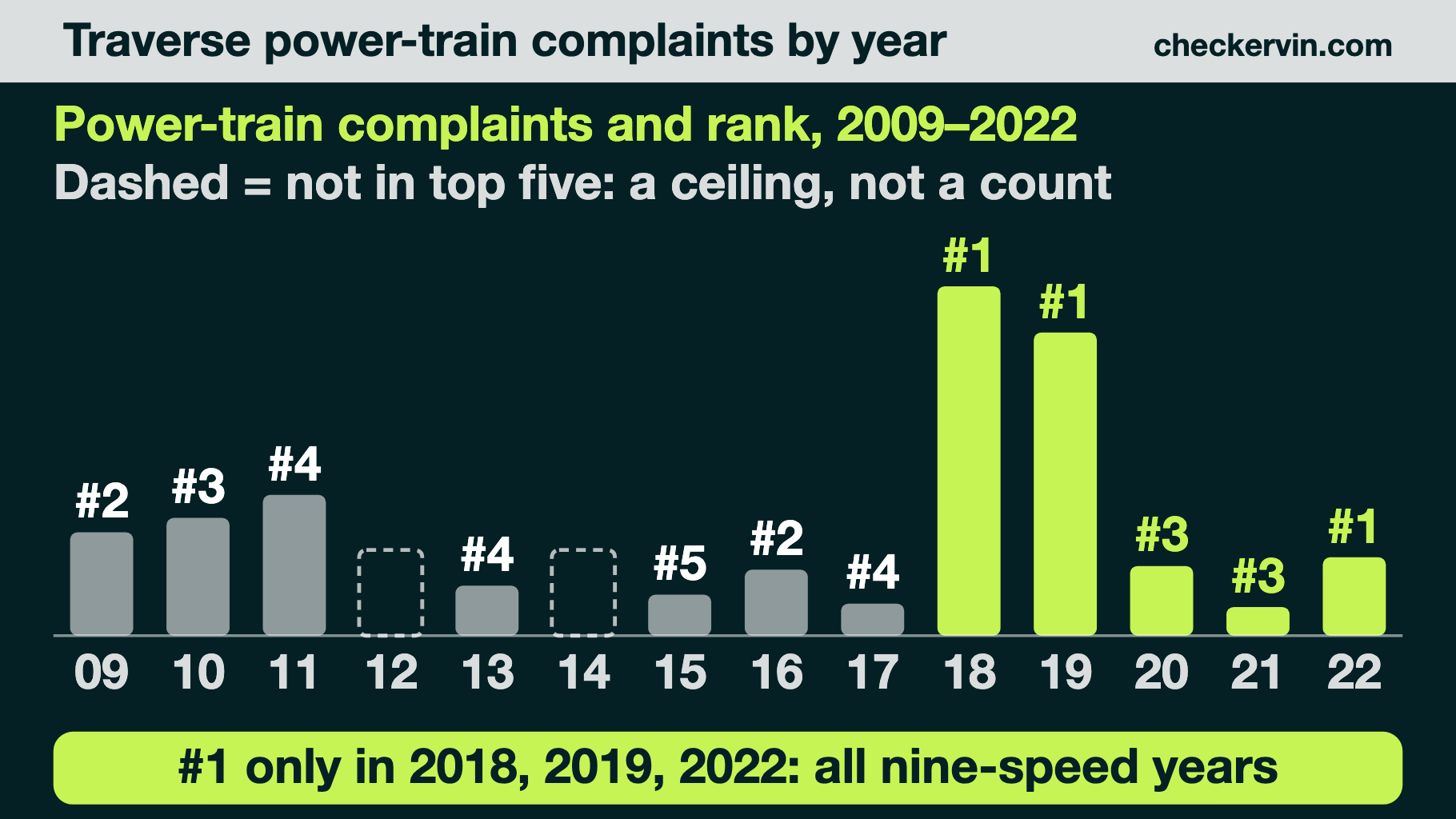
Our corpus of federal NHTSA complaints holds 5,057 owner reports against the 2009–2022 Traverse. POWER TRAIN, the category that collects transmission complaints along with shifters, shift cables, axles and more, reaches a model year’s top five in 12 of those 14 years, and the counted reports come to at least 774. In 2012 and 2014 it falls below fifth place, which means owners reported less of it than five other categories, not that they reported none.
The record splits cleanly at the 2018 redesign. The 9 six-speed years hold 309 counted power-train reports, 8.2% of their complaints, with power train ranking as high as second in 2009 and 2016. The 5 nine-speed years add 465, a much larger 35.7% of theirs. 2018 is the peak at 196 reports, 42.2% of that year’s complaints, and 2018 and 2019 together account for 47.3% of every power-train report we count across all 14 years. Power train is the single most-reported category only in 2018, 2019 and 2022, and every one of those is a nine-speed year.
Two cautions go with every figure. Complaints are unverified owner reports, not a failure rate. And because POWER TRAIN is wider than the transmission, a count is a ceiling on transmission complaints, never a count of failed transmissions. On the Traverse that second caution decides how to read both ends of the chart.
Two transmissions, one break at 2018
A Traverse has had one of two automatic transmissions, and the model year tells you which. GM’s documents name them by family and by option code:
| Traverse years | Transmission, as GM's bulletins name it |
|---|---|
| 2009 | 6T70 or 6T75 six-speed automatic (RPO MH2, MH4, MH6 or MY9), per special coverage 14404B |
| 2010-2017 | GM's six-speed automatic of the same design, with the 3-5-reverse clutch (2016 bulletin 16-NA-013) |
| 2018 on | 9T65 nine-speed automatic (RPO M3V), per bulletins 18-NA-121 and 20-NA-136 |
The split matters for price and for diagnosis. The six-speed’s documented weak point is a single clutch pack, and GM’s repair for it is well established. The nine-speed is newer, has more solenoids and more software, and GM’s own approach to fixing it changed over its first few years, as the bulletins below show. The model year is the tenth character of the VIN, and the build sheet carries the option code that names the unit.
2009-2017: the 3-5-reverse wave plate
The failure Traverse owners mean when they say “the transmission went” on an older truck is usually this one. Inside GM’s six-speed, the clutch pack that applies third, fifth and reverse uses a wavy steel cushion plate. When it cracks or fractures, the transmission loses those three gears: the Traverse may pull away in first and second, then refuse to shift up, or simply not back out of a driveway. A 2011 GM bulletin indexed against the 2009 Traverse describes the symptoms as a service engine light, harsh shifting or no reverse from a broken clutch wave plate. Power train is the second-most-reported category on the 2009 Traverse, at 58 reports, and in those narratives the wave plate is the largest transmission thread, with several owners naming the part outright.
GM answered with special coverage 14404, revised twice and last reissued as 14404B in August 2016. It covered the condition for 10 years or 120,000 miles from the date the vehicle was first placed in service. The models list names the 2009 Chevrolet Traverse, and only the 2009, alongside 2007–2009 Enclave, Acadia and Outlook crossovers with the same transmission family. The remedy is the telling part: dealers replace the 3-5-reverse clutch plates, not the transmission. The procedure has the technician split the case, clean out the metal debris, replace the filters and inspect the screens. Only if debris has reached the screens are the pump and torque converter examined further, and GM states plainly that the debris “can be cleaned and the transmission successfully repaired.”
The 2016 Traverse, the other year where power train ranks second, has its own GM bulletin. 16-NA-013 covers no reverse and no third gear with codes P0716, P0717 or P0776, and traces it to a retaining ring for the input speed sensor’s reluctor that comes out of its groove. The fix replaces the ring, the reluctor wheel, the 3-5-reverse piston and the clutch housing: again a repair inside the case. For a 2010–2017 Traverse with no reverse, the first question for any shop is whether it has opened the transmission and seen which of these it is.
Power-train reports that are not the gearbox
Read the 2010 and 2011 power-train complaints and a large share are not about shifting at all. Owners file timing-chain failures, codes P0008 and P0017, and StabiliTrak or reduced-power warnings under the same heading, because to a driver all of it feels like the car losing drive. Those years still rank power train third and fourth, but the bars overstate transmission trouble. If an older Traverse shows those codes, the bill you are facing is an engine job, which our Traverse timing chain cost guide covers in detail.
The 2009 file carries one more non-transmission item: a federal recall of the shift cable’s adjustment clip, which could let the lever read Park while the transmission was not in Park. It is a linkage problem, coded to the transmission, and it is one reason the category is a ceiling rather than a count.
The #1 years are mostly a shifter, not a gearbox
We read the 2018, 2019 and 2022power-train complaints on NHTSA’s complaint database. In each of those years the single largest thread, by a wide margin, is the “Shift to Park” message: the lever is in Park, the dash insists it is not, and the Traverse will not shut down or lock until the driver jiggles the lever or restarts it. Harsh or clunky shifts are the next most common theme; slipping and loss of drive appear, but they are a smaller share than the chart’s height suggests. In 2019, power train is 170 reports, 41.3% of the year’s complaints, and in 2022 it is 44, 44%, with the same shifter message leading both.
GM’s bulletin 19-NA-206 places the cause in the park switch inside the shifter assembly, and NHTSA indexes it against the 2018 and 2019 Traverse. We did not find a version naming the 2022, so the bulletin is not claimed for it, but the narratives describe the same message. The fault can also leave the accessories on and drain the battery overnight, which is how some owners end up replacing a battery and an alternator first; our Traverse alternator guide walks through that side of it.
What GM tells its technicians to check on the nine-speed
The real nine-speed complaints, harsh shifts, a flashing D, getting stuck in first or reverse, are the ones behind most transmission quotes on a 2018-or-newer Traverse, and GM’s response to them has moved in stages. The first came within weeks of launch. Bulletin 18-NA-121, April 2018, covers 2018 Traverses that start in first or reverse with no upshift and will not exceed 25 mph, with code P2731. GM blamed a software anomaly; the fix is a new valve body spacer plate and updated transmission software, with a four-hour labor allowance.
The second stage went the other way. In July 2020 GM launched a 9T65 Transmission Replacement Pilot for U.S. dealers, naming the Traverse from 2018. For vehicles under 18 months from delivery and under 18,000 miles, it directed technicians to replace the whole transmission instead of repairing it “in most cases,” returning the old units to GM for engineering teardown. The stated goal was fewer days in the shop and fewer repeat visits. It was a program for nearly new cars under warranty, never a free swap for older ones.
The third stage is GM’s current guidance. The October 2024 revision of the same bulletin says the pilot ended September 30, 2021, that mandatory assembly replacement is no longer authorized, and that its teardown lessons have become a repair strategy. That revision applies to low-mileage cars of later model years, so we cite it for its logic, not as a Traverse-specific rule. The logic is useful to any owner: the trouble code decides the repair. Some codes call for only a new solenoid body, some for a valve body, some for both, and only when the fluid is dark, burnt or full of metal does the transmission come out to have its clutches inspected.
Who pays for it now
For the six-speed, GM’s help has run out. Special coverage 14404B ran 10 years from each 2009 Traverse’s in-service date, so even a late-sold 2009 aged out around 2019 or 2020, and the reimbursement window for repairs paid before the program closed on August 31, 2017. The 2010–2017 Traverse was never on the list. We searched every GM communication NHTSA lists for the 2009, 2012, 2016 and 2017 Traverse for another wave-plate or transmission extension and found none, while the same search does surface 14404 and its revisions, so the method finds programs where they exist.
For the nine-speed, it comes down to the warranty clock. Chevrolet’s owner warranty page puts typical powertrain coverage at 5 years or 60,000 miles from the original in-service date, and GM’s nine-speed bulletins list their repairs under powertrain coverage. By late 2026, a 2018–2020 Traverse sold new in its model year is past five years. A 2022 sold new in 2022 may still be covered into 2027 if it is under 60,000 miles, and Traverse production continued after the last model year in our complaint data. We found no nine-speed warranty extension for the Traverse in the GM communications we searched. Asking a dealer for goodwill help costs nothing, but nothing we read obliges GM to give it.
Four recalls, and none of them is a swap
We queried NHTSA’s recall database for every Traverse model year from 2009 through 2022 and kept the campaigns coded to the power train or transmission. There are four. 09V073000 on the 2009 and 14V092000 on the 2014 both fix shift-cable hardware, a clip and an adjuster that could let the lever and the transmission disagree about Park. 20V668000 covers 2018–2020 Traverses whose start/stop accumulator endcap may be missing bolts; dealers inspect it and replace it if so. 21V817000 is a Braun recall on 2020–2021 wheelchair-accessible conversions, where a screw and clip in the wheel well can rub through to the transmission case and cause a fluid leak.
None of them replaces a transmission, and none touches the wave plate or the nine-speed’s solenoids. They matter in a different way: an open accumulator or cable recall is free to clear and should be cleared before anyone diagnoses a shifting complaint on the car.
Repair, rebuild, remanufactured or used
Is it cheaper to fix a Traverse transmission or replace it? GM’s own documents lean toward fixing it far more often than repair quotes do. Its wave-plate procedure rebuilds the clutch pack in the existing case. Its current nine-speed strategy replaces solenoid and valve bodies by trouble code. And its U.S. warranty policy, 20-NA-138, tells dealers to “perform the most cost economical repair” when choosing between repairing and replacing an assembly, with a cost comparison worksheet to prove it. That is GM’s rule for GM’s money, but it is a reasonable standard to hold any shop to with yours.
- In-case repair of the failed part (wave plate, clutch housing, valve body, solenoid body): the cheapest route when the diagnosis is clear and the case is clean
- Rebuild by a transmission shop: your own case with new wear parts, priced and warrantied by the shop
- New or remanufactured unit from GM, installed by a dealer: the top of KBB's ranges, with GM parts warranty
- Used unit from a salvage yard: the lowest parts price and the least information, since the donor's mileage is whatever the seller says
A replacement is the right call when the case itself is damaged, when metal has gone through the pump and converter, or when a shop has already rebuilt the unit once. What should make you pause is a replacement quote that names no cause. On a 2009–2017 Traverse with no reverse, ask whether the 3-5-reverse pack was inspected. On a nine-speed, ask for the trouble codes and the fluid condition. Whether a $5,000-to-$8,500 job is worth doing at all depends on what the Traverse is worth running against what it would fetch as-is.
Before you authorize the repair
- Decode the VIN for the model year, which tells you six-speed (2009-2017) or nine-speed (2018 on)
- If the complaint is a Shift to Park message, ask for the shifter park-switch check in bulletin 19-NA-206 before anything else
- On a six-speed with no reverse, third or fifth, ask whether the shop found a broken 3-5-reverse wave plate or the 16-NA-013 retainer ring
- On a nine-speed, get the trouble codes and fluid condition in writing; many codes call for a valve body or solenoid body, not a transmission
- Ask a Chevrolet dealer to read the in-service date and any powertrain coverage left on the VIN
- Clear open recalls first, including the 2018-2020 accumulator recall 20V668000
A Chevrolet VIN decode confirms the model year and drivetrain, and a transmission lookup by VIN narrows the gearbox; the GM build sheet carries the option code, such as M3V for the nine-speed. Checking what Chevrolet coverage remains by VIN tells you whether any of this is still GM’s bill, and the Chevrolet recall check clears the recall question in the same sitting. If you are shopping for a Traverse rather than repairing one, see which Traverse model years draw the most complaints overall, since steering, engine and airbag complaints lead in many years.
Where this information comes from
- NHTSA — Traverse complaint databaseThe federal complaint record this page's figures are computed from, and where we read the power-train narratives for each year.
- NHTSA-hosted GM special coverage 14404B — transmission clutch wave plateRead in full: 2009 Traverse only; 10 years/120,000 miles; dealers replace the 3-5-reverse clutch plates; 11.5-12.3 labor hours.
- NHTSA-hosted GM bulletin 16-NA-013 — no reverse, no third, P0716/P0717/P0776Read in full: 2016 Traverse; reluctor retainer ring out of its groove; repaired inside the case.
- NHTSA-hosted GM bulletin 18-NA-121 — 2018 nine-speed, P2731Read in full: names the 2018 Traverse nine-speed (RPO M3V); spacer plate and software; 4.0 hours.
- NHTSA-hosted GM bulletin 20-NA-136 (July 2020) — 9T65 replacement pilotRead in full: Traverse from 2018; under 18 months and 18,000 miles; assembly replaced instead of repaired in most cases.
- NHTSA-hosted GM bulletin 20-NA-136 (October 2024) — pilot endedRead in full: pilot ended September 30, 2021; trouble codes now decide solenoid body, valve body or clutch repair.
- NHTSA-hosted GM bulletin 20-NA-138 — engine and transmission replacement policyRead in full: GM tells U.S. dealers to perform the most cost-economical repair.
- NHTSA recalls API — Traverse by model yearQueried for every year 2009-2022; four power-train campaigns, none a transmission replacement.
- Kelley Blue Book — 2020 Traverse transmission repair and replacementThe $7,992-$8,520 Ogden, Utah range, read from search-served page text on November 22, 2026; the 2012, 2019 and 2021 pages were read the same way.
- Chevrolet — owner warranty coverageSource of the 5-year/60,000-mile powertrain term.
Keep reading
Frequently asked questions
What year Chevy Traverse has the bad transmission?
In our NHTSA complaint data, power train is the Traverse's most-reported category in 2018, 2019 and 2022, all years with the nine-speed automatic, and second in 2009 and 2016. Those rankings need reading, though. In the nine-speed years the largest single thread is a Shift to Park message caused by the shifter's park switch, not the transmission. The best-documented gearbox failure is the 3-5-reverse wave plate in GM's six-speed, which GM covered with a special warranty on the 2009 Traverse only. Power train is wider than the transmission, so every count is an upper bound.
How much is a new transmission for a 2011 Chevy Traverse?
Kelley Blue Book did not surface a 2011 Traverse range when we checked on November 22, 2026. Its nearest year, the 2012 Traverse, shows a fair repair range of $6,551 to $7,039 near Cleveland, Ohio, parts and labor included, read from search-served page text because KBB loads prices in the browser. A 2011 has the same generation of six-speed, so quotes in that neighborhood are plausible, but get a written quote for the car itself. We sell VIN checks, not repairs.
Is it cheaper to fix a Traverse transmission or replace it?
Often cheaper to fix, depending on what broke. For the six-speed's best-known failure, a broken 3-5-reverse wave plate, GM's own special-coverage procedure replaces the clutch plates and cleans out the debris rather than swapping the transmission, with an allowance of 11.5 to 12.3 labor hours. On the nine-speed, GM's current guidance replaces a solenoid body or valve body for many trouble codes before anyone opens the case. GM's warranty policy tells its dealers to do the most cost-economical repair, a fair standard to hold any shop to.
Is there a recall on the Chevy Traverse transmission?
Not one that replaces it. NHTSA lists four Traverse recalls coded to the automatic transmission: shift-cable clip and adjuster campaigns on the 2009 (09V073000) and 2014 (14V092000), a start/stop accumulator endcap bolt check on 2018-2020 models (20V668000), and a Braun wheelchair-conversion screw that can rub the transmission case on some 2020-2021 vans (21V817000). Check the specific VIN for anything still open.
Does GM cover Traverse transmission failures after the warranty?
Not under any program still running that we found. GM's wave-plate special coverage, 14404B, covered 2009 Traverses for 10 years or 120,000 miles from the in-service date, so it has expired, and it never named the 2010-2017 Traverse. GM's 9T65 replacement pilot applied only to cars under 18 months and 18,000 miles and ended September 30, 2021. A newer Traverse may still have GM's standard 5-year/60,000-mile powertrain coverage, which a dealer can confirm from the VIN.
Confirm the transmission before you price the replacement
A free CheckerVIN report shows the factory build, specifications and open recalls for any VIN, so you know which Traverse and which transmission you are pricing.
Run a free VIN check