The short answer
- Is VinReport legit?
- It is on the Department of Justice's approved NMVTIS provider list for public and commercial customers, and its terms name its operator, Vehicle Data LLC of Dover, Delaware.
- What does the approval cover?
- The right to sell the federal title record: brands, the latest title odometer, and insurer and salvage-yard reports. Not the auction, service or damage sections, which come from private sources.
- What should you check first?
- Whether you want credits or the trial. The trial rolls into a monthly plan unless canceled, and empty reports are not refunded.
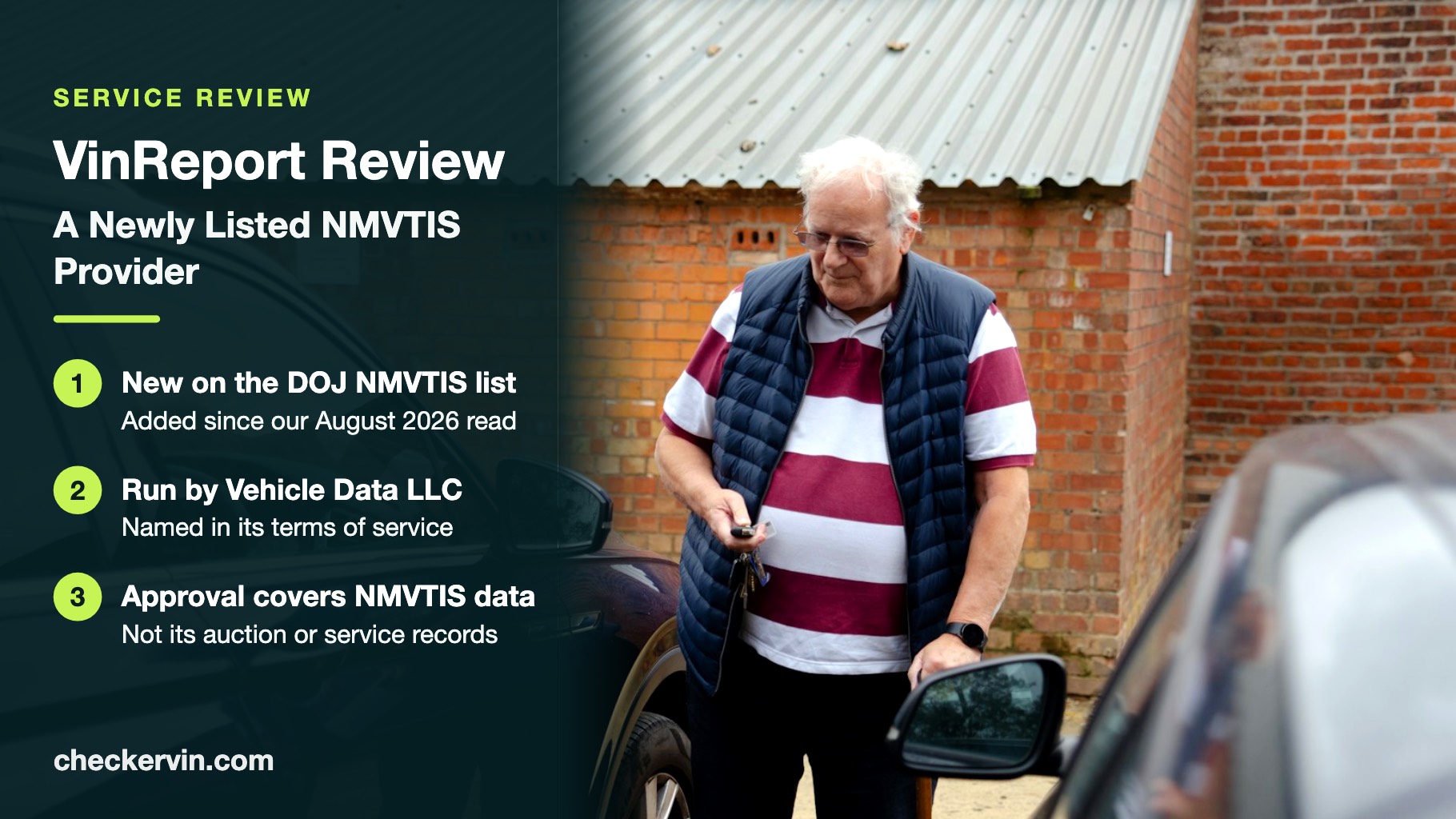
Listed
DOJ NMVTIS provider status
Public and commercial customers
New
Since our August 2026 copy
eleven names then, twelve now
Credits
How it charges
Plus a trial that becomes a monthly plan
Final
Empty-report refunds
Not offered, per its refund policy
The short verdict
VinReport is a credit-based history report with a wide menu: title and brand records it is approved to pull from NMVTIS, plus auction listings and photos, damage, service, inspection and sale records from private sources, and an AI-written summary on top. The federal listing is real and checkable. It is also narrower than the homepage suggests, because only part of the report is the federal record the listing is about.
The things to read before paying are commercial, not technical. The cheapest way in is a trial that becomes a monthly subscription unless you cancel in time, monthly credits expire, and a report that finds nothing is not refunded. None of that is unusual in this market, and all of it is in VinReport’s own terms. It is just easy to miss.
Which VinReport this is
A lot of the traffic for “vinreport” is people typing the name of a site they have already heard of, often as “vin report com.” The site this page reviews is vinreport.com, the address the Department of Justice links from its provider list. Its terms of service, effective December 1, 2025, say it is operated by Vehicle Data LLC, doing business as VINReport.com, with an address in Dover, Delaware.
The name is close to a lot of others. “VIN report” is a generic phrase, and domains built on it are common. Vinreport.io, for example, is a separate site whose homepage does not name Vehicle Data LLC; we could not establish whether the two are related, and nothing on this page applies to it. If you are about to pay, check that the address bar says vinreport.com, or start from the government list and click through.
New on the federal list: what changed
The Department of Justice publishes the businesses approved to sell NMVTIS reports, in two groups. On November 24, 2026, the group for both commercial and public customers had twelve names: Bumper.com, Carsforsale.com, Carvertical.com, Checkthatvin.com, Clearvin.com, EpicVin.com, GoodCar.com, Titlecheck.us, Vinaudit.com, Vindata.com, VinReport, Vinsmart.com.
When we copied the same list on August 21, 2026 for our FaxVIN review, it had eleven. VinReport is the only difference. The department does not print approval dates, so “new” here means new since August on our own records, not a date we can pin down further.
| What the listing shows | VinReport |
|---|---|
| Tier | Both commercial and public customers |
| Name as printed | VinReport |
| Link | vinreport.com |
| Additional websites under it | None listed |
That last row matters more than it looks. Several providers have sister sites listed under them that sell the same federal data under other names; our VinAudit reviewcovers one such pair. VinReport has none, so you are not buying a sister brand’s report under a different name.
What approval means, and what it doesn't
NMVTIS is the federal title system that state titling agencies, insurers and junk and salvage yards report into. The department describes its report as intentionally concise: five key indicators aimed at fraud and theft. The NMVTIS disclaimer VinReport prints in its own terms lists what that covers: state title information, brands, the most recent odometer reading in the state record, and reports from insurers and junk and salvage yards, including total-loss calls. Approval means a provider may sell that record to the public.
It does not mean the government has checked anything else in the report. The department says its list is alphabetical and implies no preference among providers. The same disclaimer says approved providers can include vehicle condition data from sources other than NMVTIS. So the auction photos, the service visits and the damage records stand on whatever private source supplied them. The federal approval doesn’t vouch for them either way.
Is VinReport legit? What can be checked
Three things about VinReport can be verified without taking anyone’s word for it. It is on the Department of Justice list. Its operator is named, with an address, in its terms. And its terms, refund policy and NMVTIS disclaimer are published in full and say plainly what is and isn’t covered, including that a clean report does not guarantee a vehicle is free of defects or accidents.
What cannot be checked from outside is the quality of the private data, and that holds for every provider. Its homepage shows customer testimonials and a review-site rating. We have not repeated them, because we cannot verify them, and neither should a buyer give them much weight. A sample report and the terms tell you more than a quote does.
How VinReport charges
We do not print other companies’ prices, because they change and we cannot vouch for them on the day you read this. Here is the model, from the pricing page and its FAQ as read on November 24, 2026:
- Pre-paid credits: one credit runs one report, and credits bought this way never expire
- A short, low-cost trial for first-time subscribers that includes a few credits
- The trial renews automatically into the monthly plan unless you cancel before it ends
- A monthly plan with a set number of credits each billing month, plus extra credits at a discount
- Monthly plan credits expire at the end of each billing month if unused
The trial is open to first-time subscribers only, and the FAQ says you get an email reminder before it renews. When we loaded the pricing page it also showed a countdown timer labeled as a special offer. We cannot tell from outside whether it resets, so treat the checkout total on the day as the price. How that compares with the rest of the market is in what a vehicle history report should cost.
Before you start the VinReport trial
The trial is the cheapest way in, which is why it is the way most people will go. The refund policy adds the details that decide whether it stays cheap:
- Subscriptions renew automatically; to avoid the next charge, cancel at least 24 hours before the renewal date
- You can cancel from the account dashboard or by emailing support
- No prorated refunds for a partial month or for unused credits
- Credits that came with a monthly plan lapse at the end of the billing month
- Credits bought as a pre-paid pack stay in the account until used
The practical rule follows from that list. If you are checking one or two cars, a pre-paid credit is the cleaner purchase, because nothing renews. If you start the trial anyway, set your own reminder a couple of days before it ends rather than relying on theirs. A trial only makes sense if you expect to run more reports than the trial includes and will keep using the monthly plan.
Refund terms worth reading first
VinReport’s refund policy starts from all sales final and then lists three exceptions: a technical failure that stopped a paid report from being delivered, a duplicate charge for the same report, and a report that came back for a different vehicle than the VIN you entered.
Everything else is listed as non-refundable, and some items are worth knowing in advance. A report that says no records found, or shows only basic decoding, counts as a valid result. So does a report that misses an accident you know happened, or a title status the state has not updated yet. Older cars and cars from states that report slowly are the most likely to come back thin. Not every listed provider handles this the same way: VINsmart, for one, says it credits or refunds a report with no NMVTIS data, as our VINsmart review notes.
The policy also asks customers to contact support before filing a chargeback, and warns that it will submit access logs as evidence that a report was delivered. That is common for digital goods. It means the email to support is the step to take first.
What the report says it holds
The homepage lists thirteensections under “What’s in a report,” and its pricing page also speaks of 13report categories. Here they are in VinReport’s own terms, condensed:
| Section | What VinReport says it covers |
|---|---|
| Event history | Every reported event tied to the VIN |
| Auction history | Past auction listings, photos and sale prices |
| Damage history | Accidents, collisions and reported damage |
| Title history | Ownership transfers across states |
| Title brand history | Salvage, rebuilt, flood and lemon brands |
| Mileage history | Odometer readings, to catch rollbacks |
| Service history | Maintenance and repair records |
| Inspection history | State safety and emissions inspections |
| Recall history | Open manufacturer recalls and bulletins |
| Junk / salvage records | Insurance total-loss and salvage-yard records |
| Sale listings | Past dealer and private-party listings |
| Real vehicle images | Photos of the specific VIN |
| Market valuation | A value based on sales data |
The About page gives a different count, saying 15 report sections are available, and says it checks five or more data sources per report. It also says every report carries an AI-assisted summary and a V-Score risk indicator, a rating of its own design. The numbers don’t quite agree between pages, which is a small thing. The point is the shape: the report covers the federal record and a set of private sources around it.
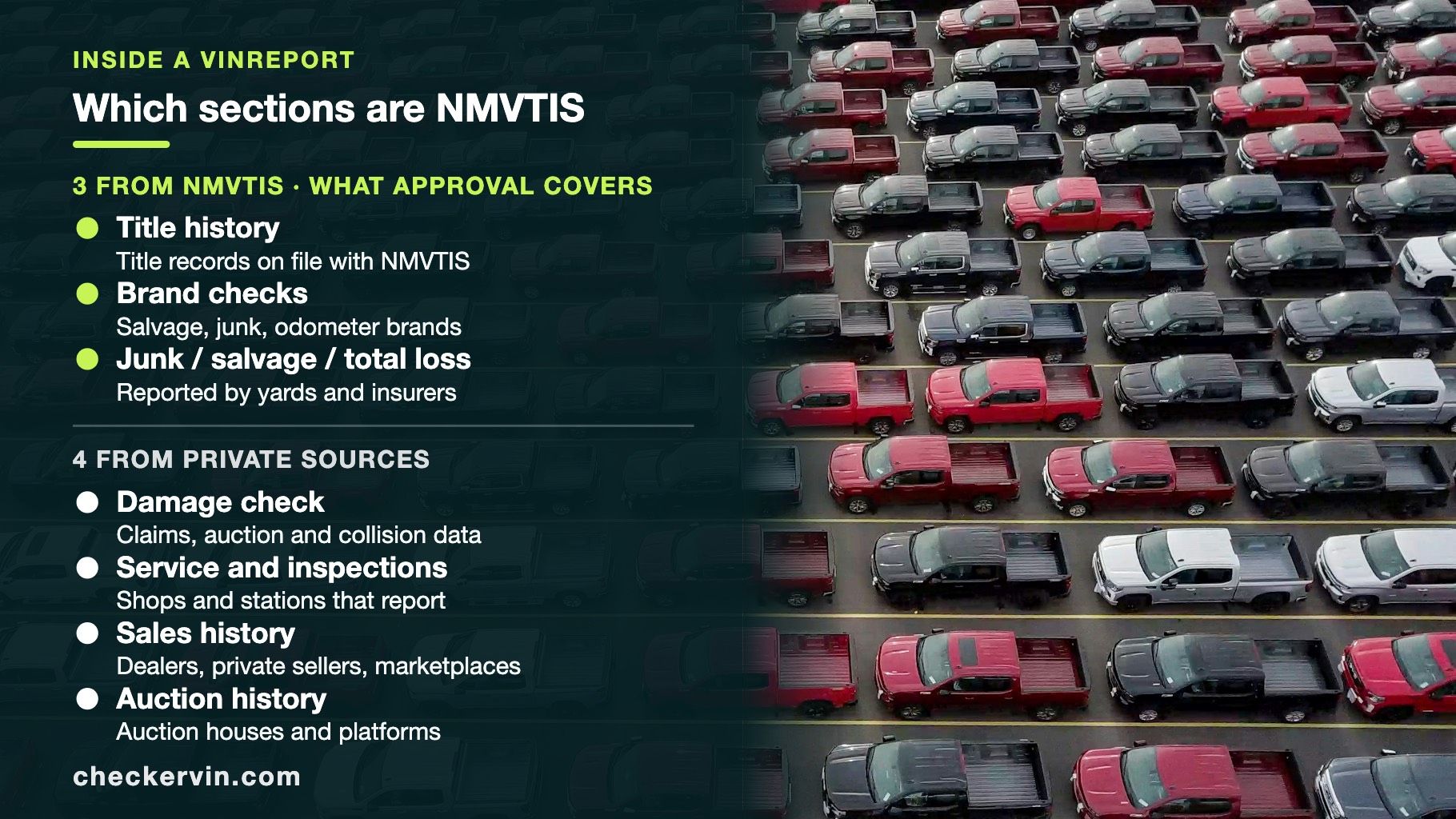
Which VinReport sections rest on NMVTIS
The useful habit with any history report is to know which line stands on mandated reporting and which stands on whatever a private source happened to collect. VinReport makes this easier than most, because its sample report prints a short note above each section saying where the records come from:
| Section | Where the records come from, per VinReport |
|---|---|
| Title history | The title information on file with NMVTIS, per the section's own note |
| Brand checks | Stated as sourced from NMVTIS |
| Junk / salvage / total loss | Businesses that reported the VIN to NMVTIS, per its explanatory note |
| Damage check | Insurance claims, auction reports and collision databases |
| Service and inspections | Dealerships, service centers and inspection stations that report to history databases |
| Sales history | Dealerships, private sellers and online marketplaces |
| Auction history | Auction houses and online auction platforms |
| Safety recalls | Not stated for this section; the campaigns carry NHTSA campaign numbers |
The first three rows are the federal record, which is what the approval is for. The rest come from private networks with uneven coverage. VinReport says so itself: the service note warns that work done at shops that don’t report won’t appear, and the damage note says not all incidents may be reported. The recall rows carry NHTSA campaign numbers, and NHTSA publishes open recalls free, so that section is one you can check yourself.
For what each federal indicator means and how to read a brand you don’t recognize, see our NMVTIS report guide.
Reading the VinReport sample report
The public sample is a 2014 Toyota Corolla with a bad history, which makes it a good demonstration. It shows a junk brand applied by Florida, junk and salvage reports from an auction company, front and right-side damage, an odometer brand, and an open airbag recall. The page opens with an AI-written paragraph that summarizes all of that and advises against buying the car.
Two habits help with a report built like this. First, treat the AI summary as a reading guide, not evidence. It is a paraphrase of the rows below it, and the rows are what came from a source. If the summary says something you cannot find in a table, trust the table. Second, the odometer panel compares the latest reading with an “expected” mileage. That expected figure is VinReport’s estimate, not a record. The record is the sequence of dated readings, and a reading that goes backward is what matters.
The sample also shows how a brand is presented. Each brand has a plain-language definition beside it, and the title section tells you to contact the issuing state about any question. That is the right instinct, and it matches the department’s own advice that every NMVTIS consumer report links to the state’s full title record. When a brand will decide the purchase, confirm it with the state titling agency.
Where VinReport stops
- Coverage gaps in the federal record: the DOJ says about 87 percent of U.S. vehicles are in NMVTIS and warns a search can return a false negative
- Damage that never led to an insurer total loss or a state brand may not be in NMVTIS at all, per the disclaimer in its own terms
- Private sections depend on who reports to those networks; a missing service visit is not proof the work was not done
- No warranty of accuracy: its terms say reports may contain delays, omissions and inaccuracies
- Not a consumer reporting agency: its terms bar using reports to screen tenants, employees or credit applicants
- Disputes go to individual arbitration in Delaware, with a class-action waiver
The first two points apply to every provider on the government list. The department says the same gaps can exist in private databases. A clean result means nothing was reported, not that nothing happened, and no report replaces an independent inspection.
If a buyer asks you to run a VinReport
Some searches for “is vinreport legit” come from sellers, not buyers. The Federal Trade Commission has warned about a scam aimed at people selling cars online. A supposed buyer insists the seller buy a history report from one particular site, and then disappears once it is paid for. The FTC says the aim may be the seller’s card details and personal information.
The FTC’s warning does not name VinReport, and nothing here suggests VinReport is involved in that pattern. The defense works the same whichever name a buyer uses. Ask why it has to be that site. Do not follow a link the buyer sends. If you decide to share a report, start from the Department of Justice list, pick a provider yourself, and type its address. A serious buyer can pay for their own report.
VinReport and CarCheckerVIN, compared fairly
We sell nothing on this page, and it would be easy to make the comparison flattering. Here it is straight.
| CarCheckerVIN today | VinReport |
|---|---|
| Price: free, no card field | Price: per-report credits, or a trial that becomes a monthly plan |
| Factory build and specifications: yes | Factory build and specifications: yes, in its sample report |
| Open safety recalls: yes | Open safety recalls: yes |
| Photos filed against the VIN: yes | Real vehicle images and auction photos: yes |
| Value: market and listing prices | Value: a market valuation and past sale listings |
| Title brands, salvage and odometer: launching soon, not available yet | Title brands, salvage and odometer: yes, as a listed NMVTIS provider |
| Service and inspection records: no | Service and inspection records: yes, from reporting shops |
What our free scan returns today:
- Factory build and specifications decoded from the VIN
- Factory warranty terms
- Open NHTSA safety recalls
- Photos filed against the VIN
- Market and listing prices
Run the free decode and recall check first
Decoded from official manufacturer and NHTSA records
How it sits against other listed providers
Every provider in the consumer tier sells the same federal core, so the differences are in what they add and how they charge. VinReport leans on a long list of private sections and sells them through credits and a subscription. VINsmart, by contrast, sells a shorter report with no subscription, as our VINsmart review describes, and our VinAudit review covers the low-cost end of the list.
Carfax is a different kind of product. The department lists it as an NMVTIS provider for commercial customers in California only, and says consumers cannot get an NMVTIS report from it. Our Carfax alternatives guide sets out where each kind of report earns its price, and how to choose a VIN check covers the rest.
Who VinReport suits
It suits a buyer who wants the federal title record and auction history in one document. Auction photos can show damage a seller has not mentioned. It also suits someone checking enough cars in a month to use a subscription’s credits. It suits less well a one-car buyer who only wants the title record. A single pre-paid credit, or a plainer report from another listed provider, does that job without anything that renews. Whichever you choose, read the listing on the government page first. Then decode the VIN and check recalls free before paying for anything.
Where this information comes from
- NMVTIS — approved data providers (DOJ / BJA)Lists VinReport, linking vinreport.com, for public and commercial customers; retrieved November 24, 2026
- NMVTIS — information for consumersThe five indicators, the 87 percent coverage figure and the false-negative warning
- FTC — Steering clear of vehicle history report scams (October 2018)The scam aimed at people selling cars online, and the FTC's advice
- VinReport — homepageReport sections, NMVTIS wording and FAQ; read November 24, 2026
- VinReport — pricingCredit, trial and subscription model and its FAQ; no prices reproduced here
- VinReport — terms of serviceOperator (Vehicle Data LLC), NMVTIS disclaimer, FCRA clause, arbitration
- VinReport — refund and cancellation policyRefundable and non-refundable cases, renewal and cancellation timing
- VinReport — about and sample reportSection-by-section source notes; the About page is at vinreport.com/about
- NHTSA recall lookupOpen recalls, free, from the source
- How we made this pageWritten by the CarCheckerVIN editorial team with AI assistance from the Department of Justice's NMVTIS pages, VinReport's own pages, the FTC and other public records; facts checked November 2026.
Keep reading
Frequently asked questions
Is VinReport legit?
VinReport is named on the Department of Justice's list of approved NMVTIS data providers for both public and commercial customers, linking to vinreport.com. Its terms of service name the operator as Vehicle Data LLC of Dover, Delaware. That approval covers access to the federal title record; it is not a rating of the rest of the report or of customer service.
Who owns VinReport?
The terms of service on vinreport.com say the site is run by Vehicle Data LLC, doing business as VINReport.com, with a Dover, Delaware address. The terms are governed by Delaware law and send disputes to individual arbitration.
How much does VinReport cost?
It sells pre-paid report credits that never expire, a short low-cost trial for first-time subscribers that rolls into a monthly plan unless canceled, and the monthly plan itself, which includes a set number of credits and discounted extras. We do not print prices because they change; check its pricing page on the day.
When did VinReport become an approved NMVTIS provider?
The Department of Justice list does not print approval dates. What we can say is that our August 21, 2026 copy of the consumer tier did not include VinReport and the list we read on November 24, 2026 did. It is listed alone, with no sister websites under it.
Does VinReport refund a report that shows no records?
No. Its refund policy says a report that returns no records found, or only basic decoding, is a valid result and is not refunded. Refunds are limited to technical failures, duplicate charges and a report that does not match the VIN you entered.
Is vinreport.com the same as vinreport.io?
The Department of Justice list links vinreport.com, and the provider status on this page belongs to that site. Vinreport.io is a separate domain whose homepage does not name Vehicle Data LLC; we could not establish whether the two are related and did not review it.
Start with the free layer
Decode any VIN free for the factory build, specifications and open safety recalls. Full vehicle history reports are launching soon.
Run a free VIN check