The short answer
- Is it a scam?
- No — it is a real service with a free decoder that works. The caveat is narrower and factual: it is not on the government's approved NMVTIS provider list, so its title data does not come from the federal system.
- Is it related to Carfax?
- No. Similar-sounding name, unrelated company, entirely different data access.
- What should you pair it with?
- The free official checks (NHTSA recalls, NICB theft) and, for title truth, a few-dollar report from an approved NMVTIS provider.

Not listed
NMVTIS approved-provider status
Per the DOJ published list
Free
Its VIN decode
Genuinely useful for identifying a car
Unrelated
Connection to Carfax
Despite the similar name
Verify
What to do with any provider
Check the government list yourself
The short verdict
FaxVIN is a functioning VIN-lookup service with a free decoder that does what a decoder should. Where buyers should be careful is in treating it as equivalent to an NMVTIS-sourced title report, because the federal government’s own list of approved providers does not include it. That does not make the service illegitimate; it makes it a different kind of product than the one many searchers think they are buying.
What the free lookup gives you
FaxVIN’s own site describes its free decode as confirming the year, make, model, trim and engine. That is genuinely useful — it confirms a listing is describing the car it claims, and it costs nothing here or anywhere else, including on this site. A fuller decode reads more from the seventeen characters than that, the assembly plant among it, which is worth knowing when you are comparing what one free tool returns against another. Our guide to reading a VIN covers what each position means if you would rather decode it by eye.
Not on the NMVTIS provider list
The Department of Justice publishes the companies approved to sell NMVTIS reports — the federal title record that state agencies, insurers and salvage businesses must report into by law. The current list names Bumper, Carsforsale, CarVertical, CheckThatVIN, ClearVin, EpicVin, GoodCar, TitleCheck, VinAudit, VinData and VinSmart for public customers. FaxVIN does not appear on it.
You do not have to take our word for that, and you should not: the list lives at the official NMVTIS provider page and takes half a minute to read. Running that check against whichever service is asking for your card is the single most useful habit in this market.
What that absence actually means — and what it doesn't
| It does mean | It does not mean |
|---|---|
| Title data shown is sourced outside the federal system | That the company is fraudulent or that its decoder is wrong |
| Title-washing detection cannot be assumed | That every piece of information it returns is inaccurate |
| You should buy title history elsewhere | That free decoding from it has no value |
| Comparisons with approved providers are not like-for-like | That approved providers are automatically better at everything |
The plate-lookup question
A large share of FaxVIN’s search traffic arrives on plate-lookup terms, and this is where expectations need managing regardless of provider. The federal Driver’s Privacy Protection Act restricts personal information in motor-vehicle records to enumerated permitted uses, so no consumer service lawfully returns an owner’s name and address from a plate. Anything implying otherwise is selling an outcome the law does not permit. Our license plate lookup guide sets out what is actually possible.
The name, and the confusion it invites
“FaxVIN” sits phonetically close to the market leader, and a share of its visitors plainly arrive believing there is a relationship. There is none. Judge the service on its own data access rather than on the association the name suggests — a rule worth applying across this entire category, where several brands are operated by the same companies and several names hint at credentials they do not hold.
Who is on the list, if the federal record is what you need
An absence is only useful if you know what to do instead. These businesses are approved to provide the federal title record to all interested parties, consumers included:
- Bumper.com
- Carsforsale.com
- Carvertical.com
- Checkthatvin.com
- Clearvin.com
- EpicVin.com
- GoodCar.com
- Titlecheck.us
- Vinaudit.com
- Vindata.com
- Vinsmart.com
11 names, and the federal data in each of their reports is the same underlying record — so the choice among them is presentation and price, not dataset. The department notes that the list is alphabetical and indicates no preference between them.
Several of those names are the same company
One more thing the same page publishes, which matters if you go shopping after reading this. Alongside several approved providers it lists the other websites those providers own that sell reports containing the same federal data.
| Approved provider | Also sold as |
|---|---|
| Bumper.com | BeenVerified.com |
| Carsforsale.com | VehicleHistoryReport.com |
| EpicVin.com | VinGurus.com and Vininspect.com |
| GoodCar.com | InfoTracer, Recordsfinder.com and StateRecords.org |
| Vinaudit.com | VinCheck.Info |
So a comparison between two names in the same row is a comparison of storefronts over one approval. It is worth two minutes before you conclude one of them is better than the other on the strength of a review that did not know they were related. We reproduce both tiers of the list, with these lines, on how to choose a VIN check.
What to run alongside it
- NHTSA recall lookup — free, official, and it is the actual regulator's data
- NICB VINCheck — free theft and total-loss screen from participating insurers
- An NMVTIS report from an approved provider — a few dollars for federally sourced title brands
- A state title check where one exists, such as Florida's free FLHSMV lookup
- A mechanic's inspection, which outranks every database on this list
Who it suits
It suits someone who wants a quick, free decode and is clear that they are getting identification rather than title certainty. It suits less well the buyer who believes a paid lookup there is interchangeable with an NMVTIS report — that is the expectation gap worth closing before money changes hands, and it is closed by spending a few dollars with an approved provider instead.
Free decode, no account, right here
Decoded from official manufacturer and NHTSA records
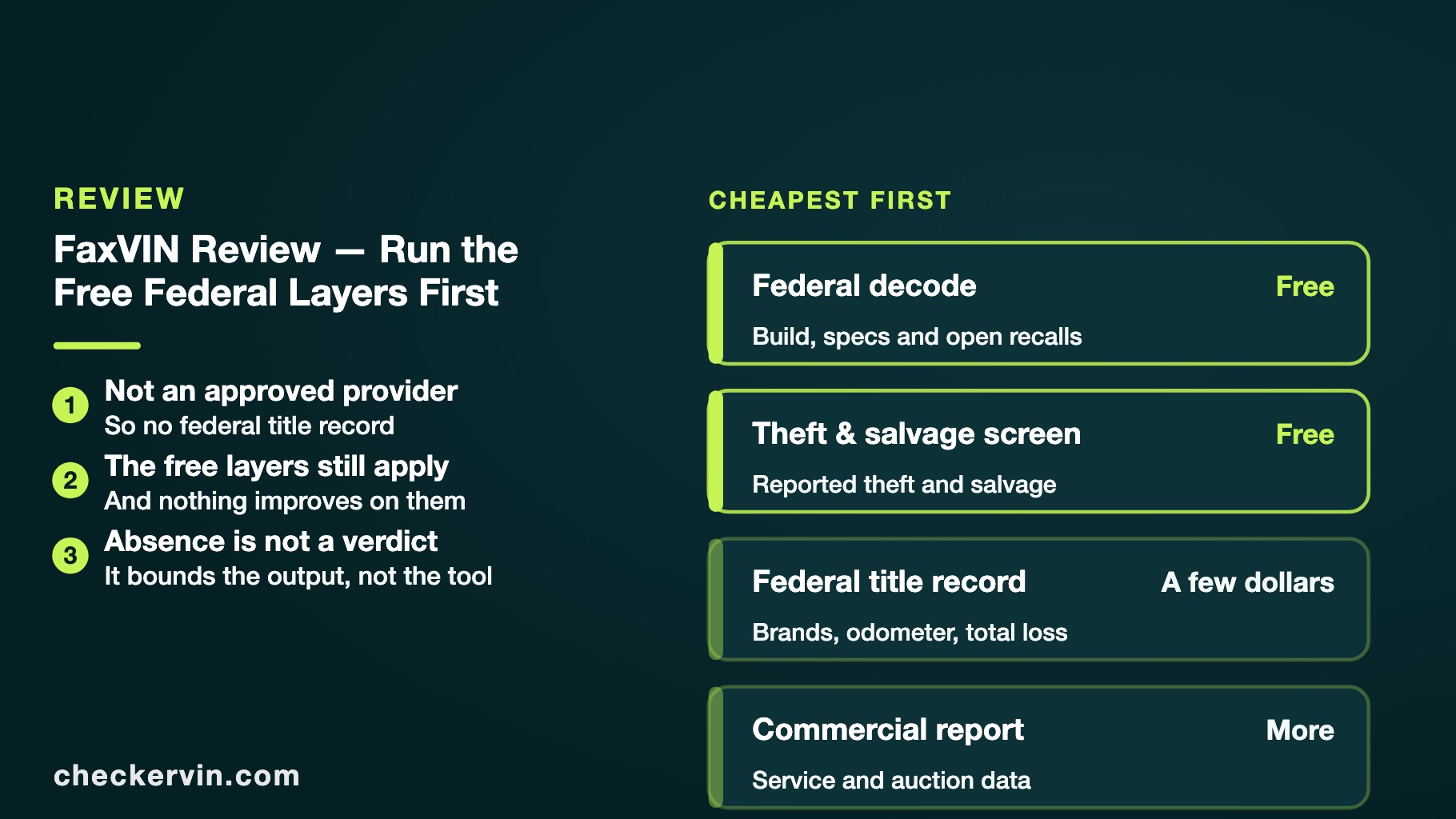
The free federal layers, which no tool improves on
The reason the approval question is a small one rather than a decisive one is that the two most useful free checks do not come from any of these companies. They come from federal sources directly, and every free tool that offers them is re-presenting the same data.
| The check | What it gives you, free |
|---|---|
| The federal VIN decode | Make, model, model year, body class, engine, plant and vehicle type, as the manufacturer filed them |
| The federal recall lookup | Every open safety campaign matched to the VIN — and the repair is free as well |
| The theft and salvage screen | Vehicles reported stolen or sent to a participating salvage yard |
None of those is improved by paying, and all three answer questions that decide purchases. Our page on the federal decoder covers what the decode returns and the result codes that say how much to trust it.
So the sequence that wastes least is: run those three, and only then decide whether the federal title record is worth a few dollars for this particular car. If it is, buy it from a listed provider. That reduces the FaxVIN question to a narrow one about a free tool, which is the right size for it.
Where this information comes from
- NMVTIS — approved data providersThe official list to check any service against
- Driver's Privacy Protection Act, 18 U.S.C. § 2721Why no consumer service returns an owner from a plate
- NICB VINCheckFree theft and salvage screen, independent of any vendor
- NHTSA recall lookupOpen recalls, free, from the regulator itself
Keep reading
Frequently asked questions
Is FaxVIN legitimate?
It is a real, operating service offering free VIN decoding and paid lookups, and plenty of people use it without incident. What it is not, as of this writing, is a company named on the Department of Justice's published list of approved NMVTIS data providers — which is the credential that governs access to the federal title system. That is a fact worth knowing rather than an accusation.
Is FaxVIN related to Carfax?
No. The names rhyme and the confusion is understandable, but they are unrelated companies with entirely different data access. Carfax is an established commercial network; FaxVIN is a separate, much smaller operation. Neither the branding nor the similarity implies shared records.
Is FaxVIN free?
Its VIN decode and some basic lookups are offered free, which is genuinely useful for confirming what a vehicle is. Deeper reports are paid. As with any service, read what a paid report is promised to contain before buying, and compare it against what a few-dollar NMVTIS report from an approved provider includes.
Does FaxVIN show title brands and salvage records?
Its marketing describes history data, but because it is not listed among approved NMVTIS providers, any title information it shows is sourced somewhere other than the federal system that states, insurers and salvage yards must report into. For title-brand certainty, buy from a provider on the government's approved list.
What should I use instead?
Use the free official checks first — NHTSA for recalls, NICB for theft and salvage, a VIN decode for the build. Then, if you need title history, buy an NMVTIS report from an approved provider such as VinAudit, EpicVIN or ClearVin. That combination costs a few dollars and rests on verifiable data access.
Free decode, honestly labeled
Decode any VIN free for the factory build, specifications and open safety recalls. No account, no card.
Run a free VIN check