The short answer
- Is VinDecoderz legit?
- It has held its domain since 2014 and is not on the DOJ's NMVTIS provider list. We could not test the site itself: it blocked our requests.
- Is VinDecoderz free?
- Unconfirmed, because the site would not load for us. A decode can always be free: NHTSA publishes the same kind of manufacturer data at no cost.
- What will a decode never tell you?
- Title brands, odometer readings, accidents, theft and owners. Those come from the federal title record, sold only by DOJ-listed providers.
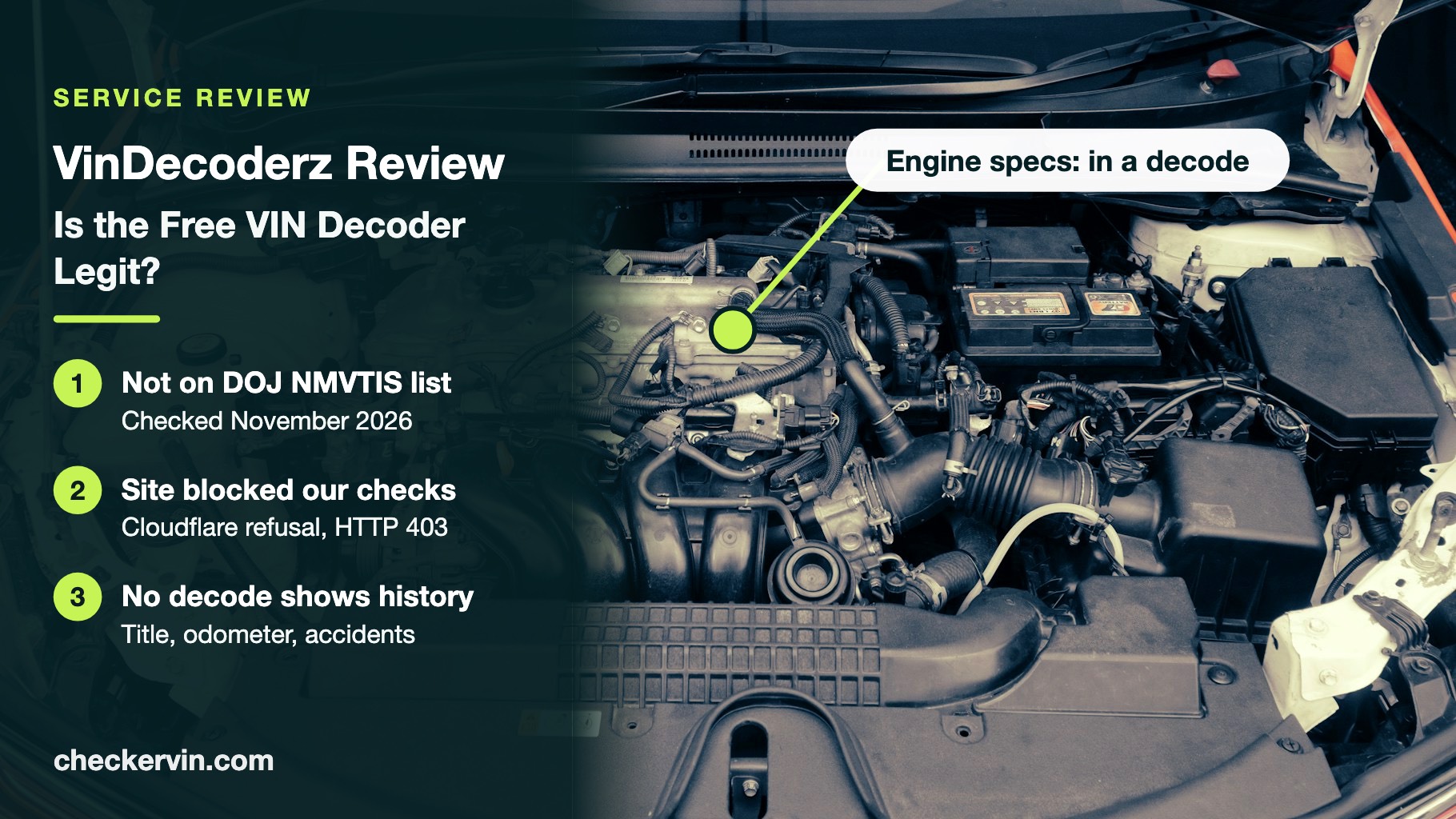
Not listed
DOJ NMVTIS provider status
Checked November 24, 2026
2014
Domain first registered
Per the .com registry record
Blocked
Our requests to the site
Cloudflare, HTTP 403
Free
NHTSA's own VIN decoder
Manufacturer-reported data
The short verdict
We cannot tell you how good VinDecoderz is at decoding, because it would not let us in. What we can tell you is what kind of product it is and what that kind of product can ever do. A VIN decoder reads the manufacturer’s description of a car out of its 17 characters: make, model, year, engine, plant. That is useful and it should cost nothing, because NHTSA gives the same manufacturer-filed data away.
What a decoder cannot be is a history check. VinDecoderz is not on the Department of Justice’s list of businesses approved to sell the federal title record, so if a used-car decision turns on title brands, odometer readings or salvage, that answer has to come from a listed provider. Use any decoder, this one included, for the build; get the history elsewhere.
What we could check, and what we could not
On November 24, 2026we tried to load the pages a fair review should start from. Every one came back as the same Cloudflare “Attention Required” block page, from a script and from a separate fetching tool:
| Page we requested | What came back |
|---|---|
| Homepage (with and without www) | Cloudflare block page, HTTP 403 |
| Terms of use | Cloudflare block page, HTTP 403 |
| Privacy policy | Cloudflare block page, HTTP 403 |
| About page | Cloudflare block page, HTTP 403 |
| robots.txt | Cloudflare block page, HTTP 403 |
We did not try to get around the block. That leaves real gaps, and we would rather name them than fill them: we could not see what fields its free decode returns, whether it sells or links to paid history reports, which company supplies any such report, what its terms of use say, or who it names as its operator. Ratings and descriptions of the site that appear in search results are not repeated here, because we could not trace them to the site’s own pages.
The block itself is not evidence of anything. Plenty of legitimate sites screen automated traffic, and a person using an ordinary browser may well get through. It does mean the rest of this review is about the record around VinDecoderz rather than its contents.
Who runs VinDecoderz? What the registry shows
Every .com domain has a public registry record, which is the one thing about a site that does not depend on the site letting you in. For vindecoderz.com, Verisign’s record shows it was first registered on February 10, 2014 and is paid up to February 10, 2028, and that its name servers are Cloudflare’s, which matches the block page we kept getting.
The registrar’s record lists the registrant as a privacy service rather than a named person or company. That is common and perfectly lawful; it simply means the registry cannot answer “who owns VinDecoderz.” Normally a site’s terms of use or about page would, and those were among the pages that refused to load. Read them yourself before typing an email address or phone number into any VIN site.
What the record does establish is age. A domain held continuously for more than a decade is not a fly-by-night operation, though age says nothing about the quality of the data behind it.
Is VinDecoderz legit? The federal list, read properly
“Legit” means two different things for a VIN site, and the answers differ. The first is whether it is allowed to do what it does. Decoding a VIN needs no license or approval; the decoding rules are public under 49 CFR Part 565 and NHTSA publishes the manufacturer data. Any site can decode, and nothing we found suggests VinDecoderz does anything else improperly.
The second is whether it can give you the federal title record. That is controlled. Only businesses approved by the Department of Justice may sell reports from NMVTIS, the national title system, and the department publishes them. On November 24, 2026 it listed 12 businesses for public customers: Bumper, Carsforsale, CarVertical, CheckThatVIN, ClearVin, EpicVin, GoodCar, TitleCheck, VinAudit, VinData, VinReport, Vinsmart.com. Several have sister sites listed beneath them. VinDecoderz appears nowhere on the page, neither as a provider nor as a sister site.
Is VinDecoderz free? What free can honestly mean
Many people search for “vindecoderz free,” and the honest answer is that we could not see whether its decode is free or what sits behind it. What we can explain is why a free decode is ordinary rather than generous.
Manufacturers send NHTSA the specifications of their VINs under the Part 565 standard, and NHTSA turns those filings into vPIC, a free public decoder with a free public interface. A site that offers a free decode is passing along data it can get for nothing. Free history is a different claim entirely: title brands and salvage records cost money to obtain, which is why every listed NMVTIS provider charges for its report. A site offering a full history for free should tell you where it gets the records, and if it does not, treat the claim with caution.
If what you want is the free layer in one place, our free vehicle history report guide sets out which checks genuinely cost nothing, and cheap VIN checks covers the paid step after that.
NHTSA's own free decoder
NHTSA’s Product Information Catalog and Vehicle Listing, vPIC, is the reference most free decoders sit on top of in some form. The agency describes it as a centralized source for basic VIN decoding built from data manufacturers report under federal rules, and its decoder page says the information shown “is reported by the manufacturer.”
Three limits are stated on NHTSA’s own pages. It is meant for model years 1981 and later, so it cannot decode the short serial numbers on older cars. It accepts partial VINs, which is useful when a character is unreadable. And because it decodes the pattern the manufacturer filed, it can tell you what a VIN pattern means, not what happened to the car carrying it. Our guide to the NHTSA VIN decoder walks through its result codes and every field it can return.
A sample decode, field by field
To show what a decode really contains, we ran a pattern rather than a real car’s VIN through vPIC: 1HGCV1F3*LA. The first three characters are Honda’s passenger-car identifier in NHTSA’s registry; the asterisk stands in for the check digit and the serial number is left off, so it describes a type of car, not anyone’s car. vPIC returned 154 fields, 67 of them filled in. The ones a buyer would care about:
| Field | What vPIC returned |
|---|---|
| Make and manufacturer | Honda; American Honda Motor Co., Inc. |
| Model, model year, trim | Accord, 2020, Sport |
| Body class and doors | Sedan/Saloon, 4 doors, 5 seats |
| Engine | 1.5-liter in-line four, turbocharged, 192 hp, engine model L15BE |
| Transmission and drive | Continuously variable (CVT), 4x2 |
| Assembly plant | Marysville, Ohio, United States |
| Weight class | GVWR Class 1C: 4,001 to 5,000 lb |
| Safety equipment | Curtain air bags in all rows; forward collision warning, lane keeping and automatic emergency braking listed as standard |
| Result code | 6 — Incomplete VIN (the wildcard we used on purpose) |
That is a lot of information, and every line of it describes the car as it left the factory. Look for what is missing: there is no field for a title, a mileage reading, an owner or an accident, because none of those exist when the VIN is assigned. Any decoder drawing on manufacturer data, VinDecoderz included, is working from the same kind of record.
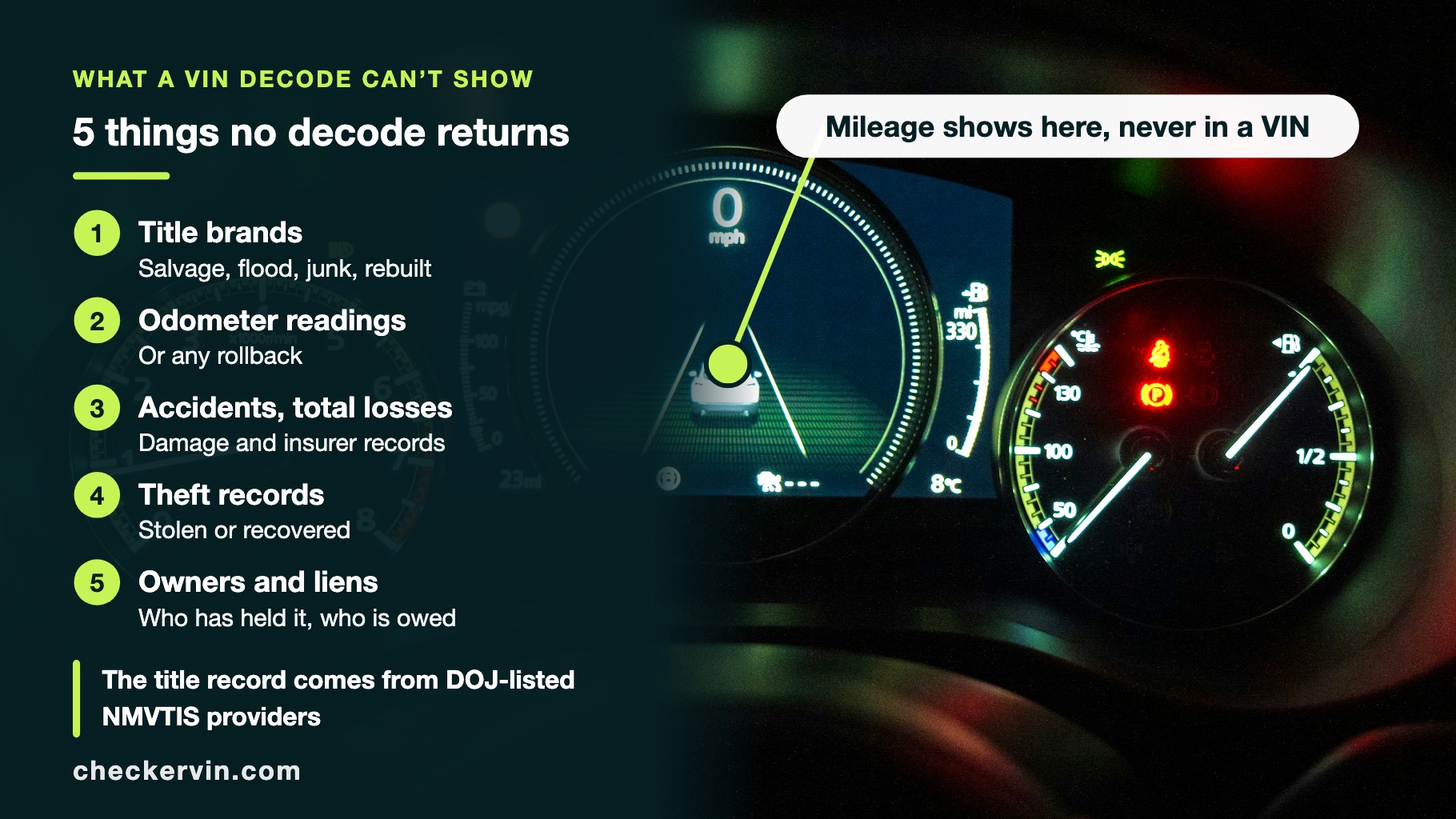
What no VIN decode can tell you
A VIN is stamped once, at the factory. Under 49 CFR Part 565 its characters encode the manufacturer, the vehicle’s attributes, a check digit, the model year, the plant and a serial number. Nothing in it changes when the car is wrecked, flooded, stolen or resold. So no decoder, free or paid, can return any of these:
- Title brands such as salvage, flood, junk or rebuilt
- Any odometer reading, or a rollback
- Accident and damage history
- Insurance total-loss determinations
- Theft records
- Who owns the vehicle, or how many people have
- Liens and loans against it
This is the single most useful thing to understand before using VinDecoderz or any other decoder. A decode that comes back clean does not mean the car is clean; it means the VIN is a valid one and it describes a real model. The questions that protect your money are answered somewhere else.
Where the title record actually lives
The federal answer to title fraud is NMVTIS. State titling agencies, insurance carriers, and junk and salvage yards report into it, which is why a brand applied in one state follows the car into another. The Department of Justice describes an NMVTIS report as intentionally concise: it carries a small set of indicators aimed at fraud and theft, including the current title, brand history and the latest odometer reading.
The department is also candid about its limits. It says 87 percent of the U.S. vehicle population is in the system and that more than half of the states report into it, so a search can return a false negative such as “no junk or salvage history,” and that the same gaps can exist in private databases. A clean report means nothing was reported, not that nothing happened. Our NMVTIS report guide explains each indicator.
The practical point for anyone who arrived here from a decoder: the title record has to be bought from one of the 12 listed providers or their sister sites. A free theft and insurer total-loss screen is also available from the NICB, at no cost.
The free check most people skip: open recalls
Decoders are often used to find out what a car is. The more valuable free question is whether it has a safety defect nobody fixed. NHTSA publishes recalls by make, model and year, and checks individual cars by VIN, all free. For the 2020 Honda Accord our sample pattern describes, the agency lists these campaigns:
| NHTSA campaign | Component |
|---|---|
| 20V771000 | Body control module software |
| 21V215000 | Fuel pump |
| 23V858000 | Fuel pump |
| 24V064000 | Front passenger occupant classification sensor |
| 26V332000 | Front passenger occupant classification sensor |
That is 5 campaigns for the model year, which is not the same as 5 open recalls on a given car. Some apply to certain builds only, and many cars will already have been repaired. Only a VIN lookup says whether a specific car still needs the work, and the repair itself is free at a dealer.
How to test any free decoder in two minutes
Since we could not test VinDecoderz ourselves, here is how you can test it, or any decoder, against the car in front of you:
- Decode the same VIN in NHTSA's vPIC decoder and compare make, model, year, engine and plant line by line
- Read the certification label on the driver's door edge or hinge pillar; federal rules require it to show the month and year of manufacture and the VIN
- Match that VIN to the windshield plate and to the title; three matching copies is the baseline
- If a decoder's trim or engine disagrees with vPIC, trust the manufacturer filing and the car itself over the site
- If a decoder asks for an email or phone number before showing specifications, ask why; the specifications are public
A disagreement between two decoders usually means one of them is guessing where a VIN pattern covers several trims. A disagreement between the decode and the door label is a different matter, and worth an explanation from the seller before any money changes hands.
VinDecoderz and CarCheckerVIN, compared fairly
We could not see inside VinDecoderz, so this comparison only uses what is verifiable on both sides.
| CarCheckerVIN today | VinDecoderz |
|---|---|
| Price: free, no card field | Price: could not verify; the site blocked us |
| Factory build and specifications: yes | Factory build and specifications: a VIN decoder by name; output not verified |
| Open safety recalls: yes | Open safety recalls: could not verify |
| Title brands and salvage: launching soon, not available yet | NMVTIS title record: not a listed provider |
What our free scan returns today:
- Factory build and specifications decoded from the VIN
- Factory warranty terms
- Open NHTSA safety recalls
- Photos filed against the VIN
- Market and listing prices
Decode a VIN and check its recalls, free
Decoded from official manufacturer and NHTSA records
A sensible order of checks
- Decode the VIN free and confirm it matches the listing, the door label and the title
- Check open recalls by VIN, free from NHTSA or here
- Run the free NICB VINCheck for theft and insurer total-loss records
- Buy one NMVTIS report from a DOJ-listed provider for the car you are serious about
- Have an independent mechanic inspect it, which no record replaces
Run that way, a decoder does the job it is built for at the start, and the only money spent before the inspection is one title report on a car that has already passed the free checks. For choosing between paid reports, see how to choose a VIN check.
Where this information comes from
- NMVTIS — approved data providers (DOJ / BJA)The public-customer provider list; VinDecoderz is not on it. Retrieved November 24, 2026
- NMVTIS — information for consumersWho reports into NMVTIS, the 87 percent coverage figure and the false-negative warning
- NHTSA vPIC — Product Information Catalog and Vehicle ListingWhat vPIC is, the 1981-and-later scope; DecodeVinValues and DecodeWMI for the sample pattern
- NHTSA VIN decoderStates that decoded information is reported by the manufacturer and that partial VINs are accepted
- NHTSA recallsThe five 2020 Accord campaigns, and the free open-recall lookup by VIN
- 49 CFR Part 565 — VIN requirementsWhat each section of a VIN encodes
- 49 CFR 567.4 — certification labelWhere the door-edge label goes and that it carries the build date and VIN
- Verisign RDAP record for vindecoderz.comRegistration and expiration dates and name servers; the registrar record lists a privacy service as registrant
- NICB VINCheckFree theft and insurer total-loss screen
- How we made this pageWritten by the CarCheckerVIN editorial team with AI assistance from NHTSA vPIC and other public records; facts checked November 2026. VinDecoderz's own pages blocked our requests, so nothing on this page is drawn from them.
Keep reading
Frequently asked questions
Is VinDecoderz legit?
We could not test it: vindecoderz.com blocked every request we made on November 24, 2026. What we can say from public records is that the domain has been registered since February 10, 2014, and that it is not on the Department of Justice list of approved NMVTIS data providers. A decoder needs no federal approval to decode a VIN; it would need that approval to sell the federal title record.
Is VinDecoderz free?
Its name and the searches around it suggest a free decoder, but we could not load the site to see what it returns or what it charges for, so we cannot confirm it. A VIN decode itself can always be free, because the underlying manufacturer data is published at no cost by NHTSA through its vPIC decoder.
Who owns VinDecoderz?
The public registry record does not say. The domain's registrant is listed as a privacy service, and the site's own terms and about pages refused to load for us, so we could not read an operator name there either. If the owner matters to you, read its terms page before entering any personal details.
Is VinDecoderz an NMVTIS provider?
No. On November 24, 2026 the Department of Justice list named 12 businesses approved to sell NMVTIS reports to the public, plus their sister sites, and VinDecoderz was not among them. Only a listed provider can sell you the federal title record.
Does a free VIN decoder show accidents or title problems?
No decoder can, VinDecoderz or any other. A VIN is assigned at the factory and describes the vehicle as built. Title brands, odometer readings, total losses and accidents happen afterward and live in title, insurance and salvage records, which a decode does not touch.
How accurate is the NHTSA VIN decoder?
NHTSA says the information it displays is reported by the manufacturer, and that vPIC covers model years 1981 and later. It decodes what the manufacturer filed for that VIN pattern, so it is as accurate as that filing. Where a pattern covers several trims or engines, it can only narrow the answer, and the door-jamb label and the car itself settle it.
Start with the free layer
Decode any VIN free for the factory build, specifications and open safety recalls. Full vehicle history reports are launching soon.
Run a free VIN check