The short answer
- Is TrueCar legit?
- Yes. It is an established marketplace that filed with the SEC from its 2014 listing until 2026. It is not the seller: a TrueCar Certified Dealer sells you the car.
- How does TrueCar make money?
- From dealers, mainly through monthly subscriptions. Dealer revenue was about nine-tenths of its revenue in its last annual report.
- What do I still check myself?
- The VIN, open recalls, the title record from an NMVTIS provider, and a mechanic's inspection. No marketplace does those for you.
Dealers
Who pays TrueCar
About 90% of revenue, FY2024
8,351
Franchise dealers in network
At Dec 31, 2024, per its 10-K
3,054
Independent used-car dealers
At Dec 31, 2024, per its 10-K
Private
Ownership since Jan 2026
Fair Holdings, led by its founder
The short verdict
TrueCar is a useful place to see what a car tends to sell for and to get a written offer from a dealer without haggling on a showroom floor. It is honest about its own model if you read its filings: it is a lead and marketing business paid by dealers, and it says plainly that it does not sell motor vehicles to consumers. Its founder put it more bluntly in February 2026: “TrueCar is not a dealer. We do not sell cars.”
That is the whole point for a used-car buyer. The marketplace gives you price context; the dealer gives you the car, the paperwork and whatever the car has been through. So the checks that protect you, on the VIN, the recalls and the title, are yours to run.
How TrueCar works, in its own words
TrueCar’s fiscal 2024 annual report, filed with the SEC on February 20, 2025, describes the shopper side in a few steps. You search new and used inventory listed by its Certified Dealers, across what it calls nearly 2 million average listings. You see market context on the price. When you are ready, you register and connect with one or more local dealers, who send you price offers on in-stock cars identified by VIN. Each offer, the filing says, comes with a savings summary and a price rating.
The same platform runs co-branded car-buying sites for over 250partner organizations, such as warehouse clubs, credit unions and insurers. If you reached “member pricing” through one of those, you were most likely on a TrueCar-powered site, with the same dealer network behind it. The filing says the network reaches up to 7 million in-market shoppers a month.
| Step | Who does it |
|---|---|
| List the car, set the asking price | The dealer |
| Show the price rating or price distribution | TrueCar |
| Pass your contact details on request | TrueCar, to the dealer you pick |
| Send a price offer on a specific VIN | The dealer |
| Sell the car, sign the contract, handle title | The dealer |
How TrueCar makes money
The answer is in the revenue table. In fiscal 2024, dealer revenue made up 90.0percent of TrueCar’s revenue, with incentive programs paid by automakers and a small “other” line making up the rest. The 10-K describes how dealers pay, and we describe it here in words rather than amounts:
- About 70% of franchise dealers, and nearly all independent dealers, pay a fixed monthly subscription set by market size and brands
- About 30% of franchise dealers pay on a performance basis tied to sales volume or, in limited cases, lead volume
- Sponsored listings: dealers pay a monthly fee to place cars near the top of search results
- Add-ons that route shoppers to the dealer's own website or send dealer-branded introduction emails
- Automakers pay per redeemed incentive for targeted offers to partner-site members
None of this is hidden or unusual; most car marketplaces are paid by sellers. It does mean the dealer is TrueCar’s customer, and a sponsored listing near the top of your results is there because a dealer paid for the spot, not because it is the best deal.
What “TrueCar Certified Dealer” means, and what it does not
The phrase sounds like an inspection. In TrueCar’s filings it is a membership: the 10-K defines its Auto Buying Program revenue as “fees paid by dealers participating in our network of TrueCar Certified Dealers.” The network includes franchise dealers for nearly every major brand and independent dealers that sell only used cars, in all 50 states and the District of Columbia.
Do not confuse it with a certified pre-ownedcar. A CPO car has passed a manufacturer or dealer program with its own inspection list and, usually, an extended warranty. A Certified Dealer is a dealer in TrueCar’s network. The two can overlap on the same listing, but one says nothing about the other. Ask the dealer which certification, if any, the car itself carries, and get the inspection checklist in writing.
The TrueCar price rating and The Curve
TrueCar uses two different kinds of price context, and they rest on different data.
| Tool | What it compares, per TrueCar |
|---|---|
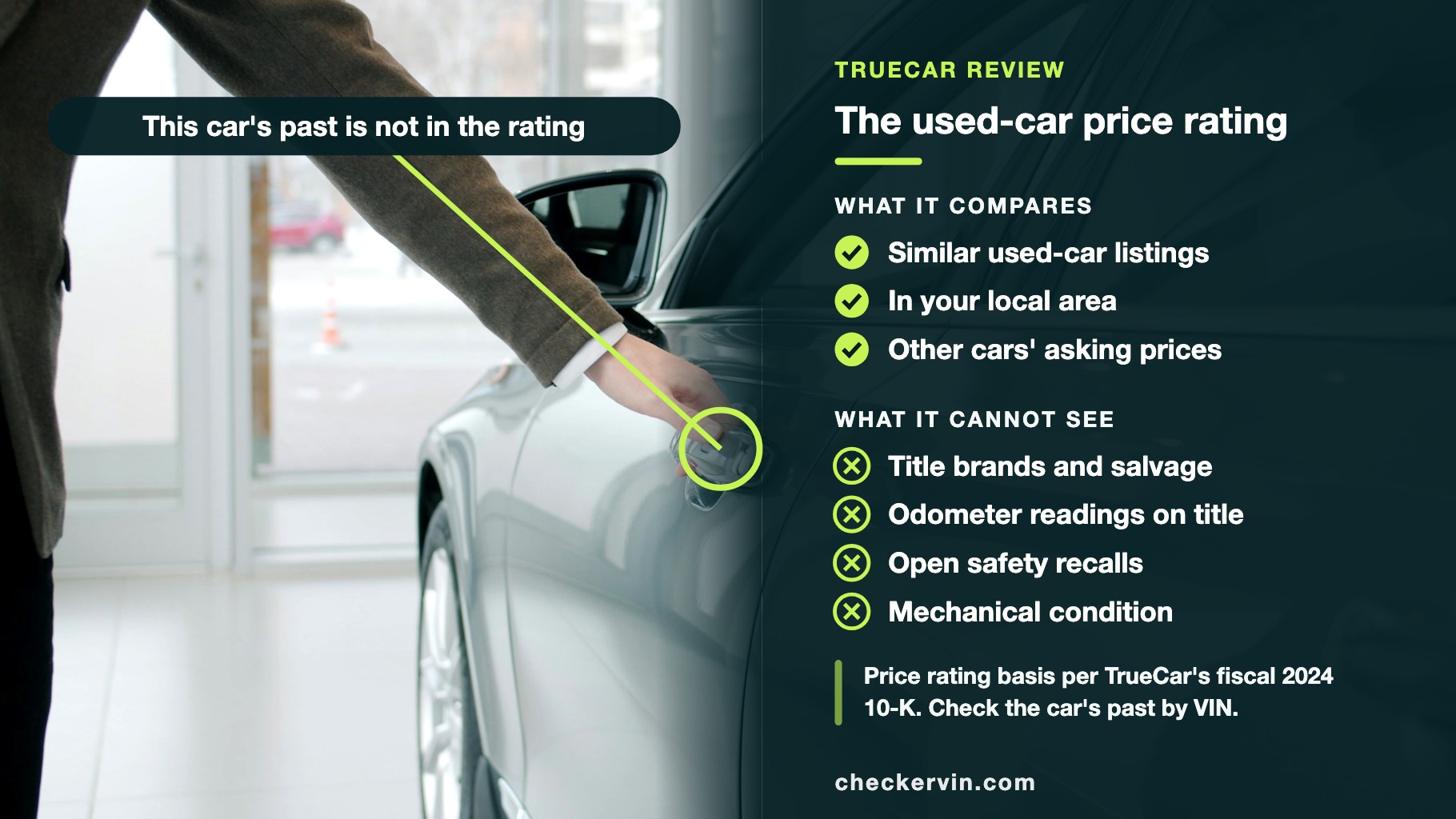
| Used-car price rating | Similar used car listings in your local area, per its 10-K |
| New-car price distribution | What others in your local market paid for a similar make, model and trim, with MSRP and a Market Average |
| The Curve (relaunched November 2026) | A bell curve built from what it calls millions of transactions, showing MSRP, what others paid locally, and dealer offers |
The distinction matters most on used cars. A rating built from listings tells you how an asking price compares with other asking prices nearby. It cannot know that this particular car had a salvage title in another state, a rolled-back odometer or an open recall, because those facts are not in the price of the cars around it. A “good” rating on a car with a branded title is a rating on the wrong comparison set.
To see what a specific VIN is worth against its own trim and equipment, our car value by VIN guide walks through it.
The Savings Certificate and all-in pricing in 2026
Two 2026 announcements change what you see on TrueCar, by its own account.
On May 18, 2026, TrueCar said it would show all-in advertised prices that include mandatory dealer fees and add-ons, naming documentation and dealer prep fees as examples, and would identify those fees inside the total. It said it had updated its dealer agreement to match. The release ties the change to FTC enforcement priorities. On March 13, 2026, the FTC had sent warning letters to 97 dealership groups saying an advertised price must be the total price, including all mandatory fees. Those letters went to dealers; the FTC release does not mention TrueCar.
On November 17, 2026, TrueCar relaunched The Curve and its Savings Certificate, which it describes as a documented, dealer-backed savings offer you take to a Certified Dealer, with a QR code that can sit in a phone wallet. The release does not set out any guarantee terms, expiry or conditions, and we could not read TrueCar’s terms of use. Treat the certificate as a starting point and have the dealer write the full price, every fee included, on a buyer’s order before you agree to anything.
Is TrueCar legit? What the record shows
It is a real, long-established business. It listed on Nasdaq in 2014 and filed annual reports with the SEC until a buyer group led by founder Scott Painter took it private on January 21, 2026, per its 8-K. The same filing says an affiliate of AutoNation, the dealer group, rolled its TrueCar shares into the new parent, so a car retailer now holds an equity stake in TrueCar’s owner.
Its fiscal 2024 10-K lists the regulatory and legal challenges it has faced, and how it describes their outcomes:
| Matter, per TrueCar's 10-K | Outcome as TrueCar reports it |
|---|---|
| Texas DMV letter on advertising (2015) | Responded; no further action, treated as informally resolved |
| Mississippi Motor Vehicle Commission letter (2016) | Responded; no further action, treated as informally resolved |
| California DMV inquiry into an unlicensed-auction allegation (2016) | Informally advised it was resolved |
| Ohio Attorney General investigatory subpoena (2017) | Supplied information; no further action, treated as resolved |
| California New Car Dealers Association lawsuit (2015) | Settled in 2017 and dismissed |
| Dealer lawsuit and a consumer class action in California (2015) | Voluntarily dismissed; class certification was denied in the consumer case |
| Federal class action alleging misleading advertising (2017) | Settled the same year and dismissed |
We searched for an FTC, CFPB or state attorney general order against TrueCar and found none. That is a statement about public enforcement records, not about any individual dealer’s conduct. Complaints about a car bought through TrueCar are, in practice, complaints about the dealer that sold it.
TrueCar used cars: what a listing tells you about history
The 10-K says used listings show vehicle information, photos and condition summaries, and that nearly every one carries a price rating. It does not describe a history report as part of the listing. TrueCar’s own blog, in a May 2024 post on used-car concerns, says shoppers searching on TrueCar can get a discount on AutoCheck reports. That is a paid report from another company, sold separately. Our AutoCheck review covers what it holds.
We could not load TrueCar’s listing pages to see what each one shows today, and a dealer can add its own report link to a listing. Either way, two points hold. Any history a dealer shows you is a report the seller chose. And on the Department of Justice’s NMVTIS page, Experian, which runs AutoCheck, is listed for commercial customers only, with the note that consumers cannot get NMVTIS reports from it. For the federal title record, you buy from a provider the department lists for the public.
The dealer sells the car, and the paperwork says so
Everything that binds you comes from the dealer: the buyer’s order, the retail installment contract, the title transfer and the warranty, if there is one. Federal law puts one document on the car itself. Under the FTC’s Used Car Rule, 16 CFR 455.2, a dealer must display a Buyers Guide on every used vehicle offered to consumers, and that form says whether the car is sold as is or with a warranty.
Read it before the test drive. It is the dealer’s own written statement of the warranty terms, and it is the same whether you found the car on TrueCar or on the lot. Our used car red flags list covers what to look for on the car and in the paperwork, and can I return a used car explains why there is rarely a cooling-off period.
The checks that stay yours: VIN, recalls and title record
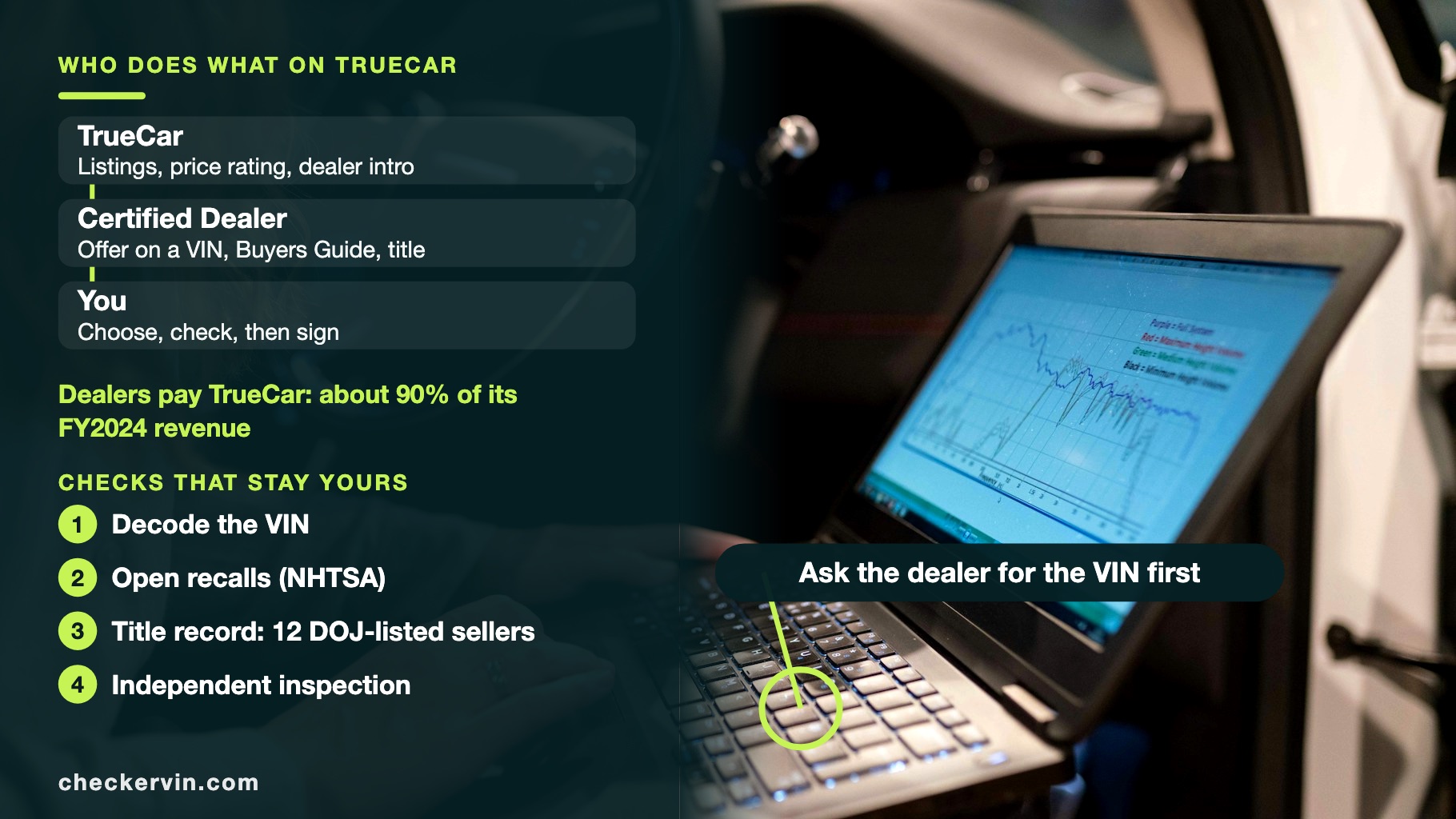
Ask the dealer for the VIN as soon as you have an offer. TrueCar’s offers are tied to one, per its 10-K, so the dealer has it. Then, before you visit:
- Decode the VIN and confirm the year, trim, engine and equipment match the listing
- Check open safety recalls with NHTSA; recall repairs are free at a franchise dealer
- Buy the title record from one of the 12 providers the Department of Justice lists for public customers
- Compare the odometer on the dash with the last reading in the title record
- Have an independent mechanic inspect the car before you sign
What our free VIN check returns today:
- Factory build and specifications decoded from the VIN
- Factory warranty terms
- Open NHTSA safety recalls
- Photos filed against the VIN
- Market and listing prices
Decode the dealer's VIN and check recalls free
Decoded from official manufacturer and NHTSA records
Our NMVTIS report guide explains each line of the title record, and how to buy a used car puts these checks in order with the test drive and the negotiation.
TrueCar in 2026: private, and narrower
The 10-K describes the business at the end of 2024. Several parts of it have since been wound down, according to TrueCar’s 2026 releases:
- February 2026: TrueCar shifted away from TrueCar+, its buy-fully-online product, and said its wholesale arm would stop buying or holding vehicles
- April 2026: it said it was moving away from lead generation toward a transaction-driven marketplace, with a five-part price breakdown from MSRP to drive-off price
- May 2026: all-in advertised pricing with mandatory dealer fees identified in the total
- November 2026: The Curve and the Savings Certificate relaunched
Because TrueCar no longer files with the SEC, newer figures on dealer counts or revenue are not public. The numbers on this page are the last audited ones, and they are dated.
Who TrueCar suits
It suits a buyer who already knows the model they want and would rather compare written offers from several dealers than negotiate in person, and members of partner programs who can stack an automaker incentive on top. It suits less well a buyer who wants the platform to vouch for a specific used car, because that is not what it does. On a new car, the remaining risk is mostly price, and TrueCar’s tools address price. On a used car, the bigger risk is the car’s past, and that is the part you check yourself. If you are weighing a dealer against a private sale, private seller vs dealer sets out what each one owes you.
Where this information comes from
- TrueCar, Inc. Form 10-K for fiscal 2024 (SEC EDGAR)Filed February 20, 2025: business model, dealer billing, price rating, dealer counts, regulatory history; read November 25, 2026
- TrueCar, Inc. Form 8-K, January 22, 2026 (SEC EDGAR)Merger with Fair Holdings completed January 21, 2026; AutoNation affiliate rollover
- TrueCar press release, February 2, 2026 (PR Newswire)TrueCar+ and the wholesale arm wound down; "TrueCar is not a dealer"
- TrueCar press release, April 15, 2026 (PR Newswire)Move from lead generation to a transaction-driven model; five-part price breakdown
- TrueCar press release, May 18, 2026 (PR Newswire)All-in advertised pricing including mandatory dealer fees; updated dealer agreement
- TrueCar press release, November 17, 2026 (PR Newswire)The Curve and the Savings Certificate relaunched
- TrueCar blog: Common Concerns When Buying a Used Car (May 31, 2024)Its own statement on discounted AutoCheck reports for TrueCar shoppers
- FTC: FTC Warns 97 Auto Dealership Groups About Deceptive Pricing (March 13, 2026)Advertised price must include all mandatory fees; addressed to dealers, not TrueCar
- NMVTIS: approved data providers (DOJ / BJA)12 providers for public customers; Experian listed for commercial customers only; read November 25, 2026
- 16 CFR 455 — the FTC Used Car Rule (eCFR)Section 455.2: the Buyers Guide every dealer must display on a used car
- NHTSA recall lookupFree open-recall check by VIN
- What we could not readTrueCar's live site, terms of use and help center returned a bot-protection block (HTTP 403) on November 25, 2026; nothing here is taken from them.
- How we made this pageWritten by the CarCheckerVIN editorial team with AI assistance from TrueCar's SEC filings and press releases, Department of Justice, FTC and NHTSA pages, and other public records; facts checked November 2026.
Keep reading
Frequently asked questions
Is TrueCar legit?
Yes, in the sense that it is a long-running, real business: it was a Nasdaq-listed company that filed annual reports with the SEC until January 2026, when a group led by its founder took it private. It does not sell cars itself. It lists cars that dealers in its network sell, and those dealers pay TrueCar. Its regulatory history, as its own 10-K describes it, is a set of state inquiries and dealer lawsuits it reports as resolved, settled or dismissed. We found no FTC or state attorney general order against TrueCar itself.
How does TrueCar work?
You search new or used inventory listed by TrueCar Certified Dealers, see market context such as a price rating or a chart of what others paid, and choose to connect with one or more dealers. The dealer then sends you an offer on a specific car with a VIN. You buy from the dealer, not from TrueCar.
How does TrueCar make money?
Mostly from dealers. In its last annual report, dealer revenue was about 90 percent of total revenue. Most dealers pay a fixed monthly subscription; some franchise dealers pay based on sales volume. Dealers can also buy sponsored placements, and automakers pay for incentive programs and advertising. Shoppers do not pay to use the site.
How is the TrueCar price rating calculated?
For used cars, TrueCar's 10-K says nearly every listing carries a price rating computed from similar used car listings in the shopper's local area. That compares asking prices; the filing does not say the used-car rating uses what buyers paid. For new cars, TrueCar shows a distribution of what others in the local market paid, which it now calls The Curve.
Are TrueCar used cars inspected by TrueCar?
Not as far as anything TrueCar publishes says. Certified Dealer describes a dealer in TrueCar's paid network, not an inspection of the car. The dealer is the seller, so the inspection, the title and the vehicle's history are things to check yourself before you sign.
Does TrueCar show a vehicle history report on used cars?
We could not load TrueCar's listing pages to see what each one shows today. Its own 2024 blog post says shoppers on TrueCar can get a discount on AutoCheck reports, which is a paid product sold separately. For the federal title record, use a provider on the Department of Justice's NMVTIS list.
Is the TrueCar Savings Certificate a guaranteed price?
TrueCar's November 2026 release calls it a documented, dealer-backed savings offer you take to a Certified Dealer. The release gives no terms, expiry or conditions, and we could not read TrueCar's terms of use. Ask the dealer to put the full price, with every fee, on a written buyer's order before you commit.
Whoever sells the car, check the VIN yourself
Decode any VIN free for the factory build, specifications, warranty and open safety recalls. Full vehicle history reports are launching soon.
Run a free VIN check