The short answer
- Do I need probate?
- Usually not, but check the right thing. 10 of the 17 states we read put no dollar figure on their smallest instrument at all. In Massachusetts, Ohio and Missouri, an heir who is not the surviving spouse does have to use the court.
- What does it actually cost?
- Signatures, not money. 6 of the 15 forms we opened need one signature and no notary. 3 need every heir sworn in front of one, which is the difference between an errand and a project.
- Am I late?
- Probably not. Florida and North Carolina exempt a death transfer from their own penalty in terms, and the Texas and Michigan clocks are written around a sale. Washington and Missouri are the states where the deadline really does bite.
10 of 17
States whose smallest instrument names no dollar figure at all
The car is outside the count, or the form simply sets no limit
6 of 15
Forms we opened that carry no notary block anywhere on them
Against 3 that require every heir to sign before one
8 of 17
States that let an owner name a beneficiary on the title in advance
The cheapest fix, and it has to happen before the death
3
States with a spouse form and nothing at all for any other heir
Massachusetts, Ohio and Missouri — where probate-first advice is simply correct
The first question everyone answers is the wrong one
Search this and you will be asked, within two paragraphs, whether the estate is under your state’s small-estate threshold. Then you will be given a number. Massachusetts is $25,000, you will read, and Ohio is $40,000, and Michigan is $60,000. Every one of those three statements is wrong in a different way, and the reason they are all wrong is that they are answers to a question the car does not raise.
We read 17states end to end for this page — statute where we could reach it, agency manual and the actual PDF where we could not, opening the form and counting its fields rather than trusting a summary of it. What came back was not a spectrum of generosity. It was two independent variables that nobody puts side by side.
The first is whether the car is counted at all. In 10 of the 17, the smallest instrument names no dollar figure whatsoever: either the statute lifts registered vehicles out of the estate for counting purposes, or the form just does not ask. The second is how many people have to sign, and in front of whom. That variable ranges from a single signature on a page with no notary block to a five-tier ladder of relatives, all sworn, before the counter will look at you. The two variables are not correlated. Florida and Pennsylvania both set no dollar cap at all, and one of them takes ten minutes while the other can take months.
What actually gates the small instrument, in 17 states
Each state below is filed by its cheapestdoor, not by its most famous number. That distinction does real work. Ohio’s $65,000is a cap on the combined value of the cars with no limit on how many of them there are, and Wisconsin’s spouse route is capped at five vehicles rather than at any sum at all. Filing either as a gross-estate threshold would repeat the exact mistake this page exists to correct.
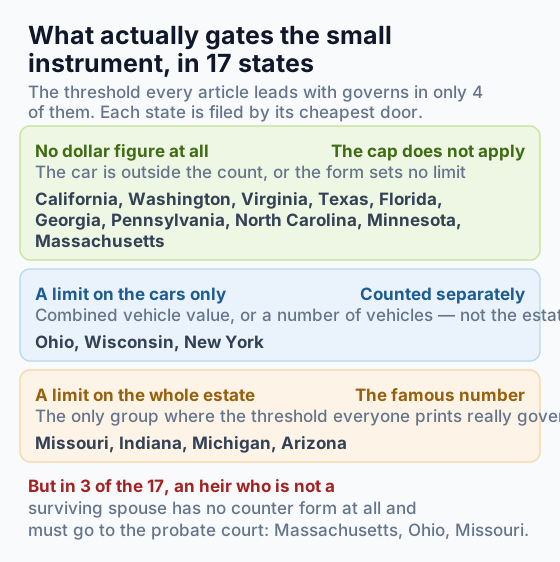
The middle group is the one that gets miscopied most often. In Ohio, Wisconsin and New Yorkthere is a number, but it is a number about vehicles. New York’s is one vehicle at $25,000or less, measured net of any lien, which means a car worth $34,000 with $10,000 still owed on it qualifies. Ohio’s covers as many cars as the decedent owned so long as they total $65,000. Wisconsin’s counts to five and does not ask what they are worth. None of those is an estate threshold, and answering “is the estate under the limit” will send you to the wrong counter.
Where the car is not counted at all
Four states say this in language plain enough to quote at a clerk who disagrees with you. California’s Probate Code § 13050(b)(1) excludes registered vehicles from the property counted toward the small-estate figure, and Vehicle Code § 5910 authorises the transfer “without the decedent leaving other property necessitating probate, and irrespective of the value of the vehicle.” Massachusetts writes the exclusion into the cap itself: voluntary administration is available where the estate is “$25,000 or less (excluding the value of a car).”
New York goes furthest. Under EPTL 5-3.1 the qualifying vehicle is “not assets of the estate but vest in ... such surviving spouse” — it never enters the estate to be counted. Minnesota’s § 524.2-403(a)(2) awards the spouse “one automobile, if any, without regard to value.” In all four, an expensive car does not push you into probate, because the car is not on the scale.
The remaining six in that group get there by omission rather than exclusion: Texas’ VTR-262, Florida’s HSMV 82152, Virginia’s VSA 24, Pennsylvania’s MV-39, Washington’s TD-420-041 and Georgia’s T-20 simply have no threshold field. Several also have no waiting period, which is the other number the guides get wrong. Georgia’s gate is not a sum at all — it is a sworn statement that the estate is not indebted.
The real price is signatures, not dollars
Once you stop asking about thresholds, the states stop sorting by generosity and start sorting by ceremony. This is the ranking that predicts how hard your week is going to be, and no competing page publishes it, because you can only build it by opening the forms.
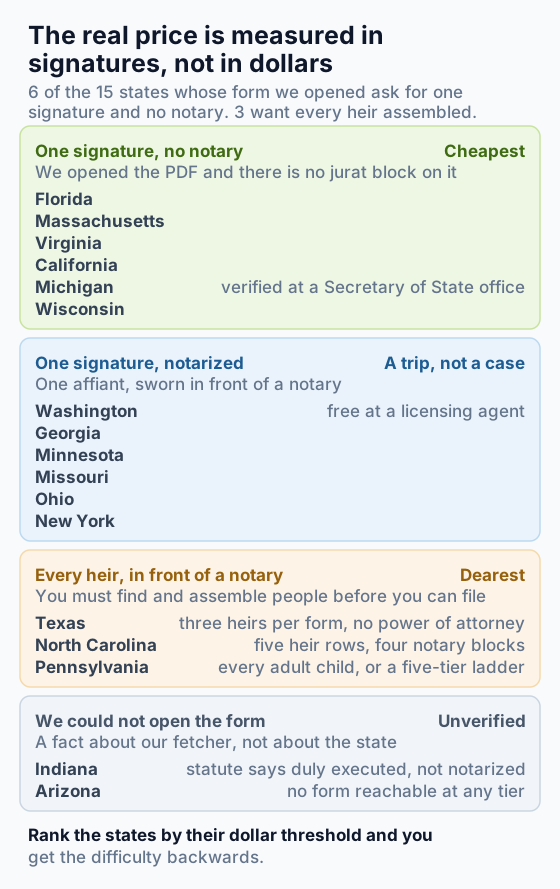
The tier above is the notary axis, because that is the one fact directly evidenced on every form we opened: the PDF either carries a jurat block or it does not. Where a state additionally demands signatures from people other than the applicant, that is called out separately rather than folded in, so nothing here asserts a ceremony we did not read.
| State | What gates the smallest door |
|---|---|
| California — REG 5 | Registered vehicles are excluded from the small-estate count outright |
| Washington — TD-420-041 | No threshold and no waiting period on the affidavit |
| Virginia — VSA 24 | No threshold, no waiting period, and no notary block |
| Texas — VTR-262 | No cap and no wait, but every heir signs before a notary |
| Florida — HSMV 82152 | No fee, no notary, no cap on the surviving-spouse transfer |
| Georgia — T-20 | No threshold; the gate is that the estate is not indebted |
| Pennsylvania — MV-39 | No cap and no wait, but potentially every adult child, notarized |
| North Carolina — MVR-317E1 | Five heir rows and four notary blocks, plus a clerk's certificate |
| Minnesota — PS2071-10 | The spouse takes one automobile “without regard to value” |
| Massachusetts — TTL103 | No cap for a spouse; the court cap excludes the value of a car |
| Ohio — BMV 3773 | Unlimited number of cars, capped at $65,000 combined value |
| Wisconsin — MV2300 | Capped at five vehicles for a spouse, not at any dollar sum |
| New York — MV-349.1 | One vehicle at $25,000 or less, measured net of any lien |
| Missouri — Form 2305 | Small estate at $40,000, after a 30-day wait, through the clerk |
| Indiana — State Form 18733 | $100,000 gross probate estate, but only a five-day wait for a car |
| Michigan — TR-40a | Indexed annually since 2026, and the figure is not on the form |
| Arizona — Not reached | $200,000 in personal property after a 30-day wait |
The forms that cost one signature and no notary
Florida’s HSMV 82152 is the cheapest instrument we found anywhere. FLHSMV cites § 319.32(7)(a)-(b) for the proposition that there is no fee, and the form carries no notarial certificate. A surviving spouse fills it in and the car moves.
Massachusetts’ TTL103, the Affidavit of Surviving Spouse under c.90D § 15A, has eleven fillable text fields and no jurat block anywhere in the document — we checked the form’s field structure rather than reading a summary of it, because this is precisely the kind of detail secondary sources get wrong. Virginia’s VSA 24 is the same story: no threshold, no waiting period, and a signature field that is a plain text widget rather than a signature widget, which is what a form looks like when nobody is going to witness it.
California’s REG 5 has eighteen fillable widgets, one signer and no notary block. Michigan’s TR-40a has no notary either, but do not read that as frictionless: the verification is done by a Secretary of State examiner at the counter, and the form says all TR-40a forms must be verified at a Secretary of State office. That is a queue rather than a fee. Wisconsin’s MV2300 also carries no notary and no fee for the spouse route, capped at five vehicles.
Where you have to assemble a family first
Texas, Pennsylvania and North Carolinaare the states where the small instrument stops being a form and starts being a project, and all three of them set no dollar cap at all — which is exactly why the threshold ranking misleads.
Pennsylvania’s MV-39 has no cap and no waiting period, and can require every adult child of the decedent to sign. Where there are no children it runs a five-tier ladder — children, then parents, then siblings, then aunts and uncles, then first cousins — and everyone on the operative tier signs, notarized. On top of that, the affiant states under oath that all debts of the decedent have been paid, with the penalties of 18 Pa.C.S. § 4904 attached, which carries a fine of at least $1,000. PennDOT also notes that MV-39 is not required at all where a Short Form Certificate exists, which is the agency’s own term and worth using at the counter.
North Carolina’s MVR-317E1 carries eighty-eight fillable fields, five heir rows and four separate notary blocks, and its second half is a certificate for the Clerk of Superior Court citing G.S. 20-77(b). Texas’ VTR-262 takes three heirs per form — more heirs, more forms — each signing before a notary, and the form adds that the section “may not be completed by execution of a power of attorney,” which closes the obvious workaround. Texas does exempt a surviving spouse from gathering the children where all of them are also the spouse’s children; where they are not, the children must sign.
3 states where an heir really does need the court
Missouri’s Department of Revenue states it flatly: without a transfer-on-death beneficiary and without a surviving spouse or unmarried minor child, the vehicle must go through probate. The smallest route is the § 473.097 small estate at $40,000, which means a thirty-day wait, a filing with the clerk and a clerk’s certificate, with publication triggered above $15,000. That is a courthouse procedure, not a counter errand.
Ohio is the same shape and it surprises people, because Ohio’s spouse route is one of the most generous in the country — BMV 3773 moves an unlimited number of cars under R.C. 2106.18 and 4505.10 so long as they total $65,000. There is no equivalent heir affidavit. An Ohio heir who is not a spouse needs a Release from Administration with Authority to Transfer, or a Certificate of Transfer, from the county probate court. Ohio also carves whole vehicle classes out of the spouse route entirely: recreational vehicles, commercial trucks, mobile and manufactured homes, campers, ATVs and golf carts still have to be probated.
Massachusetts routes heirs to court by design. The TTL103 exists only for a surviving spouse; there is no heir affidavit behind it. Everyone else uses voluntary administration, which carries a thirty-day wait and a filing fee — though this is also the state whose cap is written to exclude the value of the car, so the court route is cheaper to qualify for than the number suggests.
The instrument that would have avoided all of this
8 of the 17 states let an owner name a beneficiary on the vehicle title while they are alive: California, Virginia, Texas, Minnesota, Ohio, Missouri, Indiana and Arizona. Where one is on file, the whole apparatus above collapses into a death certificate and an ID.
California has had this since 1993, at a $10 fee, under Veh. Code § 4150.7 — one owner, one beneficiary. Texas’ § 501.0315 designation is the sharpest drafted: TxDMV’s own form states that “a will does not revoke or supersede this designation.” Missouri’s § 301.681 says the same, cannot be changed or revoked by a will, and unlike almost everywhere else accepts multiple beneficiaries. Indiana prints the conveyance on the face of the title itself — a live Indiana title can read “A.B. transfers on death to C.D.” — and IC 9-17-3-9 declares the designation expressly non-testamentary. Ohio does it on a notarized affidavit, BMV 3811, under R.C. 2131.13. Minnesota requires spousal consent before an owner can name someone other than their spouse.
8 states offer nothing of the kind: Washington, Florida, Georgia, Pennsylvania, North Carolina, Massachusetts, New York and Michigan. In several of those we confirmed the absence rather than assuming it — Washington by enumerating thirty-six sections of RCW 46.12, Georgia across a complete agency sitemap, Florida across sixty-three title manuals. Wisconsin is the one state we will not put in either column: no transfer-on-death appears anywhere in the agency paperwork, but we were never able to read Wis. Stat. § 342.175, and “the agency does not mention it” and “the statute does not exist” are different claims.
Four ways a beneficiary designation quietly fails
- 1The owner never signed the lineIndiana prints the designation on the face of the title, and the BMV states that it is not valid unless the owner signed the transfer-on-death statement before dying. A title can carry the beneficiary's name in print and still be worthless to them.
- 2There is a loan on the carVirginia's designation under § 46.2-633.2 is defeated by any lien, and by any owner that is not a natural person. A car financed at the time of death does not pass this way there.
- 3The state has a claim against the estateMinnesota is explicit and it is the trap nobody warns about: a Medical Assistance claim under Minn. Stat. § 256B.15 voids a transfer-on-death designation outright. Long-term care history is worth checking before relying on one.
- 4The beneficiary did not outlive the owner by enoughTexas requires the beneficiary to survive the owner by 120 hours under Estates Code § 115.005, and gives them a 180-day window to claim. Most states name a single beneficiary with no alternate, so a beneficiary who dies first collapses the whole arrangement back into the affidavit route.
The agencies are behind their own statutes
This is the practical reason to distrust any number on this subject, including the ones you find on a state’s own website. In three states we found the agency publishing a figure that its own cited statute contradicts.
California prints three different small-estate figures at three different URLs — the statute, the DMV’s procedures manual and the REG 5 form itself — and none of them carries a line for a death occurring on or after 1 April 2025. Virginia DMV’s page states $50,000 while hyperlinking to the § 64.2-600 that now reads $75,000 after a 2025 amendment. Arizona’s personal property threshold went from $75,000 to $200,000 on 26 September 2025.
Michigan is the worst case and it is the number most likely to be quoted at you. The $60,000 figure that saturates search results has been obsolete since 2024 PA 2. MCL 257.236 now tiers: $60,000 through 2023, $100,000 for 2024 and 2025, and from 2026 a cost-of-living-indexed amount that the Department of Treasury must certify and publish by 1 September of the preceding year. The TR-40 deliberately does not print the figure; it cross-references the statute. We could not locate Treasury’s certification for the vehicle cap, and the parallel certification for the probate code cannot be borrowed, because the two adjustment factors are defined against different years. So the honest statement about Michigan in 2026 is that the cap is indexed and the operative figure is not printed anywhere we could find — and that anyone quoting you $60,000 is working from a document two years out of date.
Ohio shows the same rot at county level. The current BMV 3773 sets $65,000, but county title offices still publish the pre-2017 rule of two automobiles totalling $40,000, and at least one county page carries both figures simultaneously. The form is the controlling artifact. Where a county page and a current state form disagree, bring the form.
The deadline you are being warned about is often not yours
Late-transfer penalties are the most-repeated warning on this topic and one of the least examined. Two states disclaim the penalty for a death transfer in terms. Florida states that a penalty fee is not due on deceased applications. North Carolina exempts a “Transfer upon Inheritance” from its own twenty-eight-day, $20 penalty.
Two more never reach an inheritance on the face of the rule. The thirty-day Texas clock is keyed throughout to a purchaser, a date of assignment and a date of sale, and Michigan’s fifteen-day, $15 rule is written the same way — both are about buying a car, not inheriting one. Pennsylvania goes further than either and lets the vehicle keep being driven on the deceased owner’s registration, renewed in the name of the estate, under 75 Pa.C.S. § 1315. The widely repeated Pennsylvania “twenty days” figure does not apply here at all. Minnesota’s death route says only that you should apply promptly; the twenty days you will see quoted is keyed to an assignment.
Two states are the real exceptions. Washington names inheritance expressly inside its fifteen-day rule at RCW 46.12.650, with $50 on day sixteen, $2 a day after that to a $125 ceiling, and a misdemeanour after forty-five days — though it also provides a waiver for illness or hospitalization, which is not an accident on this subject. And Missouri’s clock runs from when you acquire the vehicle, with no death carve-out we could find and only a discretionary waiver “for a good cause shown.”
Indiana is the one state that gives an inheritor a longer clock than a buyer: 45 days generally, but 60 days where the vehicle came through a transfer-on-death conveyance. Indiana also has the shortest waiting period on the page. Its general small-estate affidavit needs 45 days to have passed since the death; the vehicle carve-out at IC 29-1-8-1(c) needs 5. That single drafting choice is the detail probate-first articles about Indiana consistently miss.
What you are actually signing
None of the instruments on this page is a shortcut around the estate. Each one is a sworn statement, and in several states the statute attaches personal liability to it by name. This is the part the shortcut articles leave out, and it belongs on the same screen as the shortcut.
California’s Vehicle Code § 5910 expressly imports Probate Code § 13109, which makes the person who took the property personally liable to the decedent’s creditors up to the fair market value of what they received. Wisconsin puts it on the form in the first person: the MV2300 affiant states “I shall be personally liable for the debts and charges of the decedent, to the extent of the value of the vehicle(s),” under Wis. Stat. § 859.25. Pennsylvania requires the sworn “all debts of the decedent have been paid” and attaches the unsworn falsification penalties of 18 Pa.C.S. § 4904.
In practice this means the calculation is not “can I avoid probate” but “do I know what this person owed.” If there are creditors you have not accounted for, signing the affidavit puts them on you rather than on the estate. Where the debts are genuinely unknown, the court route exists for a reason, and it is the cheaper answer.
Some states let you sell it without titling it first
If the plan was always to sell the car, several states let you skip a step, a fee and a trip. Florida is the clearest: FLHSMV cites § 319.28(1)(c) for a surviving spouse assigning the decedent’s title straight through to a buyer. Massachusetts allows the same on the strength of the TTL103 affidavit. Missouri lets a transfer-on-death beneficiary assign the vehicle onward without ever titling it in their own name.
Georgia says the opposite explicitly: a title obtained on the T-20 affidavit of inheritance cannot be passed on until it has actually been issued in the heir’s name first. Georgia does soften the tax side — an inherited vehicle is charged a fraction of the ordinary title ad valorem rate — but the sequence is fixed.
If you are the buyer on the other side of one of these transactions, the name signing the title will not match the name printed on it, which is the same surface pattern as title jumping. The difference is documentary, not visual: a legitimate version comes with the affidavit and the death certificate. Ask for them.
The registration is a separate problem
Moving the title and keeping the car legal to drive are two different transactions, and at least one state makes the distinction expensive. Ohio lets a surviving spouse keep the existing plates for a small fee, but requires new registration and new plates when the vehicle goes to an heir, to a transfer-on-death beneficiary, or to a right-of-survivorship co-owner. That is a real cost that appears at the counter and on no comparison table.
Pennsylvania sits at the other extreme, allowing the registration to be renewed in the name of the estate so the car can keep being driven. Most states are silent, which in practice means the ordinary transfer rules apply. If the car is going to be driven before the paperwork clears, ask specifically about the registration rather than about the title, because the answer is not the same one.
The resulting title is usually unremarkable. We found no state that brands an inherited vehicle. The two annotations that do exist are benign: an Ohio right-of-survivorship transfer prints “acquired by right of survivorship” on the new title, and an Indiana transfer-on-death title carries the conveyance sentence while the owner is still alive. Neither is a title brand and neither affects value.
What to bring when probate is already open
If an estate has been opened, the affidavit routes generally close — Indiana says so directly, conditioning its vehicle affidavit on no appointment of a personal representative being contemplated. What the counter wants instead is the court’s appointing document, and the name for it differs enough to cause real trouble on the phone.
Michigan calls it a Letter of Authority, not letters testamentary, and wants the title assigned by the personal representative — who may assign it to themselves by completing the seller’s portion and writing “personal representative” after their signature. Wisconsin calls it Personal Representative Papers, or a Domiciliary Letter. Ohio wants Letters of Authority, a Certificate of Transfer entry, or a Release from Administration entry, depending on the path. Pennsylvania uses the term Short Form Certificate. New York’s MV-843 names letters testamentary, letters of administration, or a voluntary administrator’s affidavit, and accepts photocopies.
Run the VIN before you sign anything
Every affidavit on this page asks you to swear to something, and two of the things it asks about are checkable in advance. The first is a lien. New York measures its $25,000net of encumbrances, so a loan changes whether you qualify at all; Virginia’s beneficiary designation is defeated outright by one. The second is the car’s history, which matters because inheriting a vehicle usually means inheriting a decision about whether to keep it.
A lien check tells you whether a finance company still has a claim, and a title check tells you whether the document you are about to inherit carries a brand. Both take a bare VIN. Doing them before the counter visit rather than after is the difference between one trip and three.
What we could not read
A page like this is only as good as its sources, and several of ours failed. Naming them is not a disclaimer; it is the difference between a gap and a claim.
Illinois is excluded entirely.Every Illinois source was unreachable at every tier — the Secretary of State returns an Akamai 403 and the General Assembly site is filtered at the TCP layer — while a control request to another Illinois state domain succeeded from the same machine. That means the failure is ours, not theirs, so Illinois appears in no count on this page and we assert nothing about it.
Arizona’s forms were blocked the same way at every tier, so the statutory threshold is reported and the paperwork is not. Indiana’s State Form 18733 sits behind the same kind of block; we have its exact name and the statute that drives it, and nothing about its layout. Every Florida statutory quotation on this page is the state agency quoting its own code rather than the code itself, because the Florida legislature’s servers were unreachable. Ohio’s statute site never answered, so the Ohio material comes from current BMV forms and county title offices, which are the actual issuing authorities but are not the statute. Wisconsin’s § 342.175 was never read, which is why Wisconsin is not counted in either transfer-on-death column. Minnesota’s two forms came from mirrors rather than the agency, so their revision currency is unconfirmed.
What to do, in order
- 1Look at the title before you read anything elseIf it names a transfer-on-death beneficiary, or reads with a right-of-survivorship legend, you are finished in one step: a certified death certificate and an ID. In Indiana, check that the owner actually signed the designation line — printed is not signed.
- 2Find out whether your state counts the carIn 10 of the 17 states we read, the smallest instrument names no dollar figure at all, and in four of those the statute lifts the vehicle out of the estate by name. Do not start by valuing the estate; start by finding out whether the estate figure even applies.
- 3Count the signatures, not the dollarsThis is what actually determines how long it takes. 6 of the 15 forms we opened need one signature and no notary. 3 need every heir sworn. If you are in Texas, Pennsylvania and North Carolina, start contacting relatives today, because that is the long pole.
- 4Check whether you are the exceptionIn Massachusetts, Ohio and Missouri, an heir who is not the surviving spouse has no counter form and must use the probate court. If that is you, stop reading comparison tables and open the estate — it is the correct route, not a failure.
- 5Download the form from the state, and use its dateCounty pages, aggregator sites and older guides carry superseded figures — Ohio counties still publish a rule that changed in 2017, and the Michigan number in most search results has been wrong since 2024. The current PDF on the agency's own site is the controlling document. Check its revision stamp.
- 6Establish what the decedent owed before you swear to anythingSeveral of these affidavits make you personally liable for the estate's debts up to the value of the car, and one of them makes you state on oath that those debts are already paid. If you do not know, the court route is the cheaper answer.
- 7Run the VIN, then go onceA lien changes whether you qualify in New York and kills the beneficiary route in Virginia. Check for it, check the title's brand history, and bring the death certificate, the title, your ID and the completed form in a single trip.
Frequently asked questions
Do I need to go through probate to transfer a car title after death?
Usually not, and the threshold you are being told to check often does not apply to the car in the first place. Of the 17 states we read from statute to form, 10 put no dollar figure at all on their smallest instrument: California, Washington, Virginia, Texas, Florida, Georgia, Pennsylvania, North Carolina, Minnesota and Massachusetts. California excludes registered vehicles from the small-estate count outright and Veh. Code § 5910 says the transfer runs "irrespective of the value of the vehicle." Massachusetts writes its court cap as "$25,000 or less (excluding the value of a car)." New York's qualifying vehicle is "not assets of the estate but vest in ... such surviving spouse." Minnesota gives the spouse "one automobile, if any, without regard to value." But there is a real exception and it is not small: in Massachusetts, Ohio and Missouri there is a generous form for a surviving spouse and nothing at all for an heir who is not one, and those readers do have to go through the probate court.
What form do I need to transfer a car title after the owner dies?
It has a different name and a different ceremony in every state, and the ceremony matters more than the name. Florida's HSMV 82152 moves a car to a surviving spouse with no fee and no notary. Massachusetts' TTL103 has eleven fields and no jurat block anywhere on it. Virginia's VSA 24 has no notary either. Washington uses TD-420-041, Georgia the T-20, New York MV-349.1 for a spouse and MV-349 for next of kin, Michigan TR-40a, Ohio BMV 3773, Wisconsin MV2300, Texas VTR-262, North Carolina MVR-317E1 and Pennsylvania MV-39. 6 of the 15 forms we actually opened ask for one signature and carry no notary block at all. 3 — Texas, Pennsylvania and North Carolina — require the other heirs to sign as well, in front of a notary, which turns a counter errand into a family logistics problem.
How long do I have to transfer the title after someone dies?
Often the clock you are reading about does not run against you. Florida states plainly that "a penalty fee is not due on deceased applications." North Carolina exempts a "Transfer upon Inheritance" from its own 28-day, $20 penalty. The 30-day deadline Texas publishes is keyed throughout to a purchaser, a date of assignment and a date of sale, and Michigan's 15-day rule is written the same way — neither reaches an inheritance on its face. Pennsylvania goes further: 75 Pa.C.S. § 1315 lets the car keep being driven on the dead owner's registration, renewed in the name of the estate. Washington is the clear counter-example, naming inheritance expressly in its 15-day rule at RCW 46.12.650, with $50 on day sixteen and $2 a day after that. So is Missouri, whose clock runs from when you "acquire" the vehicle with no death carve-out we could find, waivable only "for a good cause shown."
Is a transfer-on-death designation on a car title worth doing?
Yes, and it is the single cheapest thing anyone reading this page can do for the next person. 8 of the 17 states offer one: California, Virginia, Texas, Minnesota, Ohio, Missouri, Indiana and Arizona. California has had it since 1993 at a $10 fee. Texas' designation survives a contrary will — the TxDMV form says in terms that "a will does not revoke or supersede this designation." Missouri's cannot be changed or revoked by a will either, and unlike most states it accepts multiple beneficiaries. 8 states have no such thing: Washington, Florida, Georgia, Pennsylvania, North Carolina, Massachusetts, New York and Michigan. Four traps are worth knowing. Indiana prints the designation on the face of the title and it is void unless the owner signed that line before dying. Virginia's dies if there is any lien on the car. Minnesota's is voided outright by a Medical Assistance claim under Minn. Stat. § 256B.15. And a designation naming one beneficiary who does not survive the owner by the statutory margin simply fails.
Can I sell the car without putting the title in my name first?
In some states, and it saves a fee and a trip. Florida is the clearest: § 319.28(1)(c), as FLHSMV states it, lets a surviving spouse assign the decedent's title straight through to a buyer. Massachusetts allows the same on the strength of the TTL103 affidavit. Missouri lets a transfer-on-death beneficiary assign the vehicle without titling it in their own name at all. Georgia is the opposite and says so: a title obtained on a T-20 affidavit of inheritance cannot be passed on until it has actually been issued in the heir's name. Do not assume, because the two answers look identical from the outside and only one of them survives at the counter. And if you are the buyer on the other side of one of these deals, the seller's name will not match the title — which is the same pattern as title jumping, so check the chain rather than the story.
Keep reading
Where this information comes from
- Cal. Veh. Code § 5910 — transfer without probate“Irrespective of the value of the vehicle”, and it imports Prob. Code § 13109 liability
- Cal. Prob. Code § 13050 — property excluded from the countSubdivision (b)(1) lifts registered vehicles out of the small-estate figure
- N.Y. EPTL § 5-3.1 — exempt propertyThe qualifying vehicle is “not assets of the estate but vest in… such surviving spouse”
- Minn. Stat. § 524.2-403 — exempt property“One automobile, if any, without regard to value”
- Minn. Stat. § 256B.15 — Medical Assistance claimsThe claim that voids a Minnesota transfer-on-death designation outright
- MCL 257.236 — Michigan transfer on death of ownerThe tiered and now CPI-indexed cap that replaced the $60,000 figure in 2024 PA 2
- Michigan SOS form TR-40 — certification from the heir to a vehicleSupersedes TR-29; no notary block, and it cross-references the cap rather than printing it
- Ind. Code § 29-1-8-1 — transfer of small estates without administrationSubsection (c) sets a five-day wait for a vehicle against forty-five days generally
- Ind. Code § 9-17-3-9 — transfer on death of a vehicleThe designation is printed on the title face and is expressly non-testamentary
- Ohio BMV form 3773 — clerk of courts surviving spouse affidavitCurrent form; unlimited vehicles under $65,000 combined, under R.C. 2106.18 and 4505.10
- Ohio BMV form 3811 — transfer on death beneficiary designationThe notarized affidavit that creates the designation, under R.C. 2131.13
- Va. Code § 46.2-633.2 — transfer on death of a vehicleDefeated by any lien, and by any owner that is not a natural person
- RCW 46.12.650 — transfers of ownership in WashingtonNames inheritance expressly in the fifteen-day rule, with an illness waiver
- Wis. Stat. § 859.25 — liability of transfereeThe personal liability the MV2300 affiant accepts, to the value of the vehicles
- Tex. Transp. Code § 501.0315 — beneficiary designationTxDMV's form adds that “a will does not revoke or supersede this designation”
- TxDMV form VTR-262 — affidavit of heirship for a motor vehicleThree heirs per form, each before a notary, and no power of attorney permitted
- FLHSMV — transferring a title after a deathThe source for every Florida statutory quotation here, since the legislature's servers were unreachable
- PennDOT form MV-39 — notification of assignment of vehicle to heirsThe five-tier ladder, all notarized, plus the sworn statement that all debts are paid
- NCDMV form MVR-317 — affidavit of authority to assign titleFive heir rows, four notary blocks, and a Clerk of Superior Court certificate