The short answer
- How much is the bond?
- 22 states use one and a half times value, 9 use two times, 2 use the value itself, and Alabama uses a flat schedule. There is no national figure.
- Does my state even offer one?
- 10 states do not. They route you to a court order, a quiet title action, a magistrate's sale or an affidavit instead.
- How long does it stand?
- Three years usually. Connecticut and Wisconsin run to 5, Georgia to 4, and Colorado publishes no term at all.
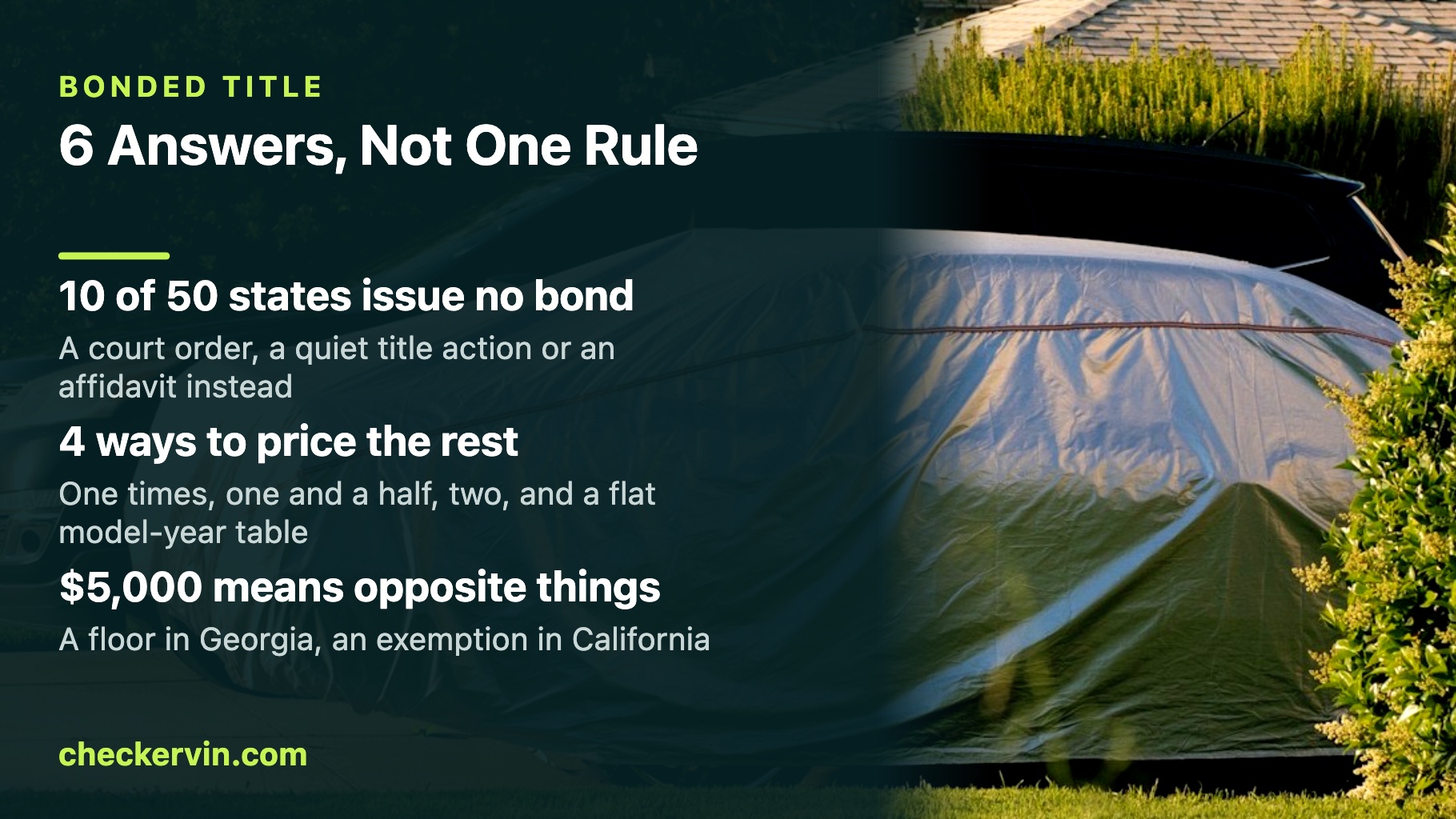
10 of 50
States that issue no bonded title at all
Each publishes a different route in its place
3
Different multiples in use, plus one flat schedule
One times, one and a half times, and two times value
4
Incompatible meanings of the word floor
Across the 9 states that publish a dollar figure
8
States where a model year decides eligibility
And the rules point in opposite directions
The one number everyone quotes
Search for this and you will be told, within the first two sentences of almost every result, that a bonded title costs one and a half times the value of the vehicle and lasts three years. The figure is not invented. It is the rule in 22 states, which is enough to make it the modal answer and enough to make it sound like a national standard.
It is not a national standard. Titling is state law, and the states have not converged. Of the 50, 9 write the bond at twice the value rather than one and a half times, 2 write it at the value itself with no multiple, and Alabama abandons the multiple entirely in favor of a flat schedule keyed to the model year. That alone would leave the quoted figure describing well under half the country.
The larger problem is that 10states do not issue a bonded title. For someone in Pennsylvania or South Carolina or Oregon, the question “how much is my bond” has no answer, and the time spent pricing one is time spent not filing the thing that would actually work. For a meaningful share of the people reading this, the useful sentence is simply that the instrument does not exist where they live.
What the bond actually secures, and who it protects
A surety bond attached to a title application is not insurance for you. It is a promise made to the state and to the world that if someone later turns up holding better proof of ownership than yours, they get paid. You are the person on the hook. The surety company writes the instrument, pays the claim if one lands, and then comes to you for the money.
That is why the amount is a multiple of the car's value rather than equal to it. The state is not pricing the car. It is pricing the risk of being wrong about who owns it, and the margin above the value is there to cover a claimant's costs as well as their loss. A state that uses two times value is not saying its cars are worth more. It is saying it wants more cover before it will put its name on a certificate it cannot fully verify.
Texas puts the logic in the section heading itself. The provision is titled Filing of Bond as Alternative to Hearing — the ordinary way to resolve a disputed or missing ownership record is to go before the county assessor-collector and have it heard, and the bond is what you post instead of turning up. Read that way, the bond is not a shortcut around the evidence. It is a deposit against the evidence never arriving.
Four numbers, and none of them predicts the others
The reason state-by-state advice on this subject goes wrong so consistently is that people treat the bond as one setting. It is four, and they move independently.
- 1Whether the instrument existsThe threshold question, and the one skipped most often. 34 states issue a bonded title. 10 publish something else in its place. In 6 more we could not reach a primary source and are saying so rather than guessing.
- 2The multipleOne times, one and a half times or two times the value, plus Alabama's flat schedule. Knowing a neighboring state's multiple tells you nothing: Georgia is two times and Tennessee, on the other side of the line, is one and a half.
- 3What the multiple is applied toMarket value in most states, but Texas uses its own Standard Presumptive Value, Nevada uses manufacturer's suggested retail price, and California uses fair market value. Nevada's base can exceed a used car's worth by a wide margin even though its multiple looks ordinary.
- 4How long it must standThree years is ordinary. Connecticut and Wisconsin run to 5. Georgia runs to 4. Colorado publishes no term beside its amount. The term decides the premium as much as the amount does.
Cross those four and there is no state whose answer you can infer from another state's. Connecticut takes twice the value and holds it for 5years, which is the steepest combination in this set; California takes the value once and lets a car worth under five thousand dollars through with no bond at all. Both are, in the language everyone uses, “a bonded title”.
The multiple: one, one and a half, two, and a schedule
3 multiples are in use across the states that publish one, and the gap between the lightest and the heaviest is a doubling on the same car, before the question of what the multiple is applied to is even asked.
| Multiple | States |
|---|---|
| 1.5x | Alaska, Arizona, Arkansas, Idaho, Iowa, Maine, Maryland, Massachusetts, Minnesota, Mississippi, Nebraska, Nevada, New Hampshire, New York, North Carolina, Rhode Island, South Dakota, Tennessee, Texas, Vermont, Washington, Wisconsin |
| 2x | Colorado, Connecticut, Florida, Georgia, Michigan, Missouri, New Mexico, Utah, Wyoming |
| 1x | California, Montana |
| Schedule | Alabama, which sets the bond from a flat table by model-year band rather than from the car's value |
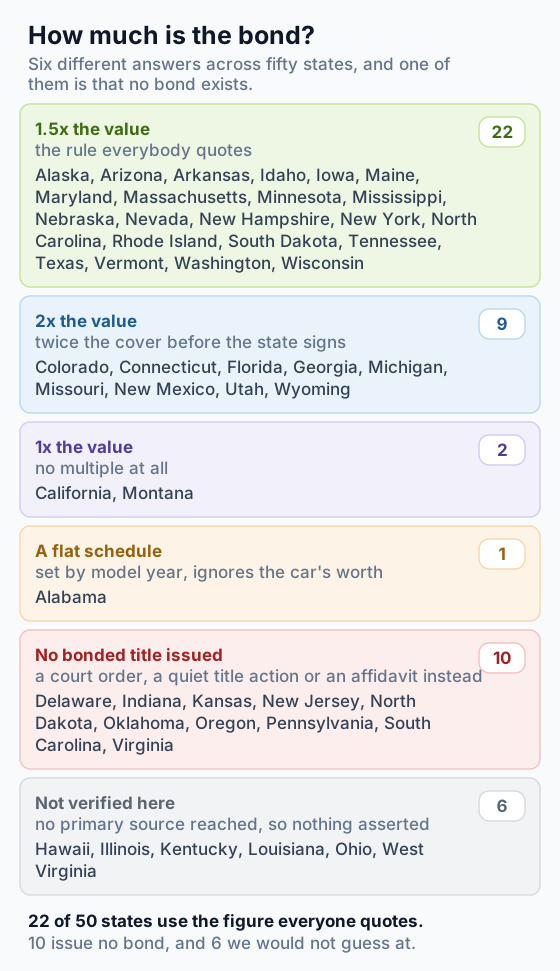
Alabama is worth pausing on, because it is the state that most clearly breaks the mental model everyone brings to this. There is no appraisal step and no calculation. The band the car's model year falls into determines the bond, which means two cars of wildly different worth in the same band post identical bonds, and a cheap car in a recent band posts a bond far above anything a multiple would have produced.
A multiple of what, exactly
The multiple is the number people compare. The base is the number that decides what they pay, and it is almost never stated in the summaries. 4 states in this set answer the question unusually, and in each of them the headline multiple is a poor guide to the bill.
| State | What the multiple is applied to |
|---|---|
| Alabama | a flat schedule set by model-year band, not a multiple of value |
| California | fair market value |
| Nevada | manufacturer's suggested retail price, not market value |
| Texas | Standard Presumptive Value, with appraisal only as a fallback |
Nevada is the one that catches people. One and a half times sounds like the mainstream rule, and it is — but applied to the manufacturer's suggested retail price, which is a figure fixed when the car was new and which takes no account of a decade of depreciation. A fifteen-year-old car in Nevada can carry a bond several times its resale value while the state's headline multiple looks unremarkable.
California runs the other way. The multiple is one, the base is fair market value, and a car valued below five thousand dollars needs no bond at all. Set the two side by side and the headline figures invert: Nevada’s looks like the higher multiple and California’s like the lower, while the sum a Nevada applicant is actually asked for can be the larger of the two by a wide margin.
The Texas base, and the field that gives it away
Texas is worth one section of its own, because it is the state most often described second-hand and the description has a specific fault. The bond is 1.5 times value, which everybody has right. What that value is, almost nobody has right.
The statute sets the bond at 1.5times “the value of the vehicle as determined by the department”, and the department’s rule makes Standard Presumptive Value the first source, not the last. An appraisal is a fallback, reached only when the state’s own sources cannot produce a figure. So every page describing the Texas bond as 1.5 times the appraised value has the order backwards, and quotes a number a Texas applicant will usually never be asked for.
The tell is in the lookup itself. Standard Presumptive Value is published through a public tool, and that tool asks for exactly 2 things: a vehicle identification number and an odometer reading. No login, no dealer credential, no proof of ownership. Those two fields are precisely what somebody holding a car with no paperwork does have — which is a design decision, and it tells you the state expects this figure to be worked out before anyone reaches a counter.
Everything after the number — which forms, which office, in what order, and the two deadlines that are routinely reported the wrong way round — belongs to the procedure rather than the resolution, and it is set out on our register a car without a title page. This page stops where the arithmetic stops.
Three years, except where it is four or five
The term is the most under-reported variable in the whole subject, and it matters because a surety prices the premium off the amount and the duration together. A bond held for five years at twice the value is not marginally dearer than one held for three at one and a half times. It is a different order of commitment.
| State | Published term |
|---|---|
| Texas | 3 years — Tex. Transp. Code 501.053(d) |
| New York | 3 years — N.Y. Veh. & Traf. Law 2105(d) |
| Connecticut | 5 years — Raised from three by P.A. 02-70 in 2002 |
| Wisconsin | 5 years — Wisconsin DOT bonded title guidance |
| Georgia | 4 years — Georgia DOR, bonded title requirements |
| Colorado | No term published — Colorado publishes no term with the bond amount |
| Wyoming | No term published — Described as a one-time, non-refundable instrument |
Connecticut deserves a specific warning. It moved to twice the value and a 5-year term by public act in 2002, which means any source describing Connecticut as one and a half times for three years is more than twenty years stale — and that description is still circulating. It is a useful test of whether a page you are reading was researched or copied.
2 of the states we could read publish an amount without publishing a term. Colorado is one; Wyoming describes its bond as a one-time, non-refundable instrument rather than something with a duration at all. We are not going to print a term for either, because they do not print one.
The word floor means four incompatible things
9states publish a dollar figure next to their bond rule. Summaries collect these into a single column headed “minimum”, which is the most damaging simplification in the whole topic, because the figures do 4 completely different jobs.
| What the figure does | States |
|---|---|
| The bond cannot be written below this, whatever the car is worth | Georgia $5,000, Wisconsin $2,500, North Carolina $100, Missouri $100 |
| Below this value the state asks for no bond at all | California $5,000, Utah $3,000, Wyoming $2,500 |
| Below this value a different and cheaper process applies | Tennessee $3,000 |
| The value the state substitutes when an appraisal comes in lower | Texas $4,000 |
Read the first two rows against each other and the danger is obvious. Georgia’s five thousand dollars is a floor: a car worth eight hundred dollars still posts a five-thousand-dollar bond. California’s five thousand dollars is an exemption: a car worth eight hundred dollars posts no bond at all. The 2 states print the same number and mean opposite things by it.
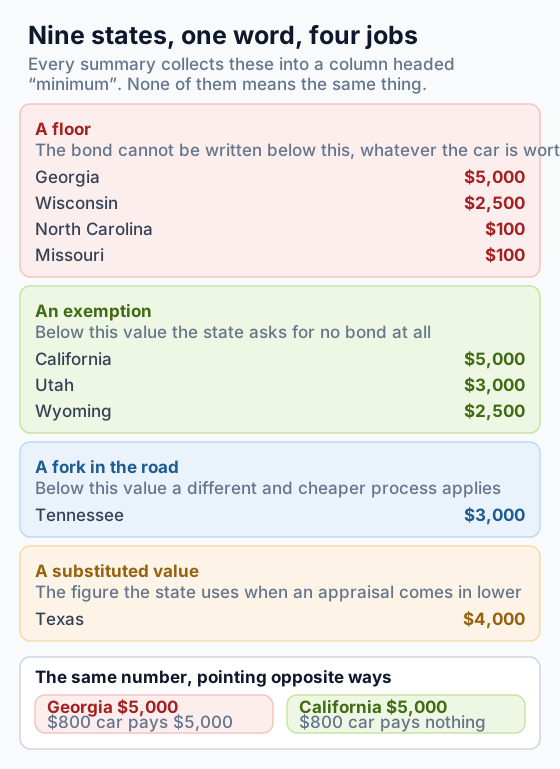
Tennessee’s three thousand does a third job again — it is a routing threshold, and a car below it goes down a cheaper administrative path rather than posting a smaller bond. Texas’s four thousand does a fourth: it is not a minimum bond but a minimum value, substituted when an appraisal on a car 25 years or older comes in beneath it.
10 states issue no bonded title at all
This is the finding that reorders the whole subject. In these states there is no bond to price, no surety to call and no form to download. The state has decided that a missing signature is a question for a court or for a sworn statement, not for an insurer.
| State | What it publishes instead |
|---|---|
| Delaware | A court order establishing ownership |
| Indiana | An affidavit where NADA value is $5,000 or less, otherwise a court order |
| Kansas | A quiet title action in district court |
| New Jersey | A twelve-step Improper Evidence of Ownership process with newspaper publication |
| North Dakota | An administrative process for untitled vehicles |
| Oklahoma | A Form 753 ownership affidavit |
| Oregon | Its own handbook describes bonded titles as something other states do |
| Pennsylvania | Five acceptable ownership documents, none of which is a bond |
| South Carolina | A magistrate's order of sale |
| Virginia | Form VSA 12, an Affidavit in Lieu of Title Certificate |
The routes divide roughly in two. Delaware, Indiana above its affidavit threshold, Kansas and South Carolina send you to a judge — a court order, a quiet title action or a magistrate’s order of sale. Oklahoma, Virginia, North Dakota, Pennsylvania and New Jersey keep it administrative, resolving the gap with affidavits and documentary proof rather than with money held against a claim.
New Jersey asks the most of the applicant among the administrative routes read here. Its Improper Evidence of Ownership process runs to twelve steps and requires publication in a newspaper along with affidavits from three disinterested parties. That is slower than buying a bond and considerably more public, and there is no faster alternative sitting beside it.
Oregon names the instrument, declines to issue it, and then erases the brand
Oregon is the clearest single illustration of why a national summary of this topic cannot be trusted, and it takes three sentences from the state’s own procedures manual to see why. The first describes the mechanism in the third person: where an applicant holds a vehicle but cannot document ownership, it says, some states issue titles carrying a bonded brand and an expiration date.
The third person is doing all the work there. An Oregon resident searching for “bonded title” finds their own state’s publication using the term, reasonably concludes the state offers one, and spends the next hour looking for a form that was never written. Oregon’s substitute is Form 550, a certification of ownership facts, and it is not a bond at all.
The second and third sentences are the part nobody quotes. Oregon DMV states that it has no authority to issue a branded title on an application backed by a bonded title from elsewhere — and that it accepts those bonded titles as valid ownership documents and issues an Oregon title carrying no brand and no indication of a bond. A document that expires in three years in Texas becomes a clean, permanent Oregon title on arrival.
New York has the bond in statute and no door to it
Going into this research the working assumption was that New York had no bond. That was wrong, and the shape of the error turned out to be more useful than the answer.
New York does have one. The Vehicle and Traffic Law provides for a bond at one and a half times value for three years, and a form exists for it. But it is imposed at the commissioner’s discretion rather than elected by an applicant. There is no consumer-facing page, no published amount, no calculator, and no application route you can start yourself. The DMV’s own guidance for people whose proof of ownership is not available does not mention the bond at all.
And the provision closes by stating that nothing in it requires the commissioner to issue a title upon presentation of a bond. The bond is a thing the state may accept, not a thing you may use. For a New York resident the honest description is that the instrument exists in the statute book and not in the process, which is exactly the distinction a list of fifty multiples would erase.
The age gates run in opposite directions across a state line
Before any of the numbers matter, the car has to be eligible, and 8 states decide eligibility on age. These rules do not point the same way. They are not even correlated.
| State | The age rule |
|---|---|
| South Dakota | Bonds vehicles 30 years old and older only |
| Tennessee | Bonds vehicles under 30 years old only |
| Idaho | Bonds vehicles under 10 years old; older ones take a conditional title |
| Florida | Excludes model year 2011 and newer |
| Georgia | Excludes model year 1985 and older |
| New York | Does not title model year 1972 and older at all |
| New Hampshire | Does not title model year 1999 and older at all |
| Maine | Titles a rolling 25-year window, so an older car has no title to bond |
South Dakota and Tennessee are exact opposites. South Dakota bonds vehicles thirty years old and older; Tennessee bonds vehicles under thirty. A 1985 car is bondable in one and not the other, on the same rule, read from opposite ends. There is no principle you can carry between them.
The final rows are a different kind of exclusion and are easy to misread as a bond rule. New York does not title 1972-and-older vehicles at all; New Hampshire does not title 1999-and-older; Maine titles a rolling twenty-five-year window. In those states an old car is not barred from the bond — there is simply no title in existence for the bond to attach to. The vehicle is registered on other evidence entirely, and asking about a bonded title is asking the wrong question.
A bond answers one question, and only one
The multiple only matters if the instrument is available for your car, and the eligibility rule is where the whole subject is most often misread. A bond resolves exactly one defect: nobody can sign the title over to you. It is priced as a fund against a rightful owner appearing later, and that is the only thing the money is standing behind.
That framing decides the two questions people bring to it and get wrong. A recorded lien is not a missing signature — it is a live interest belonging to somebody who can still be found — so a bond does not reach it. Texas draws the line by age: a bond is available where there is no security interest, where any lien is at least 10years old, or where you produce a release of all liens. A 2024 amendment to the department rule removed the option that once let a surety undertake to satisfy the lien, so obtaining the release is now the applicant’s own job.
A salvage brand is not a missing signature either. It is a statement about what happened to the car, and Texas excludes salvage and nonrepairable vehicles from the bond by statute rather than by policy. No sum posted against a future ownership claim says anything about a flood or a total loss, which is why a branded car goes through a rebuilt inspection instead and comes out the other side still branded.
Both of which put one check ahead of everything on this page. Before you read your state’s rule, establish what is recorded against the vehicle — a lien check on the VIN costs nothing and occasionally ends the matter before the multiple is ever relevant.
The Vermont route people still recommend
A registration obtained in Vermont on a bill of sale, then converted to a title back home, is still passed around as a workaround for exactly the situation this page describes. It has narrowed to the point where the advice is now more likely to cost money than save it.
Two separate statutes are involved, and conflating them is how the advice survives. The exemption that made Vermont famous sits at 23 V.S.A. § 2012, which lists the vehicles the state will register without a title. That section currently carries two competing versions on the legislature’s own page — a signal in itself that the ground has moved recently. The version presently in effect requires the vehicle to have been registered in Vermont already and to have had no change of ownership since the start of 2024, conditions a car bought from a stranger in another state will not meet.
The bond is a different section entirely. Section 2020 is where the commissioner may withhold a certificate and require a bond instead, at one and a half times value, returned at the end of three years — and it closes by directing that titles are not to be issued to nonresidents under it. Vermont’s own bond form carries the same restriction in its heading. Neither door is open to somebody who does not live there.
What we could not verify, and why we are saying so
6 states are absent from the tables above: Hawaii, Illinois, Kentucky, Louisiana, Ohio, West Virginia. For most of them we reached the agency but could not find the rule stated plainly enough to print. Two are a different case and worth describing, because they explain what this page will not do.
The Illinois Secretary of State’s site refused every method we tried — a browser user agent, a headless browser, a fetch tool and an off-network crawler, all blocked at the edge. Snippets of Illinois bond rules circulate widely, and they disagree with each other: some describe the bond as a multiple of appraised value, others of current wholesale value. Those are different numbers.
Louisiana is here for the same reason and is the more instructive case, because an earlier draft of this page did not have it here. Both the public safety department and the state legislature’s statute server refused us at every tier, so we had nothing on Louisiana but the account the broker pages give — which is confident, unanimous, and traceable to no source we could open. A claim that is repeated everywhere and verifiable nowhere is the exact thing this page exists to strip out, so Louisiana moved from a row in the table to a line in this section.
We could have printed the common version in either case. Instead the honest statement is that we did not reach the source, so these states appear as unverified rather than as rows. A blocked fetch is a fact about our tools, not a fact about Illinois or Louisiana law, and the two should not be allowed to look alike. If you are in one of these 6states, the agency’s own page is the only figure worth acting on.
What the bond costs you, as opposed to what it is written for
The state’s own fee is small, fixed and published: Texas charges $15 for the administrative step that sets the amount, Georgia $18 for the bonded title itself, each on top of the ordinary titling fees everybody pays. Those are the only figures on this page anyone can quote you in advance.
The premium is not one of them. A surety writes the bond for the full amount and charges a fraction of it, priced from the amount, the term and your credit — which is precisely why the two variables this page has spent its length separating matter to your wallet and not merely to your paperwork. Two applicants with identical cars in Connecticut and California are quoted against a bond that differs by the multiple and a duration that differs by 2 years, and no national average survives that spread.
What to do, in order
The order below is deliberate. The first three steps can each end the process outright, which is why they come before the arithmetic rather than after it.
- 1Establish whether your state issues oneBefore anything else. 10 states do not, and in those the entire bonded-title literature is irrelevant to you. Find your state in the table above and read the route it publishes instead.
- 2Check the vehicle for a recorded lienWhere a state publishes its eligibility conditions, an unreleased lien is among them. Run the VIN before you spend anything, because a lien nobody has released is a different problem with a different solution.
- 3Check the model year against the state's band8 states gate eligibility on age, and in some of them there is no title in existence to bond at all. This is a five-minute check that occasionally ends the matter.
- 4Work out the value using the state's own methodNot a valuation guide of your choosing. Texas publishes a Standard Presumptive Value lookup that takes a VIN and an odometer reading and nothing else; other states name a specific guide or require an appraisal in a fixed window.
- 5Read your own state's page before you buy anythingMultiply by the state's multiple, note the term, and only then approach a surety. Nothing on this page or any other replaces the agency's own current requirements, and the requirements change.
For the counter procedure once you know the numbers — which forms, which office, in what order — our register a car without a title page takes it from here, walking the Texas and Georgia sequences form by form. This page tells you whether there is a number; that one tells you where to carry it.
Where this information comes from
- Texas Statutes — Transportation Code § 501.053, Filing of Bond as Alternative to HearingSets the 1.5x multiple, the three-year expiry, the ten-year lien rule and the salvage exclusion.
- TxDMV — Bought a Vehicle Without a TitleThe agency's consumer page: the one-year and thirty-day windows, the $15 fee and the eligibility conditions.
- TxDMV — Form VTR-130-SOF, Bonded Title Application or Tax Collector Hearing Statement of FactCarries the two-office sequence and the 25-years-or-older valuation checkbox on its face.
- TxDMV — 43 TAC Chapter 217, adopted rules including § 217.9 Bonded TitlesThe SPV-then-guide-then-appraisal waterfall, the $4,000 substituted value and the administrative fee.
- Texas Statutes — Tax Code § 152.0412, Standard Presumptive ValueDefines the private-party transaction value the Texas bond is calculated from.
- TxDMV — Standard Presumptive Value calculatorThe public lookup that takes a VIN and an odometer reading and returns the value the bond is set from.
- Georgia Department of Revenue — Bonded Vehicle TitleThe 2x multiple, the $5,000 floor written as “but not less than”, the $18 fee and the 1985-and-older exclusion.
- Georgia Department of Revenue — Form MV-46, Certificate of Title BondThe four-year term is on the bond form itself, not on the department's web page — two documents, not one.
- Connecticut General Assembly — Gen. Stat. § 14-176, Bond in lieu of evidence of ownershipTwice value, returned at five years. The amendment history on the same page records P.A. 02-70 raising both figures from 1.5x and three years in 2002 — which is the text still circulating.
- Oregon DMV — Vehicle Procedures Manual, Chapter F (Ownership Documents)Describes the bonded brand as something other states issue, then states Oregon accepts those titles and reissues them with no brand at all.
- Vermont Statutes — 23 V.S.A. § 2020, Withholding of certificate; bondOne and a half times value, returned at three years, and no titles to nonresidents. This is the bond section; § 2012 is the separate exemption list.
- Vermont DMV — Form VT-020, Vermont Title BondHeaded “Vermont Residents Only”, on the second page rather than the first.
- New York Senate — Vehicle and Traffic Law § 2105, Application for first certificate of titleThe bond exists but is imposed at the commissioner's discretion, and the section closes by disclaiming any duty to issue a title on presentation of one.
- California DMV — Vehicle Industry Registration Procedures Manual, Motor Vehicle Ownership Surety BondThe $5,000 condition, the fair-market-value basis, and the nontransferable-vehicle and unobtainable-lien-release conditions that apply regardless of value.
Keep reading
Frequently asked questions
How much is a bonded title?
There is no national figure, and the one usually quoted covers fewer than half the states. Of the 50 states, 22 set the bond at one and a half times the vehicle's value, 9 set it at two times, 2 set it at the value itself with no multiple, and Alabama uses a flat schedule keyed to model year rather than a multiple at all. A further 10 issue no bonded title, so in those the question has no answer — the route to a title runs through a court or an affidavit instead. The remaining 6 we could not read at a primary source and have left blank rather than filled in. Work out your own figure only after you have confirmed your state issues the instrument.
Which states do not offer a bonded title?
Delaware, Indiana, Kansas, New Jersey, North Dakota, Oklahoma, Oregon, Pennsylvania, South Carolina, Virginia. Each publishes a different route in its place: Indiana sends larger claims to a court order, Kansas to a quiet title action, South Carolina to a magistrate's order of sale, Virginia to Form VSA 12, Oklahoma to a Form 753 affidavit, and New Jersey to a multi-step process that includes newspaper publication and affidavits from disinterested parties. Oregon is the unusual one: its own procedures manual describes bonded titles as something other states do, offers Form 550 instead — and then accepts an out-of-state bonded title and reissues it as an Oregon title with no brand on it at all.
How long does a bonded title last?
Three years is the ordinary term, and in Texas it is fixed by statute — a bond under Tex. Transp. Code 501.053 expires on the third anniversary of the date it became effective. But the term is not uniform. Connecticut and Wisconsin both run to 5 years and Georgia to 4. Colorado publishes a bond amount without publishing a term at all. When the term ends the bond simply lapses and the title stops being a bonded title; nothing is refunded and no new document is issued.
Is a bonded title a clean title?
It is a real certificate of title that lets you register, insure and sell the car, but it is branded as bonded for as long as the bond stands, and the brand is visible to any buyer running a history check. It also does not launder anything. The bond exists to pay a person who later proves they owned the car, which means a bonded title is an admission that the ownership record has a hole in it rather than a repair of the hole. It does not clear a lien, undo a salvage brand, or fix a break in the chain of assignments.
Can I get a bonded title in a state I do not live in?
Usually not. The programs we read at a primary source key off state residency or a vehicle already in that state's file: Vermont's statute directs the commissioner not to issue titles to nonresidents under the bond provision, and its bond form is headed for Vermont residents only. The related idea — titling a car in a state with looser paperwork and bringing the document home — turns on a question people ask second and should ask first, which is what the receiving state does with it. The answer varies a great deal: Oregon accepts an out-of-state bonded title and reissues it unbranded, while other states will look hard at a freshly issued document from a state the car has never been driven in.