The short answer
- What is the iSeeCars VIN report?
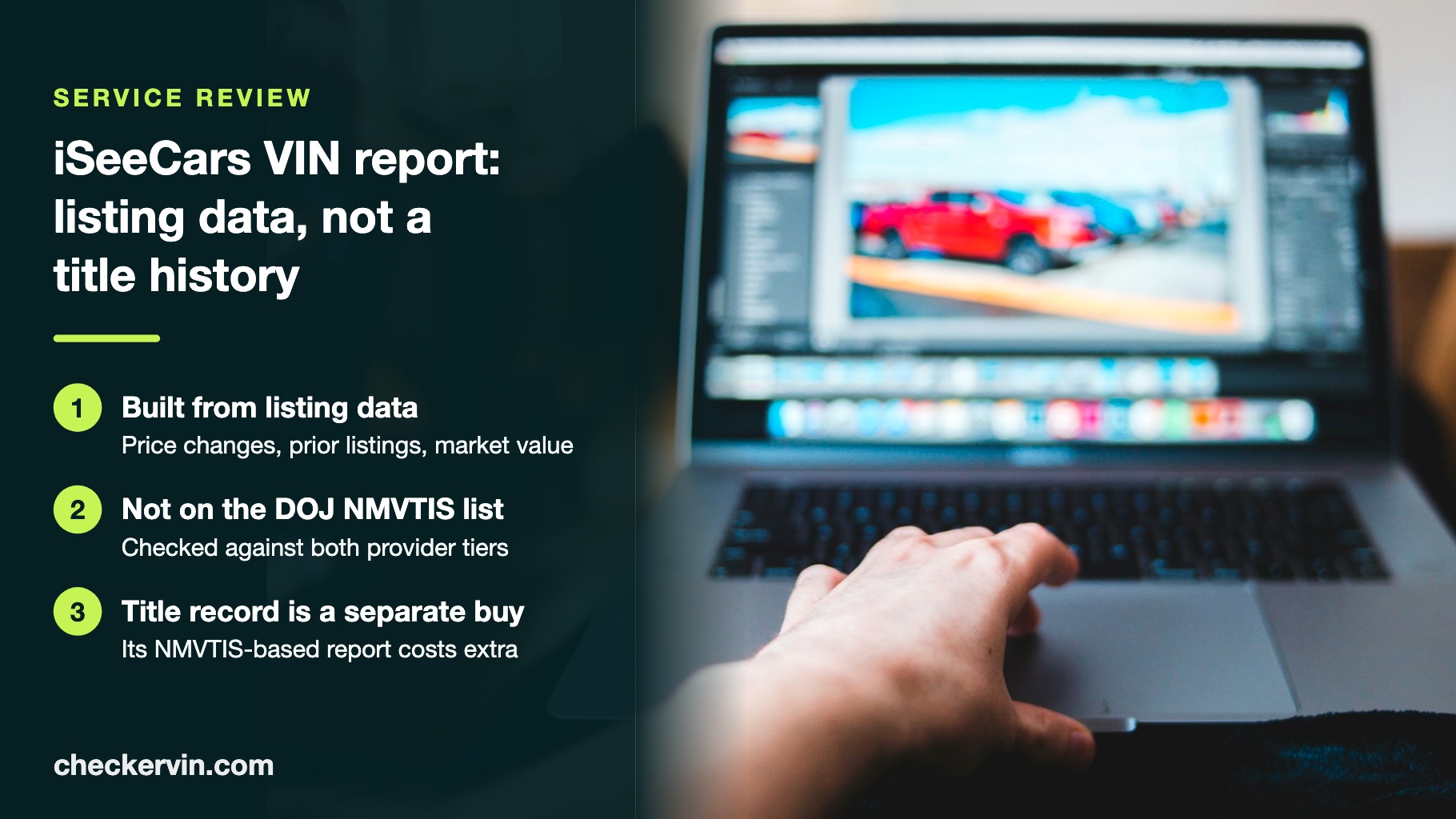
- A market-analysis report on one VIN, called the iVIN report: listing and price history, an estimated market value, local supply, depreciation, plus NHTSA recalls and an NICB theft check. iSeeCars' own FAQ says its reports are not standard vehicle history reports.
- Is it free?
- The lookup is free to start. The full iVIN report needs a monthly subscription with a cap on reports per month.
- Does it replace a title check?
- No. iSeeCars is not on the federal NMVTIS approved-provider list, and it sells title records as a separate product. For title brands, use an NMVTIS report from a listed provider.
Monthly
iVIN plans, 50 or 200 reports
Unused lookups expire each month
1981+
Coverage
US passenger vehicles only
Not listed
DOJ NMVTIS provider list
Affiliates checked too
Separate
Its NMVTIS-based history report
Bought apart from the iVIN plans
The short verdict
The iSeeCars VIN report is a good negotiating aid and a poor substitute for a title check. Those two statements do not contradict each other. A record of what a car was listed for, and for how much, tells you about the market. A title history tells you about the car. You want both before money changes hands, and they come from different places.
The company is unusually candid about this. Its plans page says, in its own words, that its reports “are not standard vehicle history reports,” and its terms describe the iVIN report as not intended to provide vehicle history.
What the iSeeCars VIN report actually is
iSeeCars describes itself as a car search engine that pulls used-car listings onto one site and scores the cars and dealers in them. Its about page says it aggregates data daily from over 75% of US used-car listings. That is a company claim we cannot audit, but it explains the product: the iVIN report is what that listing archive knows about one VIN.
Reports cover US passenger vehicles from model year 1981 onward. You can reach them from the VIN page, the iSeeCars mobile apps (which scan the VIN barcode), the “See More Insights” button on its own listings, or a browser extension that links a report whenever it spots a VIN on another site.
What an iSeeCars VIN check shows, and where each part comes from
The VIN page publishes a feature table for the report. Here it is, row by row, with the source iSeeCars names for each part.
| What the report includes | Where the data comes from |
|---|---|
| Market value price analysis | iSeeCars' own model, from an estimated mileage unless you enter the real one |
| Selling history: price changes, prior listings and sales | Listings iSeeCars has aggregated |
| Similar cars comparison and local supply | Listings iSeeCars has aggregated |
| Multi-year depreciation and best times to buy or sell | iSeeCars' own analysis of historical prices |
| Dealer scorecard | iSeeCars' own analysis |
| Theft record check | National Insurance Crime Bureau database |
| Recall history | NHTSA |
| Title and lien info | The state DMV, and only where the state provides it |
| Accident check | Not named on the page |
Read down the right-hand column and a pattern appears. Most rows are iSeeCars’ own analysis of listings. Two are federal or insurer data anyone can check free: recalls from NHTSA and theft records from NICB. Title information depends on whether your state shares it, and the accident check has no named source on the pages we read.
Is the iSeeCars VIN report free?
Partly. Entering a VIN costs nothing, and iSeeCars labels two elements free: the theft record check and the state title and lien information. Its FAQ is plain that you sign up for a monthly plan “if you want to access the full reports,” and its terms list the iVIN report among the services that require payment. One exception: when a seller has attached a summary or report to a listing, iSeeCars says it is free to view.
| iSeeCars plan (read November 2026) | What its plans page lists |
|---|---|
| iVIN Lite — monthly subscription | 50 reports a month: accident, theft and title/lien checks, listing history, recalls, pricing and market value analysis |
| iVIN Pro — higher monthly tier | 200 reports a month: everything in Lite, no ads, local market reports, and a link to a Carfax report if you hold a separate Carfax subscription |
| Vehicle history report — bought separately | Sold separately on its vehicle-history page; an NMVTIS-based title report plus an iSeeCars analysis |
Two terms matter if you only want one car checked. Unused lookups expire at the end of each month, and its FAQ says there are no partial or prorated refunds when you cancel. We could not confirm field by field what a non-subscriber sees after entering a VIN, because that depends on running a real vehicle through the tool.
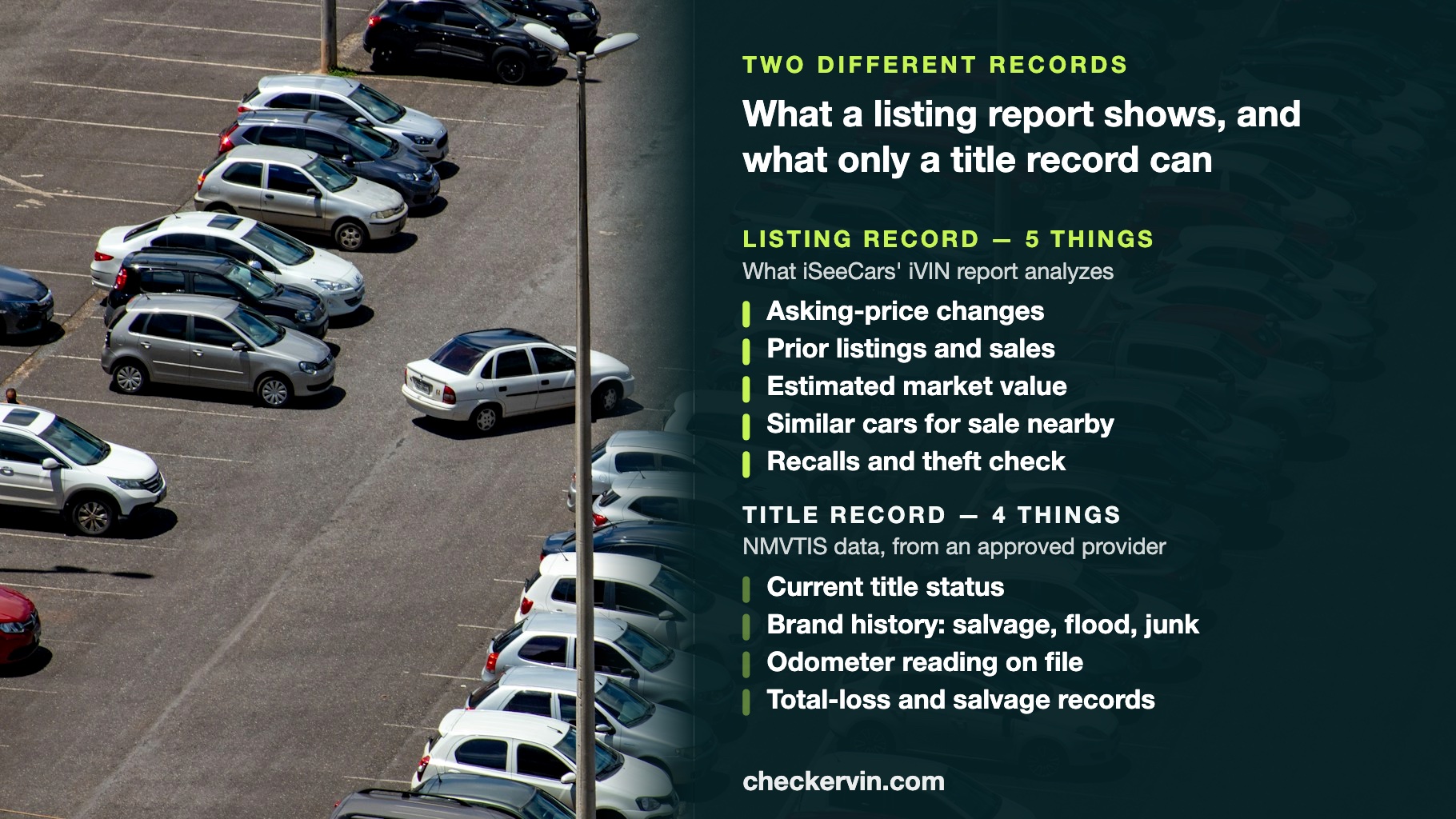
A listing history is not a title history
This is the gap worth understanding before you rely on any listing-based report. A listing is an advertisement. It records what a seller said and asked, on a given date. A title record is what a state motor vehicle agency, an insurer or a salvage yard reported about the vehicle itself.
The two rarely overlap on the things that cost buyers money. A car that was declared a total loss in one state and retitled in another can be listed clean, with photos and a fair price, and every listing record will faithfully repeat that. The federal NMVTIS system exists to catch exactly that move, because states, insurers and salvage businesses are required to report into it.
Where the listing data earns its keep
This is the part of the iSeeCars VIN report that a title record cannot do. Price changes and prior listings show whether a car has been relisted, cut in price or moved between sellers. A car that has been advertised for a long time, or reappears after a sale, gives you a reason to ask questions and room to offer less.
The market value needs one caution. The VIN page says the mileage is estimated from the car’s age and the average for similar vehicles, and that the market value is calculated from that estimate. Enter the real odometer reading and the ZIP code before you quote the number to a seller. Our car value by VIN guide covers why mileage and condition move a valuation far more than the VIN does.
Is the iSeeCars VIN report accurate?
Accurate at what it measures, with limits it states itself. The terms of service say the window stickers, history reports, build sheets and iVIN reports are based on information supplied by the seller or other third parties, that iSeeCars is not responsible for its accuracy or for omissions, and that vehicle details should be verified independently.
That is a normal disclaimer for listing data, and it points to the real limits:
- Listing details are what a seller typed, so options and condition can be wrong at the source
- The market value rests on an estimated mileage until you supply the real one
- Title and lien details appear only where the state DMV provides them
- The accident check has no named source on the pages we read, so its coverage is unknown
iSeeCars and the NMVTIS approved-provider list
The Department of Justice publishes the businesses approved to provide NMVTIS vehicle history reports. iSeeCars does not appear on that page, either as a primary provider or among the affiliate websites listed under them. The consumer tier, as it read in November 2026:
- Bumper.com
- Carsforsale.com
- Carvertical.com
- Checkthatvin.com
- Clearvin.com
- EpicVin.com
- GoodCar.com
- Titlecheck.us
- Vinaudit.com
- Vindata.com
- VinReport
- Vinsmart.com
That is 12 names, listed alphabetically, and the department states the order implies no preference. It also notes that consumers cannot get NMVTIS reports from Carfax, DMVDesk or Experian, which serve dealers. Check it yourself at the official NMVTIS provider page; it takes less than a minute.
The separate history report iSeeCars sells
iSeeCars does offer a title product, just not inside the iVIN report. Its vehicle-history page sells a vehicle history report as a separate purchase and says the title records in it are sourced from NMVTIS. It lists the contents as current title status, last title date, brand history, odometer reading, total-loss history and salvage history, plus an iSeeCars analysis of price and condition.
Since iSeeCars is not itself on the approved list, that NMVTIS data has to reach it through a provider that is. The pages we read do not say which one. That is not a sign of anything wrong, but it is a fair question to ask before you buy, and a report should identify where its title data came from. Its own FAQ also says an independent inspection is still recommended, which is good advice whoever you buy from.
What our free VIN report returns, and what it does not yet
CheckerVIN’s report is free, with no account and no card. Enter a VIN and it returns the factory build and specifications, factory warranty terms, open NHTSA safety recalls, photos filed against the VIN, and market and listing prices. That last item overlaps with the part of the iSeeCars report most people want, without a monthly plan.
Title brands, damage records, odometer readings and ownership history are launching soon rather than available now. Until they are, the honest route to the title record is an NMVTIS report from a provider on the list above. Our vehicle history report guide explains what a full report should contain.
Run the free report, no plan needed
Decoded from official manufacturer and NHTSA records
A sensible order for checking one car
- 1Decode the VIN and check recalls, freeConfirm the car is the trim, engine and year the listing claims, and that no safety recall is open. This costs nothing here or at NHTSA.
- 2Run the free NICB theft and salvage screenVINCheck is the free lookup from the National Insurance Crime Bureau, the organization the iSeeCars theft check names as its source.
- 3Look at price and listing historyAsking prices, relists and local comparables tell you what to offer. A listing-based report, ours or iSeeCars', does this job.
- 4Buy the NMVTIS title record before payingGet title brands, total-loss reports and the last odometer reading from an approved provider. This is the step a listing report cannot replace.
- 5Book an independent inspectionNo database sees a worn transmission or a hidden repair. A mechanic does.
Who the iSeeCars VIN report suits
It suits a buyer comparing several cars in the same market who wants to know which are overpriced, which have sat, and what a fair offer looks like, and who will use the 50 or 200 monthly lookups. Dealers and frequent shoppers get the most from the subscription.
It suits less well someone checking one car at the point of purchase. For that buyer, the price questions are answered free elsewhere, and the question that decides the deal is the title record, which the iVIN report does not carry. Our free vehicle history report page sets out what you can get at no cost and where paying starts to make sense.
Where this information comes from
- iSeeCars — Free VIN Check and DecoderThe iVIN feature table, data sources, 1981+ coverage and mileage-estimate note
- iSeeCars — iVIN plans and FAQPlan tiers, report counts, cancellation and the separate-access note on title records
- iSeeCars — Vehicle History ReportThe separately sold report and its NMVTIS-sourced contents
- iSeeCars — Terms of ServiceProduct descriptions and the accuracy disclaimer
- iSeeCars — About usHow the company describes its listing aggregation
- U.S. Department of Justice — approved NMVTIS data providersThe federal list, including affiliate sites under each provider
- NICB VINCheckFree theft and salvage screen from the organization iSeeCars names as its theft source
- NHTSA recall lookupOpen recalls by VIN, free from the regulator
- How we made this pageWritten by the CarCheckerVIN editorial team with AI assistance from iSeeCars' own pages, the DOJ NMVTIS provider list and other public records; facts checked November 2026.
Keep reading
Frequently asked questions
Is the iSeeCars VIN report free?
The VIN lookup is free to start, and iSeeCars labels its theft record check and state title and lien information as free. The full iVIN report needs a monthly subscription: its plans page offers two tiers, iVIN Lite with 50 reports a month and iVIN Pro with 200, and unused lookups expire at the end of each month. Summaries are also free when a seller has provided one with a listing.
Is the iSeeCars VIN report accurate?
Its terms of service say vehicle information is supplied by the seller or other third parties, that iSeeCars is not responsible for its accuracy, and that details should be verified independently. The market value is calculated from an estimated mileage unless you enter the real figure. Treat it as a well-informed pricing guide rather than a record of what happened to the car.
Is iSeeCars an approved NMVTIS data provider?
iSeeCars does not appear on the Department of Justice list of approved NMVTIS data providers, either as a primary provider or among the affiliate sites listed under them. Its separate vehicle history report says its title records come from NMVTIS, but the pages we read do not name the approved provider supplying them.
Does an iSeeCars VIN check show accidents and title brands?
The iVIN report includes an accident check, though iSeeCars does not name its source. Title brands such as salvage, flood or junk are not part of the iVIN report itself; its FAQ says separate access is needed for title records and brand history, which it sells as a separately bought, NMVTIS-based vehicle history report.
Can I use the iSeeCars VIN lookup as a VIN decoder?
Its VIN page is titled as a free VIN check and decoder, and the iVIN report includes key specifications. If all you need is what the car left the factory as, the federal NHTSA decoder and the free decode on this page return the build directly from the manufacturer's filing, with no plan required.
How do I cancel an iSeeCars VIN plan?
Its FAQ says to go to Account Info and click Cancel. The plan stays active to the end of the current billing cycle, unused lookups expire at the end of the month, and it states that no partial or prorated refunds are given.
Get the price picture free
Decode any VIN free for the factory build, specifications, open safety recalls and market and listing prices. No account, no card. Full vehicle history reports are launching soon.
Run a free VIN check