The short answer
- Why the SSN?
- A federal return above $10,000 in cash has to carry your name, address and taxpayer identification number. It is a duty on the dealer.
- What counts as cash?
- Currency, foreign currency, monetary instruments with a face amount of $10,000 or less, and digital assets. A personal check does not.
- Am I doing anything wrong?
- No. Paying cash for a car is lawful. This is a reporting rule aimed at businesses, not a limit on how you may pay.
$10,000
The threshold, and it is 'more than'
26 U.S.C. 6050I(a)
Name, TIN
What the return must carry about you
6050I(b)(2)
Jan 31
By when you must get a written statement
6050I(e)
Not a check
A personal check is not cash here
6050I(d)
Why they want your Social Security number
The request feels invasive because it arrives at the wrong moment — you are paying in full, so there is no credit application and no lender, and the number seems to have nothing to do with anything. It has everything to do with one obligation that lands on the dealer rather than on you.
A business that receives more than $10,000 in cash has to file a federal information return about the transaction, and the statute requires that return to identify the person the cash came from — by name, address and taxpayer identification number. The dealer is not assessing you. They are collecting a field they are required to report.
The rule, in one sentence
26 U.S.C. 6050I(a) applies to any person who is engaged in a trade or business and who, in the course of that trade or business, receives more than $10,000 in cash in one transaction, or in two or more related transactions. Such a person must make the return the statute describes.
Three elements do the work, and each one matters to a buyer. It applies to a trade or business, which is why private sales are different. It is triggered by more than $10,000, so exactly ten thousand is not over the line. And it counts related transactions together, which is discussed below.
What counts as cash
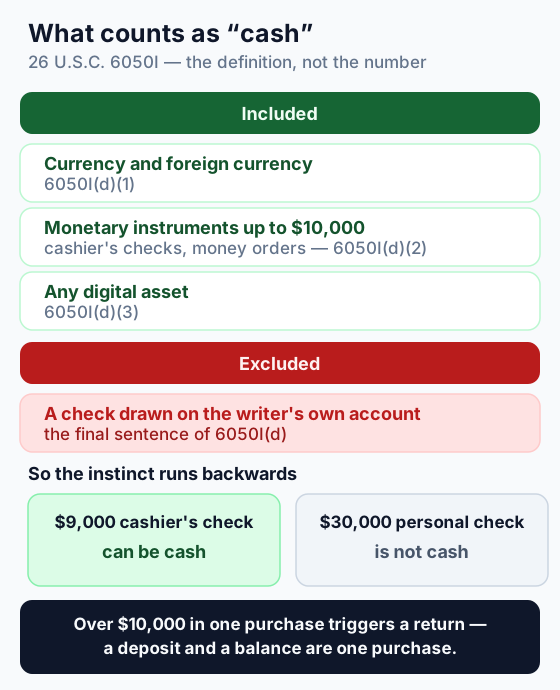
6050I(d) is headed Cash includes foreign currency and certain monetary instruments, and it extends the ordinary meaning of the word in three directions:
| Included as cash | The detail |
|---|---|
| Foreign currency | Named expressly in 6050I(d)(1) |
| Monetary instruments with a face amount of not more than $10,000 | Whether or not in bearer form, to the extent provided in regulations — this is where cashier's checks, money orders and similar instruments come in |
| Any digital asset | As defined in section 6045(g)(3)(D), added by later amendment |
And one carve-out, which is the sentence that produces the strange result: the monetary-instrument paragraph does not apply to any check drawn on the account of the writer at a financial institution. A personal check is not cash for this purpose.
The inversion that catches people out
Put those two rules side by side and the result runs against instinct. Consider two buyers paying the same dealer for the same car:
| How they paid | Is it cash for this rule? |
|---|---|
| A $30,000 personal check drawn on their own bank account | No — expressly excluded by the final sentence of 6050I(d) |
| A $9,000 cashier's check, plus $6,000 in currency | The cashier's check can count, and the currency does — together they exceed the threshold |
| $12,000 in currency | Yes, straightforwardly |
| A wire transfer from the buyer's bank | Not a monetary instrument handed over — the mechanics differ, and this is a question for the dealer's finance office rather than an assumption |
The instinct that a bank-guaranteed instrument is somehow more official, and therefore less likely to trigger reporting, is exactly backwards. The statute treats the small guaranteed instrument as cash-like precisely because it is portable and anonymous in a way a personal check is not — a personal check is already traceable to an account in the writer’s name.
Why a car specifically, and why a dump truck is not
The statute says monetary instruments count as cash to the extent provided in regulations, and the regulation is where a car buyer finds out this applies to them. 26 CFR 1.6050I-1 makes the monetary-instrument rule bite in a designated reporting transaction, which it defines as a retail sale— or a broker’s receipt of funds in connection with one — of a consumer durable, a collectible, or a travel or entertainment activity.
Then it defines consumer durable, and chooses a car as its illustration:
Two things follow. A retail car sale is squarely the kind of transaction where a cashier’s check or money order can be treated as cash, which is why this comes up at dealerships more than almost anywhere else. And the regulation’s own contrast is worth noticing — the same money for a commercial truck is analyzed differently, because a dump truck is not a consumer durable.
The regulation adds a second route that does not depend on the transaction type at all: an instrument is also treated as cash where the recipient knows it is being used in an attempt to avoid the reporting requirement.
The exception that covers most car buyers
Here is the part that resolves the common case, and it is easy to miss. Under 1.6050I-1(c)(1)(iv), a cashier’s check, bank draft, traveler’s check or money order received in a designated reporting transaction is not treated as cash if the instrument constitutes the proceeds of a loan from a bank.
So the most ordinary way a car gets paid for — you arrange finance, the bank issues a check, you hand it over — does not turn the instrument into cash. The regulation also says how the dealer establishes that: the recipient may rely on a copy of the loan document, a written statement from the bank, or similar documentation, such as a written lien instruction from the issuer.
- 1If your check is loan proceeds, say so and bring the paperA copy of the loan document or the bank's written statement is what the regulation names. Offering it up front removes the question rather than answering it later.
- 2If it is your own money in a cashier's check, expect it to countThe exception is about loan proceeds. A cashier's check drawn from your savings is not covered by it.
- 3A personal check needs none of thisA check drawn on your own account is excluded by the statute itself, so the whole analysis falls away.
There is a further exception at 1.6050I-1(c)(1)(v) for instruments received in payment on a promissory note or installment sales contract, which applies only where such contracts with substantially similar terms are used in the ordinary course of that business and where total payments received on or before the 60th day after the sale do not exceed 50 percent of the purchase price. That one is more likely to matter to a dealer arranging in-house finance than to a buyer, but it explains why the answer can differ between two dealerships.
What is actually on the form
6050I(b) sets out what the return must contain, and it is a short list:
- The name, address and taxpayer identification number of the person from whom the cash was received
- The amount of cash received
- The date and nature of the transaction
- Such other information as the Secretary may prescribe
That is the whole of your exposure in the transaction: identity, amount, date and what the transaction was. There is nothing in it about your income, your creditworthiness or the source of your funds, which is worth knowing because those are the things people assume they are being asked about when the SSN request lands.
You get a written statement, and there is a deadline
6050I(e) requires the filer to furnish a written statement to each person whose name appears on the return. The statement must show the name, address and phone number of the information contact for the filer, and the aggregate amount of cash they received from you.
It has a deadline: the statement must be furnished on or before January 31 of the year following the calendar year in which the return was required. So a purchase in March means a statement by the following January at the latest.
- 1Keep it with the purchase paperworkIt is the record that the reporting happened and who to contact about it. File it with the title, bill of sale and any inspection reports.
- 2Check the amount matches what you paidThe statement shows the aggregate cash received from you. A figure that does not match your own record is worth a call to the contact named on it.
- 3If it never arrives, askThe obligation to furnish it is on the filer. A polite request to the dealer's finance office is the normal route.
Private sellers are not filing this
The duty attaches to a person engaged in a trade or business who receives the cash in the course of that trade or business. An individual selling their own car is not in that position, so the return is not part of a private-party sale.
That is one of several practical differences between the two routes, and it cuts both ways: no reporting also means none of the structure that comes with a dealer transaction. Our private seller versus dealer guide covers which protections attach to which kind of sale, and curbstoning covers the case where somebody is running a business while presenting as a private seller — a distinction that matters here as much as anywhere.
This is a reporting rule, not a limit on paying cash
Worth stating plainly, because the paperwork can make an ordinary purchase feel suspicious. Nothing in this rule prohibits paying cash for a car, caps what you may pay, or requires you to justify where the money came from. It requires a business to file an information return when it receives more than a threshold amount, and to tell you it did.
- Paying in full with currency is lawful, and common on used vehicles
- The dealer's request for identification is a legal requirement on them, not discretion
- You are entitled to know it happened — that is what the written statement is for
- None of this replaces the checks that decide whether the car is worth buying at all
- The provision dates from 1984, and a threshold set then reaches a great many ordinary cars now
Making the day go smoothly
Almost every unpleasant moment in a cash purchase comes from a question arriving without warning at the point where the money is already on the table. None of the questions are unreasonable once you know why they are being asked, and all of them can be answered in advance.
The friction in a cash purchase is almost always administrative rather than financial. These are the things that remove it:
- Bring government-issued identification, and expect the name, address and TIN fields to be filled in
- Ask the finance office in advance what form of payment they prefer and what they will treat as cash
- Expect a deposit and a balance to be treated as one purchase rather than two payments
- Keep your own dated record of every amount handed over, so the January statement can be checked against it
- Do the vehicle checks before the payment conversation — the money is the easy part to arrange and the hardest to recover
- If a bank issued your check, bring the loan document, because the regulation names it as what the dealer may rely on
That last point is the one worth repeating on a page about payment. A cash purchase removes the lender from the transaction, and with it the only other party who had any reason to care whether the car was worth what you paid. Run the free decode for the factory build and open safety recalls, check for a title brand, and check for a lien, before the money moves rather than after.
Run the free checks before you pay
Decoded from official manufacturer and NHTSA records
Where this information comes from
- 26 U.S.C. 6050I — returns relating to cash received in trade or businessThe more-than-$10,000 threshold, the related-transactions rule, what the return must contain, the definition of cash and the written statement duty
- 26 CFR 1.6050I-1 — returns relating to cash in excess of $10,000Designated reporting transactions, the consumer durable definition using an automobile as its example, the bank loan proceeds exception and the 24-hour related transactions rule
- IRS — Form 8300 informationThe agency's own page for the return businesses file under this section
- NHTSA recall lookupThe free check to run before the money moves
Keep reading
Frequently asked questions
Why does a car dealer ask for my Social Security number when I pay cash?
Because a business that receives more than $10,000 in cash has to file a federal information return, and 26 U.S.C. 6050I(b)(2) requires that return to contain the name, address and taxpayer identification number of the person the cash came from. The request is a legal requirement on the dealer rather than a credit check.
Is a cashier's check treated as cash?
It can be. Under 6050I(d), cash includes foreign currency, any monetary instrument with a face amount of not more than $10,000 to the extent regulations provide, and any digital asset. So a cashier's check below the threshold can itself count, which surprises people who assumed only currency mattered.
Does a personal check count as cash?
No. The statute says the monetary-instrument paragraph does not apply to a check drawn on the account of the writer at a financial institution. That produces the odd result that a personal check for a large sum is not cash for this purpose while a small cashier's check may be.
Can I split the payment to stay under $10,000?
The rule already accounts for that. 6050I(a) applies to more than $10,000 received in one transaction or in two or more related transactions, so payments that belong to the same purchase are counted together. Arranging payments to avoid the reporting requirement is not something this page will help with.
Does this apply when I buy from a private seller?
No. The obligation falls on a person engaged in a trade or business who receives the cash in the course of that trade or business. An ordinary individual selling their own car is not filing this return, which is one practical difference between buying from a dealer and buying privately.
The checks that matter more when there is no lender
Decode any VIN free for the factory build, specifications and open safety recalls. No account, no card. Full vehicle history reports are launching soon.
Run a free VIN check