The short answer
- Is an online car purchase covered?
- Nothing in the rule excludes vehicles. It covers anything ordered by mail, internet or telephone, and lists only four exclusions.
- How long can delivery take?
- The stated time, or 30 days if none was stated — and 50 days where you applied to the seller for credit.
- What does it not do?
- It is a delivery and refund rule. It says nothing about whether the car is any good, which is the thing you could not inspect.
4
Exclusions in the rule, none for vehicles
16 CFR 435.3(a)
30 / 50
Days to ship — the longer one if you financed
435.2(a)(1)(ii)
7
Working days for a prompt refund
435.1(b)(1)
Not quality
What the rule does not reach
Only timing and money
The rule applies to a car, and that is the finding
16 CFR Part 435is the FTC’s Mail, Internet, or Telephone Order Merchandise Rule. Most people know it, if at all, as the reason a late parcel entitles you to a refund. Its definition is broader than its reputation.
435.1(a) defines a covered sale as one in which the buyer has ordered merchandise from the seller by mail, via the Internet, or by telephone, regardless of the method of payment or the method used to solicit the order. There is no price ceiling, no product category, and no carve-out by value.
435.3(a) then sets out the limits of the rule, and the list is short enough to read in full:
| The four exclusions in 435.3(a) | What it covers |
|---|---|
| Subscriptions ordered for serial delivery | After the initial shipment is made in compliance with the rule |
| Orders of seeds and growing plants | A narrow agricultural carve-out |
| Orders made on a collect-on-delivery basis | C.O.D. transactions |
| Prenotification negative option plans | Transactions governed by 16 CFR Part 425 instead |
A motor vehicle is not among them. That is the whole basis for this page: an online car purchase sits inside a federal rule that almost nobody writing about online car buying mentions, because the rule is filed in most people’s minds under parcels.
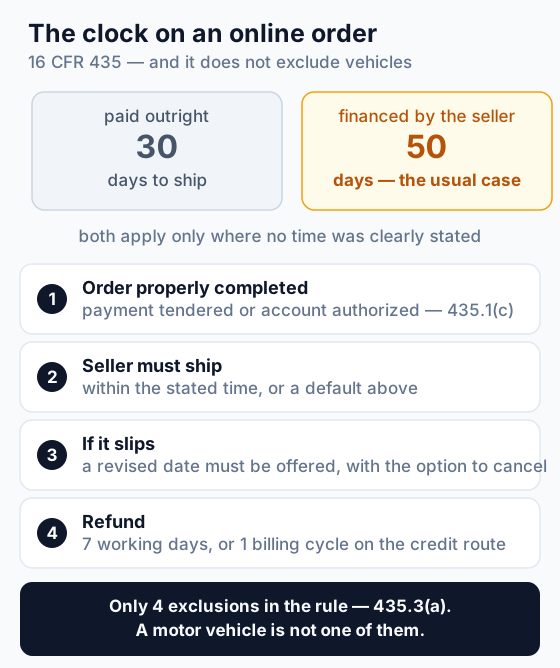
Thirty days, or fifty if you financed it
435.2(a)(1) makes it an unfair or deceptive act or practice for a seller to solicit an order unless, at the time of soliciting, it has a reasonable basis to expect that it can ship:
- Within the time clearly and conspicuously stated in the solicitation; or
- If no time is clearly and conspicuously stated, within thirty (30) days after receipt of a properly completed order
- Except: where at the time of ordering the buyer applies to the seller for credit to pay in whole or in part, the seller has fifty (50) days rather than thirty
That exception is the sentence worth knowing, because it inverts the intuition. Applying for the seller’s financing — which online car retailers make the path of least resistance — moves the deadline out by twenty days. Buyers who assume a thirty-day federal backstop while financing through the seller are working from the wrong number.
When the clock actually starts
The deadline runs from receipt of a properly completed order, and 435.1(c) defines that too. It is the point at which the buyer has tendered payment in the proper amount — cash, check or money order — or given authorization to charge an account, together with the information the seller needs to process the order.
For a vehicle bought online, that means the clock is not started by browsing, by a deposit that has not been applied, or by an application still being underwritten. It starts when the order is properly completed on the seller’s side. If you are counting days, count from that, and keep the confirmation that establishes it.
What happens when delivery slips
The rule does not simply void a late sale. It sets out machinery, and the machinery gives the buyer choices at each step.
- 1The seller must offer a revised shipping dateWhen it cannot ship within the applicable period, it has to provide a revised date and the option to cancel for a prompt refund rather than letting the order drift.
- 2Consent to a definite revised date is a choice, not a defaultSilence is treated by the rule's structure as a decision point, which is why sellers ask. Read what you are agreeing to before replying.
- 3Consent to an indefinite delay keeps your exit openWhere a buyer has consented to an indefinite delay, the rule preserves a continuing right to cancel at any time after the old definite revised shipping date, or any date superseding it.
- 4Failing to give you a way to cancel is itself a violation435.2 makes it a violation to fail to furnish the buyer with adequate means to exercise an option or to cancel prior to shipment.
That third step is the one to hold on to on a vehicle purchase, where indefinite delays are common — a car in transit, a title not yet received, a lender still finalizing. Agreeing to wait is not the same as giving up the right to stop waiting.
What resets the clock, and why a declined application matters
435.1(c)is more specific than “when you ordered”. Receipt of a properly completed order means the time at which the seller receives both the payment — full or partial, as cash, check, money order, an authorization to charge an existing account, or another payment method — and an order containing all of the information the seller needs to process and ship it. Missing information on your side delays the start as much as missing money does.
Then comes the proviso that matters on a financed car. Where the seller receives notice that a payment other than cash or credit has been dishonored, or that the buyer does not qualify for a credit sale, receipt of a properly completed order becomes a later moment rather than the original one.
If a financing problem is where you have ended up, the paperwork that governs what happens next is covered in our guide to a deal that falls through, which is a contract question rather than a shipping one.
“We cannot say when” is regulated too
Anyone who has waited on a delayed vehicle has heard some version of we are unable to give you a date. The rule addresses that specific answer.
Under 435.2(a)(3), it is a violation for a seller to inform a buyer that it is unable to make any representation about the length of a delay unless the seller has a reasonable basis for saying so and informs the buyer of the reason or reasons for the delay. An unexplained “we do not know” does not satisfy that. A reason does not have to be satisfying, but it does have to be given.
There is a further provision that quietly shifts the burden. 435.2(a)(4)provides that in an action brought by the Commission, a seller’s failure to have records or documentary proof establishing its use of systems and procedures which assure shipment in the ordinary course of business within the applicable time creates a rebuttable presumption that the seller lacked a reasonable basis for expecting to ship on time.
That is not a right you exercise personally, and it is worth understanding correctly: it governs FTC enforcement rather than your own claim. What it tells a buyer is the shape of the obligation — a seller is expected to be able to show why it thought it could deliver, not merely to assert that it hoped to.
How fast a refund has to be
435.1(b) defines prompt refund, and it is specific about both speed and method:
| Route | The standard |
|---|---|
| The general case — 435.1(b)(1) | Sent within seven (7) working days of the date the buyer's right to a refund vests, by any means at least as fast and reliable as first class mail |
| Where the seller cannot refund by the original method | Cash, check or money order within seven working days of the date the seller discovers it cannot refund the way payment was made |
| The credit route at 435.2(d)(2)(i) | Sent within one (1) billing cycle from the date the right to a refund vests |
On a car, the sums involved make this more than academic. A deposit or full payment sat with a seller for weeks past a missed delivery is a concrete cost, and the rule gives a measurable standard to point at rather than an argument about what is reasonable.
Your state may give you more, and the rule says so
435.3(b) is unusually explicit about how the federal rule sits with state and local law. The Commission states it does not intend to preempt action in the same area that is not inconsistent with the rule, and that the part does not annul or diminish any rights or remedies provided to consumers by any State law, municipal ordinance, or other local regulation, insofar as those rights or remedies are equal to or greater than those provided by this part.
It supersedes only those provisions that are inconsistent — that is, weaker. The practical reading: treat the federal rule as a floor, then check whether your state has put something better on top of it, particularly around vehicle sales and delivery.
What this rule is not
Being precise here matters, because the rule is easy to over-read into a right it does not contain.
- It is not a cooling-off period — the federal three-day rule is a separate thing with its own limits
- It is not a right to return a car you have received and dislike
- It says nothing about the vehicle's condition, history or accuracy of description
- It does not replace a retailer's own return window, which is contractual and usually more generous about regret
- It is a rule about time and money: when the car must ship, what happens if it does not, and how fast your payment comes back
If the question you actually have is whether you can hand back a car you already have, our guide to returning a used car covers the federal three-day rule and why it turns on where you agreed rather than what you bought.
The real risk is the inspection you did not do
Every protection above is about the transaction. None of it touches the thing that actually goes wrong with an online car purchase, which is that you bought a specific used vehicle without standing next to it.
The checks that substitute for a walkaround are all record checks, and they are the same ones that matter in person — they simply carry more weight when nothing else is available. A free decode settles the factory build, the specifications and open safety recalls. A title-brand check settles whether an insurer once wrote the car off. A lien check settles whether somebody else has an interest in it. None of those requires you to be in the same state as the car.
What to run before you click buy
- Decode the VIN for factory build, specifications and open recalls — free, and it takes seconds
- Check for a title brand, and read the brand's meaning rather than the label alone
- Run an independent lien check rather than relying on the listing
- Screenshot the stated delivery window at the moment you order, and keep the order confirmation
- Read whether you are applying for the seller's credit, because that is what moves the deadline to fifty days
- Find the retailer's own return terms and note the mileage limit and any fee, separately from anything federal
Run the free decode before you order
Decoded from official manufacturer and NHTSA records
Delivery day, and the ten minutes that still matter
The inspection you could not do at a lot is still available to you once the car arrives, and it is worth doing before the transporter leaves rather than after. Check the VIN on the dash and door jamb against the paperwork, look under the carpet and in the spare well, pull a seat belt to its stop, and start the car from cold if you can.
Those checks belong to the same ten minutes described in our red flags guide, and the reason to do them at delivery is that a discrepancy discovered in the first hour is a very different conversation from one discovered in the second week.
Where this information comes from
- 16 CFR 435.1 — definitionsThe covered sale, prompt refund at seven working days or one billing cycle, and receipt of a properly completed order
- 16 CFR 435.2 — mail, Internet, or telephone order salesThe 30-day default, the 50-day version where the buyer applies for credit, and the revised shipping date machinery
- 16 CFR 435.3 — limited applicabilityThe four exclusions, none of which is a motor vehicle, and the preservation of stronger state rights
- NHTSA recall lookupThe free check to run before ordering a car you cannot inspect
Keep reading
Frequently asked questions
Does the FTC mail order rule apply to buying a car online?
Nothing in the rule excludes vehicles. 16 CFR 435.1(a) covers sales where the buyer ordered merchandise by mail, via the Internet, or by telephone, regardless of the method of payment or how the order was solicited, and 435.3(a) lists only four exclusions: subscriptions for serial delivery, seeds and growing plants, C.O.D. orders, and prenotification negative option plans.
How long does an online seller have to deliver a car?
The time clearly and conspicuously stated when you ordered. If no time was stated, 30 days from receipt of a properly completed order — but where you applied to the seller for credit to pay in whole or in part, the seller has 50 days rather than 30. Financed purchases are the normal case, so the longer clock usually governs.
Can I cancel if my online car delivery is late?
The rule gives the buyer options rather than an automatic cancellation. If the seller cannot ship on time it must offer you a revised date with the option to cancel for a prompt refund, and if you consented to an indefinite delay you keep a continuing right to cancel at any time after the old definite revised shipping date.
How quickly must an online car seller refund me?
16 CFR 435.1(b) defines a prompt refund as one sent within seven working days of the date your right to a refund vests, by a means at least as fast and reliable as first class mail. Where the refund route is the credit one at 435.2(d)(2)(i), the standard is within one billing cycle instead.
Is a seven-day return policy the same as this rule?
No. A retailer's return window is a contractual promise it chose to offer, with its own mileage limits, fees and conditions. The federal rule is about shipping deadlines and refunds when delivery does not happen on time. They can both apply to the same purchase and they protect different things.
The checks that work without standing next to the car
Decode any VIN free for the factory build, specifications and open safety recalls. No account, no card. Full vehicle history reports are launching soon.
Run a free VIN check