The short answer
- Is AutoCheck free?
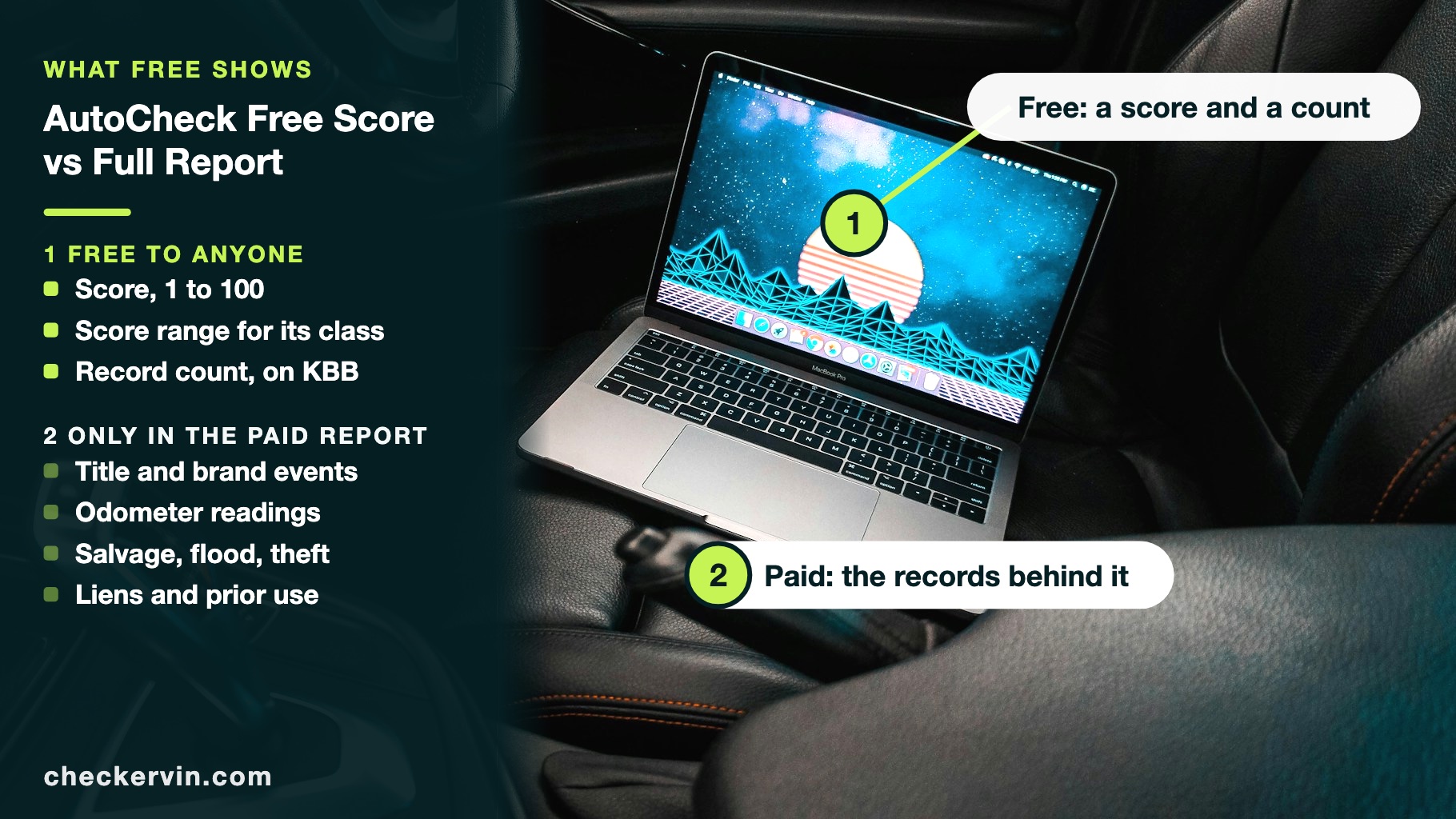
- The AutoCheck Score is free on autocheck.com by VIN or plate. The full report, with the records behind the score, is paid.
- How do I get the full report free?
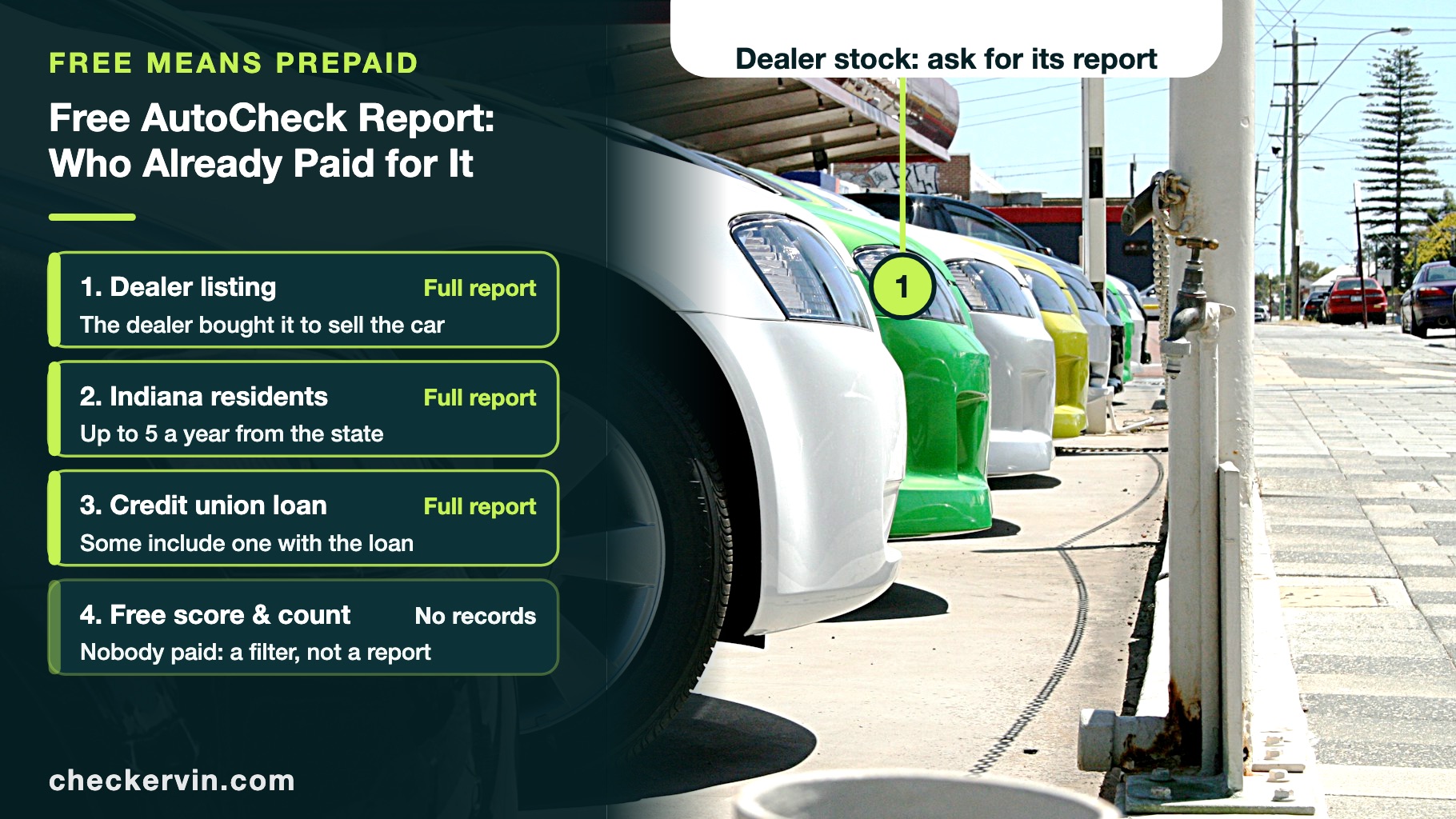
- From a dealer who attached it to the listing, a credit union that includes one with a car loan, or, for Indiana residents, the Secretary of State's service: up to 5 a year.
- What about cheap AutoCheck resellers?
- They are resellers, not Experian. You cannot verify which VIN, which date, or whether the file was changed.
Free
The AutoCheck Score
By VIN or plate on autocheck.com
1–100
Score scale
Five-year on-the-road odds vs its class
Up to 5
Free reports a year, Indiana
Residents, via the Secretary of State
Paid
The full report
Single reports or packages
The short answer
Searches for a free AutoCheck report usually mean one of two things. Some people want the number, the AutoCheck Score, and that part really is free: AutoCheck publishes a page for it. Most want a free AutoCheck vehicle history report itself: the list of title events, auction sales, odometer readings and damage records. That is a paid Experian product, so a free copy exists only when somebody else paid for it.
The useful work is finding out whether somebody already did. On a dealer’s car the answer is often yes. If you live in Indiana, the state covers a few a year. If a credit union is financing the car, it may include one. If none of those apply, the honest options are the free score, free record counts, and the federal checks that cost nothing at all.
This page follows the same idea as our free Carfax report guide, which explains why the seller decides whether a report has already been bought. What changes here is the list of routes, because AutoCheck’s free tools and partnerships are not the same as Carfax’s.
A full report is free only when someone else paid
Experian sells AutoCheck reports to consumers and to businesses. AutoCheck’s members page lists the industries it serves, among them auctions, dealerships, insurers, lenders and credit unions, and manufacturers. Those business customers are the reason free copies exist. A dealer that buys reports for its whole inventory can show one on every listing. A credit union can hand one to a borrower. Indiana has set up a service for its residents. In each case the report was bought upstream, and you are seeing a copy of it.
| Route | Who covered it, and what you get |
|---|---|
| Dealer listing | The dealer, as part of selling the car. The full report, if they attached it. |
| Indiana Secretary of State | The state service, for residents. Up to 5 full reports a year. |
| Credit union auto loan | The lender, as a member perk. A report, if your credit union offers it. |
| AutoCheck free score | Nobody: it is a free tool. The score, not the records. |
| Kelley Blue Book search | Nobody: it is a free tool. How many records exist, not what they say. |
The last two rows sit in a different category from the first three. They are free because they stop short of the records, and their job is to help you decide whether to buy. That is a fair arrangement, but it is not the same as getting the report.
What AutoCheck's free score page gives you
AutoCheck’s free-score page asks for a VIN, or a U.S. license plate and its state, and promises the AutoCheck Score for that vehicle at no charge. The page describes the score as a way to compare several vehicles and says it shows a score range for how a vehicle compares with others in its class. The form is protected by reCAPTCHA, and the page asks for nothing else before the lookup: no card field appears on it.
We did not run a VIN through it for this page. The form needs a real vehicle’s number, and we do not publish anyone’s VIN. So we are describing what AutoCheck says the free score is, not reporting what one lookup returned. Run it yourself on the car you are looking at; AutoCheck says it costs nothing.
The same page pushes the paid side. It offers a 25-report package that unlocks a dashboard comparing vehicles side by side, with the event records from the full report. And it links a subscription for people who do not have a VIN yet. Neither is free. We do not print AutoCheck’s prices, because they change; the checkout shows the current ones.
What the AutoCheck score measures, briefly
AutoCheck’s FAQ calls the score patented and says it predicts the likelihood the car will be on the road in five years. It compares vehicles of similar class and age on a scale of 1 to 100, and the FAQ ties it to the vehicle’s age, number of owners and accidents. That makes it a peer-relative estimate, not a grade: a ten-year-old car and a two-year-old car are each scored against their own kind.
Two cautions follow from that. A score is only as complete as the records behind it, so a crash nobody reported cannot lower it. And a single number can hide the one record that matters most to you, such as a salvage-auction sale or a flood brand. The score tells you which car to look at closer. The records tell you why.
Our AutoCheck review covers the score in depth: how the range works, why dealers built their buying around it, and where it misleads. If you are weighing AutoCheck against its best-known rival, AutoCheck vs Carfax compares what each network holds.
Free AutoCheck record counts on Kelley Blue Book
Kelley Blue Book runs a vehicle history page built on AutoCheck. You can search by VIN or by plate, and the page says this free search gives you the number of records; for the records themselves it sends you to a full AutoCheck report, through a link that leaves KBB for autocheck.com.
A count is more useful than it sounds. Zero records on a car several years old can mean missing data rather than a spotless past. A long list of records on a car the seller calls “one owner, never a problem” is something to ask about. KBB’s page lists what the full report covers: reported accidents, repair records, odometer problems and rollback, open recalls, major flood or frame damage, the number of previous owners, theft or repossession, and reported inspections.
KBB’s page also mentions AutoCheck’s buyback protection, described there as available at no extra cost for registered qualifying vehicles. That belongs to whoever bought the full report and registered it. It does not come with the free count, and it does not transfer to a copy you got from somebody else.
Dealer listings that include an AutoCheck report
The most common way to get a full AutoCheck report free is from the dealer selling the car. Dealers buy reports in volume, and many attach one to each listing on their own site and on marketplaces because it helps sell the car. When the link is there, it is a full report, not a teaser.
- 1Look for the report link on the listingIt is usually near the price or the vehicle details, sometimes as a badge. If the listing shows one report brand but not the other, it is reasonable to ask whether the dealer has both.
- 2Ask for it by VIN if it is missingA dealer with an AutoCheck account can run one quickly. Ask for the report on that VIN, not for a report in general.
- 3Match the VIN on the report to the carCompare all seventeen characters with the plate on the dashboard and the sticker in the door jamb. A report on a similar car reads exactly like a report on this one.
- 4Check the date it was runA report pulled when the car arrived on the lot misses anything recorded since. If the date is old, ask for a fresh one.
- 5Read the records, not only the scoreA dealer report shows the score too. Scroll past it to the auction, title and odometer lines, which are what the score summarizes.
A dealer that has reports on hand but will not show you one for this car has told you something. It is not a legal requirement under the federal Used Car Rule, which our free Carfax report page walks through, but it is a reason to slow down.
Indiana residents: up to 5 free AutoCheck reports a year
Indiana is the one state we found that gives residents full AutoCheck reports at no charge. The Indiana Secretary of State’s Vehicle History Report Service says Indiana residents can access up to 5 free AutoCheck reports per year, and that you sign in through Access Indiana to view them securely.
The allowance and the sign-in are the facts the service’s own page states. How it checks residency, and whether unused reports carry over, are not on the welcome page, so we will not guess; the service itself will tell you once you sign in. If you live in Indiana and are shopping for a used car, this is the first place to go: 5 full reports cover a realistic shortlist.
Credit unions and car loans
AutoCheck’s members page, under lenders and credit unions, says credit unions can offer members a free report when they take out an auto loan with them, as well as use the information internally to check that the vehicle’s value is not affected by its history.
That is a description of what AutoCheck sells to credit unions, not a list of which ones do it. So the move is simple: if you are financing through a credit union, ask the loan officer whether a vehicle history report comes with the loan, and if so, ask for it before you sign for the car rather than after. A lender running the report anyway to protect its own collateral is a lender that may well share it.
Free AutoCheck report in California and other states
People in California search for a free AutoCheck report often enough to show up in keyword data, and the likely hope is a state program like Indiana’s. We did not find one on the pages we checked. That is a statement about our search, not proof that nothing exists, but the Indiana service is the only state-run free AutoCheck allowance we came across.
So in California, as in the other states, the routes that work are the ones on this page that do not depend on where you live:
- A dealer's AutoCheck report on the listing, or one you ask for by VIN
- A credit union that includes a report with an auto loan
- AutoCheck's free score, by VIN or California plate
- Kelley Blue Book's free record count, by VIN or plate
- The federal title record from a Department of Justice-listed provider, which is inexpensive rather than free
One California-specific detail from the Department of Justice: its list of approved NMVTIS providers names Carfax as a commercial-only provider in California, and Experian as a commercial-only provider. Neither is listed for consumers, which matters for the federal title record covered further down.
What only the full report holds
AutoCheck’s FAQ lists what each report searches for. None of it is in the free score in readable form; the score compresses it, and the KBB count tallies it.
| Category | What AutoCheck says the report covers |
|---|---|
| Title and registration history | Title events, registration and usage history |
| Salvage or junk | Vehicles reported as salvage or junk |
| Hail, flood or fire damage | Damage events of those three kinds |
| Mileage | Odometer discrepancies or rollback |
| Gray market and lemon | Gray-market imports and lemon buybacks |
| Prior use | Rental, taxi or fleet designation |
| Abandoned, forfeited, stolen | Abandonment, forfeiture and theft records |
| Loans and liens | Liens representing ownership interests or unpaid judgments |
| Accidents | Accident damage when that information is provided to it |
The same FAQ sets the limits. AutoCheck does not provide previous owners’ names or information about them. It says it may not have every accident a vehicle was in. It only reports on vehicles built for the U.S. and Canadian markets, and a “no records found” result can mean a car built before 1981, without the kind of VIN the search needs, or one so new nothing has been filed yet.
Its data comes, per the FAQ, from state motor vehicle departments, auto auctions, Canadian motor vehicle departments, consumer protection agencies, dealers and other state agencies. The auction feed is where AutoCheck is strongest, which our review explains. On billing, the FAQ says a subscription does not renew automatically: your card is charged when you buy or choose to renew, and purchased reports stay viewable for the subscription term.
Cheap resold AutoCheck reports: what you are actually buying
Search results for a cheap or free AutoCheck include sellers advertising AutoCheck reports for a few dollars. None of them is Experian. What they sell is a report someone else pulled, passed on to you.
We are not calling any particular seller dishonest, and we are not printing their prices. The problem is narrower and you can check it yourself: a resold report is a document nobody stands behind.
- You cannot confirm which VIN it was run on. One changed character gives a different car's clean history.
- You cannot confirm when it was run. An old pull misses every title brand, auction sale or total loss recorded since.
- You cannot tell whether it was edited. A PDF or screenshot is easy to alter.
- Buyback protection belongs to the original buyer who registered it, not to you.
- Your payment goes to a party you know nothing about, often outside any normal checkout.
Compare that with the free routes above. A dealer’s copy comes from a business you can hold to account, the Indiana service comes from the state, and the free score comes from AutoCheck itself. Our cheap VIN check guide covers the low-cost reports that are legitimate, and why a resold report is not one of them.
The federal title record AutoCheck will not sell you
The Department of Justice runs NMVTIS, the federal title database that state titling agencies, insurers, auto recyclers and junk and salvage yards report into, and it publishes which companies may sell its reports. Experian.com is listed for commercial customers only, and the page says plainly that consumers cannot receive NMVTIS vehicle history reports from Carfax, DMVDesk or Experian, which provide that information only to car dealerships.
AutoCheck does not appear on the list under its own name. Consumers who want the federal title record buy it from one of the 12 businesses the department lists for both commercial and public customers:
- Bumper.com
- Carsforsale.com
- Carvertical.com
- Checkthatvin.com
- Clearvin.com
- EpicVin.com
- GoodCar.com
- Titlecheck.us
- Vinaudit.com
- Vindata.com
- VinReport
- Vinsmart.com
The department says the list is alphabetical and implies no preference. The federal record is “intentionally concise” in the department’s words: current title and brand history, the most recent mileage reading, insurer salvage or total-loss determinations, and transfers to a recycler, junk or salvage yard. It is not free, though it is inexpensive, and it answers the title-washing question directly. Our NMVTIS report guide explains each line, and free vehicle history report sets out what a genuinely free check can contain.
What CheckerVIN gives you free today
We do not sell AutoCheck reports, and we do not have AutoCheck’s data. Here is what our free scan returns when you enter a VIN, with no account and no card:
- Factory build and specifications decoded from the VIN
- Factory warranty terms
- Open NHTSA safety recalls
- Photos filed against the VIN
- Market and listing prices
A sensible order costs very little: decode the VIN here and check open recalls, run AutoCheck’s free score and KBB’s free count, collect any free full report the dealer, your state or your lender offers, then buy one federal title record for the car you are serious about, and have a mechanic look at it.
Start free: decode the VIN and check open recalls
Decoded from official manufacturer and NHTSA records
Where this information comes from
- AutoCheck — free vehicle history report scoreThe free score by VIN or plate, the score range, and the 25-report dashboard package; read November 24, 2026
- AutoCheck — frequently asked questionsWhat a report covers, the 1-to-100 score, data sources, renewal terms and market limits
- AutoCheck — members (lenders and credit unions)Credit unions offering members a free report with an auto loan
- Kelley Blue Book — vehicle history reportFree AutoCheck search showing the number of records; full detail requires the full report
- Indiana Secretary of State — Vehicle History Report ServiceIndiana residents: up to five free AutoCheck reports per year, via Access Indiana
- NMVTIS — approved data providers (DOJ / BJA)Experian commercial-only; the consumer statement; the public-tier list; read November 24, 2026
- NHTSA recall lookupOpen safety recalls by VIN, free
- How we made this pageWritten by the CarCheckerVIN editorial team with AI assistance from AutoCheck's, Kelley Blue Book's, the Indiana Secretary of State's and the Department of Justice's own pages and other public records; facts checked November 2026.
Keep reading
Frequently asked questions
Is AutoCheck free?
The score is; the report is not. AutoCheck's free-score page lets anyone enter a VIN or license plate and see the AutoCheck Score for that vehicle at no cost. The full Experian AutoCheck report, with the records behind the score, is a paid product sold as single reports and multi-report packages. A full report reaches you free only when a dealer, a lender or, in Indiana, the state has already covered it.
How do I get a free AutoCheck report?
Check the dealer's listing first, since many dealers attach one, and ask by VIN if it is missing. If you live in Indiana, the Secretary of State's vehicle history service gives residents up to five free AutoCheck reports a year after an Access Indiana sign-in. If you are financing through a credit union, ask whether it includes a report with the loan; AutoCheck markets exactly that perk to credit unions. Everyone else can get the free score from AutoCheck and free record counts from Kelley Blue Book.
What does the AutoCheck score mean?
AutoCheck's own FAQ describes it as a 1-to-100 score that predicts the likelihood the car will still be on the road in five years, compared with vehicles of similar class and age. It is shown with a score range for comparable cars, so a number means little until you see that range. It summarizes AutoCheck's records; it does not inspect the car.
Can I get a free AutoCheck report in California?
Not through a state program that we could find. Indiana's Secretary of State service is limited to Indiana residents, and we did not find a California equivalent on the pages we checked. In California the free routes are the same as anywhere else: a dealer's copy on the listing, a credit union that includes one with a loan, AutoCheck's free score and Kelley Blue Book's free record counts.
Are cheap resold AutoCheck reports legit?
You cannot tell, which is the problem. A reseller is not Experian, so you cannot confirm which VIN the report was run on, when it was run, or whether the file was edited, and any buyback protection belongs to the original buyer. We do not call any particular seller dishonest. A report from AutoCheck itself, a dealer, or the Indiana service is one you can trace.
Does a free AutoCheck VIN check show accidents?
Not in detail. The free score folds accident records into a single number, and Kelley Blue Book's free search shows how many records exist without describing them. The accident detail is in the paid report, and even there AutoCheck's FAQ says it reports accident damage when that information is provided to it and may not include every accident.
Start with what costs nothing
Decode any VIN free for the factory build, specifications and open safety recalls. Full vehicle history reports are launching soon.
Run a free VIN check