The short answer
- What are Copart's fees?
- On a standard non-licensed purchase: a buyer fee set by your final bid, title group and payment type; a virtual bid fee for bidding online; a gate fee ($79 clean title, $95 non-clean); and a $15 environmental fee. Late, storage and relist fees apply only if you miss a deadline.
- How much does it add?
- On a $5,000 clean-title car won live and paid by debit card or wire, the schedule adds $953. Pay the same car by credit card and it adds $1,203.
- What does membership cost?
- Guest is free for watching; Basic is $99 and Premier $249, per Copart's help center.
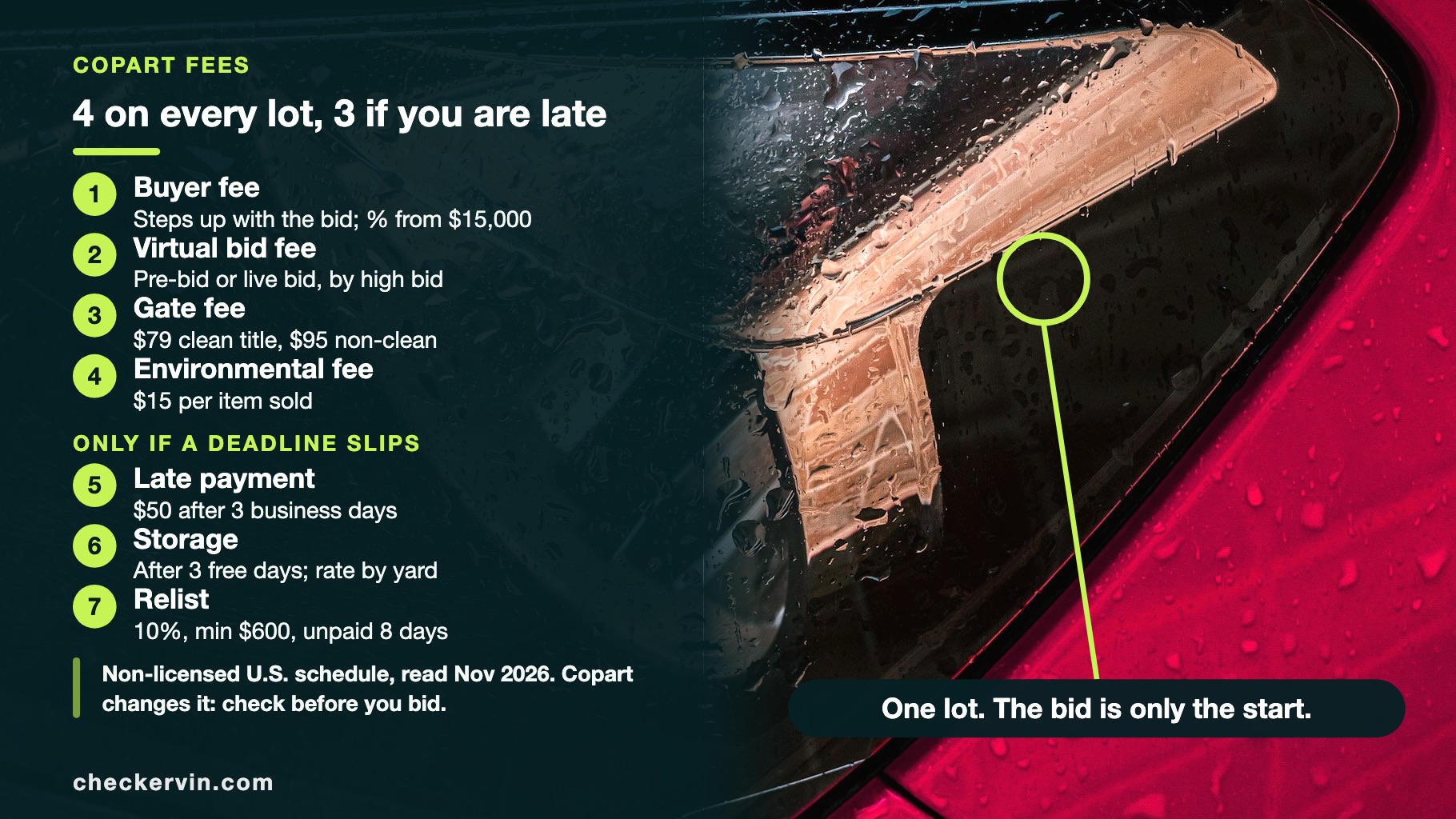
$79
Gate fee, clean title
$95 on non-clean
$15
Environmental fee per item
Non-licensed schedule
3 days
Business days to pay
Then $50 per vehicle
$600
Minimum relist fee
Unpaid after 8 calendar days
Copart fees in short
Copart charges buyers a set of fees on top of the bid, and they are large enough to change which cars are worth bidding on. On every standard vehicle sold to a non-licensed member, four lines are added to the final bid: the buyer fee, the virtual bid fee, the gate fee and the environmental fee. The buyer fee is the big one, and it is not a flat percentage. It steps up through 44 price brackets and then switches to a percentage of the bid at $15,000.
Two choices you make move that fee more than anything else: how you pay, and which title group the car belongs to. Paying with a credit card, Apple Pay, Google Pay or PayPal costs more than paying by debit card or wire, on the same car, at the same bid. A salvage, rebuilt or other non-clean title has its own, generally higher, schedule. Then there is the clock: Copart gives you 3 business days to pay and 3 days of free storage, and charges for both once they run out.
None of that tells you whether the car is worth the bid. Fees are fixed and printed; the car’s title history and damage are not. That is why this page ends with the VIN and title check, which you can start for free.
Which Copart fee schedule applies to you
Copart does not have one fee table. It publishes several, and the one that applies depends on four things you can work out before bidding:
| What decides it | How Copart splits it |
|---|---|
| Whether you hold a dealer or business license | Separate U.S. Non-Licensed and U.S. Licensed fee pages. Most private buyers are on the non-licensed schedule, which this page reads in full. |
| The car's title group | Clean Title and Non-Clean Title tabs. Copart shows which group a car is in through the Title Code tooltip on its lot details page. |
| Standard or heavy vehicle | Heavy covers industrial equipment, medium- and heavy-duty trucks, RVs, trailers, farm and construction equipment and buses. Everything else is standard. |
| How you pay | Secured and unsecured payment methods each have their own buyer-fee column. If any part of the payment uses unsecured funds, Copart applies the unsecured fee to that unit. |
Vehicles sold through CrashedToys carry CrashedToys fees, which this schedule does not cover. Heavy vehicles start on fees close to the standard ones but switch earlier to a straight percentage: above $5,000 on a clean title and $5,500 on a non-clean title, the heavy buyer fee is 15% of the bid with secured payment and 20% with unsecured. If you are buying a box truck or an RV, read the Heavy Vehicles tab rather than the numbers below.
Copart’s payments FAQ also settles a common worry from overseas buyers: Copart does not base its fees on a member’s location. The schedule is the same whether you bid from Ohio or abroad, though shipping and import costs obviously are not.
The Copart buyer fee chart, by final bid
The buyer fee (Copart’s page calls it the bidding fee) is based on your final bid and added to the total. These rows are read from the non-licensed Standard Vehicles schedule, clean title, at six sample bids. The full schedule has a row for every bracket; use it for the exact figure on your bid.
| Final bid (clean title) | Buyer fee: secured · unsecured |
|---|---|
| $400 | $160 · $182.50 |
| $1,000 | $325 · $385 |
| $2,500 | $500 · $650 |
| $5,000 | $750 · $1,000 |
| $10,000 | $850 · $1,200 |
| $20,000 | $1,450 · $2,450 |
Read down the secured column and the shape is plain. On a $400 lot the buyer fee is 40% of the bid. On a $10,000 lot it is 9%. Cheap lots carry the heaviest fees relative to their price, which is why a parts car that looks like a bargain at the hammer often is not one at the gate.
The flat fee also stops climbing for a stretch. From $10,000 up to just under $15,000, the clean-title secured fee is $850 in every bracket. At $15,000 and above, the flat amounts end and the fee becomes a percentage of the bid: 7.25% secured or 12.25% unsecured on a clean title, and 7.5% or 12.5% on a non-clean one.
Secured vs unsecured payment: what Copart accepts and what it costs
Copart sorts payment methods by how likely the money is to reach it. Its help center describes the distinction as one of risk, and it prices that risk into the buyer fee. The lists below are as Copart’s fee page showed them in November 2026.
| Payment type | Methods Copart lists |
|---|---|
| Secured | Debit card, Wire transfer, MoneyGram, Canada Corporate Creditor Account |
| Secured, subject to approval | Cash, Company check, ePay, Third-party financing, Available funds, Western Union Business Solutions GlobalPay X |
| Unsecured (higher fee) | Credit card, Apple Pay, Google Pay, PayPal |
The gap is not small. In the worked example further down, paying a $5,000 clean-title car by credit card instead of debit card or wire costs $250 more, for nothing but the payment method. Above $15,000 the difference is the gap between 7.25% and 12.25% of the bid. And the rule is strict: if any portion of the payment for a unit uses unsecured funds, the unsecured fee applies to that unit.
Copart’s help center adds that you can save up to five debit and credit cards and wallet apps on your account, and that it recommends wire transfers to international buyers. Plan the payment before the auction. A wire takes time to arrange, and the 3-business-day payment window starts on the day of the sale.
Clean vs non-clean title: two different fee schedules
Copart sorts every lot into a Clean or Non-Clean title group and shows which one in the Title Code tooltip on the lot details page. Non-clean cars carry their own buyer-fee column, their own virtual bid fees and a higher gate fee. On low bids the two schedules are close, and at the bottom brackets they match. Through the middle of the range the non-clean fee runs higher. Here is the same comparison at the sample bids, secured payment:
| Final bid (secured payment) | Buyer fee: clean · non-clean |
|---|---|
| $400 | $160 · $175 |
| $1,000 | $325 · $375 |
| $2,500 | $500 · $610 |
| $5,000 | $750 · $775 |
| $10,000 | $850 · $1,000 |
| $20,000 | $1,450 · $1,500 |
The fee is the smaller part of the title question. A non-clean title can affect whether and how you can register the car, and what inspection your state requires first. Those rules are your state’s, not Copart’s. Read our guide to the salvage title VIN check before you bid on one, and the guide to buying a car with a rebuilt title if the car has already been repaired.
Gate, virtual bid, environmental and title mailing fees
These lines do not depend on payment type, and most land on every purchase.
| Fee | What Copart's schedule says |
|---|---|
| Gate fee | $79 on clean-title purchases, $95 on non-clean. Assessed on all purchases; covers administration and moving the car from storage to the buyer loading area. |
| Virtual bid fee, pre-bid | For bids placed before the live sale. Free under $100, then $39 to $129 on a clean title by high bid ($40 to $140 non-clean). |
| Virtual bid fee, live bid | For bids placed during the live auction. Free under $100, then $49 to $149 clean ($50 to $160 non-clean). The top bracket starts at $8,000. |
| Environmental fee | $15 per item sold on the non-licensed schedule, for handling in line with environmental rules. |
| Title mailing | Up to 10 titles from one location by US Postal Service for $15, or by FedEx for $20. Copart needs a Limited Power of Attorney on file to mail titles. |
| Title picked up in person | $20 handling fee per title. |
| Third-party finance | $69 flooring service fee if you buy through a Copart-affiliated finance company. |
The virtual bid fee catches people out, because every Copart auction is online. Copart says it applies to bids placed through terminals, members’ computers, phones, tablets and other devices, so in practice it is part of almost every win. Pre-bidding is a little cheaper than winning in the live sale at the same price.
Copart storage fees, late payment and relisting: the clock after you win
The second set of Copart fees is avoidable, and they are the ones that turn a reasonable purchase into an expensive one. All three start counting on the day of the sale.
- 1Pay within 3 business days, or pay $50 moreThe vehicle and all its fees must be paid within 3 business days of purchase, counting the day of sale. Miss it and Copart adds a late payment fee of $50 per vehicle.
- 2Collect within 3 days, or start paying storageCopart's help center says it holds a vehicle at no charge for up to 3 days, including the day you bought it. After that, storage is charged at the rate set by that location, published on its location page. Weekends and holidays are charged unless they fall inside the first 3 days for online bids, or the first 2 for Buy It Now purchases.
- 3Unpaid after 8 calendar days: relisted, and you are chargedIf the lot is not paid in full within 8 calendar days, counting the day of sale, Copart relists it. The relist fee is 10% of the final sale price with a $600 minimum, taken from your deposit if you have one on file.
The relist fee deserves a second look. Because of the minimum, it is $600 on any car that sold for $6,000 or less. Walk away from a $400 parts car and the penalty is still $600. Copart’s bidding FAQ is blunt about the underlying rule: all bids are legally binding and cannot be canceled or taken back.
Storage is the one Copart fee we cannot print as a single number, because Copart does not publish one. Look up the yard where the car sits before you bid, and line up a transporter first. Copart also says you cannot drive a purchase off its lots, so even a running car needs a truck, a trailer or Copart’s delivery service.
Copart membership: Guest, Basic and Premier
Membership is the fee you pay before you can bid at all. Copart’s help center describes three tiers:
| Tier and price | What it allows |
|---|---|
| Guest, free | Search inventory, watch auctions, set vehicle alerts. No bidding. |
| Basic, $99 | For occasional buyers. With no deposit: 1 vehicle a day, up to $2,000. With a deposit of 10% of your total bids: up to 5 vehicles a day. |
| Premier, $249 | For regular buyers. One refundable $400 deposit, bidding up to $100,000 a day, 10 preliminary bids a day, up to 3 lots won a day, and priority member service. |
The choice is mostly about deposit math. A Basic member who wants to bid $10,000 needs a $1,000 deposit; a Premier member covers far more with $400. If you plan one purchase under $2,000, Basic with no deposit is the cheapest way in. If you plan one purchase above about $4,000, Premier ties up less cash in the deposit, though the higher membership price is spent, not held.
Two rules soften the commitment. Copart refunds a first-time membership and deposit in full within 7days if you have not bid, bought or used a service such as an inspection; renewals are not covered. And the tier does not change what you may bid on. Copart’s registration FAQ says eligibility comes from the licenses required where the car is located, not from Basic or Premier.
Copart deposit and buying power
Copart frames its deposit as fraud protection: a bidder who has put money down is less likely to place fake bids or walk away. The deposit sets your buying power, which is both the most you can bid and the total of your active bids at any moment.
- Basic: bid up to $2,000 with no deposit; above that, deposit 10% of the total you want to bid
- Premier: one $400 deposit covers bidding up to $100,000 at a time, with approval possible above that
- Lose an auction and the amount you bid on that lot returns to your buying power
- Deposits are fully refundable when the account is in good standing and all invoices are paid
- An unpaid lot's relist fee comes out of the deposit first, and refunding the Premier deposit downgrades you to Basic
A deposit is not a fee, but it is cash you cannot use while it sits with Copart, and it is the first thing Copart draws on if a purchase goes wrong. Bid only on cars you have already checked, and the deposit stays yours.
Licensed buyers: volume-based Copart pricing
Dealers and other licensed members use a separate U.S. Licensed fee page, and it asks a question before it shows any numbers. Copart sorts licensed members by whether they buy 25 or more vehicles and spend $75,000 or more a year and have fewer than 5 bidder accounts. Members who meet all three see one schedule; everyone else sees another.
Copart says licensed fees depend on the final sale price, payment method, license type, the number of associated bidder accounts and purchase volume, with volume counted across Copart.com, Copart.ca and CrashedToys.com. Its payments FAQ calls the high-volume tier preferred pricing. Because the licensed page loads its tables only after you choose a volume tier, we describe its structure here rather than reprint it. If you hold a dealer license, check your member dashboard for your annual count and spend, then read the tier that matches.
Copart fee calculator: working out the total yourself
We looked for a standalone Copart fee calculator on copart.com and did not find one in November 2026. The schedule is the calculator. Pick your title group and payment type, find your bid’s bracket, and add the lines in order:
- 1Buyer feeFrom the bracket that contains your final bid, in the column for your title group and payment type. Above the percentage threshold, multiply the bid by the listed rate.
- 2Virtual bid feeFrom the pre-bid or live-bid table, by your high bid. Almost every Copart purchase has one.
- 3Gate fee and environmental feeFlat amounts per purchase, with the gate fee depending on title group.
- 4Anything conditionalTitle mailing or pickup, third-party finance, and any late, storage or relist charges if a deadline slips.
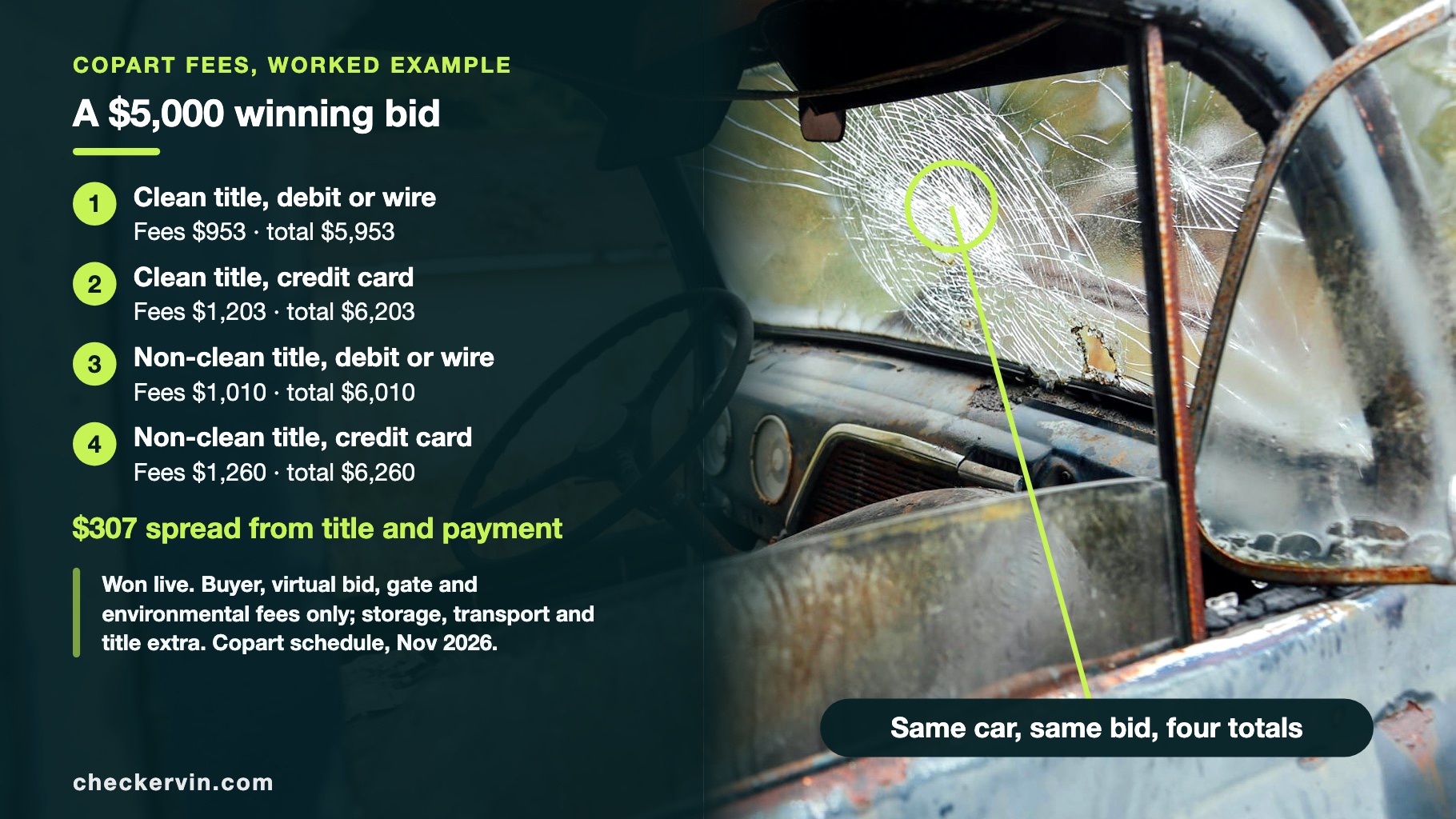
Here is that calculation done from the schedule for one $5,000 standard vehicle, won in the live auction, before storage, transport, tax and title:
| $5,000 winning bid | Copart fees · total out of pocket |
|---|---|
| Clean title, secured payment | $953 · $5,953 |
| Clean title, unsecured payment | $1,203 · $6,203 |
| Non-clean title, secured payment | $1,010 · $6,010 |
| Non-clean title, unsecured payment | $1,260 · $6,260 |
The clean, secured line breaks down as a $750 buyer fee, a $109 live-bid fee, the $79 gate fee and the $15 environmental fee. The non-clean, unsecured line is a $1,025 buyer fee, $125, $95 and $15. Same car, same bid: a spread of $307 from title group and payment method alone.
Work backward when you set a maximum bid. Decide what the car is worth to you landed in your driveway, subtract transport, your state’s tax and title costs and the repairs, then subtract the Copart fees for your bracket. What is left is your real ceiling, and it is lower than the number most people type into the bid box.
Can a normal person buy off Copart?
Yes, but which cars depends on state law. Copart’s licensing page explains that every state regulates who may buy vehicles at auction, so what you can buy is decided by the laws of the place where the car is located. When you register, Copart asks what and where you want to buy and gives you a list of documents to upload. Every member scans a government-issued photo ID; review usually takes one business day.
From there you have three routes. Lots labeled No License Required can be bought by anyone. Lots that need a dealer or business license can be bought through a broker who lends you those credentials for a fee. International buyers can use Copart’s certified resellers and lounges. A lot’s details page shows its eligibility status, so check it before you spend time on the car.
Buying through a broker adds a fee layer on top of Copart's
A broker does not replace Copart’s fees. The car still sells under Copart’s schedule, and the broker adds its own charges on top, typically a broker fee and a deposit held by the broker. We do not print brokers’ prices, because they change and each sets its own. What we can tell you is what each one is and what Copart says about it:
| Broker | Our review covers |
|---|---|
| AutoBidMaster | On Copart's own U.S. broker list; how its fee panel is structured, and where your money goes |
| SalvageReseller | Its own terms: its tie to Copart, the deposit and fee model, pay and pickup deadlines |
| A Better Bid | Its member terms: how the deposit sets your Copart bid limit, refunds, and California paperwork |
Read the AutoBidMaster review, the SalvageReseller review or the A Better Bid reviewbefore you sign up with any of them, and get the broker’s full schedule in writing. Your ceiling calculation then has three layers: Copart’s fees, the broker’s fees, and transport and title.
Fees are the small number: check the VIN and title before you bid
Every fee on Copart’s schedule is printed in advance. The thing that can actually sink a purchase is not: a title brand from another state, an odometer that does not line up, a flood history, or a car that is not what the listing says it is. Lot photos are one moment in time, and as Copart’s bidding FAQ says, a winning bid cannot be taken back. So check before you bid, not after you win.
- 1Decode the VIN from the lot pageConfirm the year, make, model, body and engine match the listing. A mismatch is the cheapest red flag you will ever find.
- 2Check open recalls, freeNHTSA's recall lookup lists open safety campaigns on that VIN, so you know what still needs fixing.
- 3Pull the federal title recordNMVTIS holds the title brands any state applied, insurer total-loss reports and odometer readings. The Department of Justice lists 12 approved providers that sell it to the public.
- 4Look for the car's earlier auction historyA car on Copart today may have been through an auction before. Our Bidfax review explains what an archived listing proves and what it cannot.
Decode the lot's VIN free before you bid
Decoded from official manufacturer and NHTSA records
For the bigger picture of how cars reach salvage auctions and where their records end up, see auction history by VIN, the Bidfax review for archived lot photos, and the NMVTIS report guide for who reports what to the federal title system.
Where this information comes from
- Copart — U.S. Non-Licensed FeesBuyer fee brackets, virtual bid, gate, environmental, title, late, storage, relist and finance fees; read November 25, 2026
- Copart — Member FeesSecured and unsecured payment-method lists; read November 25, 2026
- Copart — U.S. Licensed FeesVolume thresholds and what licensed fees depend on; read November 25, 2026
- Copart — Choosing a MembershipGuest, Basic and Premier tiers, prices and limits (updated 2025-02-18)
- Copart — Deposits & Buying PowerDeposit rules and refunds (updated 2025-09-19)
- Copart — Licensing & Documentation RequirementsState licensing, photo ID, No License Required lots and brokers
- Copart — Pay For Your VehiclesSecure and non-secure payment methods
- Copart — Payments & Deposits FAQNo location-based fees, the refund window, preferred pricing
- Copart — How To Get Your Vehicle(s)Free storage window and weekend rules (updated 2025-11-13)
- Copart — Bidding & Buying FAQBinding bids, relisting and the relist fee
- NMVTIS — approved data providersThe Department of Justice list of providers that sell the federal title record
- NMVTIS — Understanding a Vehicle History ReportTitle brands, odometer, total-loss and salvage indicators in the federal record
- How we made this pageWritten by the CarCheckerVIN editorial team with AI assistance from NHTSA vPIC and other public records, including Copart's own fee and help pages and the Department of Justice NMVTIS list; facts checked November 2026. Every fee is printed from a table built from Copart's published schedule, and the worked example is computed from it.
Keep reading
Frequently asked questions
How much does a Copart membership cost?
Copart's help center lists three tiers: a free Guest membership for watching auctions, Basic at $99 and Premier at $249. Basic suits occasional buyers; Premier adds a single refundable $400 deposit that unlocks up to $100,000 of bidding a day. A first-time membership and deposit can be refunded in full within 7 days if you have not bid, bought or used a service. Prices as read on November 25, 2026.
Can a normal person buy off Copart?
Yes, with limits set by state law rather than by Copart. Every member uploads a government photo ID, and what you can bid on depends on the licenses required where the car sits. Lots marked No License Required are open to anyone. For lots that need a dealer or business license, Copart points buyers to brokers who bid under their own credentials for a fee. Your membership tier does not change which lots you are eligible for.
What payment methods does Copart accept?
Copart's fee page splits them in two. Secured: debit card, wire transfer, MoneyGram or a Canada Corporate Creditor Account, with cash, company check, ePay, third-party financing and a few others subject to approval. Unsecured: credit card, Apple Pay, Google Pay and PayPal. Unsecured payment carries a higher buyer fee on the same car, and if any part of a payment is unsecured, the unsecured fee applies.
How much are Copart storage fees?
Copart does not publish one national storage rate. Its help center says it holds a vehicle free for up to 3 days including the day you bought it, and that storage rates vary by location, listed on each location's page. Weekends and holidays count once the free window has passed. Arrange pickup or transport before you bid, not after.
Is there an official Copart fee calculator?
We did not find a standalone fee-calculator page on copart.com in November 2026. The official tool is the fee schedule itself, which lists the buyer fee for every bid bracket by title group and payment type. Add the virtual bid fee, gate fee and environmental fee from the same page, and you have Copart's charges before storage, transport and your state's title costs.
Do I get my Copart deposit back?
Copart says all deposits are fully refundable when your account is in good standing and every invoice is paid. Two catches: an unpaid lot's relist fee (10% of the sale price, at least $600) is taken from your deposit first, and refunding the $400 Premier deposit downgrades the account to Basic.
Know the car before you pay the fees
Decode any Copart lot's VIN free for the factory build, specifications, warranty and open recalls. No account, no card. Full vehicle history reports are launching soon.
Run a free VIN check