The short answer
- Is it approved?
- Yes — listed by the Department of Justice in the tier approved to sell the federal title record to the public.
- What does that prove?
- That the federal title data in the report is genuine. It is not a quality rating, and the department says so.
- Should I buy one?
- If your question is about title brands, odometer records or a total loss. Run the free checks first either way.
Public tier
Where it sits on the DOJ list
Approved to sell to consumers
11
Providers in that tier
Same underlying federal record
1
Storefronts it is listed with
No additional owned sites
The short verdict
ClearVIN is a legitimate route to the federal vehicle title record, verifiable on a government page rather than on its own marketing. If the question you are trying to settle is whether a car carries a brand, what its odometer read at each titling, or whether an insurer declared it a total loss, buying that record from ClearVIN gets you the same underlying federal data as buying it from any other approved provider.
What it cannot do — and what no provider of this record can do — is tell you about a collision that never became a claim, or where the car was serviced. Those are different datasets, and one of them does not exist in any government system at all.
The credential that counts, and how to check it
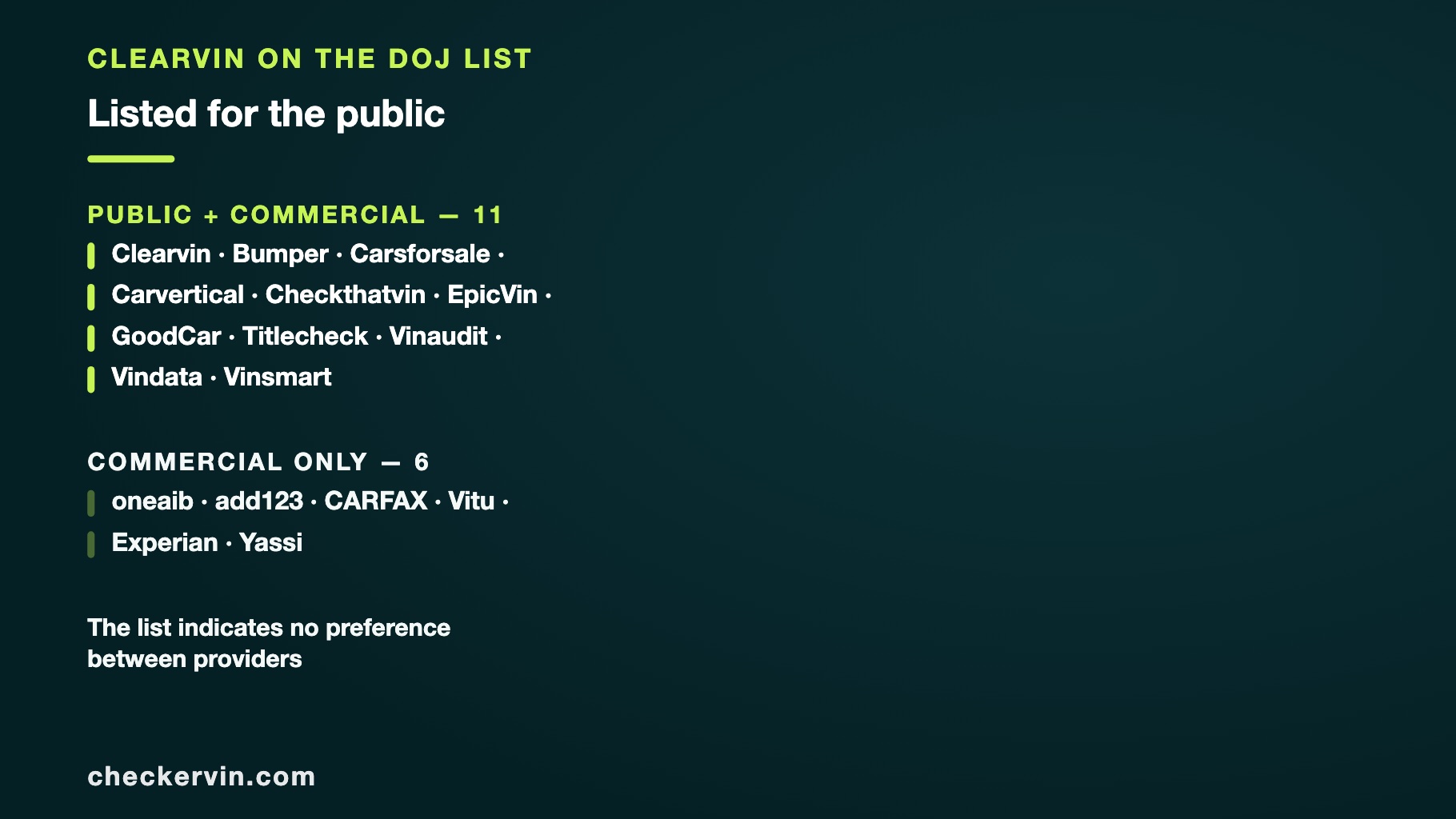
The federal title record is not sold directly to the public. It is sold through businesses the Department of Justice has approved, and the department publishes the list in two tiers: those approved to sell to all interested parties, and those approved for commercial customers only.
ClearVIN appears in the first tier— approved to provide the record to consumers as well as to trade. That is the whole of the objective case for it, and it is a stronger case than any review can make, because you can confirm it yourself in a minute.
Our page on how to choose a VIN check reproduces both tiers of the list in full, including which providers share a parent.
One name, one approval, no second storefront
A small point that the same government page makes and that is worth knowing when you are comparing services. Alongside several approved providers, the department lists additional websites those providers own which also sell reports containing the same federal data.
5 of the providersin the public tier are listed with such additional sites between them. ClearVIN is not one of them — it appears as a single entry with no second storefront attached.
That is not a quality signal in itself. It matters for one practical reason: when you compare ClearVIN against another service, you are less likely to be comparing it against a differently-branded version of the same approval, which is a real hazard elsewhere on that list.
What the federal record actually holds
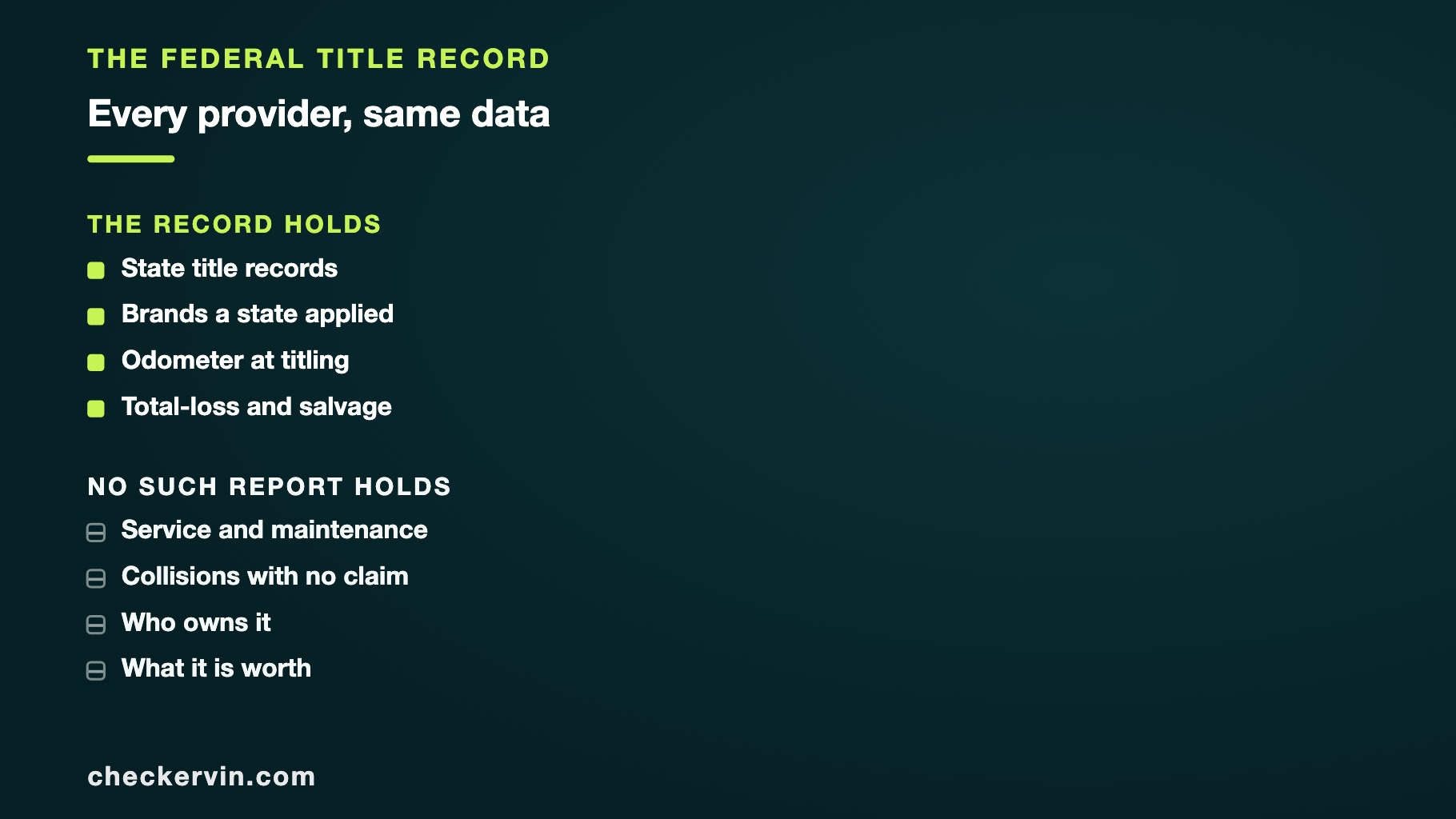
Since every approved provider is selling the same dataset, the useful question is what that dataset is. It is fed by parties who are required to report into it rather than gathered commercially.
- Title records reported by participating state motor vehicle agencies
- Brands a state applied — salvage, flood, rebuilt and the rest
- Odometer readings recorded at the point of titling
- Total-loss records reported by insurers
- Records from salvage yards and junk yards that are required to report
The last two lines are the ones that earn the purchase. A total-loss record from an insurer, and a report from a salvage yard, reach the system whether or not a state ever applied a brand — which is exactly the case where a clean-looking title is misleading.
Our page on the NMVTIS report covers the system in detail, including who is required to report into it and how often.
What no report built on this record can hold
Stated plainly, because the gap between what buyers expect and what the record contains is where disappointment with every provider in this category comes from.
- Routine service and maintenance, which no government system collects
- Collisions that produced no claim and no brand
- Who owns the vehicle, or who has owned it
- What the vehicle is worth
None of that is a criticism of ClearVIN. It is a description of the dataset, and it applies identically to every business approved to sell it. If service history is the thing you need, a commercial report is the product that holds it, and what a vehicle history report costs covers when that premium is worth paying.
What to do free, before you buy anything
Two checks cost nothing and neither is improved by any paid report. Doing them first occasionally makes the purchase unnecessary, and always makes it better informed.
- 1Decode the VINThe factory build, specifications and vehicle type, straight from the federal database. Free, no account, and it also catches a mistyped number before you pay to search one.
- 2Check open safety recallsMatched to the VIN, free to check and free to fix. On an older car an open campaign is common and it is unfinished work somebody else has already paid for.
- 3Run the free theft and salvage screenA separate free lookup that catches two of the worst outcomes early.
- 4Then buy the title recordFrom ClearVIN or any other approved provider — the federal data is the same, so pick on presentation and price rather than on the dataset.
Check any VIN free
Decoded from official manufacturer and NHTSA records
What this review deliberately does not rate
Most reviews in this category assert things the writer cannot have checked, and we would rather say what we have not done than pad the page with it.
| What we assessed | How |
|---|---|
| Approved-provider status and tier | Read from the Department of Justice page, linked below |
| Whether it shares an approval with other storefronts | Same page — it does not |
| What the underlying dataset contains | The federal system's own documentation |
| Interface, support and refunds | Not assessed — we have not purchased a report |
| Price | Not published here for anybody, because prices move and stale comparisons mislead |
If a review ranks a dozen of these services on a five-point scale across support, accuracy and value, ask how any of that was measured. The one thing in this market that is genuinely measurable is the row at the top of that table.
Who it suits, and who should look elsewhere
A short answer, on the basis of the dataset rather than the brand.
| Your situation | Verdict |
|---|---|
| Buying privately and worried about a brand or a total loss | A good fit — that is exactly the record it sells |
| Checking a car that has crossed state lines | A good fit — the federal record is the one that follows it |
| You want the service and maintenance history | Wrong dataset — no approved provider holds it |
| You only need the build and the recalls | Do not buy anything — that layer is free |
| You are a dealer or lender buying at volume | Check the commercial tier of the list as well |
For the alternatives ladder, Carfax alternatives sets the services against each other, and our VinAudit review covers another provider from the same public tier.
Where this information comes from
- U.S. Department of Justice — Approved NMVTIS Data ProvidersWhere ClearVIN's approval and tier were read from, and the statement that the list indicates no preference
- NMVTIS — the federal title history systemWhat the record is built from, and who is required to report into it
- NHTSA vPIC — VIN decoding APIThe free build-and-specifications layer to run first
- NHTSA recalls by VINFree to check, and the remedy is free as well
Frequently asked questions
Is ClearVIN legit?
It is an approved provider of the federal vehicle title record. The Department of Justice publishes the list of businesses permitted to sell that data, ClearVIN appears on it, and it is in the tier approved to sell to all interested parties rather than to commercial customers only. That is the strongest objective credential available in this market, and it is checkable on a government page rather than taken on trust.
Is ClearVIN an approved NMVTIS provider?
Yes, and specifically in the public-facing tier. The department's page lists 11 businesses approved to provide the record to all interested parties including consumers, and ClearVIN is among them. The department states that the list indicates no preference of one provider over another, so being on it establishes the data is genuine rather than that the service is the best.
What does a ClearVIN report include?
The federal title record it is approved to sell is a defined dataset: titles reported by participating state agencies, brands those states applied, odometer readings taken at titling, total-loss records from insurers, and reports from salvage and junk yards. Any provider selling that record is selling the same underlying data. What differs between providers is presentation, packaging and whatever additional information each has gathered separately.
Is ClearVIN better than Carfax?
They are not selling the same dataset, so the comparison needs care. ClearVIN is approved to sell the federal title record to consumers. Carfax appears in the commercial-only tier of the same list, with a note that it offers that federal data to commercial customers in California only — while holding a large volume of service and reported-accident data no government system has. Which is better depends on whether your question is a title question or a history question.
Is ClearVIN free?
The federal title record is not free from anybody, because the system charges to be queried. What is genuinely free is the layer underneath it: decoding the VIN for the factory build and checking for open safety recalls, both of which come from federal sources at no cost and are not improved by any paid report. Run those before you buy anything.
Does a ClearVIN report show accidents?
Not in the way most people mean. The federal record captures damage when it produced a title brand or a total-loss declaration, which is a much higher bar than a repair. A collision that was fixed without a claim, or with a claim that never totaled the car, generally leaves no trace in it. That limit applies to every provider selling this record, not to one of them.
How do I check a provider is approved before paying?
Open the Department of Justice provider page directly rather than a copy on a review site, and look for the business in the public tier. Approvals change, and the government page is the version that changes with them. It takes less time than reading a review, this one included.
Keep reading
Run the free checks before you buy a report
Factory build, specifications and open safety recalls, decoded from the VIN. No account, no card.
Run a free VIN check