The short answer
- What does “as is” waive?
- Warranties — the dealer's promise to fix things afterward. That is the whole of what the box disclaims, and it is narrower than the phrase sounds.
- What does it not waive?
- Honesty. It remains a deceptive act or practice for a dealer to misrepresent a used vehicle's mechanical condition, as is or not.
- Does it apply everywhere?
- No. Where state law limits or prohibits as-is sales, that law overrides the federal rule and the box cannot be used at all.
5
Acts the Rule still prohibits
Three deceptive, two unfair — as is or not
5 vehicles
What makes someone a dealer
Sold or offered in the previous 12 months
State law
What can void the box entirely
It overrides the federal part where it conflicts
Free
Decode and recall check
Do it before you sign anything
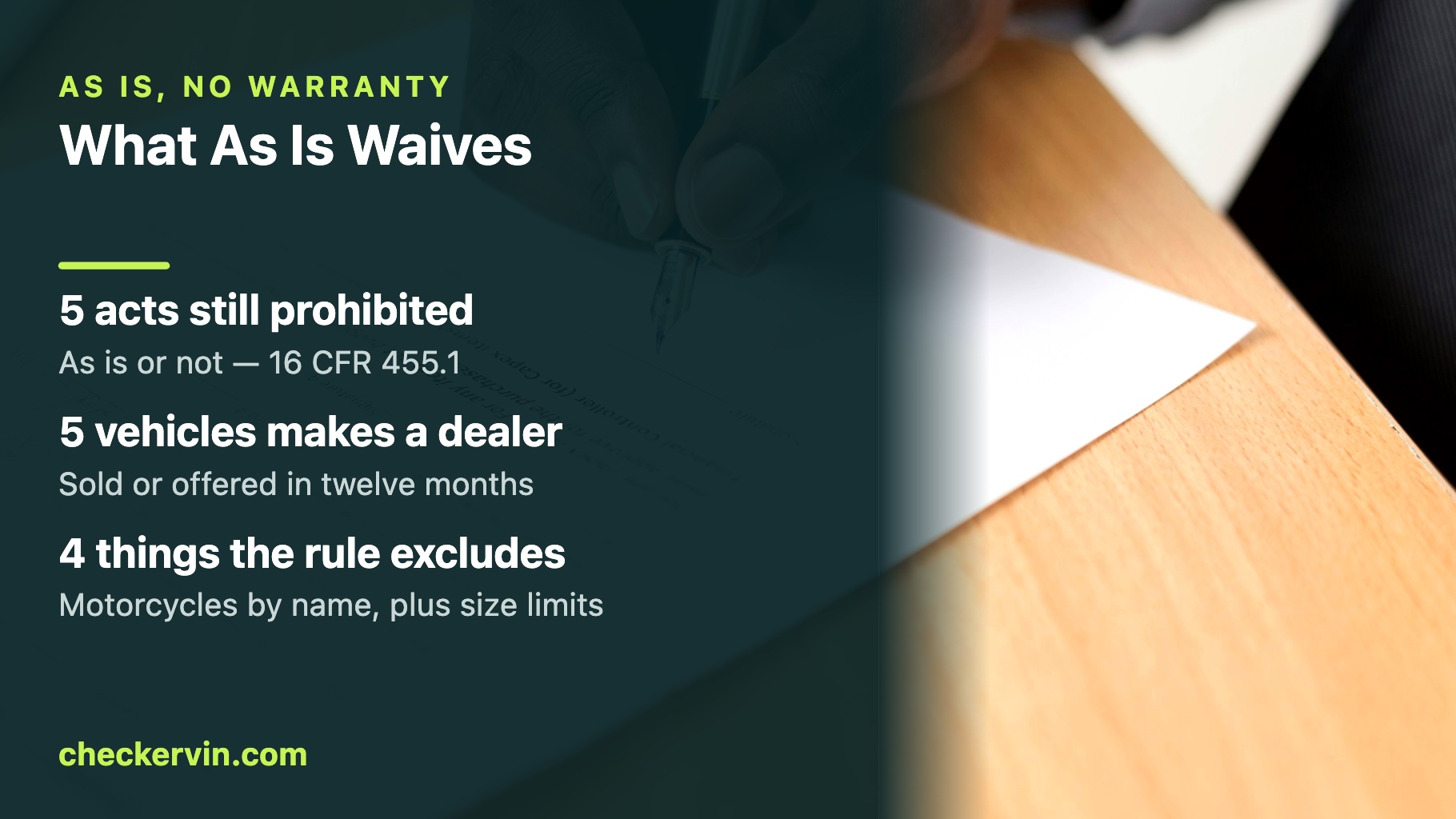
What the phrase actually waives
The Used Car Rule — 16 CFR Part 455 — requires a dealer to display a Buyers Guide on every used vehicle offered for sale, and that form carries a box marked As Is — No Dealer Warranty. Ticking it is a disclosure about warranties. It is not a general waiver of everything else.
A warranty, in the Rule’s own definition, is an undertaking in writing to refund, repair, replace, maintain or take other action with respect to the vehicle, provided at no extra charge beyond the price. So the box is saying one thing: the dealer is not undertaking to fix things afterward at their expense.
| What the As Is box does | What it does not do |
|---|---|
| Disclaims the dealer's promise to repair after sale | Permit the dealer to misrepresent the car |
| Puts the cost of later faults on the buyer | Override a state law that limits as-is sales |
| Applies to that dealer, on that vehicle | Apply to private sellers at all |
| Covers warranties | Cover fraud, or a written promise made elsewhere |
Five things the Rule prohibits regardless
Section 455.1 lists them, and none of them is switched off by an as-is sale. Three are defined as deceptive acts or practices and two as unfair ones.
| The Rule says a dealer may not... | Type |
|---|---|
| Misrepresent the mechanical condition of a used vehicle | Deceptive |
| Misrepresent the terms of any warranty offered | Deceptive |
| Represent that a vehicle is sold with a warranty when it is sold without any | Deceptive |
| Fail to disclose, prior to sale, that a vehicle is sold without any warranty | Unfair |
| Fail to make available, prior to sale, the terms of any written warranty offered | Unfair |
Read the first line again, because it does most of the work on this page. Misrepresenting the mechanical condition of a used vehicle is a deceptive act or practice, full stop. There is no exception carved out for vehicles sold as is, and the Rule does not treat the box as consent to be misled.
Who counts as a dealer
The whole Rule hangs on this definition, and it is more specific than most buyers realize. A used vehicle dealer is a person or business that sells or offers for sale five or more used vehicles in the previous twelve months.
Two details in that sentence matter. It counts vehicles offeredas well as sold, so unsold listings still count toward the total. And the Rule explicitly excludes banks and financial institutions, a business selling a used vehicle to its own employee, and a lessor selling a leased vehicle to or by its lessee or that lessee’s employee.
| Seller | Covered by the Used Car Rule? |
|---|---|
| A dealership | Yes |
| Someone who moved five or more vehicles in twelve months | Yes, whether or not they call themselves a dealer |
| A neighbor selling their own car | No |
| A bank or financial institution | No — excluded by name |
| A business selling to its own employee | No — excluded by name |
The second row is the one worth knowing. Somebody selling vehicles at that volume from a driveway is within the definition even if they present themselves as a private party, and the Buyers Guide obligations attach to them.
Which vehicles are covered, and which are not
The Rule also defines what it means by a vehicle, and the definition excludes more than people expect. It means a motorized vehicle, other than a motorcycle, with a gross vehicle weight rating under 8,500 lbs, a curb weight under 6,000 lbs, and a frontal area under 46 square feet.
- Motorcycles are excluded by name — no Buyers Guide requirement applies
- Vehicles at or above 8,500 lbs GVWR fall outside it
- Vehicles at or above 6,000 lbs curb weight fall outside it
- Vehicles with a frontal area of 46 square feet or more fall outside it
- A used vehicle means one driven more than the limited use needed to move or road test a new one
The practical effect is that heavy pickups, large vans and motorcycles can sit outside the Buyers Guide regime entirely. If you are buying one of those from a dealer and expecting the window form to be there, it may not be, and its absence is not necessarily a violation.
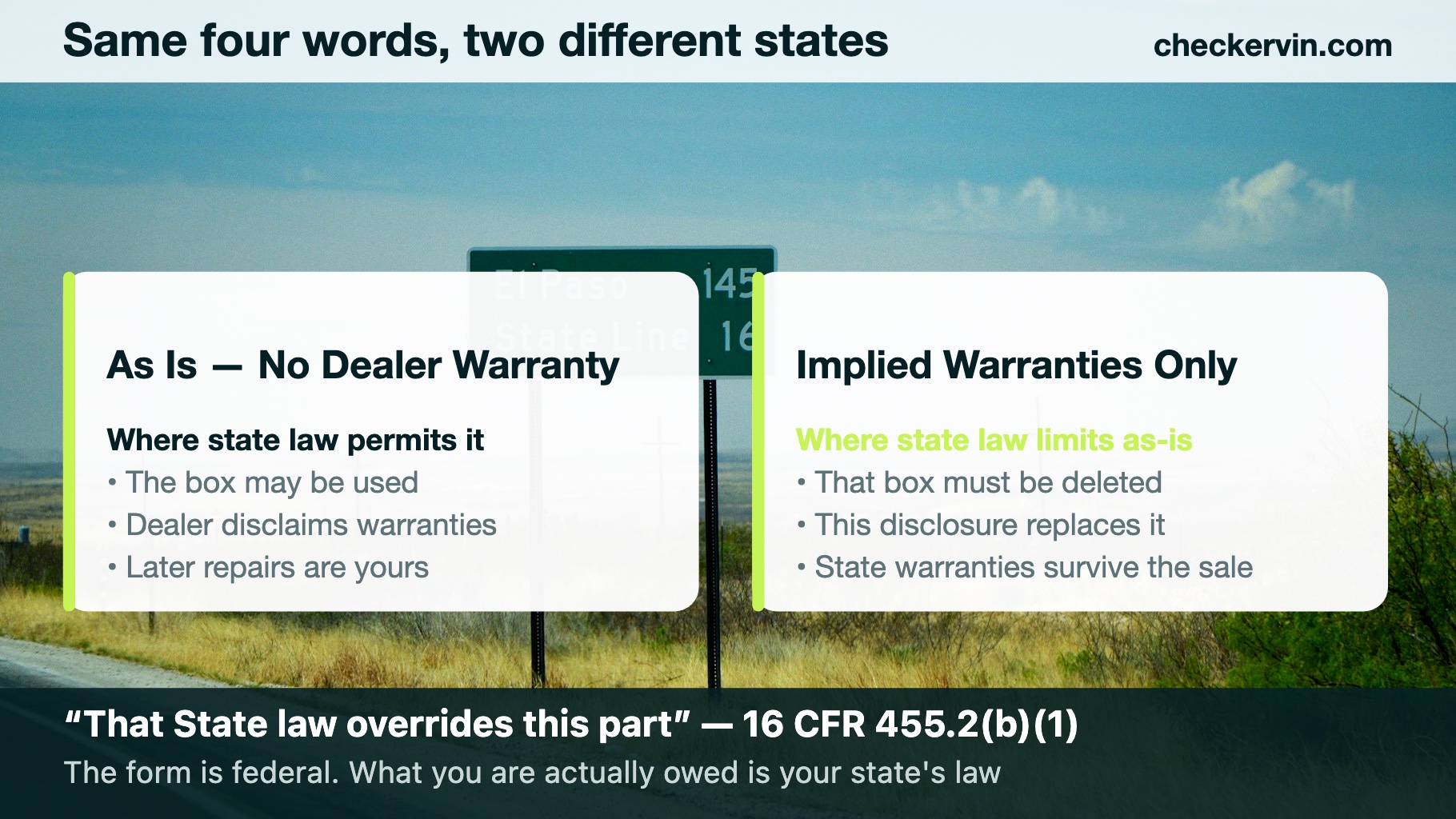
The states where the box cannot be used at all
This is the provision that most surprises people, and 16 CFR 455.2(b)(1)(ii) states it plainly rather than leaving it to be inferred. If a state’s law limits or prohibits as-is sales of vehicles, that state law overrides the federal part, and the Rule does not give a dealer the right to sell as is.
In those states the As Is heading and the paragraph beneath it must be deleted from the form, and a different disclosure takes its place. The substitute is headed Implied Warranties Only, and it tells the buyer that the dealer is not promising to fix things, but that implied warranties under state law may still give rights where a serious problem was not apparent at the time of purchase.
| In an as-is state | In a state that limits as-is sales |
|---|---|
| The As Is — No Dealer Warranty box may be used | That box must be deleted from the form |
| The dealer disclaims warranties | An Implied Warranties Only disclosure appears instead |
| State implied-warranty law may still exist | State implied warranties expressly survive the sale |
There is a further layer. Section 455.6 lets a state apply to the Commission for an exemption where its own requirement gives consumers protection as great as or greater than the Rule’s. So the answer to “what does as is mean” genuinely is state-dependent, and anyone giving you a single national answer is oversimplifying.
What an implied warranty actually is
The phrase does a lot of work above, so it is worth defining. The Rule defines an implied warranty as one arising under state law, as modified by the Magnuson-Moss Act, in connection with a dealer’s sale of a used vehicle.
The important part of that definition is where it points: at your state, not at the dealership. An implied warranty is not something a dealer offers you. It is something state law attaches to the sale unless the sale is one where the law permits it to be disclaimed — which is exactly the mechanism the As Is box operates, and exactly why states that restrict that box change the outcome.
Telling the two forms apart in ten seconds
Because the disclosure changes with the state, the first useful thing to do at a dealership is work out which version of the form is on the window. The headings differ and so does the paragraph beneath them.
| Heading on the form | What the paragraph says |
|---|---|
| As Is — No Dealer Warranty | The dealer is not undertaking to repair anything after the sale |
| Implied Warranties Only | The dealer makes no promises to fix, but implied warranties under state law may give rights over serious problems that were not apparent at purchase |
| Full Warranty or Limited Warranty | A warranty is offered, and its systems, duration and cost share must be written out |
The Implied Warranties Only wording is worth reading closely, because it is the Rule’s own summary of the position in a state that restricts as-is sales. It says the dealer does not promise to fix things when you buy the vehicle or afterward, but that implied warranties under your state’s laws may give you some rights to have the dealer take care of serious problems that were not apparent when you bought it.
If a form on a window says that rather than As Is, do not read it as the same thing in politer language. It is a materially different disclosure and it exists because the state decided the As Is box would not be available.
The ninety-day line almost nobody reads
Buried in the Buyers Guide’s required text is a provision that can change what an as-is sale means, and it is one of the least known things in the whole Rule.
Where a dealer makes a service contract available, the form must carry a Service Contract heading and a specific paragraph. That paragraph tells you the contract is available for an extra charge, tells you to ask about coverage, deductible, price and exclusions, and then says this: if you buy a service contract within 90 days of your purchase of this vehicle, implied warranties under your state’s laws may give you additional rights.
Read that against everything above. A sale can be disclaimed as is, and yet buying a service contract inside that ninety-day window may bring state implied warranties back into play. It is a genuine interaction between two things most buyers treat as unrelated — the box on the form, and the upsell at the finance desk.
Note also the Rule’s definition. A service contract is a written contract for a period or mileage to refund, repair, replace or maintain the vehicle, provided at an extra chargebeyond the price — unless offering it is the business of insurance regulated by state law. The extra charge is what separates it from a warranty, which the Rule defines as provided at no extra charge.
The window form beats the contract
Two provisions give a buyer more leverage than almost anyone uses, and both are short enough to quote in full in a conversation with a salesperson.
- 1The form is part of the contractUnder 455.3, the information on the final version of the window form is incorporated into the contract of sale, and information on the window form overrides any contrary provisions in the contract of sale. Not a supplement to the contract — a part of it that wins.
- 2Nothing said aloud can contradict itUnder 455.4, a dealer may not make any statements, oral or written, or take other actions that alter or contradict the disclosures the Rule requires. A verbal reassurance that cuts against the form is not merely unenforceable; making it is a problem in itself.
- 3So write the promise onto the formIf a dealer will genuinely cover something, it belongs on the Buyers Guide, where the Rule attaches consequences to it. If they will not write it there, you have learned what the promise was worth.
The dealer's safe harbor, and why it helps you
Section 455.1(c) contains a sentence that looks like it is written for dealers and is actually useful to buyers: if a used vehicle dealer complies with the requirements of sections 455.2 through 455.5, the dealer does not violate the Rule.
That is a safe harbor, and it explains dealership behavior you may otherwise find puzzling — the insistence on the form being displayed, the box being ticked, the copy being handed over at closing. Those steps are how a dealer stays inside the harbor.
The useful inference for a buyer is that the paperwork genuinely matters to the other side of the desk. A request to add something to the form is not a nuisance to be waved away; it is a request to change a document the dealer is relying on. That is precisely why it is worth asking, and why the answer tells you something.
Private sellers are not in this rule at all
Everything above describes obligations that attach to dealers. Buy from a private seller and none of it applies: no Buyers Guide, no required disclosure, no federal prohibition on misrepresenting the mechanical condition under this particular rule.
That does not mean a private seller may lie to you with impunity — ordinary state law on fraud and misrepresentation still exists, and it is not nothing. It does mean the specific, checkable, document-based protections on this page are absent, and that the balance of what you should spend on inspection shifts accordingly.
- No Buyers Guide will be displayed, and none is required
- No federal disclosure obligation attaches to the sale
- The form-overrides-the-contract provision has nothing to operate on
- An inspection carries proportionally more of the weight
- A written bill of sale becomes the main record of what was said
An as-is sale does not make a recall your bill
One category of repair sits entirely outside this discussion, and buyers routinely assume the opposite.
A safety recall is the manufacturer’s obligation, and the remedy is performed at no charge to the owner regardless of how many times the vehicle has changed hands or how it was sold. The As Is box concerns the dealer’s warranty, not the manufacturer’s recall duty, and nothing on the Buyers Guide transfers a recall repair to you.
Checking is free and takes a minute, using the vehicle’s VIN at the federal recall lookup. Do it before you sign rather than after, for two reasons: an open recall is information you can use in the conversation, and finding out afterward means arranging the repair yourself with a franchised dealer for that make.
- The recall remedy is free to the owner, however the car was sold
- The obligation sits with the manufacturer, not the selling dealer
- An as-is disclaimer does not reach it, because it is not a dealer warranty
- The federal lookup is free and takes a VIN
- An open recall is a legitimate point in a price negotiation
What to do before you sign
- 1Read the Buyers Guide on the windowIt is required to be displayed so both sides are readable. Which box is ticked, and what is written in the warranty section, is the deal — not what is said while you read it.
- 2Photograph both sides of itFree, takes a moment, and it fixes the version that existed before negotiation. The form is incorporated into your contract, so a photograph is a photograph of part of your contract.
- 3Get every promise written onto the formNot into an email, not into a memory of a conversation. The Rule attaches weight to what is on the form and bars statements that contradict it.
- 4Run the free checksDecode the VIN for the factory build and check open safety recalls at no cost. An as-is sale does not make an open recall your problem to pay for, and knowing about it before you sign is better than after.
- 5Pay for an independent inspectionThis is the step an as-is sale makes most valuable, because it is the one that finds the faults you would otherwise be buying at your own expense.
If you already signed
The honest position is that an as-is sale genuinely does put later repair costs on you, and most disappointments after an as-is purchase are not violations of anything. Being clear about that is more useful than false hope.
What is worth checking is whether the problem is a repair or a representation. If a dealer told you something specific and untrue about the car’s mechanical condition, or told you it came with a warranty when the form says otherwise, that is the territory section 455.1 addresses, and the As Is box does not resolve it.
- 1Find your copy of the Buyers GuideYou should have been given the window form at closing. What it says is part of your contract and overrides contrary terms in it.
- 2Separate promises from statements"We'll cover the transmission" is a promise about the future. "The transmission was rebuilt last year" is a statement about the past. They are treated very differently.
- 3Write down what was said, and whenWhile you remember it. Contemporaneous notes are worth considerably more than a recollection assembled months later.
- 4Check your state, not just the federal ruleState law is where implied warranties live and where as-is limits come from, and it is the layer most likely to change your answer.
- 5Get advice from someone qualifiedThis page explains a federal regulation. It is not legal advice and cannot account for your state or your facts.
What this page is not
It is not legal advice, and the most important variable in your situation — your state’s law on implied warranties and as-is sales — is precisely the one a national page cannot resolve for you.
It also does not cover returning a vehicle after purchase, which turns on where the sale took place rather than on which box was ticked, and which has its own page. And it does not make our own product into something it is not: our free check returns the factory build, the specifications and open safety recalls from the VIN. It does not return accident, title, odometer or theft history, and no amount of paperwork advice changes that.
What the page does give you is the actual text of the rule that most buyers are guessing about. Four words on a window form carry less weight than they appear to, and knowing exactly how much less is worth having before you sign.
Where this information comes from
- eCFR — 16 CFR Part 455, the FTC Used Car Rule455.1 defines the prohibited acts and the dealer and vehicle definitions; 455.2 the window form and the state-law override; 455.3 incorporation into the contract; 455.4 contrary statements; 455.6 state exemptions
- govinfo — 16 CFR Part 455, current annual edition (PDF)The printed text this page quotes from, including the Buyers Guide figures
- NHTSA — check for open recalls by VINFree, and unaffected by how a vehicle is sold — an open recall remains the manufacturer's to fix
Keep reading
Frequently asked questions
Does “as is” mean I have no rights at all?
No. It waives warranties, which is a narrower thing than it sounds. Under 16 CFR 455.1 it remains a deceptive act or practice for a used vehicle dealer to misrepresent the mechanical condition of a used vehicle, and selling a car as is does not change that. A dealer who tells you something untrue about the car has a problem regardless of which box was ticked.
Can a dealer sell a car as is in any state?
No. The Rule says so directly: if your state law limits or prohibits as-is sales of vehicles, that state law overrides the federal part and the Rule does not give a dealer the right to sell as is. In those states the Buyers Guide carries an Implied Warranties Only disclosure instead of the As Is box.
What is an implied warranty?
A warranty that arises automatically under your state's law rather than from anything the dealer wrote down. The federal rule defines it exactly that way — an implied warranty arising under state law, as modified by the Magnuson-Moss Act. That is why the answer to what you are owed depends on your state and not only on the paperwork.
Does the Used Car Rule apply to private sellers?
No. It applies to a used vehicle dealer, defined as a person or business that sells or offers for sale five or more used vehicles in the previous twelve months, with banks, employer-to-employee sales and lessor-lessee sales excluded. A neighbor selling one car is not covered, so none of the Buyers Guide protections apply to that sale.
Does it cover motorcycles?
No, and this surprises people. The Rule defines vehicle as a motorized vehicle other than a motorcycle, under 8,500 lbs gross vehicle weight rating, under 6,000 lbs curb weight, with a frontal area under 46 square feet. Motorcycles are excluded by name, and large trucks fall outside the weight limits.
The salesperson promised to fix it. Does that count?
Under 16 CFR 455.4 a dealer may not make statements, oral or written, that alter or contradict the required disclosures. And under 455.3 the information on the final window form is incorporated into the contract of sale and overrides contrary provisions in it. The practical lesson is the same either way: get the promise written onto the form, not into the conversation.
Can I return a car sold as is?
That is a separate question with a separate answer, and it turns on where the sale happened rather than on the As Is box. There is no general federal right to return a vehicle after purchase, and the widely believed three-day cooling-off period does not work the way most people assume.
Does buying a service contract change an as-is sale?
It may. The Buyers Guide's required service-contract paragraph states that if you buy a service contract within 90 days of your purchase of the vehicle, implied warranties under your state's laws may give you additional rights. That is a real interaction between the box on the form and the finance-desk upsell, and it is not a reason to buy a service contract you would otherwise decline.
Am I stuck with an open recall on an as-is car?
No. A safety recall is the manufacturer's obligation and the remedy is free to the owner however the vehicle was sold. The As Is box disclaims the dealer's warranty; it has nothing to do with the manufacturer's recall duty. Check by VIN at the federal recall lookup before you sign, because an open recall is also a fair point in the negotiation.
What should I do before signing an as-is deal?
Read the Buyers Guide on the window, photograph both sides of it, get any promise written onto it rather than said aloud, and pay for an independent inspection. The Rule gives you a document that becomes part of your contract; almost nobody uses it, and it is free.
Run the free checks before you sign
Decode any 17-character VIN for the factory build, specifications and open safety recalls. No account required.
Run a free VIN check