The short answer
- What does a car loan calculator actually compute?
- One equation with four inputs — amount financed, rate, term, and payment — solved for whichever one you left out. It is arithmetic, not advice, and it has no opinion about whether the loan is a good idea.
- Which input should you be moving?
- The amount financed and the rate. Stretching the term is the only lever that lowers the payment while raising the total cost, which is exactly why it is the one you will be offered.
- What is the figure that compares two offers?
- The APR, as Regulation Z defines it — a measure of the cost of credit expressed as a yearly rate. Not the monthly payment, and not the sticker rate.
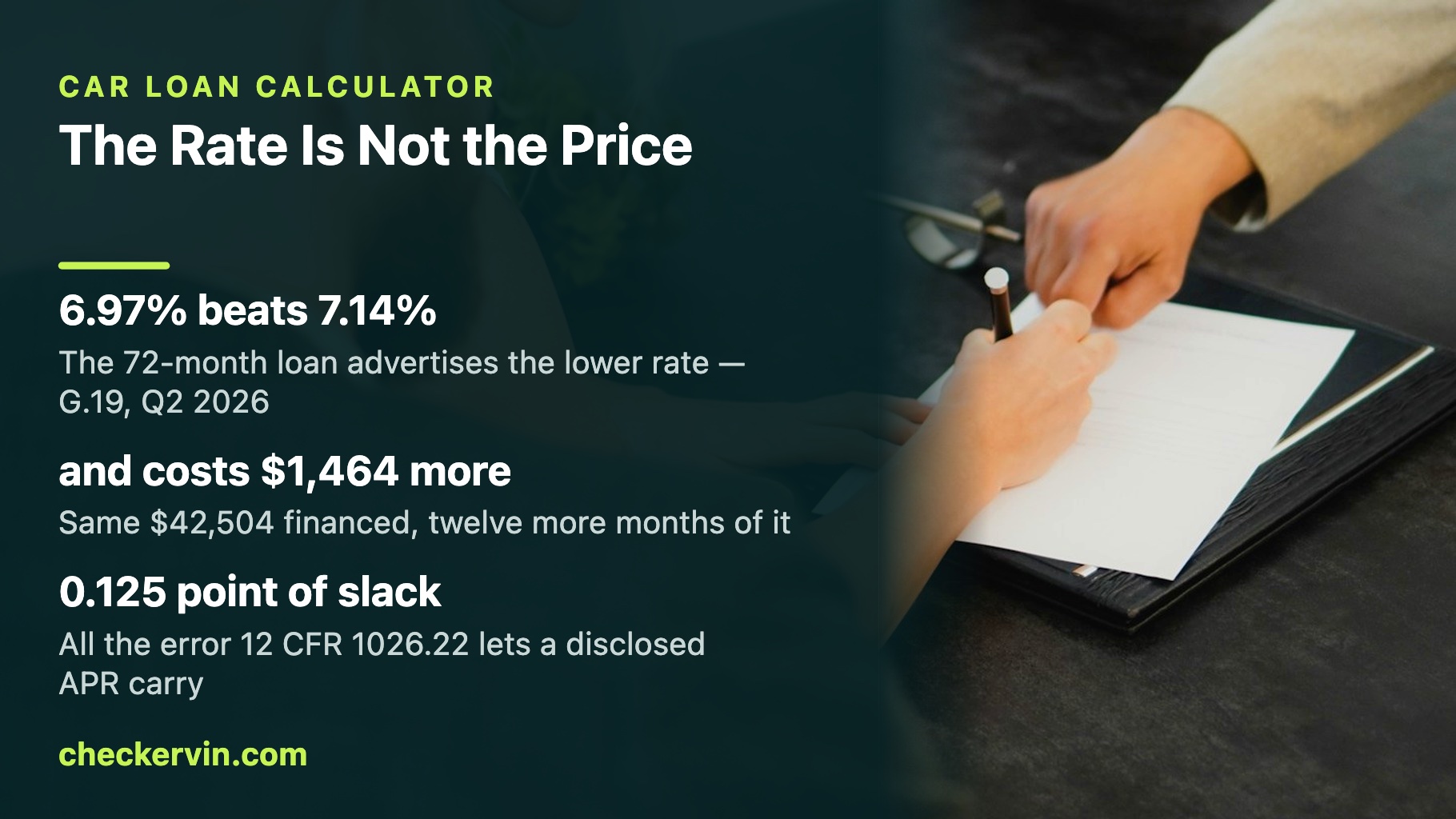
7.14%
60-month new-car rate
Commercial banks, Q2 2026 (preliminary)
6.97%
72-month new-car rate
Lower rate, longer loan
$1,464
What the longer loan adds
In total interest, same car
66 mo
Average new-car maturity
Last published, Q1 2026
Four levers, one number — and only one of them is free
A car loan calculator is a single equation with four terms: the amount financed, the annual rate, the number of months, and the monthly payment. Give it any three and it returns the fourth. That is the whole product. Every calculator on the internet solves the same equation and they all agree, which is worth saying plainly, because the differences between them are matters of styling rather than mathematics.
What varies enormously is what happens to the total when you move each lever to make the payment smaller. Three of the four levers behave the way intuition expects. Pay a larger deposit and the amount financed falls, so both the payment and the total cost fall. Find a lower rate and both fall. Buy a cheaper car and both fall.
The fourth lever does not behave that way. Extending the term spreads the same debt over more months, so the payment falls — and because the balance now shrinks more slowly, interest accrues against a larger sum for longer, so the total rises. It is the only adjustment available that improves the number on the screen while making the deal worse, and it is therefore the adjustment most likely to be suggested to you.
What the law says a car loan costs
There is a legally defined answer to “what does this loan cost?”, and it is not the monthly payment. The Truth in Lending Act, implemented by Regulation Z at 12 CFR part 1026, requires a closed-end consumer credit contract to disclose a specific set of figures using specific words. The one that measures cost is the annual percentage rate, which § 1026.18(e) requires to be described to you as “the cost of your credit as a yearly rate.”
The APR is not the same thing as the interest rate, and the distinction is the single most useful piece of knowledge in this entire subject. The interest rate prices the borrowed money. The APR, per § 1026.22(a)(1), is a measure that “relates the amount and timing of value received by the consumer to the amount and timing of payments made” — so charges that the regulation counts as finance charges are pulled inside it. Two offers quoting the same interest rate can carry different APRs, and when they do, the gap is made of fees.
Regulation Z also specifies how the number is produced. The APR must be determined by either the actuarial method or the United States Rule method, with the equations set out in appendix J to part 1026. This is why every honest calculator returns the same figure: the method is prescribed. The full list of figures a finance contract has to state — amount financed, finance charge, payment schedule, total of payments — is covered on our page about what happens when financing falls through, which is where those disclosures matter most.
The Federal Reserve publishes what a car loan costs
Most figures quoted for “average car loan rates” come from lenders and lead-generation sites with an interest in the answer. There is a public alternative. The Federal Reserve Board’s G.19 Consumer Credit release carries a table called Terms of Credit, and it has been recording new-car loan rates at commercial banks for decades. The release read for this page is dated 7 August 2026.
| Period | 60-month rate → 72-month rate, and the spread |
|---|---|
| 2021 | 4.82% → 4.82% · no spread |
| 2022 | 5.36% → 5.50% · +14 bp on the longer loan |
| 2023 | 7.83% → 7.89% · +6 bp on the longer loan |
| 2024 | 8.16% → 8.29% · +13 bp on the longer loan |
| 2025 | 7.65% → 7.80% · +15 bp on the longer loan |
| Q1 2026 | 7.53% → 7.53% · no spread |
| Q2 2026 (preliminary) | 7.14% → 6.97% · -17 bp — the longer loan is cheaper |
Read the spread rather than the rates. For every full year in the table the 72-month loan carries a small premium over the 60-month loan — between 6 and 15 basis points, which is what you would expect, since lending for longer against a faster-depreciating asset is a larger risk. Then the premium closes to nothing in Q1 2026 and inverts in Q2 2026 (preliminary).
When the longer loan carries the lower rate
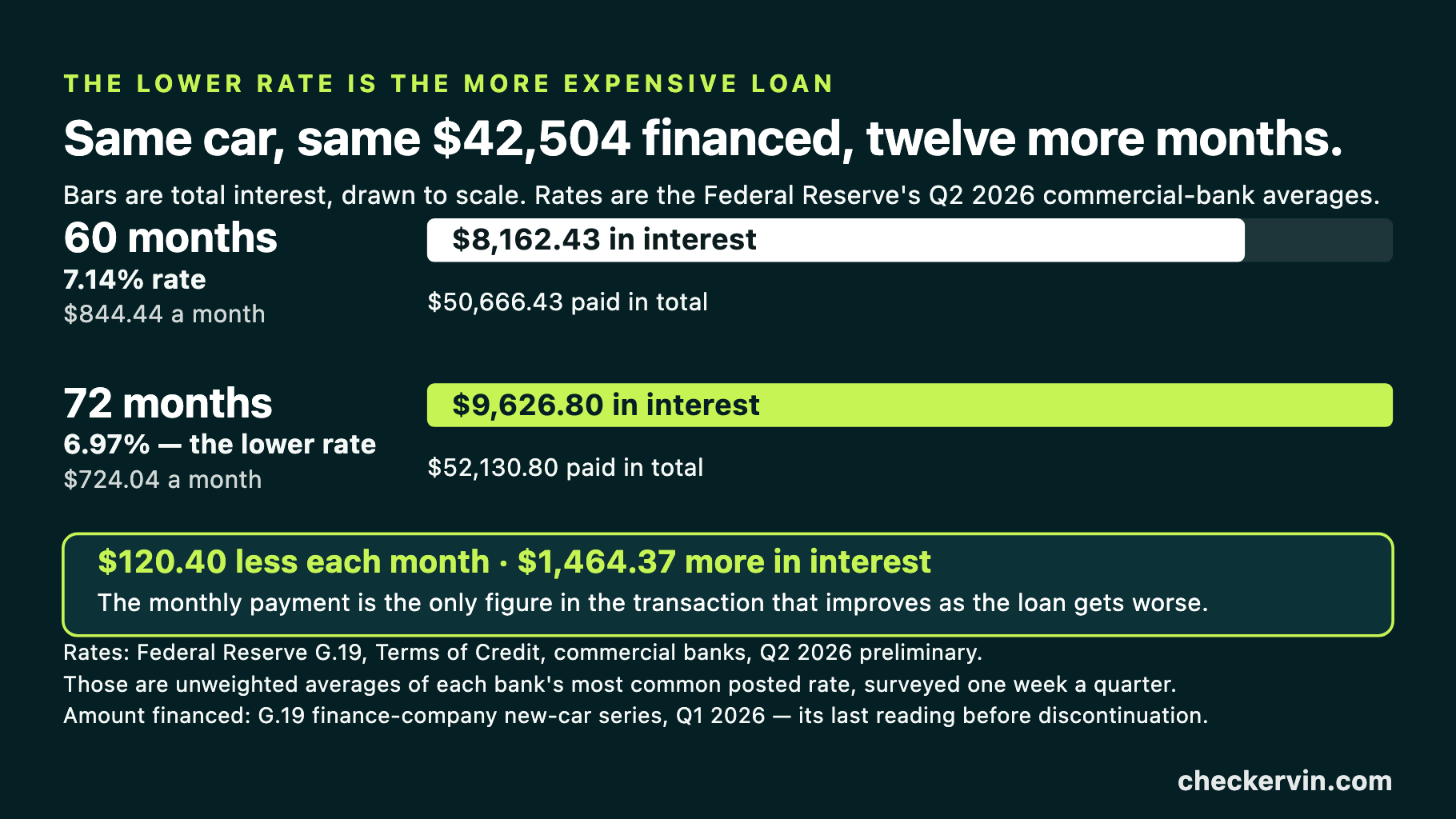
An inverted spread is the cleanest demonstration available of why the rate is not the cost. Take the amount the Federal Reserve last recorded as the average new-car loan — $42,504, from the finance-company series in Q1 2026 — and run it at both of the Q2 2026 (preliminary) bank rates.
| Same car, same amount financed | 60 months → 72 months |
|---|---|
| Rate | 7.14% → 6.97% — the longer loan is the cheaper rate |
| Amount financed | $42,504 → $42,504 — unchanged |
| Monthly payment | $844.44 → $724.04 — $120.40 less |
| Total interest | $8,162.43 → $9,626.80 — $1,464.37 more |
| Total paid | $50,666.43 → $52,130.80 |
The longer loan wins on both of the numbers you are shown at the desk. It has the lower rate, and it takes $120.40 off the monthly payment. It loses on the number nobody prints in large type: it costs $1,464.37 more in interest — 17.9% more — for the same car at a lower advertised rate.
That is not a trick and nobody has done anything wrong. It is simply what happens when you carry a balance for twelve extra months. But it is precisely the case a monthly payment cannot show you, and precisely the case that a rate comparison gets backwards. The only figure that gets it right is the total of payments, which Regulation Z § 1026.18(h) requires the contract to state in those words, described as “the amount you will have paid when you have made all scheduled payments.” Find that line and read it. It is on the page for exactly this reason.
Where the interest actually sits in the loan
The second thing a payment hides is that the payment does not do the same job every month. Interest is charged on the outstanding balance, and the outstanding balance is at its largest on day one, so the earliest payments are mostly interest and the last ones are almost entirely principal. The payment itself never changes, which is what makes the effect invisible.
Here is the 60-month loan above, month by month at the marks that matter.
| Payment | Interest · principal · what is left |
|---|---|
| #1 | $252.90 interest (29.9% of the payment) · $591.54 principal · $41,912 balance |
| #12 | $213.01 interest (25.2% of the payment) · $631.43 principal · $35,169 balance |
| #24 | $166.42 interest (19.7% of the payment) · $678.02 principal · $27,292 balance |
| #36 | $116.39 interest (13.8% of the payment) · $728.05 principal · $18,834 balance |
| #48 | $62.68 interest (7.4% of the payment) · $781.76 principal · $9,752 balance |
| #60 | $4.99 interest (0.6% of the payment) · $839.45 principal · $0 balance |
The first payment is 29.9% interest. The forty-eighth is 7.4%. And half of all the interest on this loan is paid by month 19 — inside the first third of the term.
That single fact governs several decisions people make badly. Refinancing late in a loan recovers much less than refinancing early, because most of the interest has already gone. Paying extra is worth far more in year one than in year four, for the same reason. And trading in after two years means you have paid the expensive part of the interest and are about to skip the cheap part — while the car has taken its steepest depreciation, a pattern the depreciation page works through separately.
An eighth of a percentage point, translated into dollars
Regulation Z does not require the disclosed APR to be exactly right. Under § 1026.22(a)(2) it is treated as accurate if it falls within one eighth of one percentage point either side of the figure the actuarial method produces. For what the regulation calls an irregular transaction — one with multiple advances, irregular payment periods or irregular payment amounts — § 1026.22(a)(3) widens that to a quarter of a point.
An eighth of a point sounds like rounding. On the average new-car loan it is worth $150.84 over five years. Set that beside the tolerance the same regulation applies to the finance charge in § 1026.18(d)(2), which is $10 where the amount financed is over $1,000 and $5 where it is not:
| Regulation Z tolerance | What it permits, on a loan of this size |
|---|---|
| § 1026.18(d)(2) | Finance charge — accurate within ± $10 where the amount financed is over $1,000 |
| § 1026.22(a)(2) | APR, regular transaction — accurate within ± 0.125 percentage points, about ± $151 of the same money |
| § 1026.22(a)(3) | APR, irregular transaction — accurate within ± 0.25 percentage points, about ± $302 |
These are tolerances on two different disclosures and the law is not contradicting itself. The point of the comparison is narrower and worth holding on to: a percentage is a compressed unit, and small movements in it are not small. If a quoted rate drifts by a quarter of a point between the conversation and the contract, that is not a rounding difference. It is real money, and the only way to see it as money is to look at the total of payments rather than the rate.
The Federal Reserve's table does not cover used cars
Everything above comes from a table about new car loans, and most people reading a page like this are financing a used one. That is a real limitation and it deserves to be stated rather than papered over.
The G.19 Terms of Credit table publishes commercial-bank rates for new car loans at 60 and 72 months. It does not publish a used-car equivalent. The finance-company series that gave us the $42,504 average amount financed was also a new-car series — and the Board has now discontinued it, so Q1 2026 is the last reading rather than the current one. The published series moved from $35,307 in 2021 to $42,504 at its end, a rise of 20.4%, with average maturity easing from 67 months to 66.
Used-car borrowers should expect to pay more than the new-car rates in that table, not less. The collateral is older, its value is harder to establish and falls faster in absolute terms early on, and the lender has less recourse to a manufacturer’s captive finance arm subsidizing the deal. Treat the new-car figures as a floor that somebody with strong credit was being offered, and use the arithmetic rather than the rate.
One G.19 figure does cover both. The release’s memo item for motor vehicle loans — owned and securitized by depository institutions, finance companies and credit unions, covering passenger cars and light trucks for personal use but excluding boats, motorcycles and recreational vehicles — stood at $1,571.5 billion in the latest quarter, against $1,388.1 billion in 2021.
The lender is underwriting the car, not just you
A car loan is secured credit. Regulation Z § 1026.18(m) requires the contract to disclose that the creditor has or will acquire a security interest in the vehicle, which is the formal way of saying the car is the collateral. That has a consequence people rarely connect to the interest rate: the lender is assessing the vehicle as well as the borrower, and a vehicle it does not like will change or end the offer regardless of your credit.
- A branded title — salvage, rebuilt, flood, lemon-law buyback — narrows the field of lenders sharply, and the ones that remain price for it
- A VIN whose decode does not match the trim on the invoice is a valuation problem before it is anything else
- An open safety recall does not usually block financing, but it is free to repair and worth resolving before you own it
- Odometer readings that do not run forward across the title record undermine the value the loan is written against
- A car whose title is not yet in the seller's name cannot be pledged to your lender, which is where deals stall
Each of those is checkable before you apply, for nothing, from the seventeen characters on the windshield. Doing it first means the financing conversation starts from a vehicle you already know is financeable — and means you are not discovering a title brand from a loan officer. Our title check guide covers what the brands mean, and odometer rollback checks cover the readings.
Decode the VIN before you apply
Decoded from official manufacturer and NHTSA records
The order to do this in
- 1Get a rate before you get a carA pre-approval from a bank or credit union turns you into a cash buyer with a known ceiling, and gives you a rate to compare the dealership's offer against. Without one you have no benchmark, which is the position the finance office would prefer you to be in.
- 2Decode the VIN and check the title recordFree, instant, and it tells you whether the car you are about to borrow against carries a brand that changes the terms. This is cheaper to do now than after an application.
- 3Fix the amount financed before you discuss the paymentNegotiate the price of the car, the value of your trade and the size of your deposit as three separate numbers. Once the conversation moves to a monthly figure, all three become adjustable in ways you cannot see.
- 4Ask for the APR, in writing, and the total of paymentsBoth are required disclosures. The APR compares offers; the total of payments is the only number that reflects the term. A rate quoted without a term attached is not an offer, it is an opening.
- 5Read the term as a decision, not a defaultSeventy-two and eighty-four month contracts exist to make expensive cars look affordable. If the car only works at the longer term, the honest reading is that it is above budget rather than that the loan is clever.
- 6Check the prepayment lineSection 1026.18(k) requires the contract to state whether a charge applies for paying the principal off early. Since half the interest on a five-year loan is gone by month 19, the freedom to overpay early is worth having.
What no calculator can know about your loan
The equation is honest about what it does. It is the things sitting outside the equation that decide whether a deal was good, and none of them appear in any calculator’s four boxes.
| Outside the arithmetic | Why it changes the answer |
|---|---|
| The gap between your pre-approval and the offered rate | Dealer-arranged financing can carry a markup over the rate the lender approved. Only a competing quote reveals it. |
| Products folded into the amount financed | Service contracts, protection packages and insurance products added at the desk raise the amount financed, so the payment barely moves and the total does. |
| Negative equity rolled from the last car | An unpaid balance carried forward is added to the new loan. The payment can look identical while you finance a car you no longer own. |
| The depreciation curve of this specific car | The loan amortizes on a straight schedule; the car does not lose value on one. The gap between the two is what being underwater means. |
| The condition and history of the collateral | A calculator has no idea whether the car is worth the money. That is the only question the VIN can answer for free. |
The recurring shape here is that everything unfavorable is easiest to hide inside a monthly payment, because a payment is a single number produced by four inputs and it cannot tell you which one moved. Insisting on the amount financed, the APR, the term and the total of payments as four separate figures is not pedantry. It is the only way to keep the four levers visible while somebody else is pulling them.
Where this information comes from
- Federal Reserve Board — G.19 Consumer Credit releaseTerms of Credit table: new-car rates at commercial banks, finance company loan terms, and the motor vehicle loans memo item. Release of 7 August 2026.
- 12 CFR § 1026.22 — determination of the annual percentage rateThe actuarial and United States Rule methods, and the eighth-of-a-point accuracy tolerance
- 12 CFR § 1026.18 — content of disclosuresAmount financed, finance charge, APR, total of payments, prepayment and security interest
- Truth in Lending Act, 15 U.S.C. § 1601 et seq.The statute Regulation Z implements
- NMVTIS — national title recordTitle brands from every reporting state, keyed to the VIN the lender is securing against
Keep reading
Frequently asked questions
Why is my 72-month rate lower than the 60-month rate?
It happens, and the Federal Reserve's own survey caught it. In its Q2 2026 (preliminary) figures the 60-month new-car rate at commercial banks is 7.14% while the 72-month rate is 6.97% — the longer loan advertising the cheaper number. It does not make the longer loan cheaper. On the average amount financed it still costs $1,464 more in total interest, because you are paying a slightly smaller rate over twelve more months on a slower-shrinking balance.
What is the difference between the interest rate and the APR?
The rate is the price of the borrowed money. The APR, as Regulation Z defines it, is a measure of the whole cost of credit expressed as a yearly rate — it folds in charges that count as finance charges, which is why it is usually the higher of the two. The APR is the figure the law requires to be disclosed and the only one that compares two offers honestly.
How accurate does a disclosed car loan APR have to be?
Under 12 CFR § 1026.22(a)(2) an APR is treated as accurate if it is within 0.125 of a percentage point — an eighth of a point — of the rate produced by the actuarial method. For an irregular transaction the tolerance widens to a quarter of a point. On the average new-car loan an eighth of a point is worth about $151 across five years.
How much is the average new car loan?
$42,504, on the last reading the Federal Reserve published for finance companies (Q1 2026), with an average maturity of 66 months. That series has since been discontinued, so it is a last look rather than a current one — and it covers new cars only.
Does a car's history affect what I can borrow against it?
It can. The loan is secured by the vehicle, so the lender is underwriting the collateral as well as you. A branded title — salvage, rebuilt, flood — narrows the list of lenders willing to write against it and changes the terms of those who will. Decoding the VIN and checking the title record before you apply costs nothing and tells you which conversation you are about to have.
The loan is written against a specific car
Decode any VIN free for the factory build, specifications and open safety recalls before you sign for it. No account, no card.
Run a free VIN check