The short answer
- What does cosigning commit me to?
- The whole debt. Not a share of it, and not only after the borrower has been pursued — the required federal notice says the creditor can collect from you without trying the borrower first.
- Is there a document I should get?
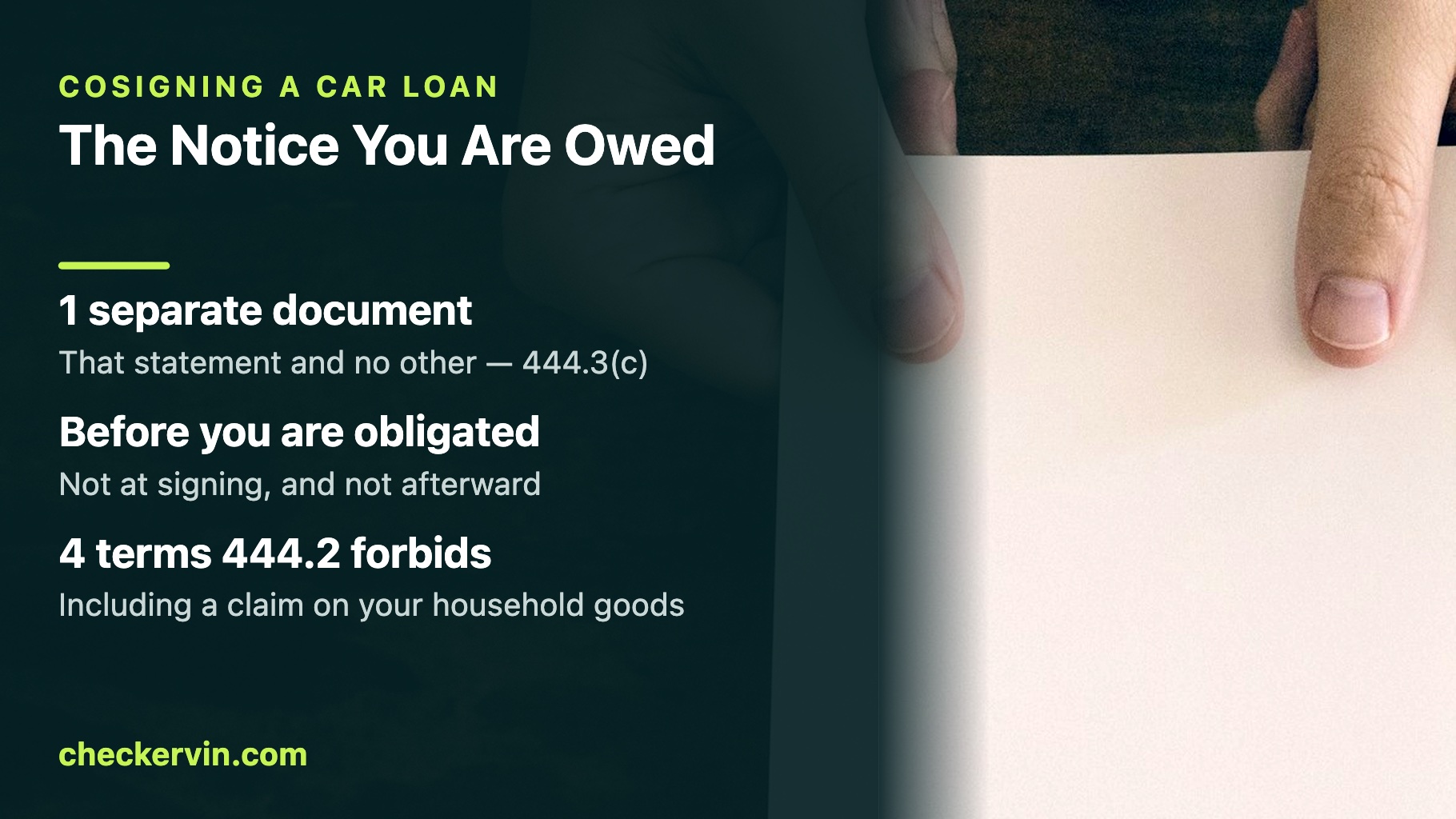
- Yes. 16 CFR 444.3 requires a separate document containing a prescribed statement and no other, given to you before you become obligated.
- Does it apply to every lender?
- No. The rule defines its lenders as those within the jurisdiction of the Federal Trade Commission, which does not extend to banks or federal credit unions.
Separate
What the notice must be
Its own document, that statement and no other
Before
When you must receive it
Prior to becoming obligated, not at signing
4
Contract terms 444.2 prohibits
Including a security interest in household goods
Free
Decode and recall check
Do it before anyone signs anything
What cosigning actually is
The rule defines a cosigner precisely, and the definition is more useful than the everyday understanding. A cosigner is a natural person who renders himself or herself liable for the obligation of another person without compensation.
That last phrase does the work. The rule goes on to say that a person who does not receive goods, services or money in return for a credit obligation does not receive compensation within the meaning of the definition. So the distinguishing feature of a cosigner is that they take on the debt and get nothing in exchange — the car goes to somebody else.
It also includes, expressly, any person whose signature is requested as a condition of granting credit to another person, or as a condition for forbearance on collecting another’s obligation that is already in default. That second limb is worth noticing: being asked to sign in order to stop a collection process is cosigning too.
The notice you are owed, and what makes it unusual
Section 444.3 makes two things unfair or deceptive acts or practices. It is deceptive for a lender or retail installment seller, directly or indirectly, to misrepresent the nature or extent of cosigner liability to any person. And it is unfair to obligate a cosigner unless the cosigner is informed, prior to becoming obligated, of the nature of their liability.
Then it says how to comply, and the wording of that requirement is the striking part. The disclosure must consist of a separate document that shall contain the prescribed statement and no other, given to the cosigner prior to becoming obligated.
| What the rule requires | Why it matters |
|---|---|
| A separate document | Not a clause inside the contract, and not a paragraph on the back |
| That statement and no other | Nothing may be added to it, so it cannot be diluted |
| Before you become obligated | Not at signing, and not afterward |
| Given to the cosigner | To you, personally — not to the borrower to pass on |
What the notice says, in full
Here is the statement the rule prescribes. It is worth reading as written rather than summarized, because summarizing is exactly what the “and no other” requirement exists to prevent.
That is the whole of it. Four paragraphs, no defined terms, no cross-references, and a closing line that tells you the notice itself is not the thing creating your liability — a distinction people otherwise get wrong in both directions.
Why you are being asked at all
Before the mechanics, the situation. A lender asks for a cosigner when it has assessed the borrower and concluded it does not want the risk on those terms alone. That is the entire content of the request, and it is information.
It does not mean the borrower is untrustworthy. Thin credit files, short employment history and youth all produce the same answer from an underwriting model, and none of them is a character judgment. But it does mean a professional lender, with the borrower’s full file in front of it, priced the risk and wanted someone else standing behind it.
The rule’s definition captures the asymmetry exactly: a cosigner is someone who becomes liable without compensation, and who does not receive the goods, services or money. You are supplying the creditworthiness and somebody else is receiving the car. That can be a perfectly good thing to do for someone. It is worth doing with your eyes open about which half of the transaction you are on.
They can come to you first
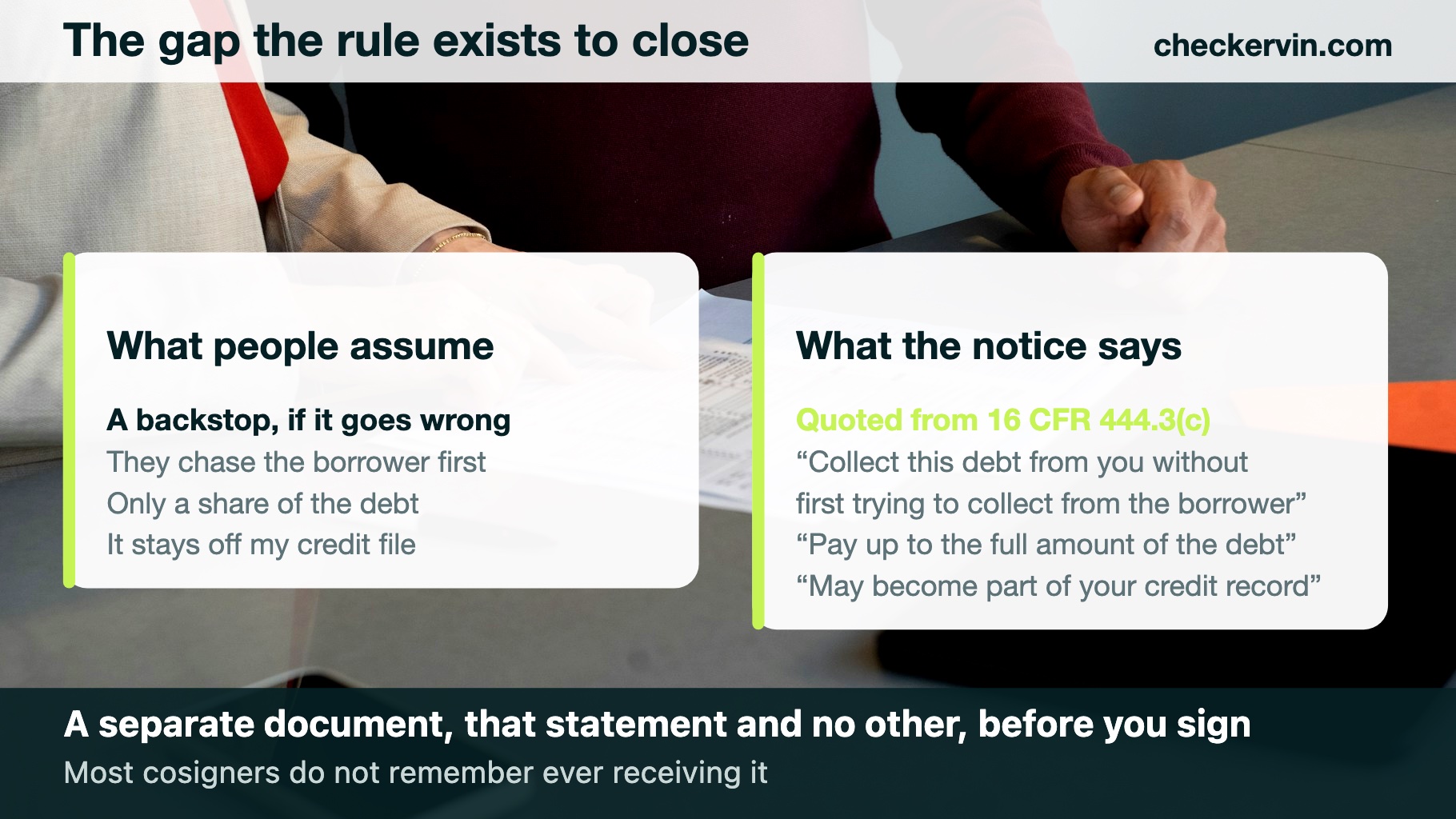
If one sentence justifies this page, it is this one: the creditor can collect this debt from you without first trying to collect from the borrower.
The common understanding of cosigning is that it is a backstop — the lender pursues the borrower, exhausts that, and only then turns to you. The notice states the opposite in plain words, and adds that the creditor can use the same collection methods against you that can be used against the borrower, naming suing you and garnishing your wages as examples.
| What people assume | What the notice says |
|---|---|
| A backstop if the borrower fails | Liable for the full amount, from the start |
| They will chase the borrower first | They can collect from you without trying the borrower |
| Softer treatment than the borrower | The same collection methods, including suit and garnishment |
| A favor that costs nothing unless it goes wrong | Late fees and collection costs are yours too |
It lands on your credit record
The notice says that if this debt is ever in default, that fact may become a part of your credit record. Not the borrower’s alone — yours.
The practical consequence people underestimate is not the default itself but the ordinary case: the obligation exists on your file for as long as the loan does, and it is a debt you are liable for whether or not anyone has missed a payment. That has effects on what else you can borrow, long before anything goes wrong.
It also means you have a live interest in whether the payments are being made, and no automatic way to find out. Anyone considering cosigning should agree in advance how they will know, because the first notification a cosigner often gets is the one that arrives after the damage.
Who has to give you the notice, and who does not
This is the limit on everything above, and it is written into the rule’s own definitions rather than inferred. A lender is a person who engages in the business of lending money to consumers within the jurisdiction of the Federal Trade Commission. A retail installment seller is defined the same way.
The Federal Trade Commission’s jurisdiction does not extend to banks or federal credit unions. So the notice requirement in this rule reaches dealerships and finance companies that fall within FTC jurisdiction, and does not reach every institution that might lend on a car.
There is also a safe harbor, in the same shape as the one in the Used Car Rule: a lender or retail installment seller who complies with the disclosure requirement does not violate the prohibition. That is why the paperwork exists at all, and why asking for it is asking for something the other side has a reason to produce.
The label on the paperwork does not decide it
A sentence in the definition catches people out in both directions: a person is a cosigner within the meaning of the rule whether or not he or she is designated as such on a credit obligation.
So the question is not what the form calls you. It is whether you have made yourself liable for someone else’s obligation without receiving the goods, services or money. If that describes what you are being asked to do, the label “guarantor”, “co-applicant” or nothing at all does not change the analysis.
- You are signing so that someone else can be granted credit
- You are signing so a creditor will hold off collecting someone else's defaulted debt
- You will not receive the vehicle, the services or the money
- You are a natural person rather than a business
- You are not being paid to do it
Four terms the contract may not contain
Section 444.2 is separate from the cosigner notice and applies to the credit obligation itself. It makes it an unfair act or practice for a lender or retail installment seller to take or receive an obligation from a consumer that contains any of four things.
| Prohibited term | What it would let a creditor do |
|---|---|
| A confession of judgment or warrant of attorney | Obtain judgment without notice or a chance to be heard |
| A waiver of exemption from attachment or execution | Reach property state law would otherwise protect |
| An assignment of wages | Take earnings directly, subject to narrow exceptions |
| A nonpossessory security interest in household goods | Claim your possessions as collateral for a car debt |
The wage-assignment prohibition has exceptions worth knowing: it is permitted where the assignment is revocable at the debtor’s will, where it is a payroll deduction or preauthorized payment plan set up at the time of the transaction, or where it applies only to wages already earned. And the confession-of-judgment prohibition carries a narrow carve-out for executory process in Louisiana.
The household goods rule, and its oddly specific list
The fourth prohibited term deserves its own treatment, because the rule defines household goods with unusual precision and the definition is quietly revealing about what it was written to stop.
Household goods means clothing, furniture, appliances, one radio and one television, linens, china, crockery, kitchenware, and personal effects — including wedding rings — of the consumer and their dependents.
| Included | Excluded |
|---|---|
| Clothing, furniture, appliances | Works of art |
| One radio and one television | Electronic entertainment equipment beyond that one radio and one television |
| Linens, china, crockery, kitchenware | Items acquired as antiques |
| Personal effects, including wedding rings | Jewelry other than wedding rings |
The rule even defines an antique: any item over one hundred years of age, including items repaired or renovated without changing their original form or character.
The spouse exception
One carve-out in the cosigner definition matters for couples buying a car. The term does not include a spouse whose signature is required on a credit obligation to perfect a security interest pursuant to state law.
That is narrow, and it should be read narrowly. It covers a signature required by state law to make the security interest effective — not a spouse who is being asked to guarantee the debt generally. A spouse in the second position is a cosigner like anyone else, and the definition’s designated-or-not sentence applies to them too.
State law can displace parts of this
Section 444.5 works the same way as the state-exemption provision in the Used Car Rule. If a state agency applies and the Commission determines that a state requirement or prohibition applies to the same transactions and affords consumers protection substantially equivalent to or greater than this rule, that provision of the rule stops being in effect in that state, to the extent the Commission specifies and for as long as the state administers and enforces its own requirement effectively.
So, as with almost everything in consumer credit, the federal layer is a floor and the state layer is where the answer for you personally may actually live. A national page can tell you what the federal rule says; it cannot tell you what your state has done with it.
What the notice does not tell you
The Notice to Cosigner is short by design, and its silences are as worth knowing as its contents. It is a warning about the nature of the obligation, not a summary of your agreement.
| Not in the notice | Where it lives instead |
|---|---|
| How much the debt is | The credit agreement and its disclosures |
| The interest rate and the term | The credit agreement and its disclosures |
| What happens if the car is repossessed | The security agreement and your state's law |
| Whether you can be released later | The agreement, and whatever the lender will agree to |
| What the car is actually worth or its condition | An inspection, and a VIN check on the vehicle |
The last line closes the notice itself: this notice is not the contract that makes you liable for the debt. Read that as an instruction rather than a disclaimer. The document you have been handed is the warning; the document that binds you is a different one, and you should read that too.
Cosigner is not the same as co-borrower
These get used interchangeably in conversation and they are not the same, with the difference sitting exactly on the rule’s compensation test.
| Cosigner | Co-borrower |
|---|---|
| Liable for the debt | Liable for the debt |
| Receives nothing in return | Receives the vehicle, or a share of it |
| Usually not on the title | Usually on the title |
| Covered by the Notice to Cosigner requirement | Not a cosigner under the rule's definition |
If you are going to be liable either way, it is worth understanding which one you are being asked to be, because only one of them ends with your name on the car. That is a question about the title rather than the loan, and it is answered by the paperwork at the DMV rather than by the finance office.
Before you sign
- 1Ask for the separate noticeIf the lender is within the rule's scope you are owed a document containing that statement and no other, before you become obligated. Asking costs nothing and tells you something either way.
- 2Read the four paragraphs as though they describe youBecause they do. The test the notice itself proposes is whether you can afford to pay the whole debt if you have to, and whether you want to accept the responsibility.
- 3Check the contract for the four prohibited termsConfession of judgment, waiver of exemption, wage assignment outside the narrow exceptions, and a nonpossessory security interest in household goods.
- 4Agree how you will find out about missed paymentsYou are liable and you have no automatic notification. Decide in advance, with the borrower, how you will know before a default reaches your credit record.
- 5Check the car itselfYou are guaranteeing a debt secured against a specific vehicle. Decode the VIN free for the factory build and check open safety recalls before anyone signs anything.
If you already signed
The honest position first: cosigning is a contract, and you cannot generally undo it on your own. Getting out usually requires the lender to release you, the borrower to refinance in their own name, or the debt to be paid off, and none of those is in your unilateral control.
- Find out whether you were given the separate notice, and keep it if you were
- Ask the lender in writing for the current balance and payment status
- Check your own credit file to see how the obligation is being reported
- Ask the borrower directly whether refinancing in their own name is realistic
- Get advice from someone qualified in your state before making decisions
The first item is worth doing even if nothing is wrong. The rule makes it a deceptive act or practice to misrepresent the nature or extent of cosigner liability, and an unfair one to obligate a cosigner without informing them beforehand. Whether you were told, and how, is a fact worth establishing while you can.
What this page is not
It is not legal or financial advice. It sets out what a specific federal rule says, and the variables most likely to decide your situation — your state’s law, your lender’s type, and the terms of your particular agreement — are exactly the ones a national page cannot resolve.
It also does not tell you whether cosigning for a particular person is a good idea. That is a judgment about a relationship and a budget, and the notice’s own framing is the right test: can you afford to pay the whole thing if you have to, and do you want to accept that responsibility.
What we can do is the vehicle half. Our free check returns the factory build, the specifications and open safety recalls from the VIN, at no cost and with no account. It does not return accident, title, odometer or theft history, and it has nothing to say about anyone’s credit.
Where this information comes from
- eCFR — 16 CFR Part 444, the FTC Credit Practices Rule444.1 defines cosigner and household goods; 444.2 lists the four prohibited contract terms; 444.3 requires the separate Notice to Cosigner and prescribes its wording; 444.5 covers state exemptions
- govinfo — 16 CFR Part 444, current annual edition (PDF)The printed text quoted on this page, including the full Notice to Cosigner
- NHTSA — check for open recalls by VINFree, and worth running on the specific vehicle a cosigned loan is secured against
Keep reading
Frequently asked questions
Is there a federal notice for cosigners?
Yes. Under 16 CFR 444.3 a lender or retail installment seller must give a cosigner a disclosure consisting of a separate document containing a prescribed statement and no other, before the cosigner becomes obligated. Most people who have cosigned a car loan do not remember receiving it, and it is short enough to read in under a minute.
Can the lender come after me before the borrower?
The required notice says so directly: the creditor can collect this debt from you without first trying to collect from the borrower, and can use the same collection methods against you that can be used against the borrower, such as suing you or garnishing your wages. That single sentence is the thing most cosigners are surprised by.
Does cosigning affect my credit?
The federal notice states that if the debt is ever in default, that fact may become part of your credit record. Cosigning is not a character reference; it is your obligation, and its performance is recorded against you.
Am I a cosigner if the paperwork does not call me one?
Possibly. The rule defines a cosigner as a natural person who makes themselves liable for another's obligation without compensation, and says a person is a cosigner whether or not they are designated as such on the credit obligation. The label is not what settles it.
Does this rule apply to my bank or credit union?
Read it carefully, because the rule limits itself. It defines a lender and a retail installment seller as persons operating within the jurisdiction of the Federal Trade Commission, and that jurisdiction does not extend to banks or federal credit unions. A dealership arranging financing or a finance company is a different matter.
What is the difference between a cosigner and a co-borrower?
A cosigner takes on the debt without receiving the goods, services or money — the rule says a person who does not receive them is not compensated. A co-borrower is a joint owner and joint debtor. Both are liable, but only one of them gets the car, and it may not be the one signing.
Can a car loan contract take a security interest in my furniture?
Not a nonpossessory one. Under 16 CFR 444.2 it is an unfair act or practice for a lender or retail installment seller to take an obligation containing a nonpossessory security interest in household goods other than a purchase money security interest, and the rule defines household goods to include clothing, furniture, appliances, one radio and one television, linens, china, crockery and kitchenware.
Why does the lender want a cosigner?
Because it assessed the borrower and did not want the risk on those terms alone. That is not necessarily a judgment about character — thin credit files, short employment history and youth all produce the same underwriting answer. It does mean a professional lender with the full file in front of it wanted someone else standing behind the debt.
Can I get off a car loan I cosigned?
Not unilaterally. The obligation is a contract, and ending it generally requires the lender to release you, the borrower to refinance in their own name, or the debt to be paid off. None of those is something you can do alone, which is why the decision matters most before you sign.
Check the vehicle before anyone signs
Decode any 17-character VIN free for the factory build, specifications and open safety recalls. No account required.
Run a free VIN check