The short answer
- What is the dealer describing?
- Spot delivery — you took the car before the financing was finalized. The call afterwards is what consumer lawyers call yo-yo financing.
- What should I do first?
- Read your own paperwork before you reply, and photograph every page. What you signed determines almost everything that follows.
- What am I looking for in it?
- A block headed NOTICE, printed in bold. Federal rule 16 CFR 433.2 requires it in consumer credit contracts, and it says holders take the contract subject to your claims against the seller.
433.2
The rule requiring the notice
16 CFR, the FTC Holder Rule
10 pt
Minimum type size
Bold face, in the contract
Amounts paid
The recovery ceiling
Written into the notice
In writing
How to answer the call
Keep every version you signed
What just happened, in the trade's own words
Two separate things happened to you, and giving each its name makes the situation much easier to think about.
| The term | What it describes |
|---|---|
| Spot delivery | You were allowed to take the vehicle on the spot, before the financing was finalized. Legal in itself, and common |
| Yo-yo financing | The follow-up call saying the financing did not hold, asking you to return the car or re-sign at different terms |
| Conditional delivery | The name a contract may use for the same arrangement, often in a clause you signed without noticing |
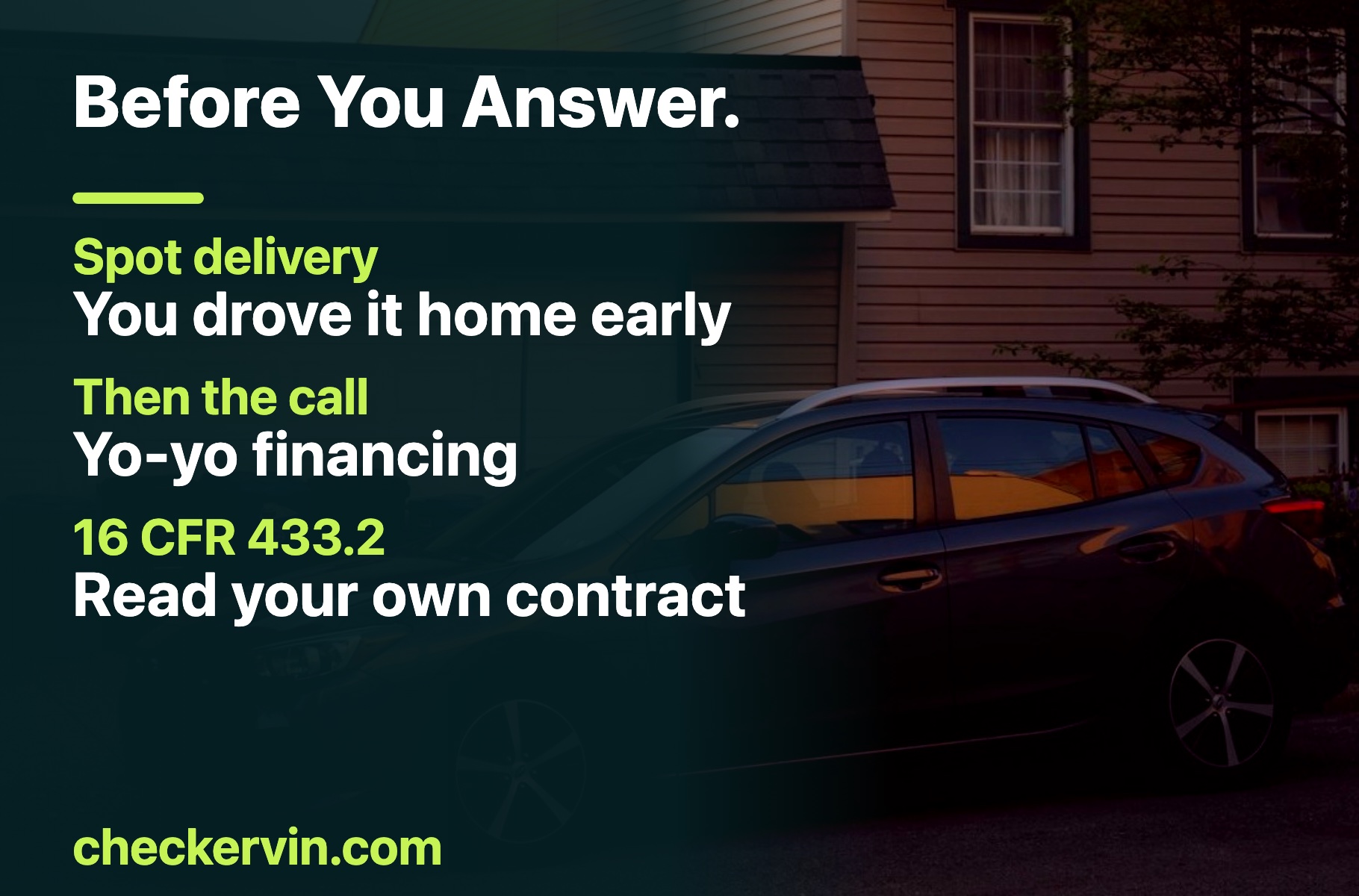
The first is a business practice. The second is where disputes come from, and it is the reason a number of plaintiff-side law firms rank for this exact search. That should tell you something useful on its own: this is a well-worn situation with an established body of people who handle it, not a freak event you have to reason about from first principles.
Read your own paperwork before you answer
The single most valuable thing you can do in the first hour is not to phone anybody. It is to find every page you signed and photograph all of them, including the reverse sides and anything that looks like boilerplate.
- The retail installment contract or purchase agreement, every page
- Any separate document about delivery, conditional delivery or financing approval
- The buyers guide window form, if you bought from a dealer
- Your trade-in paperwork and the payoff figure quoted on it
- Anything you were handed at the desk, however unimportant it looked
Photograph rather than only file them. If the dealership later produces a version of a document that differs from the one you took home, dated photographs of your copy are the cheapest evidence in the entire dispute, and they are free.
The notice the federal government requires inside your contract
Now to the part no other page on this subject seems to mention. If you financed through the dealer, your credit contract is very likely required to carry a specific paragraph, and the requirement is federal rather than a matter of state variation.
The rule is 16 CFR 433.2, the FTC's Preservation of Consumers' Claims and Defenses rule, known in the trade as the Holder Rule. It makes it an unfair or deceptive act or practice under section 5 of the FTC Act for a seller to take or receive a consumer credit contract that fails to contain this provision:
Go and look for it. It is usually in a box, often near the signature block, and it is printed in capitals because the rule effectively requires it to stand out. Finding it tells you the contract was drawn as an assignable consumer credit contract — the kind meant to be sold on to a bank or finance company.
Ten point, bold face, and why the formatting is in the rule
The regulation does not merely require the words. It requires them “in at least ten point, bold face, type.” A drafting requirement about type size inside a consumer protection rule is unusual enough to be worth a moment.
The reason is plain once stated: a paragraph that preserves your rights is worth nothing if it is set in the smallest type on a crowded page. By fixing a floor on size and weight, the rule makes the notice findable by an ordinary person holding an ordinary contract. That is exactly the use you are putting it to right now.
There is a second variant of the notice at 433.2(b), used where the transaction is financed by a purchase money loan rather than by a credit contract the seller takes directly. The wording differs by a few words — it refers to goods or services obtained with the proceeds — and the effect is the same.
What the notice is worth, and what it is not
Be precise about what the paragraph does, because overstating it helps nobody. It does two things.
| What the notice does | What that means in practice |
|---|---|
| Preserves claims and defenses | Whoever ends up holding the contract takes it subject to the claims and defenses you could assert against the seller |
| Caps recovery | Recovery under the notice shall not exceed amounts you paid under the contract — it is a ceiling written into the text itself |
The ceiling is worth reading precisely too. It is expressed as amounts paid by the debtor under the contract, which is a different quantity from the price of the car, from what you still owe, and from any loss you might feel you have suffered. Whatever else is in dispute, that phrase is the measure the notice itself sets.
What it does not do is decide your dispute, cancel your obligations, or tell you whether the dealer may take the car back. Those turn on your contract and your state's law. The notice matters because it prevents a particular argument — the claim that a finance company which bought your contract is a stranger to whatever the dealership did. Under the rule that argument is not available to a holder.
How old this rule is, and why that matters
One detail puts the notice in perspective. The rule was published in 1975, and the only carve-out in 16 CFR 433.3 exempts sellers who took or received an open end consumer credit contract before November 1, 1977 from the requirement in 433.2(a).
In other words the exemption is a transitional provision for paperwork nearly fifty years old. For any ordinary vehicle purchase financed today, there is no live exemption to argue about. That is worth knowing because it changes what the absence of the notice would mean: on a modern consumer credit contract, a missing notice is not an exemption quietly being exercised. It is something to ask about.
Who counts as the creditor, and the referral test
The definitions in 16 CFR 433.1 are worth reading, because they capture arrangements people assume fall outside the rule.
A consumer is a natural person who seeks or acquires goods or services for personal, family or household use. A creditor is a person who, in the ordinary course of business, lends purchase money or finances the sale of goods or services to consumers on a deferred payment basis.
The definition of a purchase money loan is the interesting one. It covers a cash advance received in return for a finance charge within the meaning of the Truth in Lending Act and Regulation Z, applied in whole or substantial part to a purchase from a seller who either refers consumers to the creditor, or is affiliated with the creditor by common control, contract or business arrangement.
Your trade-in and your down payment
The vehicle you handed over is usually the most valuable thing in the dispute and the thing most easily lost, because a dealership can sell a trade-in quickly.
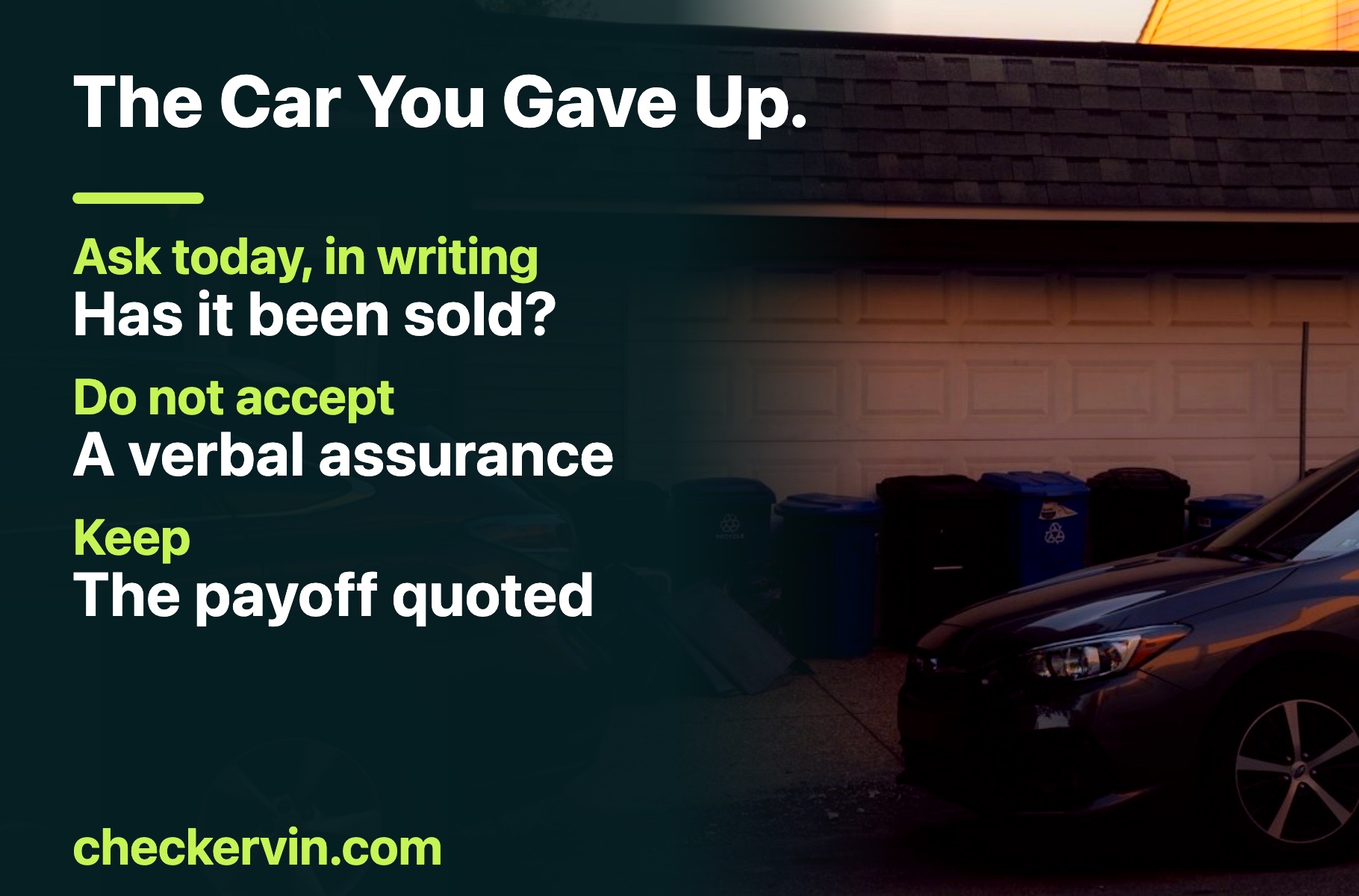
- Ask in writing, today, whether your trade-in has been sold
- Ask for it back in its original condition if you are being asked to unwind the deal
- Keep the payoff figure you were quoted, which may differ from what was actually paid
- Do not rely on a verbal assurance that it is being held for you
- Note the date and time of every call and who you spoke to
If you have the VIN of your trade-in, run it and keep the record. It costs nothing and it establishes what the vehicle was, which is a question that can become contested later.
Being asked to come in and sign again
The request that usually accompanies the call is that you return and sign a new agreement, commonly at a higher rate, a longer term, or a larger down payment.
Nobody can make you sign a new contract. Signing is an agreement, and an agreement you do not make does not bind you. That is not a clever argument; it is the ordinary meaning of signing. What is genuinely uncertain, and what varies by state, is what happens if you decline — whether the original agreement stands, and what the dealership may lawfully do about the car.
That uncertainty is precisely why the sequence matters: read first, gather the documents, then get advice specific to your state before you agree to anything. A decision made on the phone, under time pressure, in the absence of your own paperwork, is the one outcome worth avoiding.
The five numbers to compare, if you are handed a second contract
If you do go in and are presented with new paperwork, there is a defined set of figures that a closed-end consumer credit disclosure has to state, using those terms. Comparing them line by line against your original is the most concrete thing you can do in the room, and it takes about two minutes.
The requirements are in 12 CFR 1026.18, the content-of-disclosures section of Regulation Z, which implements the Truth in Lending Act.
| 12 CFR 1026.18 | The figure it requires, using that term |
|---|---|
| (b) Amount financed | The credit provided to you or on your behalf — cash price less any down payment, plus other financed amounts, less any prepaid finance charge |
| (d) Finance charge | Described in the rule's own words as the dollar amount the credit will cost you |
| (e) Annual percentage rate | The cost of your credit as a yearly rate |
| (g) Payment schedule | The number, amounts and timing of the payments scheduled to repay the obligation |
| (h) Total of payments | The amount you will have paid when you have made all scheduled payments |
Two more are worth finding while you are there. Paragraph (a) requires the identity of the creditor making the disclosures — which tells you who you would actually be borrowing from under the new paperwork, and whether that has changed. And paragraph (j) requires, in a credit sale, the total sale price: the total price of the purchase on credit including the down payment.
There is also an itemization right most buyers never exercise. Paragraph (c) requires a separate written itemization of the amount financed — including any amounts the creditor paid to other people on your behalf, with those people identified — unless the creditor instead offers you a statement of your right to request it and you do not ask. So if you were given a checkbox rather than an itemization, the itemization is still yours for the asking, and it is the document that shows where the financed money actually went.
What to gather before you talk to anyone
Whether you end up speaking to the dealership, your state attorney general, or a lawyer, the same short file makes the conversation useful rather than exploratory.
- 1Photograph every signed pageBoth sides, including the reverse of the installment contract, and anything headed conditional or delivery.
- 2Find and photograph the NOTICE boxThe Holder Rule paragraph, if it is present. Its presence, absence or type size are all facts worth recording now rather than later.
- 3Write down the timelineThe date you signed, the date you took the car, the date of the call, and what was said each time.
- 4Establish the vehiclesDecode the VIN of the car you bought and of the trade-in you handed over, and keep both records with the file.
- 5Put your questions in writingEmail rather than phone where you can. A written answer from the dealership is worth more than a remembered one.
Where this page stops, said plainly
This is not legal advice and we are not lawyers. Everything above describes what a federal regulation requires to appear in a consumer credit contract, so that you can find it and read it in your own paperwork.
What we deliberately have not done is tell you whether the dealership is entitled to the car back, whether your contract is binding, or what remedy you have. Those answers depend on your contract and on state law that differs materially from one state to the next, and any page that answers them confidently for a national audience is guessing.
Our own free check decodes a VIN and returns the factory build, the specifications and any open safety recall. It cannot tell you anything about your financing. It is useful here for one narrow purpose: establishing exactly which vehicles were involved, on the record, on the day you looked. The post-purchase checklist covers the rest of the paperwork.
Where this information comes from
- 12 CFR 1026.18 — content of disclosures (Regulation Z)Amount financed, finance charge, APR, payment schedule, total of payments — and the itemization right
- 16 CFR 433.2 — preservation of consumers' claims and defensesThe required NOTICE, the ten point bold face requirement, and the recovery ceiling
- 16 CFR 433.1 — definitionsConsumer, creditor, and the purchase money loan referral and affiliation test
- FTC — buying a used carFederal consumer guidance on dealer purchases
- NHTSA recall lookupFree open-recall check on the VIN of either vehicle
Keep reading
Frequently asked questions
What is spot delivery or yo-yo financing?
Spot delivery is being allowed to drive the car home before the financing is finalized. Yo-yo financing describes what happens when the dealer later says the financing did not go through and asks you to return the car or sign new terms, usually at a higher rate.
Do I have to sign a new contract at a higher rate?
Nobody can compel you to sign a new agreement on different terms. Whether the original agreement is binding, and what each side may do next, depends on what you signed and on your state's law, which varies considerably.
What is the NOTICE printed in my credit contract?
The FTC Holder Rule at 16 CFR 433.2 requires consumer credit contracts to carry a notice, in at least ten point bold face type, saying any holder of the contract is subject to all claims and defenses the debtor could assert against the seller. Recovery under it cannot exceed amounts the debtor paid.
Can the dealer keep my trade-in or deposit?
That depends on your contract and your state's law, and it is one of the most common points of dispute. Ask in writing for the trade-in back in its original condition and check whether it has already been sold before you agree to anything.
Is this page legal advice?
No. It explains what a federal regulation requires to appear in a consumer credit contract so that you can find and read it yourself. Whether it helps in your situation is a question for a lawyer licensed in your state, or your state attorney general's office.
Establish the vehicles on the record
Decode the VIN of the car you bought and the one you traded in, and check both for open recalls. Free, no account, and worth keeping with the file.
Run a free VIN check