The short answer
- What does it cost?
- Estimator averages run from $276 (YourMechanic) to $864 (AutoNation). A Bosch reman 140-amp unit for the 2.5-liter sells for $471.24 with core.
- Is it really the alternator?
- Volkswagen tells its dealers to replace the generator only after its guided test plan fails. Ask for that result before you pay.
- 2011–2014 Jetta sedan?
- A VW tech tip says to inspect the 200-amp SA1 fuse first, in capitals: do not replace the generator.
$276–$864
Estimator averages, Jetta alternator
YourMechanic, AutoNation; Nov. 2026
5 of 15
Years electrical leads the Jetta record
2010, 2011, 2012, 2015 and 2020; NHTSA complaints
SA1, 200 A
Fuse VW says to check first
2011–2014 Jetta sedan, TT 27-11-02
0
Jetta alternator recalls, 2008–2022
NHTSA query, every Jetta name
The numbers, and whose numbers they are
CheckerVIN decodes VINs and lists open recalls; we do not fix cars, so every price on this page is someone else’s, dated. On November 22, 2026, YourMechanic’s Jetta alternator estimate showed an average of $276, split into about $136 for parts and $140 for labor. AutoNation Mobile Service showed an average of $864 and said the job takes about two hours. Neither site would serve its page to our research tools, so both figures come from their search listings, read in two separate searches. A search summary also attributed a model-year range to RepairPal; we could not open that page or find the figure again, so it is left out.
A gap that wide usually means the two sites are pricing different parts. The low average reads like an aftermarket unit at a mobile mechanic’s rate. For a sense of what a known part costs, UroTuning lists a Bosch remanufactured 140-amp alternator, part 07K903023CX, for the 2.5-liter five-cylinder at $471.24 on sale (marked down from $684.62). That price includes an $82 core fee you get back when the old unit is returned. Labor, tax and any belt come on top. The cheapest alternator is still the one you did not need, and Volkswagen’s own paperwork is unusually blunt about that.
What the Jetta complaint record shows
Our corpus holds 5,480 federal NHTSA complaints against the 2008–2022 Jetta. NHTSA files some of them under other names (Jetta SportWagen, the Jetta Hybrid, the GLI, a 2015 TDI listing), and our record pools them, because they are the same car sold under the Jetta name. NHTSA has no alternator category. The nearest one, ELECTRICAL SYSTEM, also takes in the battery, wiring, fuses, radios, ignition switches, locks and control modules. It is an outer limit on charging trouble and never a count of failed alternators.
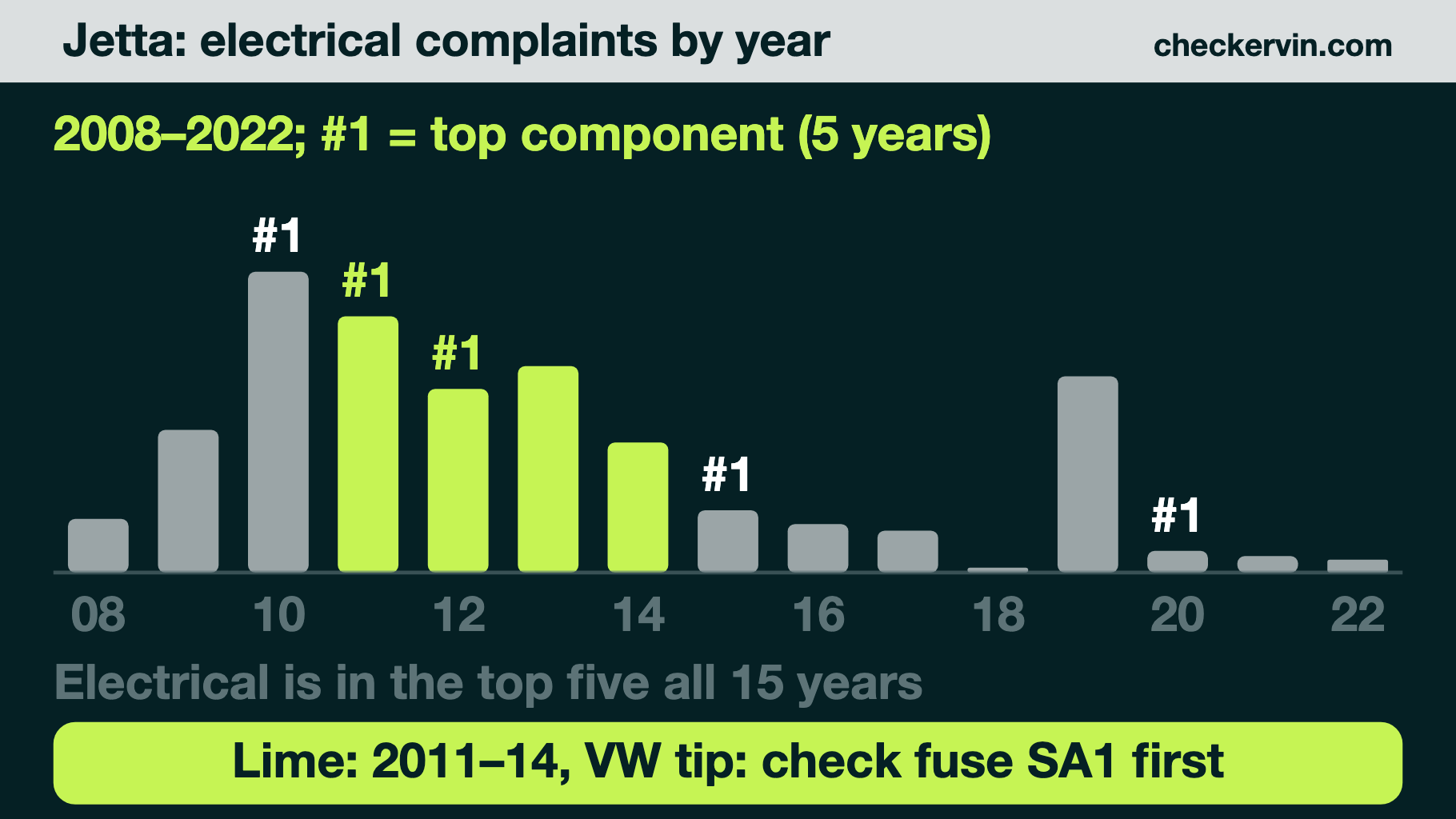
We keep each year’s top five components, and electrical makes that list in all 15 model years, so these are full yearly counts: 1,316 electrical complaints in all. It is the single most-reported component in 2010, 2011, 2012, 2015 and 2020. The tallest bar is 2010, at 236 reports, about 27% of every complaint filed against that model year. The 2011–2014 cars, the years a Volkswagen charging tip covers for the sedan, hold 46% of the electrical total on their own. The 2019 also files a lot of electrical reports (154), but power train leads that year.
When we read the electrical complaints themselves, the alternator is named in a small minority. Batteries come up far more often, and in the busiest years the dominant stories are not about charging at all, which the section on what fills those years covers.
Volkswagen’s rule: no failed test, no generator
Volkswagen calls the alternator a generator, and in June 2013 it issued a bulletin titled simply “Generator Replacement.” It has been re-issued as models were added, most recently in March 2023, and now covers every Volkswagen from 2012 to 2024 except the Routan, the Touareg Hybrid, the Jetta Hybrid and the electric cars. It lists the symptoms that bring a car in: a discharged battery, a no-start, the battery light in the instrument cluster, “low voltage” fault codes in several control modules, engine noise, and an accessory belt that is damaged or missing.
Then it sets the rule. If diagnosis points at the generator, the dealer must confirm it with Volkswagen’s Guided Fault Finding test plan, and replace the generator only if that test fails. The failed test has to be uploaded to Volkswagen or kept on file, because a warranty claim without it can be refused. The one exception is a mechanical failure the scan tool cannot see, such as a noisy bearing, and even then the reason must be written into the repair order.
2011–2014 Jetta sedan: check the 200-amp fuse before anything else
The sixth-generation Jetta sedan, sold from the 2011 model year, has a Volkswagen tech tip of its own. TT 27-11-02, first issued in January 2011 and updated in December 2013, covers the 2011–2014 Jetta sedan and 2012–2014 Passat under the heading “No Charging System Voltage.” Its instruction is to start a low battery or no-charge diagnosis at the SA1 200-amp fuse in the SA fuse block, and it adds, in capitals, not to replace the generator.
The tip describes a voltage drop test across two threaded connections, numbered 508 and SA1. A drop above 0.02 volts means disconnecting the battery, removing the cables at both points and checking continuity across the threaded plate between them. If the fuse is open, it is replaced and the connections are checked closely. In plain terms: on these cars the alternator’s output can be stopped by a fuse or a poor connection on its way to the battery, and the car looks exactly like it has a dead alternator.
One 2012 owner’s complaint to NHTSA describes two batteries, three alternators and a full set of fuses, with the car still not charging. We cannot say what was wrong with that car; NHTSA complaints are unverified owner reports. It is the pattern the tip was written to stop. The tip names the sedan only, not the SportWagen of the same years, so on a SportWagen ask the shop which main fuse protects the charging circuit.
The pulley clutch comes before the alternator
Where it is fitted, the Jetta alternator’s pulley has a one-way clutch built into it, so the pulley drives the alternator in one direction and freewheels in the other. Volkswagen’s TT 27-13-01, dated May 2013 and extended in 2015 to cover the 2005–2015 Jetta and Jetta SportWagen among other models, says to check that clutch before replacing the alternator. The method is simple: take the belt off, hold the fan blades inside the alternator with a trim tool, and turn the pulley by hand. It should spin freely in one direction only. If it spins freely both ways, the clutch has failed and should be replaced before diagnosis goes any further.
That matters on a quote because the generator bulletin lists engine noise and a damaged or missing belt among its symptoms, and the pulley sits right where the belt meets the alternator. A pulley is a separate part. Ask whether it was tested, and whether the price is for the pulley, the alternator, or both. One more document for older cars: Volkswagen told dealers in 2010 that on 2008–2010 Jettas, headlights that dim slightly at idle can be normal, because the alternator cannot fully smooth out voltage swings at idle speed. A faint flicker alone is not a failed alternator.
What fills the Jetta’s electrical years
Reading the electrical complaints year by year changes what the bars mean. In 2010, the tallest year, the leading story is the factory radio: owners describe it popping and going dark, often taking the hands-free phone with it, and some say the dead unit kept drawing power and flattened the battery. The radio bulletins we found for that period are software updates for the premium RCD 510 unit; none covers a dead radio that keeps drawing current.
The 2011 reports are mixed: melted fuse plates, locks, stalls and keys. One recall belongs here. Campaign 11V-196 covers 2011 Jettas built from March 2010 to March 2011, where a converter box shared a fuse with the horn and alarm. If that fuse blew, it could shut off engine management, lights and wipers while driving. Dealers moved the horn and alarm to separate fuses at no charge.
From 2012through 2015 the most common story is an ignition key that sticks and will not turn the engine off. Recall 19V-615 covers 2011–2018 Jettas with an automatic transmission, a manual handbrake and keyless entry: a build-up on the shift-lever micro switch could let the key come out when the car is not in Park, and dealers add a switch and circuit board free. We cannot say every stuck-key report is that fault. The point for an alternator quote is that the bars in these years are mostly not about charging.
The 2020 is first-ranked on a small base (17 reports), scattered across screens, start-stop and warning lights. Recall 23V-604 is worth knowing on a 2019 or 2020 Jetta with a conventional ignition switch: the ignition switch can fail in heat, shutting the electrical system down and stalling the engine. A car that dies on the road with warning lights everywhere is the car a shop suspects of a failed alternator. A free Volkswagen recall check shows whether that campaign is still open.
Dead overnight is usually not a charging fault
A Jetta that starts fine after a drive but is dead in the morning points at something drawing current while parked, not at the alternator. Volkswagen’s bulletin on excessive static current draw, re-issued in 2022 for every Volkswagen from 2000 on except the Routan, sets the target: after the car sleeps for two hours, the draw should be about 40 milliamps. Its procedure tests the battery first, then measures the sleep current with a clamp, and warns technicians not to disconnect the battery or pull fuses during the test, because waking the car’s network spoils the reading. It also says to look first at non-factory add-ons such as aftermarket radios.
One drain had a factory fix. On the 2015 Jetta TDI with the 2.0-liter diesel, Volkswagen’s update 23N7 changed engine software after finding that the engine computer, waking about nine hours after shut-off to run a self-check, could keep the network awake if a door was opened at the wrong moment. Volkswagen offered it free within the federal emissions warranty. If a 2015 TDI keeps going flat, ask whether 23N7 was ever done.
Which alternator your Jetta takes, and what it costs
The Jetta changed engines often in this period, and the alternator follows the engine. EPA’s fuel economy listings give the lineup by year; a Volkswagen VIN decode or the engine size lookup confirms which one your car has.
| Jetta years (EPA listings) | Engines, and what we could price |
|---|---|
| 2008–2013 | 2.5L five-cylinder; Bosch reman 140 A 07K903023CX, $471.24 with $82 core (UroTuning) |
| 2009–2015 | 2.0L TDI diesel; 2015 TDI also has the 23N7 battery software update |
| 2011–2015 | 2.0L non-turbo four; 2.0L turbo from 2012; 1.8L turbo from 2014; 2011–2014 sedan covered by the SA1 fuse tip |
| 2016–2018 | 1.4L turbo, 1.8L turbo; GLI 2.0L turbo |
| 2019–2021 | 1.4L turbo; GLI 2.0L turbo |
| 2022 | 1.5L turbo; GLI 2.0L turbo |
| 2013–2016 Hybrid | 1.4L turbo hybrid; excluded from VW's generator bulletins |
We priced only the 2.5-liter unit with a confirmed listing. For the turbo engines, get the part number from the shop and check it against your VIN. The remanufactured Bosch price is a useful anchor: if a quote for a 2.5-liter car is far above it, ask whether the part is new from Volkswagen, and why.
The battery work that goes with the job
Every alternator replacement starts by disconnecting the battery, and on newer Jettas that step has its own rules. Volkswagen tech tip 01-19-05TT, which covers the 2018–2024 Jetta among other models, warns that removing the positive cable first can let the terminal touch the engine computer’s case and short it, leaving a car that cranks but will not start. The ground cable always comes off first. The tip also has technicians check fuse SB9 for the ignition coils.
If the battery is replaced too, cars from 2015 on with a battery monitoring module need the new battery adapted to the car. Volkswagen’s tip 27-20-02TT says that without it the start-stop system stops working, charging may be affected and fault codes can follow. A 2018 tip adds that some models leave the factory with an enhanced flooded battery and may take a glass-mat battery only where Volkswagen’s parts catalog allows it. The battery size lookup by VIN shows the group your Jetta should carry. A new alternator charging a battery the car does not recognize can look like a repair that did not work.
Jetta Hybrid: an alternator quote needs a second look
The Jetta Hybrid was sold for the 2013 to 2016 model years with a 1.4-liter turbo engine and an electric drive motor. Every version of Volkswagen’s generator replacement bulletin lists it as an exception, next to the Touareg Hybrid and the electric models. We did not find a Volkswagen document that says how the Hybrid’s 12-volt battery is charged, so we will not claim more than the bulletin does. It is enough to change the question: on a Jetta Hybrid with a charging warning, ask for the Volkswagen part number and the test result before approving an alternator. Its other bulletins deal with the high-voltage system, which only trained technicians should open.
Before you authorize a Jetta alternator
- Ask for the battery test result, the charging voltage with the engine running, and any low-voltage fault codes
- Ask what test shows the alternator failed, the way Volkswagen's bulletin requires of its dealers
- On a 2011–2014 sedan, ask whether the SA1 200-amp fuse and its connections were checked
- Ask whether the pulley's one-way clutch was tested, and whether the quote is for the pulley, the alternator or both
- If the car dies overnight, ask for a sleep-current measurement instead
- Check the VIN for open recalls, especially 11V-196 on a 2011 and 23V-604 on a 2019–2020
- Ask whether the part is new Volkswagen, remanufactured or aftermarket, and about the core charge
The guide to bulletins versus recalls explains why a recall is free at any age while a bulletin like the generator one is a set of instructions, not a free repair. The Volkswagen warranty check by VIN estimates whether factory coverage might still pay.
If you are buying the Jetta, not repairing it
Charging trouble rarely shows on a short test drive, so ask. Has the car ever needed a jump? Was the alternator or battery replaced, and did the problem stop afterward? On a 2010, does the factory radio work? On a 2011–2015, does the key turn off and come out cleanly every time? Open recalls are worth clearing before you buy. The Volkswagen Jetta years-to-avoid page lays out the whole record by year. Our Jetta water pump post covers the costlier cooling repair and Volkswagen’s extended coverage for it. The 2018 sits at the bottom of the chart with only 3 electrical reports, but a short record is not proof of a sound car.
A free CheckerVIN report returns the factory build, engine, specifications and open safety recalls for any VIN. It does not include accident, title, odometer or repair history, so it cannot tell you whether an alternator was ever replaced. Only the seller’s receipts can.
Where this information comes from
- Volkswagen TSB 27-19-02, Generator Replacement, March 2023 (NHTSA copy)2012–2024 Volkswagens except the Jetta Hybrid and others: replace the generator only if the Guided Fault Finding test fails.
- Volkswagen TB 27-13-01, Generator Replacement, June 2013 (NHTSA copy)The original 2012–2014 issue, with the symptom list: discharged battery, no start, battery light, belt damaged or missing.
- Volkswagen TT 27-11-02, No Charging System Voltage (NHTSA copy)2011–2014 Jetta sedan: inspect the SA1 200 amp fuse first; do not replace the generator.
- Volkswagen TT 27-13-01, One Way Clutch Pulley Testing, 2015 update (NHTSA copy)2005–2015 Jetta and SportWagen: a pulley that spins freely both ways has failed; replace it before further diagnosis.
- Volkswagen TSB 27-15-03, Excessive Static Current Draw, March 2022 (NHTSA copy)About 40 mA sleep current after two hours; test the battery first, do not disconnect it during the test.
- Volkswagen UPDATE 23N7, TDI Battery Management Software, October 2014 (NHTSA copy)2015 Jetta 2.0L TDI: engine computer could keep the network awake and drain the battery while parked.
- Volkswagen 01-19-05TT, Engine Crank No Start, July 2024 (NHTSA copy)2018–2024 Jetta and others: disconnect the ground cable first or the engine computer can short.
- Volkswagen 27-20-02TT, Battery Adaptation, May 2023 (NHTSA copy)2015–2024 cars with a battery monitoring module: adapt a new battery or start-stop and charging can be affected.
- NHTSA: recalls by VINOur query of every 2008–2022 Jetta name found no alternator recall; 11V-196, 19V-615 and 23V-604 are the electrical campaigns used here.
- EPA and DOE: fueleconomy.gov vehicle listingsJetta engines by model year, used for the parts table.
Keep reading
Frequently asked questions
How much does it cost to replace the alternator on a Volkswagen Jetta?
Two estimators we checked on November 22, 2026 disagree widely: YourMechanic shows an average of $276 (about $136 parts, $140 labor) and AutoNation Mobile Service shows $864, with about two hours of labor. A Bosch remanufactured 140-amp unit for the 2.5-liter Jetta sells for $471.24 at UroTuning, a price that includes an $82 refundable core fee. The engine decides the part, so get a quote that names it.
Are VW Jettas expensive to fix?
For this repair, not unusually. On the same day YourMechanic's Jetta alternator average ($276) came in below its Toyota RAV4 average ($353), though AutoNation's Jetta figure was higher. Some Jetta jobs do cost more: the turbo engines' water pump is a module, not a simple part, which our Jetta water pump post covers. The bigger risk on an alternator job is paying for one that was never the fault.
Is an alternator an expensive thing to replace?
It sits in the middle. On a Jetta the part is most of the bill; AutoNation puts the labor at about two hours. What turns it expensive is a wrong diagnosis. Volkswagen's own bulletin tells dealers to replace the generator only after its guided test plan fails, and on 2011–2014 Jetta sedans to check the 200-amp SA1 fuse first.
What are the signs of a bad alternator on a Jetta?
Volkswagen's bulletin lists a discharged battery, a no-start, the battery light in the cluster, low-voltage fault codes in several modules, engine noise and a damaged or missing accessory belt. Most of those can also come from a weak battery, a blown main fuse, a failed pulley clutch or a module that will not sleep, which is why the test result matters more than the symptom.
Does the Jetta Hybrid have an alternator?
Volkswagen's generator replacement bulletins list the Jetta Hybrid (sold for the 2013–2016 model years) as an exception, alongside the Touareg Hybrid and electric models. We did not find a Volkswagen document that describes how the Hybrid's 12-volt battery is charged, so if a shop quotes an alternator for one, ask for the Volkswagen part number and the test result first.
Check the VIN before you price the alternator
A free CheckerVIN report shows the factory build, engine, specifications and open recalls for any VIN: enough to know which Jetta alternator fits and whether a recall comes first.
Run a free VIN check