The short answer
- What does it cost?
- RepairPal lists $658–$920 for a 2015 Sienna and $695–$941 for a 2004. Most of the spread is labor on the 3.5L V6.
- Does my Sienna have one?
- Only if it is a 2020 or older. Every 2021-and-newer Sienna is a hybrid, and its 12-volt battery is charged by the hybrid system.
- Is the alternator the usual problem?
- Rarely. Electrical complaints make the top five in 14 of 15 years, but owners mostly describe power sliding doors.
$658–$920
RepairPal, 2015 Sienna alternator
Search-served, Nov 2026
2.4 hr
Toyota's time to swap just the pulley
2011–2012 V6, T-SB-0055-12
54%
Of counted electrical reports
From the 2011–2016 door-wiring recall years
None
Belt alternator on 2021+ Siennas
Hybrid-only from 2021
The published numbers, and how far apart they are
No estimator publishes one Sienna alternator price, and the ones that do disagree by more than the cost of the part. RepairPal’s 2015 Sienna page lists an alternator replacement at $658 to $920, and its 2004 page lists $695 to $941. AutoNation Mobile Service gives a Sienna average of $804 and puts the job at about two hours. YourMechanic shows an average of $358, split into $218 of parts and $140 of labor. Every one of those sites refused a direct page fetch when we checked on November 23, 2026, so these are the figures their pages showed in search results that day, not numbers we read on the pages themselves.
The forum threads that rank for this search quote $825, $960 and $1,250 without saying what was included, and we have left them out. The useful question is why a $358 job and a $941 job can both be honest quotes for the same van. The answer is the engine, how much of the front end a shop takes apart to reach the alternator, and whether the 2021-or-newer van in the driveway has an alternator at all. We sell VIN checks, not repairs, and publish no price of our own.
Which Sienna, which engine
The federal fuel economy listings show four distinct powertrains in the years our record covers, 2008 through 2022. The second-generation van, sold from 2004, used a 3.3-liter V6 before switching to the 3.5-liter 2GR-FE; by 2008, the first year in our data, every Sienna had the 3.5.
| Model years and engine | Alternator |
|---|---|
| 2008–2010, 3.5L V6 (2GR-FE), 5-speed | Belt-driven; Toyota's parts diagram starts at the front bumper |
| 2011–2013, 2.7L four (1AR-FE), base vans | Belt-driven; factory procedure not reviewed here |
| 2011–2016, 3.5L V6 (2GR-FE), 6-speed | Belt-driven; 2011–2012 vans are covered by Toyota's pulley bulletin |
| 2017–2020, 3.5L V6 (2GR-FKS), 8-speed | Belt-driven; factory procedure not reviewed here |
| 2021 and newer, 2.5L hybrid (A25A-FXS) | No belt-driven alternator; the hybrid system charges the 12-volt battery |
The four-cylinder was a short-lived base option, listed only for 2011 through 2013, so most used Siennas you will price are V6 vans. Our engine size by VIN lookup reads the engine from the factory record and the Toyota VIN decoder adds trim and plant, which is enough to know which row of that table you are paying for.
2021 and newer: there is no alternator to price
From the 2021 model year Toyota dropped the gas-only Sienna. The federal fuel economy listing for 2021 shows Sienna Hybrid versions and nothing else, and NHTSA’s complaint database returns no 2021 vans under the plain “Sienna” name. The engine is a 2.5-liter four that works with electric motors, and the van has two batteries: the hybrid pack under the front seats and an ordinary 12-volt battery that wakes up the computers.
Toyota’s storage bulletin T-SB-0040-20, which lists the 2021 Sienna Hybrid, tells dealers to keep the hybrid system on for 30 minutes in Park “in order to charge the HV battery and the auxiliary battery.” That is the 12-volt being charged with no belt-driven alternator in the picture. Toyota’s other hybrids do this with a DC-DC converter that steps the pack voltage down to 12 volts, and the parts retailer Go-Parts describes the 2021–2024 Sienna’s unit as an inverter with a built-in converter that charges the 12-volt battery. We could not open Toyota’s parts catalog or a Sienna-specific responder guide to confirm the part name, so treat that detail as the retailer’s.
A 2021-or-newer van that keeps going flat is far more likely to have a 12-volt battery or software problem than a failed converter, and Toyota has issued bulletins for exactly that. The Sienna Hybrid battery cost post walks through them, along with what the big pack costs.
Why the V6 job is a front-end job
On the 3.5-liter V6 the alternator mounts low on the front of the engine, behind the radiator and close to the passenger-side wheel well. Toyota’s repair manual for the 2009 Sienna draws the parts that come off around it, and the list reads like a collision repair: the front bumper cover and its energy absorber, the engine under cover, the battery and tray, the engine cover, the right headlight, both air intake ducts, the hood latch and its support, the upper radiator support, the radiator with its fan shroud and the transmission cooler hoses, then the fender liner seal, the belt and finally the alternator. That is the factory’s complete picture, not a promise that every shop removes every piece.
Owners and independent shops often take a shorter route. In the third-party video below, a home mechanic tests and replaces the alternator on a 2011 Sienna V6 and says in his description that he got it out through the front without pulling the radiator or the upper radiator support. That is the gap that produces a $358 quote and a $900 quote for the same van: one shop works around the radiator, another follows the manual, and the second bill includes coolant.
We did not read the factory procedure for the 2017–2020 direct-injection V6 or the 2011–2013 four-cylinder, so we will not call either easy or hard. Ask which engine the labor time is written for and whether coolant is on the invoice.
2011–2012: Toyota's bulletin replaced the pulley, not the alternator
The one Toyota service bulletin we found about Sienna charging is worth knowing before anyone sells you a whole alternator. T-SB-0055-12, dated March 13, 2012 and titled “Charging System Inoperative,” covers 2011–2012 Siennas with the 3.5-liter V6, along with Camry, Highlander and other Toyotas of the same years. In Toyota’s words, some vehicles with these engines “may exhibit insufficient charging performance from the alternator,” and the fix is an updated clutch pulley and pulley cap, not a new alternator.
The labor table is the most revealing number in this post. Toyota booked 2.4 hours on a 2011–2012 Sienna just to remove and replace the pulley, against 0.8 hours for the same V6 in a 2011 Avalon or RAV4. Same engine, same part, three times the time, because of where the alternator sits in the van. The bulletin applies to vans built before a set VIN for each drivetrain and was covered under Toyota’s 36-month or 36,000-mile warranty, which every one of them has long outlived. Its diagnostic order is a useful checklist on any year: battery first, then fuses, belt and wiring, then the charging circuit under load, and only then the pulley.
What 2,982 federal complaints say about the electrical system
Our corpus holds 2,982 NHTSA owner complaints against the 2008–2022 Sienna, and each model year keeps its five most-reported components. NHTSA has no alternator category. The nearest is the electrical system, which also covers the 12-volt battery, wiring, lighting, locks, door motors and modules, so it is a ceiling on alternator trouble, never a count of it.
On this van the ceiling is high in a way it is not on most Toyotas. The electrical system makes the top five in 14 of 15 model years, missing only 2019, where it ranks below a fifth-place component with 6 reports. That adds up to at least 345 counted reports, about 11.6% of every complaint on the nameplate. It never leads a year; first place goes to structure, air bags, power train, unknown or other and service brakes instead.
The peak is 2011, with 69 reports, and the 2011–2016 vans together hold 187 of the 345, or 54%. The 3 vans from 2008 to 2010 add 93, and from 2017 to 2020 the category never tops 20 reports a year. The last 2 bars are hybrids: 31 electrical reports across 2021 and 2022, none of which can involve a belt-driven alternator. Live NHTSA listings now run a few complaints above our August pull for several years, so read every figure here as a minimum.
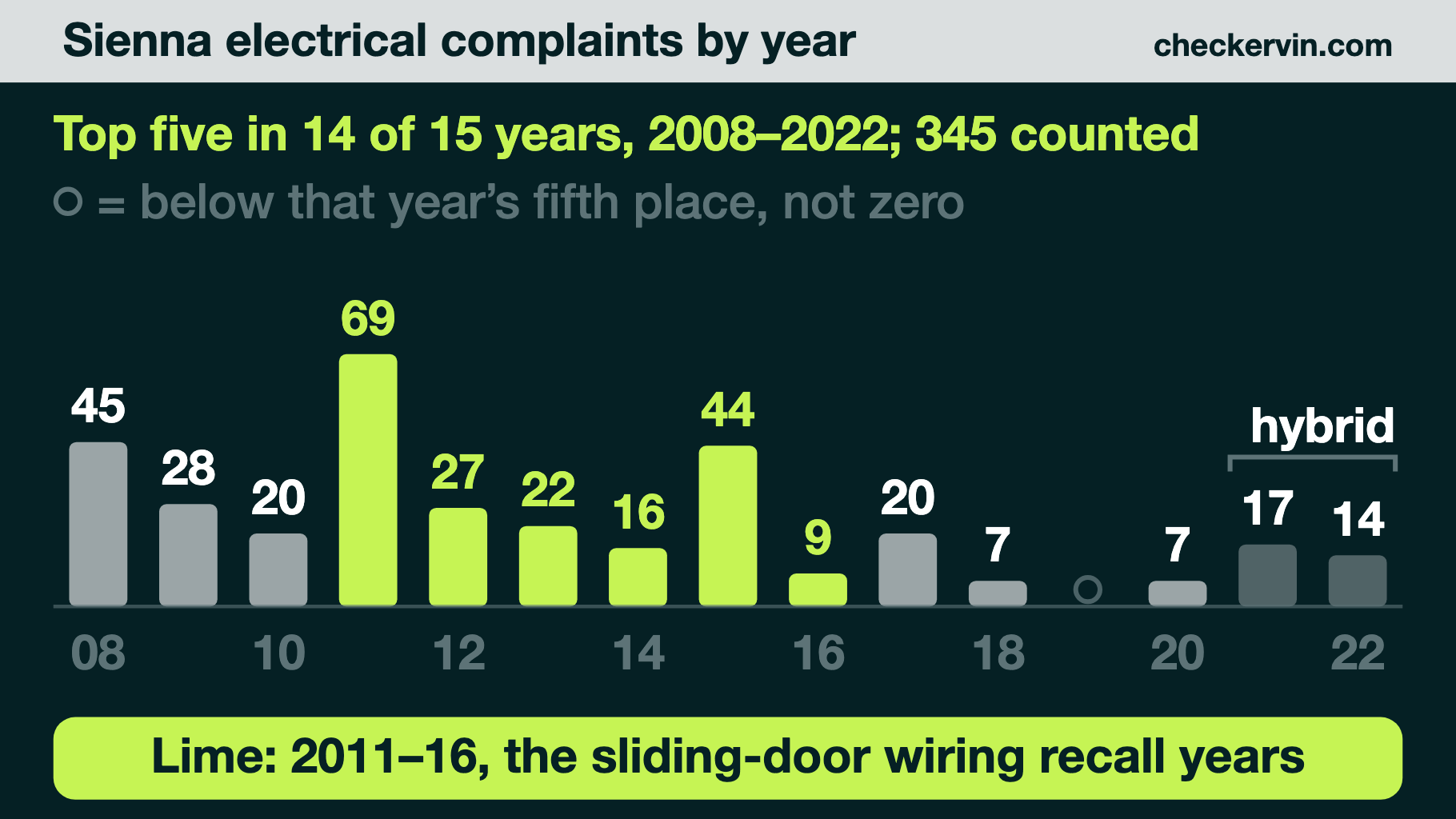
What the electrical complaints are actually about
Reading the electrical narratives year by year, the Sienna’s dominant story is the power sliding door. On the 2008–2010 vans it is door cables that snap and doors that will neither open nor close, under power or by hand. On the 2011–2016 vans it is doors that open on their own and the long wait for the recall fix. After those come locks, alarms, heated seats, lighting and gauges. The alternator turns up rarely, and when it does it is often in a list of parts an owner already replaced without curing the problem.
The handful of charging stories are still worth reading. A 2012 owner describes a battery light, a stall and two dealer alternator replacements in a few months. A 2011 owner describes a battery that drained after an alternator test came back clean and a new battery went in. A 2017 owner describes a “check charging system” message and a van that would not start. Those are reasons to take a battery light seriously and to test before replacing, not evidence that Sienna alternators fail as a pattern.
The door story has a recall behind it. Campaign 16V858 covers 2011–2016 Siennas built between January 2010 and August 2016: if a power sliding door fails to open when commanded, for example when frozen shut, it may later open unexpectedly, possibly while driving. The remedy is a new junction block and new rear sliding door wire harnesses. That is electrical work in the federal filing, and it explains why the electrical bars tower over the same years.
Recalls, checked against a known positive
We queried NHTSA’s recall database for every Sienna model year from 2008 through 2020 under the plain name and 2021–2022 under “Sienna Hybrid,” and searched the results for alternators, charging and electrical components. The search can see electrical campaigns: it returns 12V120000, a 2012 campaign filed under electrical equipment for aftermarket remote starters that could disrupt the van’s data network. It also returns the door-wiring recall above.
No campaign in those years names the alternator or the charging system, so no recall pays for this part. Sienna years do carry other campaigns, Takata airbag inflators among them, and our recall check by VIN or the Toyota recall lookupshows which are still open on a specific van. On a 2011–2016 Sienna, confirm 16V858 is closed before you worry about anything under the hood.
Test before you buy the part
Toyota’s manual for the 2009 V6 gives the pass marks for a charging test: with no load, 13.2 to 14.8 volts at 10 amps or less; with an electrical load applied, 30 amps or more. A parts store or dealer can run that check in minutes, and each step below can end the hunt before an alternator is ordered.
- Load-test the 12-volt battery after a full charge; a weak battery fails here and the alternator is cleared
- Run the charging test with the engine on and compare it with Toyota's 13.2–14.8 volt range
- Inspect the belt and listen for a chirp; on 2011–2012 V6 vans, check the clutch pulley Toyota's bulletin replaced
- If the van dies only after sitting, test for a parasitic drain; sliding door and lock faults can keep modules awake
- Look for aftermarket remote starters or wiring left by previous owners
- On a 2021+ hybrid, skip the alternator entirely and have the 12-volt battery and hybrid system checked
If the battery is the culprit, our battery size by VIN page reads the right group size from the van’s build.
What a fair Sienna alternator quote looks like
- The engine the labor time is written for, matching the VIN
- The test result that justified the part: battery, charging output or drain
- New Toyota, new aftermarket or remanufactured unit, with the warranty on each
- Core charge and whether it comes back when the old unit is returned
- Belt replacement and a tensioner check while everything is apart
- Coolant, if the shop removes the radiator as Toyota's diagram does
Judge the labor line against Toyota’s own clock. If the factory booked 2.4 hours to change only the pulley on a 2011–2012 V6 van, a full alternator job quoted at well under two hours of labor is either a shop that knows a shortcut or a price that will grow once the bumper is off. Ask which.
If you are buying the Sienna, not repairing it
A charging fault is one of the cheaper things to find on a used Sienna. Start it cold, watch for a battery or charging warning once it is running, and work both sliding doors several times, because on these vans the doors are where the electrical money usually goes. Ask whether 16V858 was done on a 2011–2016 van, and whether a 2011–2012 V6 ever had the pulley bulletin.
By total complaints, 2011 is the heaviest year in our record, at 615, and 2020 the lightest gas year, at 38. The Sienna years-to-avoid breakdown scores each year on the whole record, and the Toyota warranty check by VIN settles what coverage is left on a newer van. For a gas van you are keeping, the Sienna transmission fluid post covers the other service owners tend to put off, and the Camry alternator post shows how the same V6 compares in a sedan.
Where this information comes from
- Toyota T-SB-0055-12 (NHTSA copy) — Charging System InoperativeCovers 2011–2012 V6 Siennas; replaces the alternator clutch pulley; 2.4 hours on the Sienna versus 0.8 on the Avalon and RAV4.
- Toyota T-SB-0040-20 Rev1 (NHTSA copy) — HV and auxiliary battery maintenanceLists the 2021 Sienna Hybrid; the hybrid system charges the 12-volt battery, with no alternator involved.
- NHTSA recalls API — 2011 SiennaReturns 16V858000, the sliding door wiring recall; our 2008–2022 query found no alternator campaign.
- EPA and DOE fueleconomy.gov — 2021 Toyota model listLists only Sienna Hybrid for 2021; the same service lists the 2.7-liter four for 2011–2013 and the 8-speed V6 from 2017.
- NHTSA — recalls by VINThe official lookup for open campaigns on a specific Sienna.
- Toyota repair manual, 2009 Sienna 2GR-FE alternator components (workshop-manuals.com)The parts drawn around the alternator, from the front bumper to the radiator, plus the charging test values.
- RepairPal — 2015 Toyota Sienna repair costsThe $658–$920 alternator figure, as shown in search results on November 23, 2026.
Keep reading
Frequently asked questions
How much does it cost to replace the alternator on a Toyota Sienna?
Published estimates for gas Siennas sit between a few hundred dollars and about $950. RepairPal's 2015 Sienna page lists $658 to $920 and its 2004 page $695 to $941; AutoNation Mobile Service gives an average of $804 and about two hours; YourMechanic shows an average of $358 with $140 of labor. We read those figures in search results in November 2026 because each site refused a direct fetch. The spread is mostly labor: on the 3.5-liter V6 the alternator sits low at the front of the engine, and Toyota's own parts diagram for it starts with the front bumper.
Does the 2021 and newer Toyota Sienna have an alternator?
Not a belt-driven one. Every Sienna from the 2021 model year on is a hybrid with a 2.5-liter four-cylinder, and the federal fuel economy listing for 2021 shows only Sienna Hybrid versions. Toyota's storage bulletin that covers the 2021 Sienna Hybrid tells dealers to keep the hybrid system on for 30 minutes to charge both the hybrid battery and the 12-volt battery. A 12-volt charging fault on these vans is a hybrid-system diagnosis, not an alternator swap.
How long does a Toyota Sienna alternator last?
Toyota does not publish a life or a replacement interval for it; the alternator is not a scheduled maintenance item. The one documented early problem is Toyota's 2012 bulletin for 2011–2012 V6 Siennas built before a set VIN, which replaced the alternator's clutch pulley rather than the alternator. Beyond that, the federal complaint record names alternators rarely, so the honest answer is that it lasts until a charging test says otherwise.
What is a fair price to replace a Sienna alternator?
On a gas V6, a quote inside the $658 to $941 band RepairPal publishes for the 2004 and 2015 vans is ordinary, and AutoNation's $804 average sits in it. What makes a quote fair is what is in it: the engine the labor time is for, a test result showing the alternator failed, the unit type and warranty, and the belt. Toyota itself booked 2.4 hours on 2011–2012 Siennas just to change the alternator's pulley, so a labor line far below that on a V6 deserves a question.
What is a bad year for a Toyota Sienna?
By total federal complaints, 2011 is the heaviest year in our 2008–2022 record, at 615 complaints, led by Air Bags. Electrical complaints peak in the same year. The 2011–2016 vans share a power sliding door wiring recall, 16V858, so check that it was done on any van from those years. Our Sienna years-to-avoid page scores every model year on the whole record, not just the charging system.
Know the engine before you price the alternator
A free CheckerVIN report shows the model year, engine, factory build and open recalls for any VIN, so you know whether you are pricing a V6 front-end job, a four-cylinder, or a hybrid with no alternator at all.
Run a free VIN check