The short answer
- What does it cost?
- KBB lists $375–$787 as a general figure; a ZIP-specific 2018 RAV4 listing ran $610–$1,121. Electric pumps on 2019+ cars cost more.
- Is it really the pump?
- On a 2019–2021 RAV4, a coolant leak may be the bypass valve Toyota covers under program 24TE04, or a 2019–2020 block under recall.
- Any free fix for the pump?
- No recall replaces a RAV4 water pump, 2006–2022. Toyota’s 2020 and 2023 Tech Tips on the electric pump publish no fix.
$375–$787
KBB general RAV4 range
Parts and labor, no ZIP, Oct 2026
46%
2019–2020 share of engine reports
Counted in top fives, 2008–2022
24TE04
Toyota coolant valve program
2019–2021 RAV4, 10 yrs / 100,000 mi
0
Water pump recalls
RAV4, Hybrid and Prime, MY2006–2022
What the estimators say, and whose numbers they are
We decode VINs; we do not fix cooling systems. Every dollar figure here belongs to the company named beside it, and each was read on October 25, 2026.
| Source | What it lists for a RAV4 water pump |
|---|---|
| Kelley Blue Book, 2019 and 2021 RAV4 and 2021 RAV4 Hybrid pages | $375 to $787 including parts and labor, as a general figure; no Fair Repair Range without a ZIP code |
| Kelley Blue Book, 2018 RAV4, ZIP 31201 | $610 to $1,121 Fair Repair Range, as shown in its search listing; the live page did not reproduce it |
| Haynes repair guide | About $150 to $500, and 1 hour 30 minutes to 5 hours of work |
Read the table with two cautions. KBB’s $375 to $787 appears word for word on its pages for a gas RAV4 and a hybrid, years apart, so it behaves like a sitewide default rather than a RAV4 estimate. The same pages add that belt-driven pumps are not that expensive while electric ones can get pricey, which matters because every RAV4 from 2019 on has the electric kind. Haynes’s range is a parts-and-time guide for doing it yourself, and the engines it lists stop before the current RAV4’s.
We also tried RepairPal’s RAV4 estimator. It refused our request, and the figures that search engines showed for it did not agree with each other from one query to the next, so we print none. If you want a third number, enter your ZIP code on KBB or RepairPal yourself and compare it against the shop’s written quote.
Which water pump your RAV4 has
Between 2008 and 2022 the RAV4 changed engines three times, and the pump changed with the last change. The model year narrows it down; the VIN settles it.
| Model years and engine | Pump type and what Toyota has said about it |
|---|---|
| 2006–2008, 2.4L four (2AZ-FE) | Conventional pump; these are the years of Toyota’s ZE7 oil consumption program |
| 2006–2012, 3.5L V6 (2GR-FE) | Conventional pump on the same engine family as the Camry V6; dropped from the RAV4 for 2013 |
| 2009–2018, 2.5L four (2AR-FE) | Conventional pump, covered by Toyota’s non-electric pump leak bulletin T-SB-0103-20 |
| 2019–2022, 2.5L four (A25A-FKS) and hybrid (A25A-FXS) | Electric pump, named in Toyota Tech Tips T-TT-0614-20 and T-TT-0733-23 |
If you already read our Camry water pump costpost, most of the hardware is familiar: the RAV4 shares the 2AZ, 2AR, 2GR and A25A engines with it. What differs is the RAV4’s timing. Its electric pump arrived a year later, in 2019, and its heaviest complaint years line up with a coolant valve program and a block recall that the Camry carries too but that weigh far more on the RAV4’s record. Our engine size by VIN lookup reads the engine from the factory record, and the Toyota VIN decoder adds trim and plant.
2008–2018: the conventional pump, and Toyota’s seep test
Every RAV4 engine before 2019 runs a conventional water pump, the kind Toyota’s service bulletin T-SB-0103-20 calls non-electric. That bulletin, revised in June 2024 and covering the 2008 to 2024 RAV4 and 2016 to 2024 RAV4 Hybrid, is the most useful single document for an owner looking at a crusty pump, because it says when not to replace one.
Toyota explains that the pump’s shaft seal is meant to let a small amount of coolant through to cool and lubricate itself, and that coolant evaporates through a port. Debris caught in the seal can open a brief gap and let coolant out of the weep hole, and Toyota calls that a temporary leak that clears on its own. Its rule is plain: dry coolant residue, do not replace the pump; wet residue or drips, replace it. The test it gives dealers is a dry paper towel pressed against the deposits. If the towel comes away wet, the leak is active.
The bulletin also lists the other reasons a pump does need replacing: coolant below the low mark with the pump visibly leaking, and a pulley bearing with excess play or rough rotation. Anything else leaking in the cooling system is to be found and fixed first. For the V6 years, the labor picture is the one our Camry post lays out from Toyota’s manual: a buried pump on a transverse 3.5-liter, which is why a V6 RAV4 sits at the top of any range. The four-cylinder cars are the cheap end.
The 2008 RAV4 carries one more piece of history. Toyota’s ZE7 warranty enhancement covered excessive oil consumption on certain 2006–2008 RAV4s with the 2AZ engine, with secondary coverage of 10 years from first use or 150,000 miles. That window has closed on every 2008 car, and it never covered the pump, but it explains the engine complaints for that year, covered below.
2019 and later: an electric pump with no published fix
The 2019 redesign brought the 2.5-liter A25A engine and a water pump driven electrically rather than by the accessory belt. Toyota’s clearest statement of that is not a brochure but a dealer Tech Tip. T-TT-0614-20, dated May 28, 2020, covers 2020 RAV4 and RAV4 Hybrid models with the A25A-FKS or A25A-FXS engine that may light the check-engine lamp with codes P26CB71, P26CA14 or P26CA31, or leak coolant from the electric water pump body or its electrical connector.
The bulletin offers no repair. It says the issue is under investigation and tells technicians to call Toyota’s Technical Assistance line before working on the car. A second Tech Tip, T-TT-0733-23 from April 2023, repeats the pattern for 2022 to 2024 RAV4 and RAV4 Hybrid models: a leak from the engine water pump, or a check-engine light with P26CA14 (pump circuit short or open) or P26CA31 (pump no signal), and an instruction to photograph the pump and connectors and contact Technical Assistance first.
For an owner, that has two consequences. First, a pump code on a RAV4 still within Toyota’s warranty is a dealer visit, not a parts order; our Toyota warranty check by VINexplains how to find the in-service date that starts the clock. Second, out of warranty, the electric pump is the expensive end of the job: KBB’s own caution about electric pumps applies to every RAV4 from 2019. Unlike the Camry’s 2018 pump code, nothing in NHTSA’s file of Toyota communications for the 2008–2022 RAV4 fixes P26CB71 with a software update, so do not assume one exists.
The valve that looks like a pump leak
On a 2019–2021 RAV4 the most likely source of a small coolant drip near the front of the engine may not be the pump at all. Toyota’s Customer Support Program 24TE04, announced to dealers on December 5, 2024, covers a flow shut-off valve that can leak a small amount of coolant onto other parts of the car. Toyota says the drip can bring up an Engine Maintenance Required message or stop the air conditioning from working normally. The replacement part is listed as a water by-pass hose assembly, and owners often call it the coolant bypass valve.
| 24TE04 term | What Toyota’s dealer letter says |
|---|---|
| Covered RAV4s | Certain 2019–2021 RAV4 and RAV4 Hybrid built early March 2018 to early February 2021, plus certain 2021 RAV4 Prime |
| Coverage | Until November 30, 2025 regardless of mileage, then 10 years from first use or 100,000 miles |
| Labor Toyota allows | 1.4 hours on a gas RAV4, 1.5 hours on a Hybrid or Prime |
| Codes | P268111 or P268115 with Engine Maintenance Required, per bulletin T-SB-0112-24 |
| Later owners | Coverage transfers; the program counts as emission related, so branded titles qualify |
Two details are worth carrying into a service lane. Toyota counts about 925,000 RAV4s in the program, so this is not a rare part. And the program only pays once the condition is verified, which means a dealer has to find the leak. If an independent shop has already quoted you a water pump on a 2019–2021 RAV4 with coolant on the front of the engine, ask it to rule out the bypass valve first, and if you paid for this repair before Toyota’s owner letter reached you, that letter describes a reimbursement route. Our TSB vs recall explainer covers how a support program differs from a recall.
The coverage runs out on mileage before age for most cars. A complaint we read from a 2020 owner was turned down just past 100,000 miles, and a 2019 narrative describes the same refusal. If your RAV4 is close to that mark, get it diagnosed now.
RAV4 Hybrid and Prime: the same engine pump, plus more
The 2019-and-later RAV4 Hybrid uses the A25A-FXS, and Toyota’s 2020 and 2023 Tech Tips name it alongside the gas car, so its engine pump is electric as well. It is also in program 24TE04, with its own part number and a slightly longer labor allowance. The 2021 RAV4 Prime appears in that program too, though Toyota counts very few Primes in it.
A hybrid also cools its power electronics on a separate loop with its own pump, which is a different part in a different place. We could not confirm from a Toyota document which engine pump the 2016–2018 RAV4 Hybrid uses, beyond its inclusion in the non-electric pump bulletin’s list. The practical rule: a hybrid quote should name the pump it replaces and give the part number.
What the ENGINE count holds, and what it does not
NHTSA’s complaint file has no water pump category. A pump complaint is filed under the engine and cooling heading along with oil burning, stalls, cracked blocks and leaking valves. So the count below is an upper bound on pump trouble and mostly a measure of something else.
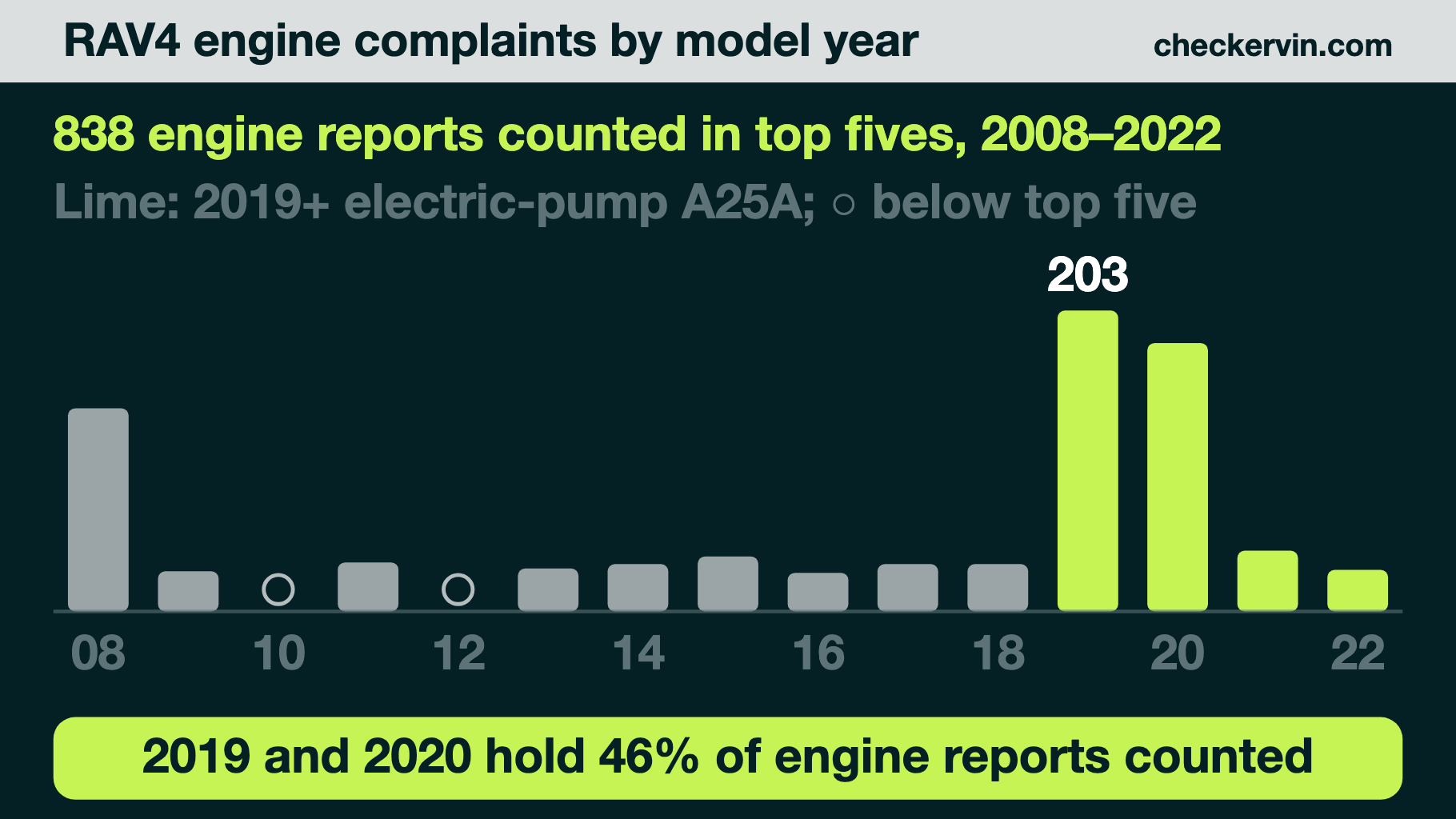
Our corpus holds 5,738 complaints against the 2008–2022RAV4. The engine category makes a model year’s five most-reported components in 13 of 15 years, and those years give a counted minimum of 838 engine reports. That is 17.5% of all top-five reports and ranks 2 of 14 categories, behind electrical system at 908. In 2010 and 2012 the category drops below fifth place, which never exceeds 34 reports (in 2010); it is not zero there.
The shape has three parts. The single 2AZ year, 2008, holds 137 reports (16% of the counted total, and 24% of that year’s complaints), and the engine narratives we read for it are mostly about oil consumption, the ZE7 problem, with a handful about noisy or leaking pumps. The ten years from 2009 to 2018 contribute only 248, never more than 37 in a year. Then the A25A years from 2019 add 453, 54% of the total, and 384 of them sit in 2019 and 2020. The peak is 2019, with 203 engine reports, 23% of that year’s complaints.
Reading those 2019 and 2020 narratives, coolant is the dominant theme: low-coolant warnings, bypass valve failures, block leaks, and a smaller set naming the electric pump and code P26CB. That fits the documents rather than any pump-specific defect, and it is why a RAV4 owner from those years has more free options than most. Our Toyota RAV4 years-to-avoid breakdown scores every year on its whole record.
The block recall, and none for the pump
A recall is the only route that would replace a pump free regardless of age or mileage, so it deserved a real check. On October 25, 2026 we queried NHTSA’s recall API for the RAV4 in every year from 2006 through 2022, and for the RAV4 Hybrid and RAV4 Prime from 2019, and read every summary. None names a water pump.
The same pass does return one cooling campaign, which shows the query could find one. Campaign 20V064000 covers certain 2019–2020 RAV4 and RAV4 Hybrid models with 2.5-liter engines whose castings may have porosity that cracks and lets coolant leak internally or externally. NHTSA’s summary warns of overheating and a stall on gas cars. Dealers inspect and replace the engine, block included, as necessary, free of charge.
So on a 2019 or 2020 RAV4 there are two free coolant-leak repairs to rule out before you pay for a pump: the block recall and the 24TE04 valve. Our Toyota recalls by VIN page runs the open-recall check, and buying a car with an open recall covers what to do if one turns up on a car you are shopping.
Confirm it is the pump before you pay for one
A puddle of pink coolant under a RAV4 can come from the pump, a hose, the radiator, the reservoir cap, the bypass valve or, on 2019–2020 cars, a recalled block. A good shop proves the source before it orders anything.
- On a 2019–2020 RAV4, the VIN checked for recall 20V064000 first.
- On a 2019–2021 RAV4, the bypass valve inspected and codes P268111 or P268115 checked against program 24TE04.
- On a 2019 or later RAV4, any P26CB71, P26CA14 or P26CA31 code read out and quoted on the work order.
- On a 2008–2018 RAV4, wet coolant at the pump’s weep area, not just dry residue, per Toyota’s towel test.
- A pressure test of the cooling system, and the pulley bearing checked for play with the belt off.
A dried trace of coolant on an older pump is normal by Toyota’s own account. An active drip, a reservoir that keeps falling or a rough bearing is not. Topping up with the right fluid matters while you wait; our coolant type by VIN page matches the Toyota coolant to the car.
Reading a RAV4 water pump quote
Two RAV4 quotes usually differ on what they include, so line them up item by item.
- Does the quote name the engine, and is the part an electric pump (2019 on) or a conventional one?
- Is the pump Toyota or Aisin original equipment, or aftermarket, and what warranty comes with it?
- Is Toyota-specification coolant included, and how much?
- On a 2019–2021 car, has the shop ruled out the bypass valve Toyota covers?
- On a V6, how many labor hours, and how does the shop plan to reach the pump?
Toyota’s own allowance for the 24TE04 valve, 1.4 hours on a gas RAV4, is a useful yardstick for that repair. If a shop quotes much more time to replace the same valve, ask why.
If you are shopping a used RAV4
A receipt for a recent pump on a 2008–2018 RAV4 past 100,000 miles is worth a few hundred dollars to you, more on a V6. On a 2019–2021 car, the documents to ask for are different: proof that recall 20V064000 is closed if it is a 2019 or 2020, and any record of a 24TE04 valve repair. Program coverage follows the car, so check the mileage against the 100,000-mile limit.
Our 2014 Toyota RAV4 recordcollects one 2.5-liter year’s complaints and recalls in one place, and the free check below covers the rest.
Where this information comes from
- Toyota Customer Support Program 24TE04 — dealer letter and FAQ (NHTSA-hosted)RAV4 build dates, 925,210 vehicles, 10-year/100,000-mile coverage, 1.4-hour labor allowance.
- Toyota Tech Tip T-TT-0614-20 — A25A MIL ON and/or coolant leak from water pump (NHTSA-hosted)Names the electric water pump on the 2020 RAV4 and RAV4 HV and codes P26CB71, P26CA14, P26CA31.
- Toyota Tech Tip T-TT-0733-23 — 2022–2024 A25A pump leak, P26CA14, P26CA31 (NHTSA-hosted)Extends the electric-pump leak pattern to 2022–2024 RAV4 and RAV4 HV.
- Toyota T-SB-0103-20 Rev1 — water pump leak inspection and diagnostic tips (NHTSA-hosted)Toyota’s dry-residue versus active-leak rule and paper towel test for non-electric pumps.
- Toyota T-SB-0112-24 Rev2 — Engine Maintenance Required, P268111/P268115 (NHTSA-hosted)The repair procedure behind program 24TE04, with the RAV4 bypass hose part numbers.
- NHTSA — recalls API, 2019 RAV4Returns 20V064000, the 2.5-liter block porosity coolant-leak campaign. Queried 2006–2022 on October 25, 2026.
- Toyota Warranty Enhancement Program ZE7 memo (NHTSA-hosted)Lists certain 2006–2008 RAV4s with the 2AZ engine for excessive oil consumption.
- NHTSA — recall lookup by VINRun your own car; campaigns are added after our snapshot. Also the source of the complaint records computed above.
- Toyota Canada — 2009 RAV4 releaseConfirms the 2.5-liter four replaced the 2.4 for 2009 and the 3.5-liter V6 continued.
- Kelley Blue Book — RAV4 water pump replacementThe general $375–$787 figure and the note on electric pumps, retrieved October 25, 2026.
- Haynes — change the water pump, Toyota RAV4The 1.5-to-5-hour and $150–$500 do-it-yourself ranges, retrieved October 25, 2026.
Keep reading
Frequently asked questions
How much does it cost to replace a water pump on a Toyota RAV4?
Kelley Blue Book's RAV4 water pump pages, read on October 25, 2026, give a general $375 to $787 including parts and labor when no ZIP code is entered, and note that electric pumps can cost more. A search-served KBB listing for a 2018 RAV4 near Macon, Georgia showed $610 to $1,121. Haynes puts the job at roughly $150 to $500 in parts for a do-it-yourselfer. Those are their figures, not ours, and none of them separates the 2019-and-later electric pump from the older belt-driven one.
Does the Toyota RAV4 have an electric water pump?
The 2019-and-later RAV4 does. Toyota Tech Tip T-TT-0614-20 describes coolant leaking from the electric water pump body or its electrical connector on 2020 RAV4 and RAV4 Hybrid models with the A25A-FKS and A25A-FXS engines, and a 2023 Tech Tip covers 2022 to 2024 RAV4s with pump codes P26CA14 and P26CA31. RAV4s from 2008 through 2018 use a conventional, non-electric pump.
Is there a recall or warranty extension for RAV4 water pumps?
Not for the pump. NHTSA's recall API, queried October 25, 2026 for every RAV4, RAV4 Hybrid and RAV4 Prime year from 2006 through 2022, returns no campaign that names a water pump. Two nearby repairs are free, though: recall 20V064000 inspects and replaces 2019-2020 RAV4 2.5-liter engines whose blocks can leak coolant, and Toyota Customer Support Program 24TE04 replaces a leaking flow shut-off valve on certain 2019-2021 RAV4s for 10 years or 100,000 miles from first use.
What is the RAV4 coolant bypass valve problem?
Toyota calls the part a flow shut-off valve and sells it as a water by-pass hose assembly. On certain 2019-2021 RAV4 and RAV4 Hybrid models it can leak a small amount of coolant onto other parts, which can bring up an Engine Maintenance Required message, codes P268111 or P268115, or an A/C that stops working normally. Customer Support Program 24TE04 covers the repair at a Toyota dealer for 10 years from first use or 100,000 miles, whichever comes first, and the coverage transfers to later owners.
How do I know if my RAV4 water pump is failing?
On a 2008-2018 RAV4, Toyota's own bulletin T-SB-0103-20 separates dry coolant residue at the pump, which it says does not need a new pump, from wet residue or drips, which does. Press a dry paper towel against the deposits: wet means an active leak. A rough or loose pulley bearing also calls for a pump. On a 2019-or-later RAV4, a check-engine light with P26CB71, P26CA14 or P26CA31 points at the electric pump circuit, while P268111 or P268115 points at the bypass valve instead.
Check the free repairs first
A free CheckerVIN report shows the factory engine, specifications and open recalls for any VIN, so you know which pump your RAV4 has and whether a recall covers the leak.
Run a free VIN check