The short answer
- What does it cost?
- For a 2016–2018 car, $2,549 aftermarket (Best Hybrid Batteries) to a $3,541.14 MSRP for Toyota's own pack, before labor. Retrieved October 2026.
- Which pack do I need?
- 2016–2018 is NiMH. On 2019–2021 cars Toyota's bulletin ties chemistry to the VIN: W in position five for NiMH, 6 for lithium-ion.
- What about the RAV4 Prime?
- An 18.1 kWh plug-in pack, a different part entirely. We found no verifiable price; get a dealer quote and check the 10-year coverage first.
$2,549
Aftermarket 2016–2018 pack
Best Hybrid Batteries, Oct 2026, install extra
$3,541
Toyota part MSRP, 2016–2018
G9510-48082 on dealer parts sites, plus $1,350 core
18.9%
Electrical share of RAV4 top-five reports
2008–2022, gas and hybrid pooled
3
Gas-only years led by electrical
Before the hybrid arrived for 2016
The prices, and whose they are
We sell VIN checks, not batteries, so every figure in this table belongs to the seller or publisher named next to it. All were read on October 25, 2026. Most of them price the 2016–2018 RAV4 Hybrid, because that is the generation the aftermarket has caught up with; the 2019-and-later car is thinner on published prices, and the Prime has none we could verify.
| Source and what it sells | What it lists |
|---|---|
| Best Hybrid Batteries — 2016–2018 pack | $2,549 (it shows $4,849 as MSRP); 3-year unlimited-mileage warranty, 6-year option for $765 more; scheduled install typically $300–$400, not included |
| Toyota part G9510-48082 — 2016–2018 pack | $3,541.14 MSRP on dealer parts sites, sold at $2,825.83 (North Park Toyota) and $2,974.56 (AutoNation Toyota South Austin); $1,350 core charge |
| Greentec Auto — remanufactured | $2,000–$2,850, with about $2,850 shown for each of 2016, 2017 and 2018; labor typically $500–$1,000 |
| Greentec Auto — new from Toyota | $3,000–$9,000, a range the same article caps at $5,000 in its FAQ |
| SlashGear, October 2026 | $3,000–$8,000 for a new pack, $1,500–$3,500 used |
The narrow, checkable numbers are the first two rows, and they are both parts prices for the same car. Toyota’s own pack lists about a thousand dollars over the aftermarket one before any discount, and dealer parts sites knock several hundred off that. The core charge is refunded when the old pack goes back, so it is a deposit rather than a cost, but it is real cash on the day if a shop does not handle the return. Add an hour or two of labor and an out-of-warranty 2016–2018 car lands near $3,000 either way. The wide ranges in the last two rows are summaries, not quotes, and the $9,000 top end almost certainly includes dealer labor on newer cars.
What we could not verify: a RepairPal estimate for the RAV4 Hybrid (its page refused our fetch and no figure surfaced elsewhere), a factory part number and price for the 2019-and-later pack, and any price at all for a RAV4 Prime pack. One page we found names a 2019-and-later part number; we could not confirm it against a Toyota catalog, so it is not on this page.
Three RAV4s with a big battery, three different parts
The RAV4 Hybrid arrived for the 2016model year as part of the fourth-generation RAV4’s refresh. MotorWeek’s first drive called it the big news of that update and described a nickel-metal hydride pack feeding front and rear electric motors, 194 horsepower combined. That pack is the one the table above mostly prices, and it fits 2016, 2017 and 2018 cars.
The 2019 redesign moved to an all-new platform and a new pack. Green Car Journal’s drive of the 2019 RAV4 Hybrid placed a nickel-metal hydride pack beneath the rear seat, smaller than the one before it. But that is not the whole story for the generation, and the next section is the reason a 2019-or-later order needs more care than the trim badge suggests.
The third car is the RAV4 Prime, sold from the 2021 model year. It is a plug-in hybrid with, per MotorWeek, an 18.1 kWh lithium-ion pack under the rear load floor, 42 miles of electric driving and 302 horsepower. It looks like a RAV4 Hybrid in a parking lot and shares the badge on the tailgate, which is exactly why owners searching this phrase can end up comparing a Prime quote against a Hybrid price.
The fifth VIN character can name the chemistry
Toyota’s service bulletin T-SB-0026-22, issued March 2022 and hosted by NHTSA, is about a wiring fault rather than the battery. Its production-change table, though, does something no price page does: it lists 2019–2021 RAV4 Hybrid builds by battery type, and the two types carry different VIN patterns. NiMH cars run “…WRFV…” through positions five to eight, and lithium-ion cars run “…6RFV…”. The table shows both chemistries coming out of the same plants in the same years.
So for a 2019–2021 RAV4 Hybrid, the fifth character of the VIN is the first thing to read before ordering a pack: a W points to nickel-metal hydride, a 6 to lithium-ion. That is our reading of Toyota’s table, not a rule Toyota publishes for buyers, and the bulletin does not cover 2022-and-later cars, so treat it as a strong hint to confirm with a dealer rather than a final answer. A Toyota VIN decode confirms the model year and drivetrain from the factory record; a dealer parts counter can confirm the pack part number against the full VIN.
The RAV4 Prime is a different purchase
An 18.1 kWh pack is a different class of part from the hybrid pack, which exists to capture braking energy and assist the engine rather than drive the car on its own for 40 miles. That size gap is why Prime figures and Hybrid figures should never sit in the same comparison. The only Prime-specific replacement range we found came from a low-quality page with no source behind it, so we are not repeating it.
The practical answer is that almost no Prime owner should be paying for a pack in 2026. The oldest Prime is a 2021, and Toyota raised hybrid battery coverage to 10 years or 150,000 miles from the 2020 model year, so a Prime outside that term on age does not exist yet; mileage is the only way out. The Prime has had its own hybrid-system recalls, covered below, and it was added in 2024 to the harness program in the section after next. None of them is a pack replacement.
The warranty clock, briefly
Toyota’s coverage change is the same one that applies to every Toyota hybrid, and our Camry Hybrid battery cost post walks through it with the sources. For a RAV4 it sorts like this, read against 2026and the first owner’s in-service date rather than the model year.
| RAV4 years | Pack coverage in 2026 |
|---|---|
| 2016–2018 Hybrid | 8 years / 100,000 miles. Even a late-sold 2018 is about 8 years old, so these cars are out unless a CARB-state term still runs. |
| 2019 Hybrid | 8 years / 100,000 miles. A 2019 delivered in 2019 can stay covered into 2027 if the odometer allows. |
| 2020 and newer Hybrid | 10 years / 150,000 miles on the pack, so a 2020 car is covered toward 2030. Toyota's 2024 RAV4 Hybrid warranty guide lists the same term. |
| 2021 and newer Prime | Inside the 10-year term on age; confirm the term in the car's own warranty booklet. |
The 2019/2020 line is where the money sits on a used RAV4. Same body, same powertrain, and one of them may have six more years of pack coverage than the other. Our Toyota warranty check by VIN page explains how to get the in-service date that starts the clock.
When the hybrid warning is a cable, not a battery
The same March 2022 bulletin explains a fault that looks like pack trouble to an owner. Some 2019–2021 RAV4 Hybrids light the check-engine lamp with codes P0AA649 or P1C8049, both describing a hybrid battery voltage isolation fault, and Toyota traces it to corrosion at a high-voltage connector under the car, at the rear motor generator. AM radio static is the other symptom it lists.
Toyota then turned that into Customer Support Program 22TE09, first published December 2022. It covers the floor wire harness and rear traction motor cable on 2019–2022 RAV4 Hybrids with all-wheel drive for 8 years or 100,000 miles, at a Toyota dealer, when the corrosion meets Toyota’s inspection criteria. Its letter says the corrosion can leave the car unable to start. A 2024 update added the 2021–2022 RAV4 Prime. This is not a recall, so it will not show up on a recall search; it is a coverage extension the dealer applies when the condition is found.
The 2020 complaint narratives in the federal file show the pattern in owners’ own words: a “hybrid system malfunction” warning, a dealer inspection, and a corroded floor harness rather than a failed pack. If a shop quotes a pack for a 2019–2022 AWD car with an isolation code, ask whether the harness was inspected first.
What the RAV4 complaint file can and cannot say
Our corpus holds 5,738 NHTSA complaints against the 2008–2022RAV4. Gas and hybrid cars share the nameplate, and the file does not separate them, so nothing in it is a count of hybrid packs. Each model year keeps its five most-reported components; a category missing from a year is below that year’s fifth, not absent.
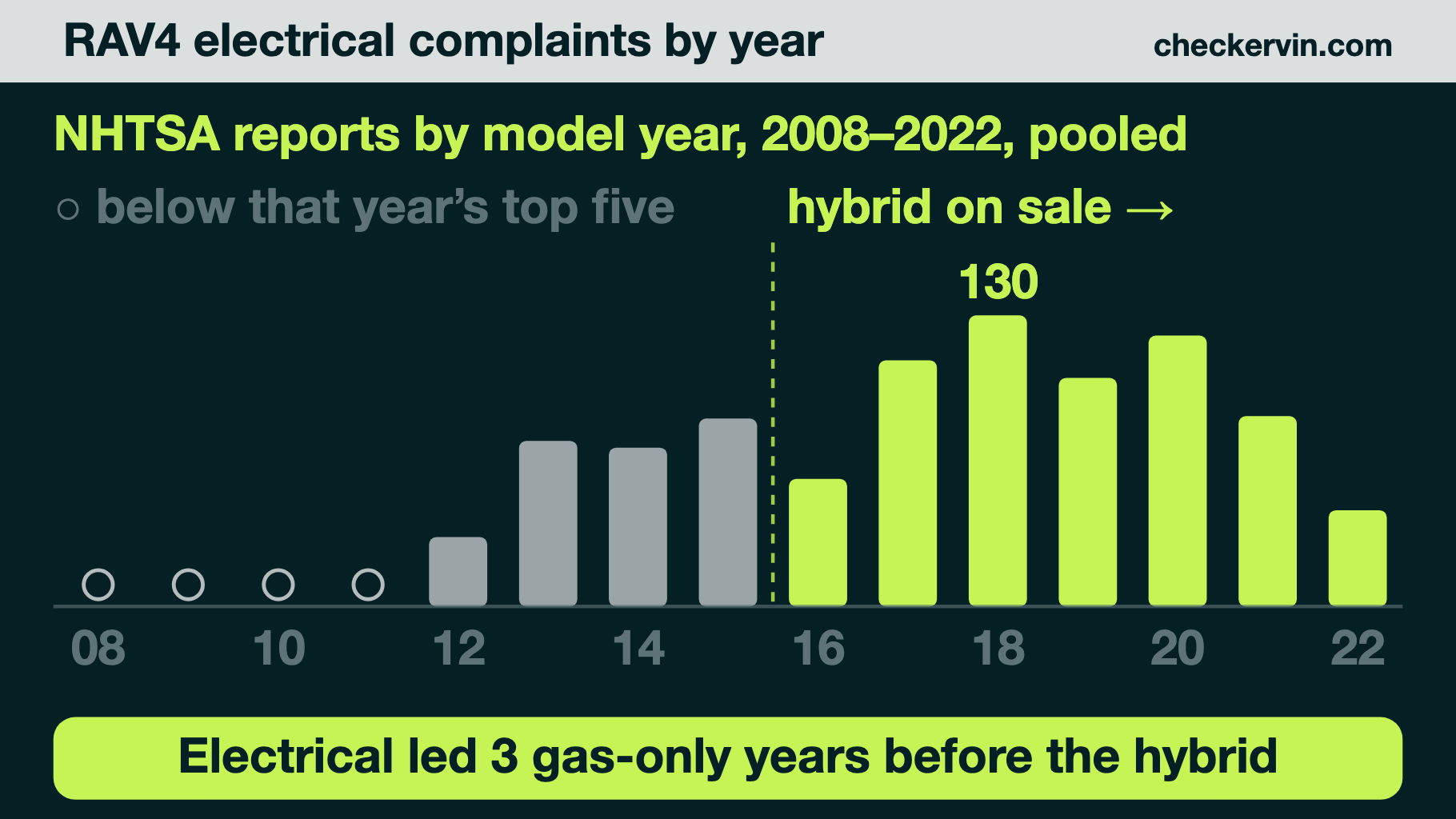
Within those top fives, the electrical system accounts for at least 908 of 4,792 counted reports, or 18.9%, and it appears in 11 of 15 model years. Its peak is 2018, with 130 reports. On the Camry, the same pooling buried the hybrid signal; on the RAV4 the pooled file runs the other way. The all-hybrid Prius, over the same span, puts 10.6% of its counted reports on the electrical system, with the category present in 15 of 15 years. The RAV4 share is about 1.8times that, which would be a striking hybrid finding if the RAV4’s electrical complaints had started with the hybrid. They did not.
One other category is worth naming because it is genuinely hybrid-adjacent. In 2019 the top component is fuel/propulsion system, with 265reports. That year carries a low-pressure fuel pump recall (20V682) for the RAV4, and 2019–2020 RAV4 Hybrid owners sued over a fuel tank that, they alleged, would not take its rated capacity; CarComplaints.com’s coverage cites a November 2019 Toyota bulletin calling a fuel gauge concern “under investigation.” Neither has anything to do with the traction battery.
The electrical signal arrived before the hybrid did
The RAV4 gives this record a natural control that the Camry and Prius do not: eight model years, 2008–2015, in which no RAV4 sold here had a hybrid pack. In 2008, 2009, 2010, 2011 the electrical system never reaches the top five. From 2012 it does, every year, and it is the most-reported component in 2013, 2014, 2015, all gas-only. Across 2012–2015 it is 30.3% of counted reports; across the hybrid-era years 2016–2022 it is 23.7%, and it leads 2016, 2017, 2018, 2022.
So the share did not jump when the pack arrived. Whatever drives RAV4 electrical complaints was already in the gas car. Reading the narratives filed under the electrical system for 2015 and 2018, the subject that keeps recurring is engine-compartment smoke or fire, often described near the 12-volt battery, and the fire-flagged complaints in our data rise with it: 98 across 2012–2015 against 30 across 2008–2011. Toyota later recalled 2013–2018 RAV4s (23V734) because some replacement 12-volt batteries do not sit properly in the tray and can short against the hold-down. We cannot tie individual complaints to that recall, and we do not claim to; the point is that none of it concerns a hybrid pack.
The 2020 narratives shift to a different 12-volt story: new RAV4 Hybrids that will not start after sitting two to four days. Our Toyota RAV4 years-to-avoid breakdown scores each model year on its whole record, which is the right use of this file.
Recalls, checked against a known positive
A recall is the one route to a free pack regardless of age or mileage, so it was worth a real check. On October 25, 2026 we queried NHTSA’s recall API for the “RAV4,” “RAV4 Hybrid” and “RAV4 Prime” models for every year from 2012 through 2024. No campaign replaces a traction battery.
An empty result only counts if the query can see a hit. It can: the same query for the 2012 Prius returns two hybrid propulsion campaigns, and the 2021 RAV4 Prime returns two of its own. One, 23V041, updates hybrid control software that could shut the system down under hard acceleration in EV mode in cold weather. The other, 23V478, replaces a DC-DC converter on 2021–2022 Primes that could short-circuit and overheat; until the fix, Toyota advised owners not to charge below 41°F. Both are hybrid-system campaigns and neither touches the pack. The 2016–2018 hybrids’ campaigns sit under the plain “RAV4” model, which is where the 12-volt tray recall appears.
Campaigns get added over time, so run your own VIN rather than trusting our snapshot. Our Toyota recalls by VIN page shows how, and buying a car with an open recall covers what to do when one turns up open on a car you are negotiating for.
The battery that strands most owners costs a tenth as much
Every RAV4 Hybrid and Prime also carries an ordinary 12-volt battery that wakes the computers and closes the high-voltage relays. When it is flat the car will not go into ready mode, and that looks like a dead hybrid system. Search results blur the two: Kelley Blue Book’s “battery replacement” page for the 2017 RAV4 Hybrid shows no pricing data for the pack and a $45–$250 range for a car battery in its FAQ. Honda owners hit the same confusion, and our CR-V Hybrid battery cost post found it on that SERP too.
- Test the 12-volt first. If it fails, our battery size by VIN page matches the group size.
- On a 2019–2022 AWD hybrid with an isolation code, ask whether the floor harness was inspected under 22TE09.
- Read the fifth VIN character on a 2019–2021 car and get the chemistry written on the quote.
- Ask whether the price includes labor, and whether a core charge applies if the shop does not return the old pack.
- Divide each pack price by its warranty months; a $2,549 pack with three years and a cheaper one with one year are not the same deal.
For the first item, use our battery size by VIN page; it is a purchase measured in hundreds, not thousands.
If you are shopping a used RAV4 Hybrid
The model year matters more than the mileage for pack risk. A 2020-or-newer Hybrid, or any Prime, bought in 2026can carry years of pack coverage that the asking price rarely reflects. A 2016–2018 car has aged out nationally, so budget the aftermarket price from the table plus an hour or two of labor as a known possible cost. A 2019 sits in between and depends on its in-service date.
Then check the rest of the car on its own terms. A free decode returns the build and open recalls; it does not test pack health, and a CheckerVIN report does not include accident, title or odometer history. For those, a pre-purchase inspection at a shop that can read hybrid battery data, plus the free federal and insurance databases, are the honest routes.
Where this information comes from
- Toyota T-SB-0026-22, hosted by NHTSA2019–2021 RAV4 Hybrid isolation codes and harness corrosion; its production table lists NiMH and lithium-ion builds by VIN.
- Toyota Customer Support Program 22TE09, hosted by NHTSA8-year/100,000-mile coverage for the floor harness on 2019–2022 AWD RAV4 Hybrids; the 2024 update adds the 2021–2022 Prime.
- NHTSA recalls API, 2021 RAV4 PrimeReturns 23V041 and 23V478, the hybrid-system campaigns described above; neither replaces the pack.
- NHTSA recalls API, 2012 Prius (known positive)Returns two hybrid propulsion campaigns, showing the query finds such recalls when they exist.
- NHTSA recalls API, 2015 RAV4Includes 23V734, the 2013–2018 12-volt battery tray recall.
- NHTSA recall lookup by VINRun your own car; campaigns are added after our snapshot. Also the source of the complaint records computed above.
- Best Hybrid Batteries, RAV4 2016–2018 packThe $2,549 price, warranty options and install estimate quoted above, retrieved October 25, 2026.
- North Park Toyota parts, G9510-48082The $3,541.14 MSRP, $2,825.83 sale price and $1,350 core charge, as listed October 25, 2026.
- Greentec Auto, RAV4 Hybrid replacement costRemanufactured, new and labor ranges quoted above, retrieved October 25, 2026.
- MotorWeek, 2021 RAV4 PrimeThe 18.1 kWh lithium-ion pack, 42-mile electric range and 302 horsepower.
- Green Car Journal, 2019 RAV4 HybridThe redesigned car's nickel-metal hydride pack beneath the rear seat.
Keep reading
Frequently asked questions
How much does a Toyota RAV4 Hybrid battery replacement cost?
For the 2016-2018 RAV4 Hybrid, Best Hybrid Batteries lists an aftermarket pack at $2,549 plus typically $300-$400 for a scheduled install, and Toyota dealer parts sites list the factory pack (G9510-48082) at a $3,541.14 MSRP, with a $1,350 core charge if the old pack is not returned. Greentec Auto puts remanufactured RAV4 packs at $2,000-$2,850 and labor at $500-$1,000. Those are their figures, retrieved October 2026, not ours. A RAV4 Prime pack is a different, much larger part and is not covered by any of them.
Does my RAV4 Hybrid have a lithium-ion or nickel-metal hydride battery?
For 2016-2018, nickel-metal hydride. For 2019 and later it depends on the build: Toyota's service bulletin T-SB-0026-22 lists both NiMH and lithium-ion RAV4 Hybrid production for 2019-2021, and its VIN table puts a W in the fifth position on NiMH cars and a 6 on lithium-ion cars. Read the fifth character of your VIN, then confirm with a dealer before ordering, because the packs do not interchange.
How much is a RAV4 Prime battery?
We could not find a verifiable price. The Prime carries an 18.1 kWh lithium-ion plug-in pack, per MotorWeek, which is a different part from any RAV4 Hybrid pack, and no aftermarket seller we checked lists one. Get a written dealer quote, and check the in-service date first: Toyota's hybrid battery coverage from the 2020 model year runs 10 years or 150,000 miles, so every Prime is still young enough to be inside it on age.
My RAV4 Hybrid says check hybrid system. Is the battery dead?
Not necessarily. On 2019-2022 AWD RAV4 Hybrids, Toyota's Customer Support Program 22TE09 covers corrosion at the high-voltage floor wire harness and rear traction motor cable for 8 years or 100,000 miles, and its bulletin says that corrosion can stop the car starting. A dead 12-volt battery also stops a hybrid from entering ready mode. Have both ruled out before anyone prices a pack.
Do RAV4 Hybrid batteries fail often?
The federal complaint file cannot say. Our corpus files gas and hybrid RAV4s under one nameplate, and its electrical complaints began in gas-only years: the category entered the RAV4's top five in 2012 and led 3 model years before the hybrid went on sale for 2016. Reading the hybrid-era narratives, the recurring subject is the 12-volt battery going flat, not the traction pack.
Know which RAV4 you have before you price a pack
A free CheckerVIN report shows the factory build, specifications and open recalls for any VIN, so the pack you order matches the car in your driveway.
Run a free VIN check