The short answer
- What does it cost?
- Estimator averages run $353 (YourMechanic) to $558 (AutoNation). Toyota’s 2019 RAV4 alternators list at $435.62 to $527.27, part only.
- Is it really the alternator?
- Test first. On a 2013–2018 RAV4, recall 23V-734 covers a battery that can short against its hold-down bracket and stall the engine. It is free at a Toyota dealer.
- Hybrid or Prime?
- Toyota describes the 12-volt battery on these as charged by the hybrid system through a DC/DC converter. Get the part number before approving an alternator.
$353–$558
Estimator averages, RAV4 alternator
YourMechanic, AutoNation; Nov. 2026
1,853,568
2013–2018 RAV4s in recall 23V-734
Battery hold-down and tray, free remedy
7 of 15
Years electrical leads the RAV4 record
2013–2018 and 2022; NHTSA complaints
0
RAV4 alternator recalls, 2008–2022
NHTSA query, all RAV4 names
The numbers, and whose numbers they are
CheckerVIN decodes VINs and lists open recalls. We do not repair cars, so every price here belongs to someone else, with the date we read it. On November 22, 2026, YourMechanic’s RAV4 alternator estimate showed an average of $353: about $213 in parts and $140 in labor. AutoNation Mobile Service showed an average of $558. Both sites refuse direct requests from our research tools, so we read those figures from their search listings, and two separate searches returned the same numbers for each. A search summary credited RepairPal with a higher range for a 2024 RAV4; we could not open the page to confirm it, so it is not used here.
The estimator averages assume an aftermarket or remanufactured unit. A new Toyota alternator is a separate line. ToyotaPartsDeal prints two prices for each part, a higher one that reads as list and a lower sale price. For the 2019 RAV4’s 2.5-liter engine it lists three alternators, rated 115, 130 and 150 amps, at $435.62, $450.75 and $527.27. For the 2.5-liter RAV4s built from mid-2013 through November 2015 the two 100-amp units list at $703.27 and $710.40. Labor, tax and any core charge come on top. Get a quote that names the part and its source. Then ask the more useful question: what test says the alternator is the problem?
What the RAV4 complaint record shows
Our corpus holds 5,793 federal NHTSA complaints against the 2008–2022 RAV4. NHTSA files some of them under other names (RAV4 Hybrid from 2016, RAV4 Prime from 2021, the electric RAV4 EV from 2012 to 2014), and our record pools them all. NHTSA has no alternator category. The nearest one, ELECTRICAL SYSTEM, also covers the 12-volt battery, wiring, screens, locks and control modules, so it is an outer limit on charging trouble and never a count of failed alternators.
We keep each year’s top five components. Electrical makes that list in 11 of the 15 years; in 2008, 2009, 2010 and 2011 it falls below fifth place, so those years are uncounted, not zero. Across the counted years we have 922electrical complaints. The pattern is the striking part: electrical is the RAV4’s most-reported component in every model year from 2013 through 2018, and again in 2022. The tallest bar is 2018, at 131 reports. In the six years from 2013 to 2018, electrical makes up 31% of all complaints; in the later counted years it is 16%.
Those six years are exactly the RAV4s Toyota recalled in 2023 for a 12-volt battery problem. When we read the electrical complaints, dead and drained batteries were the most common theme in every one of them. The alternator is named in a small minority.
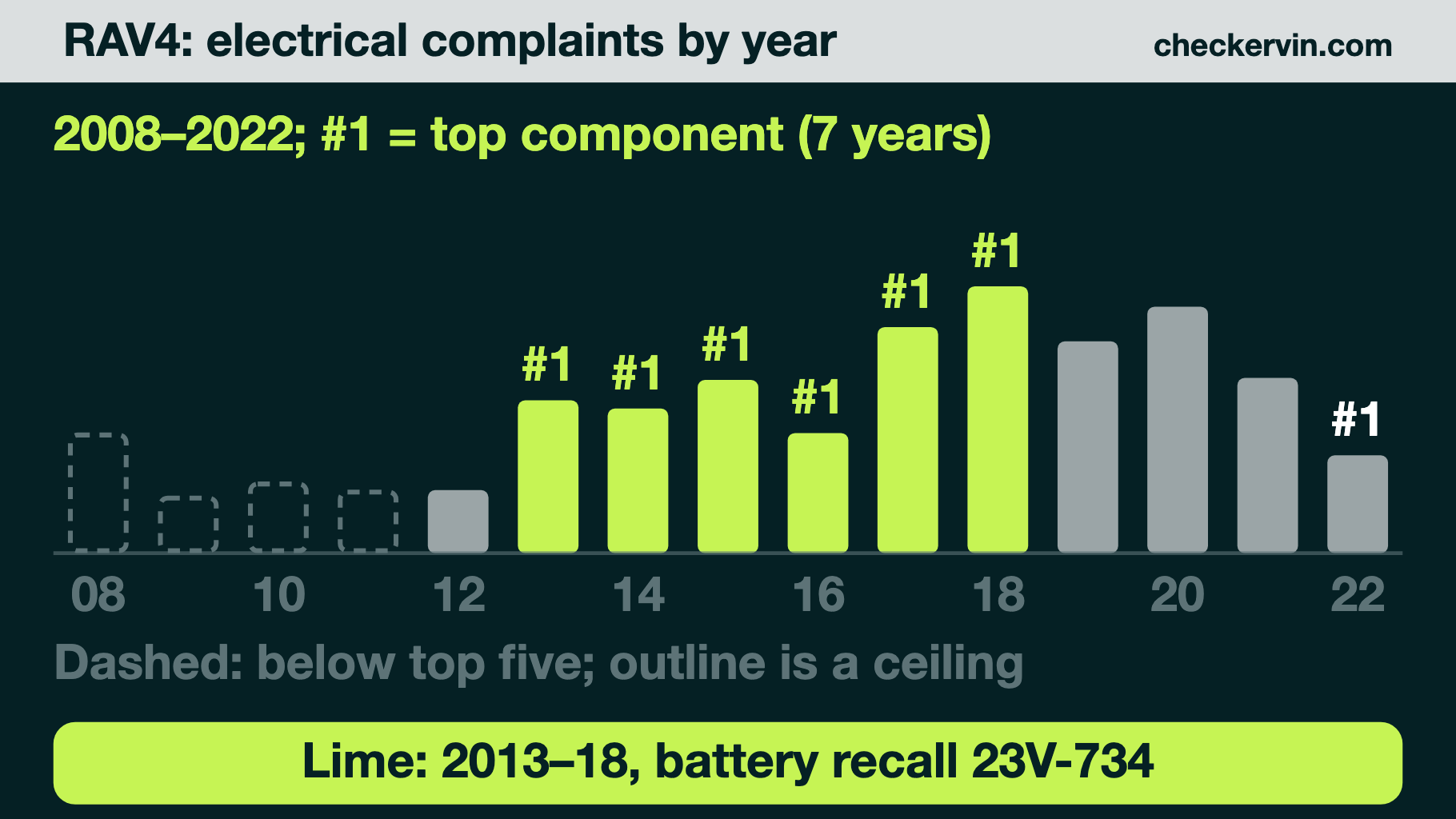
2013–2018: the battery tray recall
In February 2021 NHTSA opened a preliminary evaluation, PE21005, into fires starting in the battery area of 2013–2018 RAV4s. Its closing summary is specific. None of the fires it identified involved the battery the car left the factory with. They happened in cars with aftermarket batteries, or batteries older than the original’s expected life. The cause was geometry. These RAV4s kept the battery tray and hold-down of the 2006–2012 generation, which carried a larger Group 24F battery, but were specified with a smaller Group 35. A replacement battery that could slide, held by a bracket not tightened to spec, could let the positive terminal touch the grounded hold-down bracket.
Toyota found aftermarket catalogs listing a battery size it says is wrong for the car, and in November 2021 sent owners an advisory about the correct size. In November 2023 it filed recall 23V-734 for 1,853,568 RAV4s. Its defect report adds that some aftermarket Group 35 batteries have a smaller top than others, so even the right group size can move if the clamp is loose. Dealers replace the battery clamp, the tray and the positive terminal cover at no charge. Remedy parts arrived late: owner letters went out in phases from December 2024 into mid-2025, and NHTSA complaints from 2017–2018 owners describe months of waiting.
Why a shorting battery can look like a dead alternator
This matters for an alternator quote because of how the failure shows up. Toyota’s March 2021 dealer message quotes NHTSA’s description: the battery’s positive terminal shorts to the hold-down frame, which may cause a sudden loss of electrical power, stalling, or a fire. The investigation’s summary describes the same order of events, an engine stall first, then a fire. A car that dies on the road with warning lights across the dash is exactly the car a shop suspects of a failed alternator.
The 2017 and 2018 complaints show the overlap. Owners describe stalls with a “charging system malfunction” message. One 2018 owner writes that the dealer replaced the alternator and thermostat, and three days later the car shut off again at highway speed. Others got the car running again by reseating a battery terminal, or were told the battery had a dead cell. We cannot say what caused any single car’s trouble; NHTSA complaints are unverified owner reports. They do show why the battery, its clamp and its cables deserve a look before an alternator goes in.
It also matters after the repair. An alternator job starts by disconnecting the battery. On these cars, whoever puts it back should use the Group 35 size and the hold-down torque Toyota specifies. NHTSA’s summary gives 17 newton-meters on the front bolt and 4.9 on the J-hook. The battery size lookup by VIN confirms the group your RAV4 should carry.
2011: Toyota’s charging fix was a pulley, not an alternator
The only RAV4 alternator document we found in fifteen model years is Toyota Technical Service Bulletin T-SB-0055-12, dated March 13, 2012, titled “Charging System Inoperative.” We pulled every manufacturer communication filed with NHTSA for the 2008–2022RAV4, RAV4 Hybrid and RAV4 Prime and searched them for alternator and charging language; the same search caught the Prime’s converter bulletins, so it could see the words. This was the only alternator hit.
It covers the 2011 RAV4 with either engine, the 2.5-liter four (2AR) or the 3.5-liter V6 (2GR), along with several other 2011–2012 Toyotas. Toyota says some of these cars may show insufficient charging from the alternator and that an updated pulley assembly is available. The fix replaces the alternator’s clutch pulley, booked at 0.8 hours on either RAV4 engine, and applies to cars built before production-change VINs listed in the bulletin. Before the pulley, the procedure has the technician test the battery, then check fuses, belts and wiring, then test the charging circuit under load. In our record the 2011 sits below the electrical top-five line, so this is not a common complaint. On a 2011 with a weak charge, though, ask whether the pulley was ever updated before paying for a whole alternator.
Which alternator your RAV4 takes, and what Toyota lists it for
The RAV4 has used several engines in this period, and the alternator follows the engine. These are the list prices ToyotaPartsDeal printed on November 22, 2026. Its sale prices run about a third lower; other sellers vary. Confirm the fit by VIN.
| RAV4 | Alternator we could confirm |
|---|---|
| 2011, 2.5L (2AR) or V6 (2GR) | Bulletin T-SB-0055-12 replaces the clutch pulley only, part 27415-0W020 (2AR) or 27415-0W130 (2GR) |
| 2013–2015 builds, 2.5L (2AR-FE) | 27060-0V140 or 27060-0V170, 100 A; $710.40 / $703.27 list |
| 2019, 2.5L (A25A) | 27060-F2010 115 A $435.62; 27060-F0040 130 A $450.75; 27060-F0060 150 A $527.27 |
| Hybrid, Prime, EV | Toyota documents describe the 12-volt battery charged through a DC/DC converter; get the part number in writing |
Two things stand out. The newer A25A alternators list for less than the 2013–2015 units, so a later RAV4 is not automatically the pricier repair. And the estimator averages sit well under any new Toyota part, which tells you most of the quoted parts are not new Toyota. A Toyota VIN decodeconfirms the engine and drivetrain, which decide the part. We did not check the 2016–2018 or 2020–2022 listings.
Labor and access: what we could and could not confirm
We could not get Toyota’s flat-rate time for replacing the alternator on the 2AR-FE or the A25A, or the removal steps. Those live in Toyota’s paid service information. The one Toyota time we have is the 2011 pulley job at 0.8 hours, which is a different operation. YourMechanic’s average labor charge of $140 suggests a job of an hour or two at independent rates, but neither estimator breaks it out by engine, so we will not guess which RAV4 is harder to reach.
What we can say is where labor gets wasted. The battery hold-down remedy is free. Toyota’s 2020–2021 drain fix is a 0.8-hour software job, covered while the basic warranty lasts. A misdiagnosed alternator is a repair you pay for twice. Ask the shop to write down the hours, the battery test, the charging voltage with the engine running, and the part it plans to fit.
RAV4 Hybrid, Prime and EV: the 12-volt battery is charged another way
The RAV4 Hybrid joined the lineup for 2016 and the plug-in RAV4 Prime for 2021, and NHTSA lists the electric RAV4 EV for the 2012 to 2014 model years. Toyota does not describe these as charging the 12-volt battery from a belt. Its storage bulletins for the RAV4 Hybrid, indexed by NHTSA to the 2016, 2017 and 2020 models, say hybrids carry two batteries, the high-voltage pack and a 12-volt auxiliary battery, and tell technicians to leave the hybrid system on in Park to charge both. Toyota’s emergency response guide for its electrified vehicles says the DC/DC converter steps the high-voltage supply down to run accessories and charge the 12-volt battery.
The Prime’s paperwork names that converter directly. Bulletin T-SB-0007-21 fixes a converter warning on early 2021 Primes caused by poorly plated ground bolts. Recall 23V-478 replaces the DC-DC converter on 2021–2022 Primes because a damaged module can short and overheat. And T-SB-0056-22 updates software on 2021 Primes whose hybrid computer stays awake and drains the 12-volt battery, often after a jump start or battery disconnect, under the hybrid warranty.
We found no Toyota document saying “no alternator” in those words for the RAV4 Hybrid, so we will not claim more than the documents do. They are enough to change the question. On a hybrid, a 12-volt charging warning points first at the 12-volt battery, the converter or the hybrid system. The RAV4 Hybrid battery post covers the high-voltage side.
2020–2021: dead after a week parked
The 2020 RAV4 has 121counted electrical complaints, and the most common story in them is a battery that is flat after the car sits for a week or two, sometimes with a “low voltage” message and a battery that tests good. Toyota’s bulletin T-SB-0095-20 lists a depleted 12-volt battery with the ignition off among the symptoms of a telematics module fault on 2020–2021 RAV4s and RAV4 Hybrids, fixed by a module reset and firmware update booked at 0.8 hours. A companion tech tip tells technicians to check plug-in chargers and insurance dongles that keep the car’s network awake, and to confirm the car is driven enough to stay charged. Our Camry alternator post walks through the same bulletin on that car. None of it involves the alternator.
Before you authorize a RAV4 alternator
- Ask for the battery test result, the charging voltage with the engine running, and any stored codes
- On a 2013–2018, check the VIN for recall 23V-734 and look at the battery size, clamp and terminals
- On a 2011, ask whether the T-SB-0055-12 clutch pulley was updated
- On a 2020–2021 that dies after sitting, ask whether the T-SB-0095-20 module update applies
- On a Hybrid, Prime or EV, get the Toyota part number in writing and check recall 23V-478 on a Prime
- Ask whether the alternator quoted is new Toyota, remanufactured or aftermarket, and about the core charge
The Toyota recall lookup by VIN shows any open campaign in a minute. The guide to bulletins versus recalls explains why 23V-734 is free at any age while a service bulletin is a paid repair once the warranty ends.
If you are buying the RAV4, not repairing it
Charging problems rarely show on a test drive, so ask direct questions. Has the battery been replaced, and with what size? Has the car ever stalled or needed a jump? Was an alternator replaced, and did the problem stop? On a 2013–2018, open the hood: a battery that rocks in its tray, or a loose clamp, is a reason to get the recall done before you drive it home. The Toyota RAV4 years-to-avoid page lays out the full record by year, and the Toyota warranty check by VIN estimates whether factory or hybrid coverage remains.
A free CheckerVIN report returns the factory build, engine, specifications and open safety recalls for any VIN. It does not include accident, title, odometer or repair history, so it cannot tell you whether an alternator or battery was ever replaced. Only the seller’s receipts can.
Where this information comes from
- Toyota Part 573 safety recall report 23V-734, December 2024 (NHTSA copy)2013–2018 RAV4, 1,853,568 vehicles; replacement battery can move and short against the hold-down; free clamp, tray and cover.
- Toyota defect information report and chronology, recall 23V-734 (NHTSA copy)Aftermarket suppliers recommended a battery size contrary to Toyota's published information.
- Toyota owner remedy letter, recall 23V-734 (NHTSA copy)About 45 minutes at a dealer; reimbursement for owners who already paid for this repair.
- NHTSA closing resume, investigation PE21005: battery hold-down thermal eventsNo fire involved the original battery; tray designed for Group 24F, car specified Group 35; short can stall the engine first.
- Toyota dealer message, March 2021 (NHTSA copy): NHTSA opens RAV4 12V battery evaluationQuotes NHTSA: sudden loss of electrical power, stalling and/or fire.
- Toyota T-SB-0055-12, March 2012 (NHTSA copy): Charging System Inoperative2011 RAV4 2AR and 2GR: updated alternator clutch pulley, 0.8 hr, after battery and charging tests.
- Toyota T-SB-0095-20 Rev2 (NHTSA copy): DCM reset and firmware update2020–2021 RAV4 and RAV4 Hybrid: depleted 12-volt battery with the ignition off; 0.8 hr.
- Toyota T-SB-0006-19 (NHTSA copy): maintenance for HV and auxiliary batteries2020 RAV4 Hybrid: two batteries; hybrid system on in Park charges the HV and auxiliary battery.
- Toyota T-SB-0056-22 (NHTSA copy): depleted 12V auxiliary battery, 2021 RAV4 PrimeHybrid computer may not sleep after a jump start or battery disconnect; software update under hybrid warranty.
- NHTSA: recalls by VINOur query of every 2008–2022 RAV4, RAV4 Hybrid, RAV4 Prime and RAV4 EV found no recall naming the alternator.
Keep reading
Frequently asked questions
How much does it cost to replace the alternator on a Toyota RAV4?
Two online estimators we checked on November 22, 2026 put it at an average of $353 (YourMechanic: about $213 parts and $140 labor) and $558 (AutoNation Mobile Service). A new Toyota unit costs more as a part alone: ToyotaPartsDeal prints $435.62 to $527.27 for the three 2019 RAV4 alternators and about $703 to $710 for the 2013–2015 2.5-liter units, with lower sale prices beside them. Ask for a written quote that names the part and its source.
How long does a RAV4 alternator last?
Toyota publishes no replacement interval for it in any document we read; it is replaced when it fails a test. What the record does show is that RAV4 charging complaints are mostly about the 12-volt battery, not the alternator. Owners report alternators replaced at a wide range of mileages, and some report the problem came back afterward because the cause was elsewhere.
What is the most common problem with a Toyota RAV4?
It depends on the model year. In our NHTSA data the electrical system is the most-reported component in 7 of the 15 RAV4 model years from 2008 to 2022 (2013–2018 and 2022), and dead or drained 12-volt batteries are the most common theme in those reports. The 2019 is different: fuel / propulsion system and engine complaints lead it. Our RAV4 years-to-avoid page covers every year.
What are the first signs of a bad alternator on a RAV4?
A battery or charging warning light, a charging-system message, dimming lights, and a car that dies while driving. The same signs come from a failing battery, a loose cable or ground, or, on a 2013–2018 RAV4, a battery shorting against its hold-down bracket. Toyota's own charging bulletin starts with the battery, then fuses, belts and wiring, then a charging test under load. Ask for those results before an alternator is ordered.
Does the RAV4 Hybrid have an alternator?
Toyota's documents for the RAV4 Hybrid describe two batteries, the high-voltage battery and a 12-volt auxiliary battery, and tell technicians to keep the hybrid system on in Park to charge both. Toyota's emergency response guide says the DC/DC converter steps down high-voltage electricity to charge the 12-volt battery. We found no Toyota document that says 'no alternator' in so many words, so if a shop quotes one for a RAV4 Hybrid or Prime, ask for the Toyota part number first.
Check the VIN before you price the alternator
A free CheckerVIN report shows the factory build, engine, specifications and open recalls for any VIN: enough to know which RAV4 alternator fits and whether the battery recall comes first.
Run a free VIN check