The short answer
- What does it cost?
- RepairPal lists $895–$1,153 across all Prius years; its 2010–2020 per-year pages run roughly $635–$790. Figures retrieved November 2026.
- Which pump?
- A Prius has an engine water pump and a separate electric inverter pump. Get the quote to name the part; they are different jobs.
- Anything free?
- Recall 12V-536 replaces the hybrid-system water pump on 2004–2009 Prius cars at no charge. No pump recall covers 2010 or later.
$895–$1,153
RepairPal Prius average
Labor $260–$382, as listed Nov 2026
12V-536
Hybrid pump recall
2004–2009 Prius, about 350,000 cars
9 of 15
Years ENGINE made the top five
2008–2022, never ranked first
0
Accessory belts on the 2010+ engine
Toyota: electric water pump
What the estimators list, and what they leave out
We decode VINs; we do not repair hybrids. Every dollar figure here belongs to the company named beside it, read on November 22, 2026.
| Source | What it lists for a Prius water pump |
|---|---|
| RepairPal, all years | $895 to $1,153; labor $260 to $382, parts $635 to $771, before taxes and fees |
| RepairPal, 2010 Prius | $673 to $770; labor $207 to $304, parts about $466 |
| RepairPal, 2015 Prius | $692 to $789; labor $207 to $304, parts about $484 |
| RepairPal, 2020 Prius | $637 to $701; labor $246 to $311, parts about $390 |
| RepairPal, 2005 and 2009 Prius | $1,384 to $2,133; parts $1,164 to $1,810 |
| Kelley Blue Book | $375 to $787 including parts and labor; generic figure shown without a ZIP code |
The table has a shape worth noticing. Every per-year RepairPal page we read for 2010 through 2020 (the 2010, 2011, 2015 and 2020 cars) sits below its own all-years figure, and the labor lines are small, around two to three hundred dollars. The all-years number is pulled up by the older cars, where the parts line alone exceeds a thousand dollars. RepairPal does not say which pump its estimate prices, and on a Prius that is the question that matters.
KBB’s $375 to $787 appears on its pages for many unrelated models and years, so read it as a site-wide default; the page itself says a local Fair Repair Range is not yet available. It does make one fair point: belt-driven pumps are cheap, “electric ones can get pricey.” Every Prius pump discussed below is electric.
A Prius has two pumps, and they are different jobs
A conventional car has one water pump. A Prius has at least two cooling circuits: the gas engine’s, and a separate low-temperature loop for the inverter, the power electronics between the battery and the motors. Each loop has its own reservoir under the hood and its own pump. The inverter pump is electric on every generation, and from 2010 the engine pump is too.
| Pump | What it does and what failure looks like |
|---|---|
| Engine water pump | Circulates coolant through the gas engine. Failure means rising engine temperature or a leak |
| Inverter (hybrid system) pump | Cools the inverter. Failure usually lights the hybrid warning and can cut power |
Toyota’s own recall paperwork draws the same line. Its 2012 notice to 2004–2009 owners calls the recalled part the “Water Pump for the Hybrid System,” not the engine pump. A shop quote should name one or the other, and the part number settles it. Our Toyota VIN decoder confirms the model year and engine, which fixes which parts catalog applies.
2010–2015: the first Toyota engine with an electric water pump
The third-generation Prius brought the 1.8-liter 2ZR-FXE, and with it an engine that has no drive belts at all. Toyota’s May 18, 2009 launch release describes “TMC’s first electric-powered water pump that draws its energy from the battery,” and its US pressroom said in September 2010 that the 1.8-liter Prius engine was the first Toyota powerplant requiring no accessory drive belts.
That changes the repair. There is no belt to inspect, no pulley bearing to growl, and no timing-belt job to bundle the pump with. The pump is a motorized unit bolted to the engine with its own electrical connector. ToyotaPartsDeal lists the Toyota engine water pump, 161A0-29015 (which replaced 161A0-39015), as fitting 2010–2015 Prius cars, at $260.27 against a Toyota list price of $373.21 when we checked. That part price is the reason RepairPal’s per-year totals for these cars stay under about $800 with labor included.
It also changes how failure looks. A belt-driven pump usually weeps coolant or gets noisy before it quits. An electric pump can simply stop, and the first sign may be the temperature warning. Several owner narratives in NHTSA’s complaint file describe exactly that: a stall or warning at speed, then a dealer diagnosis of a failed water pump.
2004–2009: the hybrid pump recall that is still free
In November 2012 Toyota filed recall 12V-536 for about 350,000 Prius cars from 2004 through certain 2009 builds. Its dealer letter explains the defect: the coil wire in the electric motor of the hybrid-system water pump may have been scratched at the supplier, can corrode and break, and the pump stops. A short between coil wires can also blow the fuse feeding the system, and then “the hybrid system will stop while the vehicle is being driven.” Dealers replace the pump at no charge under Toyota campaign C0U.
A safety recall does not expire with age or mileage, so a 2004–2009 car that never had C0U done still qualifies. That makes the recall check the first step before paying for a hybrid pump on these cars. Our Toyota recalls by VIN page runs it. The 2008 and 2009 records in our data carry 10 recall campaigns between them, and 12V-536 is one of them.
The recall covers the hybrid pump, once. Owners have filed complaints about recall replacement pumps failing again years later, which is a paid repair. RepairPal’s parts line for the 2005 and 2009 cars, $1,164 to $1,810, is the highest in its Prius pages, though it does not say which pump it prices.
The inverter pump on 2010-and-later cars
The later cars kept a separate inverter loop and pump, but we found nothing that makes its replacement free. Toyota’s 2010–2015 programs on NHTSA’s record cover the inverter’s power module (recalls 14V-053, 18V-684 and 20V-369, and warranty enhancement ZE3), the EGR valve, oil consumption and the brake booster. None names a water pump.
Do not confuse those inverter campaigns with the pump. They address the transistors inside the inverter and are mostly software updates, with the inverter repaired or replaced if it already failed. A pump that stops is a different fault, though the symptoms overlap: both can light the hybrid system warning and leave the car in reduced power. The common code for a cooling problem in that loop is P0A93, which Kelley Blue Book describes as an inverter cooling system performance fault usually tied to the electric pump, low coolant or trapped air.
The pump itself is not the hard part of that job; the care goes into refilling and bleeding that loop, because an air pocket can set the same code again. It uses Toyota’s long-life coolant, which our coolant type by VIN page matches to the car.
How a pump failure differs from the head-gasket chain
Third-generation Prius cars are known for head-gasket failures, and our Prius head gasket cost post covers that story, which runs through a clogged EGR circuit, not the pump. The two get confused because both end with coolant where it should not be.
The difference is speed and evidence. A failed engine pump stops circulation outright: the gauge or warning climbs within minutes, and the coolant is usually still in the reservoir. Caught at that point, the fix is a pump at the prices above. The head-gasket chain is slow, with coolant disappearing over months without a visible leak, misfire at cold start and white exhaust. NHTSA narratives contain both, and at least two join them: an owner keeps driving after a pump failure and is later told the head gasket or the engine is done.
What the ENGINE record shows, and why it is thin
NHTSA has no water-pump category. An engine-pump complaint files under the engine heading along with misfires, oil burning and gasket failures, so the engine count is an upper bound on pump trouble at most. On the Prius even that upper bound is small, and we say so plainly: this is a thin anchor.
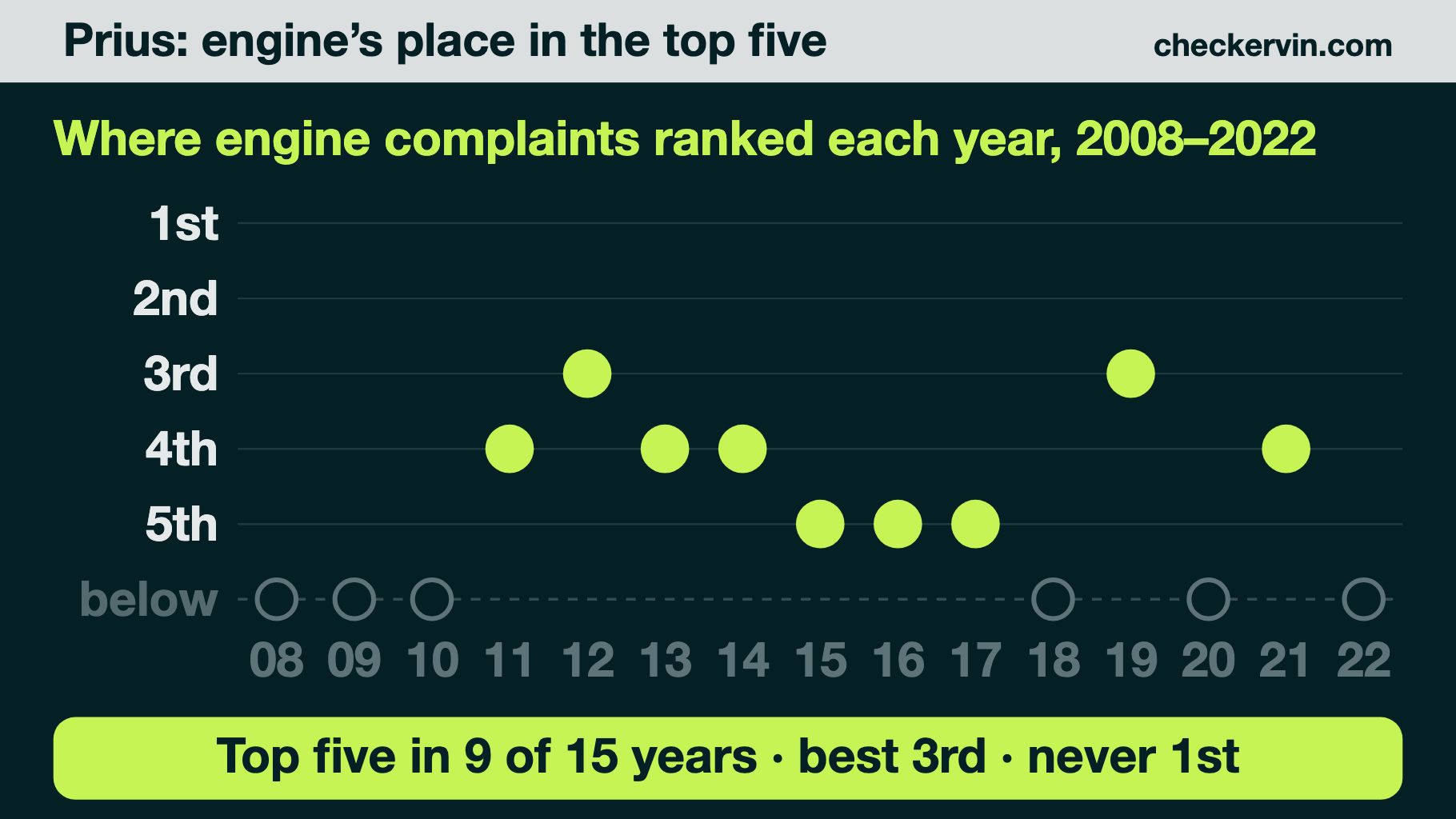
Our corpus holds 7,406 complaints against the 2008–2022 Prius. The engine category reaches a year’s five most-reported components in 9 of 15 years and never ranks first. Its best placing is 3rd, in 2012, 2019 (tied in 2019), and in 2015, 2016, 2017 it only scrapes in at fifth. Across the years where it appears we count 236 engine reports, a minimum, against 3,740 for service brakes, the nameplate’s leading category, about 16 times as many. Engine ranks 8th of 13 categories in that tally. Its peak, 2012, is 73 reports, 10% of that year’s complaints.
The third-generation years hold 192 of those counted reports, 81%, but 2010is not among them: the engine category fell below that year’s fifth, which was 193 reports, in a file dominated by brake complaints. In 2008 and 2009 engine misses the top five entirely, behind lighting and brake complaints. Reading the complaint narratives makes the second point sharper. Water-pump mentions are rare, they cluster in 2008–2010 filings, and many of them describe the inverter pump while being tagged engine. The tag is not a pump count in either direction. Our Toyota Prius years to avoid page scores each year on its whole record instead.
Coolant loss that is not the pump
Before agreeing to a pump, rule out the leaks Toyota has already documented on these cars. Two are on NHTSA’s bulletin index.
Toyota bulletin T-SB-0135-19, dated September 26, 2019, covers 2016–2019 Prius and 2017–2019 Prius Prime cars that leak coolant at the front exhaust pipe heat exchanger. The signs are a low coolant level, a check-engine light with code P148F00 and poor heater output, and the fix is an updated front exhaust pipe, 1.5 hours of labor. Toyota covers it under the federal emission warranty for 96 months or 80,000 miles, and for 2016–2017 Prius and 2017–2019 Prime cars registered in California and nine other states with its emission rules, 180 months or 150,000 miles. A 2016 car in one of those states can still be inside that window.
For the 2010 car, NHTSA’s index lists bulletin TSB-0352-09 for coolant leaking from the transaxle coolant drain plug, a leak a quick look could pin on the pump. Toyota also publishes a general bulletin, T-SB-0008-20, on telling a true leak from normal seepage at a seal. Our TSB vs recall explainer covers why a bulletin repair is free only while a warranty applies.
- Which reservoir is low: engine or inverter loop?
- Stored codes read out, including P0A93 or P148F00 if present.
- A pressure test of the engine cooling system before any part is ordered.
- On a 2016–2019 car, the exhaust heat exchanger checked against T-SB-0135-19.
- On a 2004–2009 car, the VIN checked for recall 12V-536.
How many miles a Prius water pump lasts
There is no Toyota replacement interval to quote. On the 2010-and-later engine there is no drive belt either, so nothing in the maintenance schedule brings a mechanic to the pump. It is replaced when it leaks, stops or throws a code. Owner complaints in NHTSA’s file describe pump failures from well under 100,000 miles to nearly 200,000, so mileage alone predicts little.
A preemptive pump on a high-mileage Prius is a judgment call, not a requirement. The case for it is the failure mode: an electric pump can quit without warning, and the downside of driving on is an engine. The case against it is that a healthy pump can run for many more years. If the engine cooling system is already drained for other work, adding the pump costs little more than the part.
Reading a Prius water pump quote
- Does it say engine pump or inverter pump, with a Toyota part number?
- Is the part genuine Toyota or aftermarket, and what warranty comes with it?
- Is Toyota long-life coolant included, and is the loop bled after the refill?
- On a 2004–2009 hybrid pump, has the recall been ruled out first?
- Is a drive belt or timing belt listed? On a 2010-and-later Prius engine, there is no accessory belt to replace.
A dealer and an independent shop will often differ mostly on the pump’s price and the labor rate; the hours on either pump are short. If the car is young enough for factory coverage, our Toyota warranty check by VIN explains how to find the in-service date that starts each warranty clock.
If you are shopping a used Prius
On a 2004–2009 car, confirm recall C0U is closed. On a 2010–2015 car, ask whether either pump has been replaced and whether the car ever overheated; an overheat on this engine is the event to worry about, more than the pump. Our 2010 Toyota Prius recordgathers one of the busiest years’ complaints and recalls in one place.
Where this information comes from
- Toyota Safety Recall C0U dealer remedy letter, 12V-536 (NHTSA-hosted)Defines the recalled part as the hybrid-system water pump, gives the coil-wire defect, the free remedy and about 350,000 covered cars.
- NHTSA — recalls API, 2008 PriusReturns 12V536000. Queried for every year 2004–2022 on November 22, 2026; no 2010-or-later campaign mentions a water pump.
- Toyota T-SB-0135-19 — low coolant, P148F00, 2016–2019 Prius (NHTSA-hosted)The exhaust heat exchanger leak that mimics a pump, with its 96-month and 180-month coverage terms.
- NHTSA — recall lookup by VINCheck a specific car; also the source of the complaint records computed above.
- Toyota — Third-generation Prius launch release, May 18, 2009Describes the 2ZR-FXE's electric water pump drawing power from the battery.
- Toyota USA pressroom — third-generation Prius, September 9, 2010States the 1.8-liter engine uses an electric water pump and needs no accessory drive belts.
- RepairPal — Toyota Prius water pump replacement estimateThe all-years and per-year ranges quoted above, as listed November 22, 2026.
- Kelley Blue Book — Prius water pump replacementThe generic $375–$787 figure and the note on electric pumps, retrieved November 22, 2026.
- ToyotaPartsDeal — Toyota 161A0-29015 engine water pumpListed fitment for 2010–2015 Prius and the part and list prices quoted, retrieved November 22, 2026.
Keep reading
Frequently asked questions
How much does it cost to replace a water pump on a Toyota Prius?
RepairPal's Prius estimator, as listed on November 22, 2026, gives $895 to $1,153 across all years, with labor of $260 to $382 and parts of $635 to $771. Its per-year pages run lower for the 2010 to 2020 cars, for example $673 to $770 for a 2010 Prius, and higher for the 2005 and 2009 cars at $1,384 to $2,133. Kelley Blue Book shows a generic $375 to $787 when no ZIP code is entered. Those are their figures, not ours, and none of them says which of the car's pumps it prices.
Does a Prius have two water pumps?
Yes. The gas engine has its own water pump, and the hybrid system's inverter has a separate cooling loop driven by its own electric pump. Toyota's 2012 recall of 2004 to 2009 Prius cars was for the hybrid-system pump, which Toyota called the Water Pump for the Hybrid System. On the 2010 and later 1.8-liter engine, the engine pump is electric too; Toyota described it in 2009 as its first electric-powered water pump.
Is there a recall on the Prius water pump?
For 2004 to certain 2009 Prius cars, yes: NHTSA campaign 12V-536, Toyota code C0U, replaces the hybrid-system electric water pump free because a scratched motor coil wire can corrode and break. An unrepaired car is still eligible. For 2010 and later Prius cars we found no water-pump recall and no water-pump warranty enhancement in NHTSA's recall and manufacturer-communication records, checked November 22, 2026.
How many miles before a Prius water pump needs replacing?
Toyota does not schedule it. The 2010 and later 1.8-liter engine has no accessory drive belts, so there is no belt service to pair a pump with, and the pump is replaced when it fails or leaks. What matters more than mileage is catching a failure early, because an engine that keeps running without coolant flow can damage the head gasket, a far larger bill.
How do I know whether the engine pump or the inverter pump failed?
Read the codes and look at which warning came on. An engine pump problem shows up as engine temperature climbing, a temperature warning or coolant loss from the engine circuit. An inverter pump problem usually lights the hybrid system warning and sets an inverter cooling code such as P0A93, often with reduced power. The two loops have separate reservoirs under the hood, so a shop can check each one. Ask the quote to name the part number either way.
Start with the recall check
A free CheckerVIN report shows the factory build, specifications and open recalls for any VIN, including the 12V-536 hybrid pump campaign on 2004–2009 Prius cars.
Run a free VIN check