The short answer
- What does it cost?
- $2,549–$2,949 for an aftermarket pack by generation (Best Hybrid Batteries), or Toyota’s pack at a $5,002.79 MSRP, before labor. Retrieved October 2026.
- Am I covered?
- A 2020-or-newer Highlander Hybrid carries 10 years/150,000 miles on the pack. Earlier cars had 8 years/100,000; only some 2019s remain inside it.
- What should I rule out first?
- An open inverter recall on 2006–2010 cars, and brake booster faults that Toyota covered on 2008–2010 and 2014–2016 cars. Both light hybrid-looking warnings.
$2,949
Aftermarket 2014–2019 pack
Best Hybrid Batteries, Oct 2026, install extra
$5,003
Toyota pack MSRP, 2011 to 2020 cars
Same list price on three part numbers
13.7%
Electrical share of top-five reports
2008–2022, gas and hybrid pooled
3
Recent years with electrical outside the top five
2020–2022, the fourth generation
One dealer price, four aftermarket prices
We sell VIN checks, not batteries, so every price below belongs to the seller named next to it. All were read on October 25, 2026. The pattern is unusual among the Toyota hybrids we have priced: the aftermarket charges more for each newer generation, while Toyota’s own pack has carried one list price since the 2011 refresh.
| Source and pack | What it lists |
|---|---|
| Best Hybrid Batteries — 2006–2007 | $2,549 (shown against a $3,949 MSRP) |
| Best Hybrid Batteries — 2008–2010 | $2,649 (against $4,249) |
| Best Hybrid Batteries — 2011–2013 | $2,849 (against $4,849) |
| Best Hybrid Batteries — 2014–2019 | $2,949 (against $4,949); NiMH; 3-year unlimited-mileage warranty, 6-year option for $885 more; scheduled install typically $300–$400, not included |
| Toyota G9510-48032 — listed for 2009 and 2011 | $4,847.66 MSRP, sold at $3,808.55 on ToyotaPartsDeal |
| Toyota G9510-48060 — 2011–2013 | $5,002.79 MSRP, sold at $3,932.01 (ToyotaPartsDeal) and $3,994.77 (North Park Toyota, with a $1,350 core charge) |
| Toyota G9510-48070, now G9510-48120 — 2014–2019 | $5,002.79 MSRP, sold at $3,932.01 on ToyotaPartsDeal |
| Toyota G9510-48090 — 2020 | $5,002.79 MSRP, sold at $3,932.01 on ToyotaPartsDeal |
Read the table across rather than down. For a 2014–2019 car the choice is a $2,949 aftermarket pack with a three-year warranty, or a factory pack at about $3,900 to $4,000 after the usual parts-site discount, before an hour or two of dealer labor. That is a gap of roughly a thousand dollars on parts, smaller than the “dealer is double” rule of thumb suggests. The core charge is refunded when the old pack goes back, so treat it as a deposit you need cash for on the day.
The 2020-and-later car is the odd one out. The factory pack is listed, but Best Hybrid Batteries sells no fourth-generation Highlander pack, and we found no other aftermarket price we could verify. That matters less than it sounds: every one of those cars is still young enough to be inside Toyota’s pack coverage, covered two sections down.
What we could not verify: a RepairPal estimate for the Highlander Hybrid (its page refused our fetch and no figure surfaced elsewhere), and any installed dealer total. Many search results for this phrase are copied pages on unrelated university and seminary domains quoting ranges with no source; none of them is on this page.
Which Highlander Hybrid you have decides the part
The Highlander Hybrid launched for the 2006 model year, and the aftermarket and Toyota’s parts catalogs list a different pack for each of five spans since. MotorWeek’s road test of that first car describes a 288-volt nickel-metal hydride pack under the second-row seat, a 3.3-liter V6 and 268 horsepower combined. Our complaint data begins with the 2008 redesign, so the 2006–2007 cars appear in this post only through recalls and prices.
The 2011 refresh swapped in a 3.5-liter V6 and, by the parts catalogs, a different pack; the aftermarket sells 2008–2010 and 2011–2013 packs separately at different prices. The third generation, 2014–2019, keeps the V6, and NHTSA’s vehicle listings for its hybrid show all-wheel drive only. The 2020 redesign moved to a 2.5-liter four-cylinder, 243 horsepower combined per MotorWeek, and made front-wheel drive available alongside all-wheel drive. Green Car Reports and Toyota’s own dismantling material describe its pack as nickel-metal hydride.
Unlike the 2019–2021 RAV4 Hybrid, where Toyota’s bulletin splits builds between two chemistries by VIN, we found no Highlander Hybrid source for a lithium-ion pack, so there is no VIN-chemistry trick here. What the VIN does settle is the model year and drivetrain, which pick the part number. A Toyota VIN decode confirms both from the factory record; a dealer parts counter can then confirm the pack against the full VIN.
The warranty clock, briefly
Toyota raised hybrid pack coverage from 8 years or 100,000 miles to 10 years or 150,000 miles starting with the 2020 model year, and our Camry Hybrid battery cost post walks through the announcement and the California-rules exception with sources. For a Highlander the change happens to line up with the redesign, which makes the sorting simple.
| Highlander Hybrid years | Pack coverage in 2026 |
|---|---|
| 2006–2018 | 8 years / 100,000 miles nationally, now run out on age. Assume you pay unless the warranty booklet shows a longer state term. |
| 2019 | 8 years / 100,000 miles. A 2019 delivered in 2019 can stay covered into 2027 if the odometer allows; check the in-service date. |
| 2020 and newer | 10 years / 150,000 miles on the pack. A 2020 delivered in 2020 is covered toward 2030 if the odometer allows. |
Practically, a pack bill is a 2006–2018 problem, with the 2019 close behind, and the price table above is the budget. For the clock on a specific car, our Toyota warranty check by VIN page explains how to get the in-service date that starts it.
The third motor, and the cable Toyota now covers for 10 years
Every all-wheel-drive Highlander Hybrid drives its rear axle with an electric motor rather than a driveshaft. MotorWeek’s 2006 test put it plainly: all-wheel drive adds a third motor-generator for the rear wheels. That motor is fed by high-voltage cable run under the floor, and on the fourth generation the cable has its own program.
Toyota’s Customer Support Program 22TE09 began with the RAV4 Hybrid and added the 2020–2022 Highlander Hybrid AWD in May 2023, later extended through 2024. It covers corrosion at the connector of the floor wire harness and rear traction motor cable, which Toyota’s letter says can cause AM radio static or leave the car unable to start. The May 2026 update to that letter changes the term: coverage expands from 8 years or 100,000 miles to 10 years with unlimited mileage, provided a separate campaign, LSC 25TD01, is completed by September 30, 2028. Cars without it revert to the shorter term when that campaign expires.
The recall that looks like a dead pack
The first Highlander Hybrids carried an inverter fault that Toyota recalled twice. In 2011, campaign 11V342 covered 2006–2007 cars whose inverter module could contain poorly soldered transistors. In 2013, campaign 13V396 widened it to 2006–2010 Highlander Hybrids built through July 2010, for transistors in the intelligent power module that could be heat-damaged. NHTSA files the second one under hybrid propulsion.
The symptoms in both recalls are the reason this belongs in a battery post. The recall text lists the check-engine light, slip indicator, brake warning and master warning coming on together, with the car dropping into a limp mode or the hybrid system shutting down while driving. To an owner of a 15-year-old hybrid, that reads as a worn-out pack. The remedy is a free power module replacement at a Toyota dealer, and an open recall has no age or mileage limit. Our Toyota recalls by VIN page shows how to check whether a specific car still has it open.
The hybrid part owners actually report is the brake booster
Hybrid Highlanders brake through an electronically controlled actuator and a booster pump that keeps an accumulator pressurized, so regenerative and friction braking can blend. It is a hybrid-only part, and on this SUV it has needed help twice. Toyota’s program ZKC covered the brake actuator and booster pump on certain 2008–2010 Highlander Hybrids, verified by codes C1252, C1253, C1256 or C1391, until December 31, 2020 regardless of mileage and then for 10 years or 150,000 miles from first use. Program 24TE01 did the same for the brake booster and pump on certain 2014–2016 Highlander Hybrids, until March 31, 2025, then 10 years or 150,000 miles.
We read the narratives NHTSA files under the 2008 and 2010 Highlander Hybrid. Where owners mention the hybrid at all, the recurring subject is this brake unit: ABS, VSC and brake warnings together, a pedal that goes soft, codes C1252 and C1391, and several owners writing that the program had expired before their car failed. Inverter complaints come second. The traction battery is rarely the subject.
By 2026the 2008–2010 coverage has run out on age, and a 2014–2016 car is at or near the end of its 10 years. That turns the brake unit into a real repair cost on an older Highlander Hybrid, alongside the pack, and it is worth a line on any pre-purchase inspection.
Filters, fans and the trouble with rebuilt packs
Toyota’s bulletin T-SB-0062-20 covers hybrid pack cooling across its range, including the 2006–2019 Highlander Hybrid. It says dust and lint can build up in the pack’s intake filter or cooling fan and reduce cooling. For the 2014–2019 Highlander it lists three external intake filters, two of one part number and one of another, and recommends inspecting them every 5,000 miles and running the full cleaning procedure every 20,000 miles or whenever the pack is replaced. A pack that runs hot ages faster, so a clean filter is the cheapest battery maintenance there is.
A second Toyota tech tip, T-TT-0365-15, is aimed at dealers seeing codes P0A80 or P1AC000 on hybrids whose packs had been opened and modified, the 2006–2017 Highlander Hybrid among them. Its condition line is blunt: modified or altered parts are not covered under warranty. That does not matter on an aged-out car. It matters a great deal on a car still inside any Toyota coverage, where a module-swap repair can cost more than it saves.
What the Highlander complaint file can and cannot say
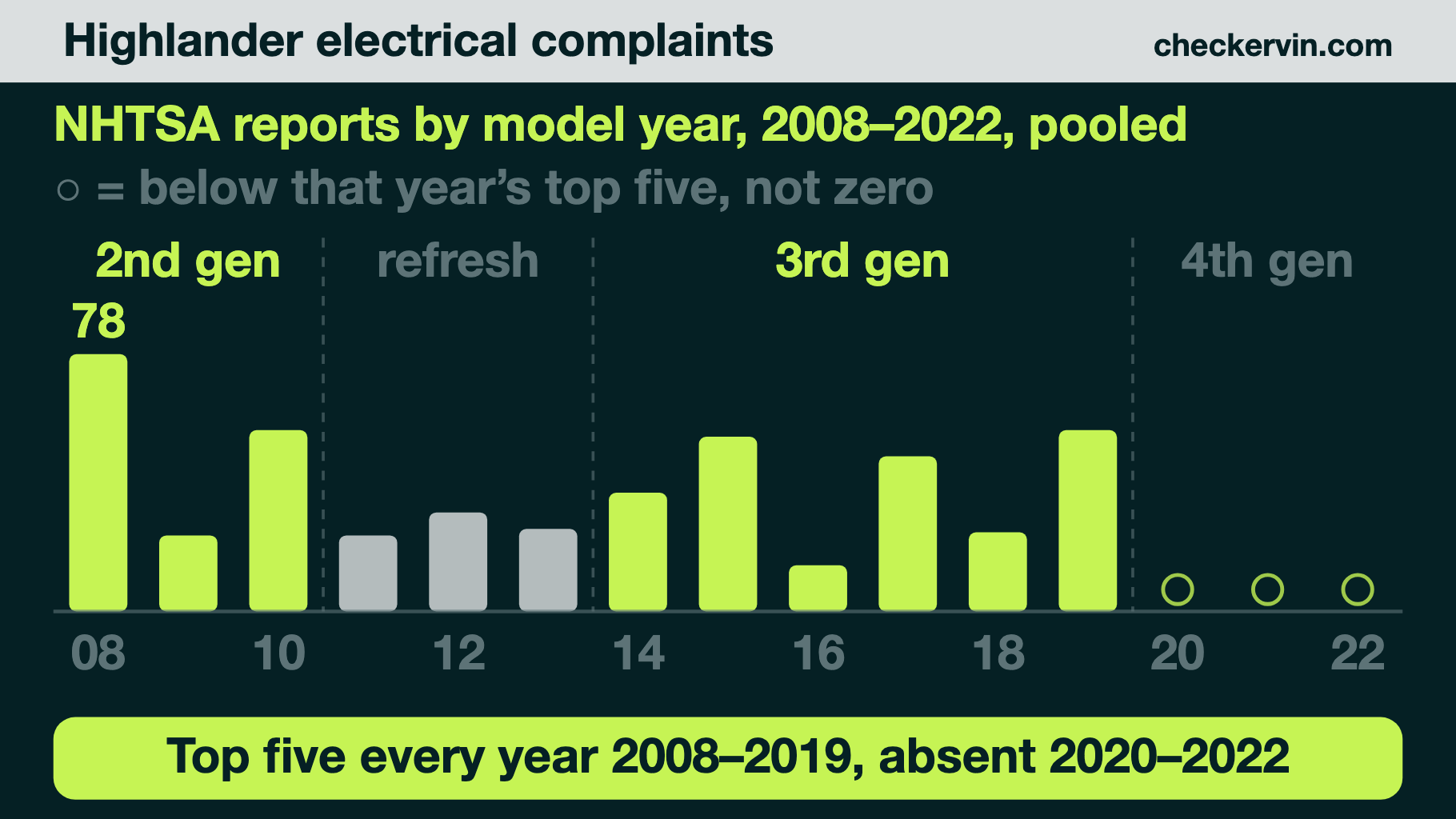
Our corpus holds 4,097 NHTSA complaints against the 2008–2022 Highlander, pulled 2026-08-15. Gas and hybrid cars share the nameplate, and even NHTSA’s own listing labeled Highlander Hybrid for 2008 carries gas-car VINs alongside hybrid ones, so nothing in it is a count of packs. Each model year keeps its five most-reported components; a category missing from a year is below that year’s fifth, not absent. NHTSA’s live listings for the newest years have grown since our pull, so treat recent years as minimums.
Within those top fives, the electrical system accounts for at least 463 of 3,369 counted reports, or 13.7%. It leads the year in 2010, 2014, 2015, and its peak is 2008, with 78 reports. The all-hybrid Prius over the same span puts 10.6% of its counted reports on the electrical system, with the category present in 15 of 15 years. So the pooled Highlander share runs about 1.3 times the Prius share, which would look like a hybrid finding if the category behaved like one. It does not, and the next section shows why.
Remember too that this category covers the 12-volt battery, wiring, lighting and body modules, not just high-voltage parts. The narratives above say the hybrid-specific trouble on older cars clusters in the brakes and the inverter. Our Toyota Highlander years-to-avoid breakdown scores each model year on its whole record, which is the right use of this file.
Where the electrical signal stops
The chart above has a clean edge. The electrical system is in the Highlander’s top five every model year from 2008 through 2019, 12 years running, and makes up 18.6% of the counted reports in that stretch. From 2020, the year the redesign arrived, it is in none of them. To miss the top five it had to fall below each year’s fifth-place count: 30 in 2020, 50 in 2021, 22 in 2022.
Part of that is age: the newest cars have had the least time to wear anything out. But the earlier generations carried the category from their first model year, not only once they were old, which is not how pack wear would draw it. The edge tracks the generation, and what changed in 2020 was the whole vehicle: a new platform and a new hybrid system. Meanwhile power train leads every fourth-generation year, as it has since 2017; we did not read those narratives for this post and make no claim about them.
Recalls, checked against a known positive
On October 25, 2026 we queried NHTSA’s recall API for the “Highlander” and “Highlander Hybrid” models for every year from 2006 through 2024. No campaign replaces a traction battery. The only campaign filed under hybrid propulsion is the inverter recall, 13V396, which the “Highlander Hybrid” query returns for 2006 through 2010, so the query can see a hybrid campaign on this nameplate when one exists. The 2012 Prius, our standing check, returns two of its own.
The rest are ordinary Highlander campaigns shared by gas and hybrid cars: airbags, seats, power windows, labels. Campaigns get added over time, so run your own VIN rather than trusting our snapshot, and if one turns up open on a car you are negotiating for, read buying a car with an open recall first.
If you are shopping a used Highlander Hybrid
Split the decision at 2020. A fourth-generation car bought in 2026carries pack coverage for years yet, and on AWD the harness program as well; ask for the in-service date and whether LSC 25TD01 is done. A 2006–2018 car is out of pack coverage, and a 2019 nearly so, so price it with the aftermarket figure for its generation plus installation, and keep a margin for the brake unit on 2008–2010 and 2014–2016 cars.
- On a 2006–2010 car, confirm the inverter recall 13V396 is closed.
- Have the codes read: C1252, C1253, C1256 or C1391 point at the brake unit, not the pack.
- On 2014–2019, check the three hybrid pack intake filters behind the second row.
- Get the pack chemistry, warranty length and install price in writing on any quote.
- Test the 12-volt battery; a weak one stops any hybrid from reaching ready mode.
For the last item, our battery size by VIN page matches the group size; it is a purchase in the hundreds, not thousands. A free decode returns the build and open recalls; it does not test pack health, and a CheckerVIN report does not include accident, title or odometer history. A pre-purchase inspection at a shop that can read hybrid battery data, plus the free federal and insurance databases, are the honest routes for those.
Where this information comes from
- Toyota Customer Support Program 22TE09, May 2026 update, hosted by NHTSAAdds 2020–2024 Highlander Hybrid AWD and expands harness coverage to 10 years/unlimited miles with LSC 25TD01 done by September 30, 2028.
- Toyota Customer Support Program 24TE01, hosted by NHTSABrake booster and pump coverage on certain 2014–2016 Highlander Hybrids, with the qualifying codes and terms.
- Toyota program ZKC bulletin, hosted by NHTSABrake actuator and booster pump coverage on certain 2008–2010 Highlander Hybrids.
- Toyota T-SB-0062-20, hosted by NHTSAHybrid pack cooling maintenance; lists the 2014–2019 Highlander Hybrid intake filters and inspection interval.
- Toyota T-TT-0365-15, hosted by NHTSADealer guidance on modified hybrid packs; states modified parts are not covered under warranty.
- NHTSA recalls API, 2008 Highlander HybridReturns 13V396, the inverter power module recall filed under hybrid propulsion; no campaign replaces the pack.
- NHTSA recalls API, 2012 Prius (known positive)Returns two hybrid propulsion campaigns, showing the query finds them when they exist.
- NHTSA recall lookup by VINRun your own car; campaigns are added after our snapshot. Also the source of the complaint records computed above.
- Best Hybrid Batteries, Highlander 2014–2019 packThe $2,949 price, warranty options and install estimate; sibling pages list the earlier generations. Retrieved October 25, 2026.
- ToyotaPartsDeal, 2020 Highlander HV batteryG9510-48090 at a $5,002.79 MSRP; the 2009, 2011 and 2016 pages list the earlier packs. Retrieved October 25, 2026.
- MotorWeek, 2006 Highlander Hybrid road testThe 288-volt nickel-metal hydride pack under the second row and the third, rear motor-generator.
Keep reading
Frequently asked questions
How much does a Toyota Highlander Hybrid battery replacement cost?
Best Hybrid Batteries lists Highlander Hybrid packs at $2,549 (2006-2007), $2,649 (2008-2010), $2,849 (2011-2013) and $2,949 (2014-2019), plus a scheduled install it puts at typically $300-$400. Toyota's own pack lists at a $5,002.79 MSRP for the 2011-2013, 2014-2019 and 2020 Highlander on dealer parts sites, discounted to about $3,900-$4,000, with a $1,350 core charge on at least one listing. Those are their figures, retrieved October 2026, before dealer labor.
Is the Highlander Hybrid battery covered by warranty?
On a 2020 or newer Highlander Hybrid, Toyota covers the pack for 10 years or 150,000 miles from the first owner's in-service date, so in 2026 every fourth-generation car is still inside it on age. Highlander Hybrids from 2019 and earlier carried 8 years or 100,000 miles nationally. By 2026 the 2006-2018 cars have aged out, and a 2019 is covered only if it went into service late enough and is under the mileage limit; cars in states that follow California's rules can carry a longer battery term.
My Highlander Hybrid shows brake and hybrid warnings. Is the battery dead?
Often not. On 2008-2010 and 2014-2016 Highlander Hybrids, Toyota ran support programs for the brake actuator and booster pump, identified by codes C1252, C1253, C1256 or C1391, and the warning lights from that fault cluster with the hybrid warnings. On 2006-2010 cars an open recall (13V396) replaces the inverter's power module free. Have the codes read before anyone prices a pack.
Does the Highlander Hybrid use a lithium-ion battery?
Not in any generation we could document. The first Highlander Hybrid used a 288-volt nickel-metal hydride pack under the second-row seat, Best Hybrid Batteries lists its 2014-2019 pack as NiMH, and coverage of the 2020 redesign reports Toyota kept nickel-metal hydride. Confirm the part number against your VIN before ordering anyway, because each generation's pack is a different part.
Do Highlander Hybrid batteries fail often?
The federal complaint file cannot say. Our corpus files gas and hybrid Highlanders under one nameplate, so its electrical category, which also covers 12-volt batteries, wiring and lighting, is not a pack count. That category made the top five in every model year from 2008 to 2019 and in none from 2020 to 2022. Reading the hybrid narratives for the older cars, the recurring complaint is the brake actuator, not the traction battery.
Check the Highlander before you price the pack
A free CheckerVIN report shows the factory build, specifications and open recalls for any VIN, including the inverter campaign on older Highlander Hybrids.
Run a free VIN check