The short answer
- What does it cost?
- RepairPal lists $978–$1,310 on average for a Highlander alternator, with labor a much larger share than on a Camry.
- Is it really the alternator?
- Often not. The electrical category leads only 2010, 2014 and 2015, all years Toyota wrote power back door bulletins for, and owners mostly describe liftgates, locks and batteries.
- What about the hybrid?
- Toyota's bulletins for the 2015–2016 and 2021 Highlander Hybrid say the hybrid battery charges the 12-volt battery. There is no belt-driven alternator to replace.
$978–$1,310
RepairPal Highlander alternator average
Retrieved Nov 2026, before tax
12 of 15
Years electrical makes the top five
2008–2022 Highlander, federal complaints
402,500
Highlanders in Toyota's back door program
Warranty Enhancement ZG4, 2008–2013
28800-31550
Toyota's Stop & Start battery
2017–2019 V6, per tech tip T-TT-0523-19
The numbers, and whose numbers they are
No Toyota price list covers this repair, so the most specific published figures come from RepairPal. Its Toyota Highlander alternator estimator puts the average job at $978 to $1,310, before taxes and fees and without adjusting for where you live. The page is marked as last updated September 3, 2026, and we read it in November 2026. Its model-year pages spread wider. A 2014 Highlander shows $873 to $1,419, of which labor is $439 to $644 and parts $433 to $775. A 2022 shows $1,334 to $1,648, with labor at $671 to $985 and parts at around $663.
Those are RepairPal’s figures, not ours. We sell VIN checks, not repairs, and publish no price of our own. What we can add is which Highlanders have a belt-driven alternator at all, what the federal complaint record says Highlander electrical trouble usually turns out to be, and which Toyota documents point somewhere other than the alternator.
Why the Highlander's labor line runs high
The striking number in those estimates is labor. On RepairPal’s own Camry estimator, when we read it in October 2026, labor for an alternator ran about $165 to $241, which is why the Camry alternator post calls that a parts-heavy repair. On the Highlander pages, labor alone runs two to four times as much, and on the 2022 page it is larger than the part.
We tried to confirm the reason in Toyota’s own procedure. The factory repair manual section for the 2008 Highlander’s 3.5-liter V6 alternator is hosted online, but the pages we could retrieve are diagrams with no readable steps, so we will not tell you how many parts come off before the alternator does. Treat the estimator’s labor band as the signal: on this SUV, the alternator is not a quick swap. Ask the shop for its labor time in hours and the procedure it is quoting from, and compare that against a second shop before you approve the job.
Which Highlander, which job
Between 2008 and 2022 the Highlander was sold with a four-cylinder, two generations of 3.5-liter V6 and two hybrid systems. The model year narrows it down; the VIN settles it.
| Model years and engine | What charges the 12-volt battery |
|---|---|
| 2009–2019, 2.7L four (base front-drive trims) | Belt-driven alternator; factory procedure not reviewed here |
| 2008–2016, 3.5L V6 | Belt-driven alternator; RepairPal's 2014 labor band is $439–$644 |
| 2017–2022, 3.5L V6 | Belt-driven alternator; 2017–2019 LE Plus, XLE, SE and Limited add Stop & Start and its own battery |
| 2015–2016 and 2021 Highlander Hybrid | No belt-driven alternator; Toyota says the hybrid battery charges it |
| Other Highlander Hybrid years | Not checked against a Toyota document here; ask for the part number |
Our engine size by VIN lookup reads the engine from the factory record, and the Toyota VIN decoderadds trim and plant. Trim matters on 2017–2019 cars, because Toyota fits Stop & Start, and the special battery that goes with it, by trim.
Highlander Hybrid: the 12-volt battery is charged by the hybrid system
A Highlander Hybrid has an ordinary-looking 12-volt battery, which makes it easy to assume an alternator keeps it charged. Toyota’s own bulletins say otherwise. Its storage bulletin for the 2015–2016 Highlander HV, T-SB-0027-14, tells dealers to run the car in Ready mode for 30 minutes every two months and explains that the 12-volt auxiliary battery “is also charged by the HV battery regardless of the gasoline engine operation.” The 2021 version, T-SB-0040-20, carries the same sentence for the 2021 Highlander HV.
We are scoping that to the years those two documents cover. We did not find a Toyota document for the other hybrid years that says how their 12-volt side is fed, and we will not fill the gap with a guess. What holds for every hybrid year is the practical point: if a quote says “alternator” on a Highlander Hybrid, the part number will tell you what is really being priced.
What 4,258 federal complaints say about the electrical system
Our corpus holds 4,258 NHTSA owner complaints against the 2008–2022Highlander, counting every name NHTSA files it under, Highlander Hybrid and Highlander HV included. Each model year keeps its five most-reported components. NHTSA has no alternator category. The nearest is the electrical system, which also takes in the 12-volt battery, wiring, lighting, door locks, the power liftgate’s electrics and the growing list of modules, so it is a ceiling on alternator trouble, not a measure of it.
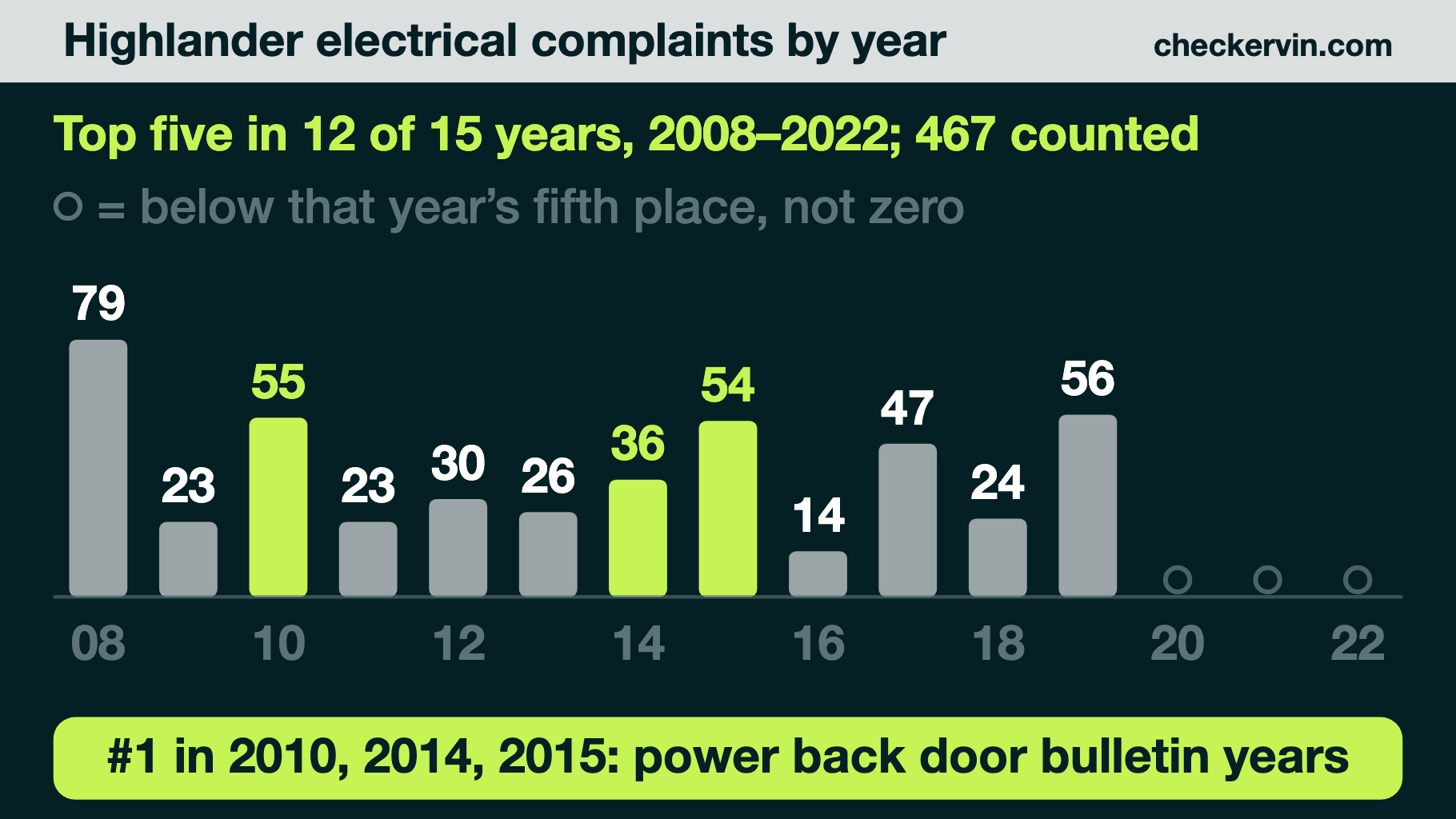
On the Highlander that ceiling is higher than on many Toyotas. The category makes the top five in 12 of 15 model years, adding up to at least 467 counted reports, about 11% of every complaint on the nameplate. That is a minimum, because a year only counts when the category reaches its top five. The tallest single bar is 2008, with 79 reports, though only in second place; reading those narratives, many are Highlander Hybrid shutdowns and brake-actuator faults that owners filed under electrical, plus wiring chewed by rodents.
It leads a model year 3 times: 2010, 2014 and 2015. Those years hold 145 electrical reports between them, 31% of everything counted. In 2010 the category is 23% of that year’s complaints. From 2020 on it drops out of the top five altogether (2020, 2021 and 2022), ranking below a fifth-place component carrying between 31 and 50 reports, while power train leads every one of those years. Below that line means below it, not zero.
The lead years: a back door, not a charging system
The three years the electrical system tops the Highlander’s record have something in common, and it is not the alternator. Reading the 2010 electrical narratives, the dominant story is a false warning that the rear hatch is open, with dome lights and chimes firing on turns, bumps or with a window down, along with liftgates that will not open or close and door locks that stop responding. Alternators come up only in passing.
Toyota acknowledged the liftgate side of that. In March 2017 it announced Warranty Enhancement Program ZG4 for the power back door on 2008–2013 Highlander and Highlander Hybrid models, roughly 402,500 vehicles, for a door that “may reach the fully closed position and then reverse to the open position” or closes with a pop or clunk. Coverage ran to October 25, 2018 regardless of mileage, then to 8 years or 150,000 miles from first use, so by its own terms it has now run out on these cars.
The 2014 and 2015narratives read similarly: door lock actuators failing one door after another, power liftgates that stop halfway or beep and reverse, and Entune screens that freeze and reboot. Toyota’s bulletin T-SB-0023-16 covers 2014–2015 Highlander and Highlander HV back doors that are “inoperative or stops during operation,” sometimes only in cold weather, and fixes them with a new door computer at 0.5 labor hours or a pair of liftgate actuators at 0.6 hours, under the 36-month, 36,000-mile basic warranty.
2017–2019: the battery is part of the charging job
The electrical system ranks #4, #5, #5across 2017, 2018 and 2019, and the narratives change character. Owners of V6 cars describe stalls at red lights with the engine auto-stopped, no-starts with a “brake power low” message, and batteries replaced earlier than they expected. One describes stalling at a light after the battery and alternator had both been checked.
Toyota’s tech tip T-TT-0523-19 explains part of the picture. Stop & Start is standard on V6 Highlander LE Plus, XLE, SE and Limited models from 2017 to 2019, and those cars need battery part number 28800-31550, an enhanced flooded battery “specially designed for deep discharges.” Toyota says no TrueStart battery is approved for them and that testers must be set to the EFB type. A wrong battery, or a right battery tested as the wrong type, is exactly the kind of fault that gets misread as an alternator.
Our battery size by VINpage reads the battery group from the build, and on a 2017–2019 car the label on the battery itself should show that Toyota part number.
What the recall record covers, and what it doesn't
We queried NHTSA’s recall database for every Highlander, Highlander HV and Highlander Hybrid model year from 2008 through 2022 and filtered for the electrical system, alternators, batteries and charging. Two campaigns filed under the electrical system came back, which shows the search can see them: 14V272000, airbag computer software on 2014 models, and 16V775000, a brake fluid level sensor left unplugged on some 2016 models. Neither touches the charging system.
No campaign in those fifteen years names the alternator, and no Toyota service bulletin we found for those years names it either, so no recall or bulletin pays for this part. Other campaigns may still be open on a given car, and the Toyota recall lookup by VIN shows which ones are unrepaired.
Signs it really is the alternator, and the cheap tests first
The alternator charges the battery while the engine runs. So the symptoms that point to it happen with the engine running: a battery or charging warning that stays on, lights that dim at idle and brighten when you rev, accessories cutting out on the road, and a battery that goes flat during a drive. A whine from the front of the engine or a squealing belt adds weight. A car that is fine on the road but dead in the morning points the other way, to the battery or a drain.
- Load-test the 12-volt battery after a full charge, using the EFB setting on a 2017–2019 Stop & Start car
- Run a charging-system test with the engine on; parts stores and dealers do it in minutes
- Inspect the accessory belt and tensioner: a glazed belt can under-charge a healthy alternator
- If the car dies only after sitting, test for a parasitic drain before touching the charging side
- If the warning is a door, lock or liftgate message, diagnose that system, not the alternator
- On a hybrid, ask for the hybrid-system codes and the part number before accepting an alternator quote
Reading a Highlander alternator quote
- Labor time in hours, the engine it is for, and whether that engine matches the VIN
- New Toyota, new aftermarket or remanufactured unit, and the warranty on each
- Core charge, and whether it is refunded when the old unit is returned
- Whether the belt is replaced and the tensioner inspected while everything is apart
- The test result that justified the part: battery, charging output, or drain
With labor this large a share of the bill, a second quote is worth more here than on most alternator jobs. Two shops quoting the same part with very different hours tells you one of them is using the wrong engine’s procedure.
If you are buying the Highlander, not repairing it
A charging fault is easy to check on the lot. Watch the dash for a battery or charging warning once the engine is running, operate the power liftgate several times, and try every door lock from the fob. On a 2008–2015 car, the liftgate and locks are where the federal record says the electrical money usually goes. On a 2017–2019 V6, ask when the battery was last replaced and with what.
The Toyota Highlander years-to-avoid breakdown scores each model year on the whole complaint record, where the power train dominates from 2017 on. A Toyota warranty check by VIN settles whether any factory coverage is left on a newer car.
Where this information comes from
- Toyota Warranty Enhancement Program ZG4 (NHTSA copy) — Power Back Door2008–2013 Highlander and Highlander Hybrid, about 402,500 vehicles; coverage terms quoted above.
- Toyota T-SB-0023-16 Rev1 (NHTSA copy) — Power Back Door Inoperative2014–2015 Highlander and Highlander HV; door computer or actuator replacement, 0.5–0.6 labor hours.
- Toyota T-TT-0523-19 Rev1 (NHTSA copy) — Highlander Stop & Start battery2017–2019 Stop & Start cars need EFB battery 28800-31550; which trims have the system.
- Toyota T-SB-0027-14 Rev1 (NHTSA copy) — HV and auxiliary battery maintenance2015–2016 Highlander HV: the 12-volt battery is charged by the hybrid battery.
- Toyota T-SB-0040-20 Rev1 (NHTSA copy) — HV and auxiliary battery maintenanceThe same statement for the 2021 Highlander HV.
- NHTSA recalls API — 2016 HighlanderReturns 16V775000, an electrical-system campaign; our 2008–2022 query found none for the alternator.
- RepairPal — Toyota Highlander alternator replacement estimateThe $978–$1,310 average quoted above, page updated September 3, 2026, retrieved November 2026.
Keep reading
Frequently asked questions
How much does it cost to replace the alternator on a Toyota Highlander?
RepairPal's Highlander alternator estimator lists an average of $978 to $1,310, before taxes and fees and without adjusting for location, on a page marked as updated September 3, 2026 and retrieved in November 2026. Its year pages spread wider: $873 to $1,419 for a 2014, with labor at $439 to $644, and $1,334 to $1,648 for a 2022, with labor at $671 to $985. Those labor bands are two to four times what the same estimator shows for a Camry, so ask any shop which engine its labor time is for.
What are the common signs of a failing Toyota Highlander alternator?
A battery or charging warning that stays lit with the engine running, headlights and dash lights that dim and brighten with engine speed, a battery that goes flat while you drive rather than overnight, a whine from the front of the engine, and a squealing or glazed accessory belt. A Highlander that dies only after sitting points to a drain or a tired battery first. On a 2017–2019 V6 with Stop & Start, a weak battery can also cause stalls at lights and no-start messages that look like a charging fault.
How long does an alternator last in a Toyota Highlander?
Toyota publishes no replacement interval for it; the alternator is replaced when it fails a test, not on a schedule. The federal complaint record cannot answer the question either, because NHTSA has no alternator category, and Highlander owners describing electrical faults name batteries, liftgates and door locks far more often than alternators. Rather than replacing one on age, have the charging system tested whenever the battery is replaced or a warning appears.
Does the Toyota Highlander Hybrid have an alternator?
Not a belt-driven one. Toyota's storage bulletins for the 2015–2016 and 2021 Highlander Hybrid say the 12-volt auxiliary battery is charged by the hybrid battery regardless of whether the gasoline engine is running. If a shop quotes an alternator for a Highlander Hybrid, ask for the part number, because the 12-volt side is fed through the hybrid system and a fault there is a hybrid diagnosis with its own codes and price.
Is there a recall or warranty extension for the Highlander alternator?
No. We checked NHTSA's recall database for every 2008–2022 Highlander and Highlander Hybrid and found no campaign naming the alternator or charging system, and no Toyota service bulletin for those years names the part. The Highlander's best-known electrical warranty extension, program ZG4, covered the power back door on 2008–2013 models and has run out by its own terms. A Toyota warranty check by VIN shows whether any factory coverage is left on a newer car.
Know the engine before you price the alternator
A free CheckerVIN report shows the factory build, engine, specifications and open recalls for any VIN, so you know whether you are pricing a V6 alternator, a four-cylinder one, or a hybrid with no belt-driven alternator at all.
Run a free VIN check