The short answer
- What does it cost?
- RepairPal lists $527–$814 on average for a Corolla alternator, with only $113–$166 of it labor. The part is most of the bill.
- Which years matter?
- 2009–2010 Corollas with the 1.8L engine have a Toyota bulletin for a badly seated alternator pulley. The federal electrical record is small in every year.
- What about the hybrid?
- A Corolla Hybrid has no conventional alternator; the hybrid system charges its 12-volt battery. An alternator quote for one is a misquote.
$527–$814
RepairPal Corolla alternator average
Retrieved Oct 2026, before tax
0.7 hr
Toyota's labor time to swap it
T-SB-0004-11, 2009–2010 1.8L
6 of 14
Years electrical makes the top five
2008–2021 Corolla, federal complaints
Never
Years electrical ranks first
The category covers far more than the alternator
The numbers, and whose numbers they are
RepairPal publishes the most specific figure for this car. Its Toyota Corolla alternator estimator puts the average job at $527 to $814, made up of about $113 to $166 in labor and $414 to $648 in parts, before taxes and fees and without adjusting for where you live. The page is marked as last updated September 3, 2026, and we retrieved it in October 2026. RepairPal blocks direct fetches, so we read its figures as served in two separate searches; both showed the same numbers.
The labor band is the telling part. Toyota’s own warranty table for the 2009–2010 Corolla books 0.7 hours to remove and replace the alternator assembly on the 1.8-liter engine, and RepairPal’s narrow labor range points the same way. That leaves the unit itself, new Toyota, new aftermarket or remanufactured, as the line that moves the total. We sell VIN checks, not repairs, and publish no price of our own. What follows is which Corollas carry which alternator, which year has a factory bulletin, and what the complaint record says owners actually run into.
The Corolla’s sibling has its own write-up: the Camry alternator cost post covers a bigger split between four-cylinder and V6 labor and the 2020 Camry’s battery drain. Most of that does not carry over here, for reasons the sections below make specific.
What 6,096 federal complaints say about the electrical system
Our corpus holds 6,096 NHTSA owner complaints against the 2008–2021 Corolla, and each model year keeps its five most-reported components. NHTSA has no alternator category. The nearest is the electrical system, which also takes in the 12-volt battery, wiring, lighting, door locks, screens and electronic modules. It is a ceiling on alternator trouble, not a measure of it.
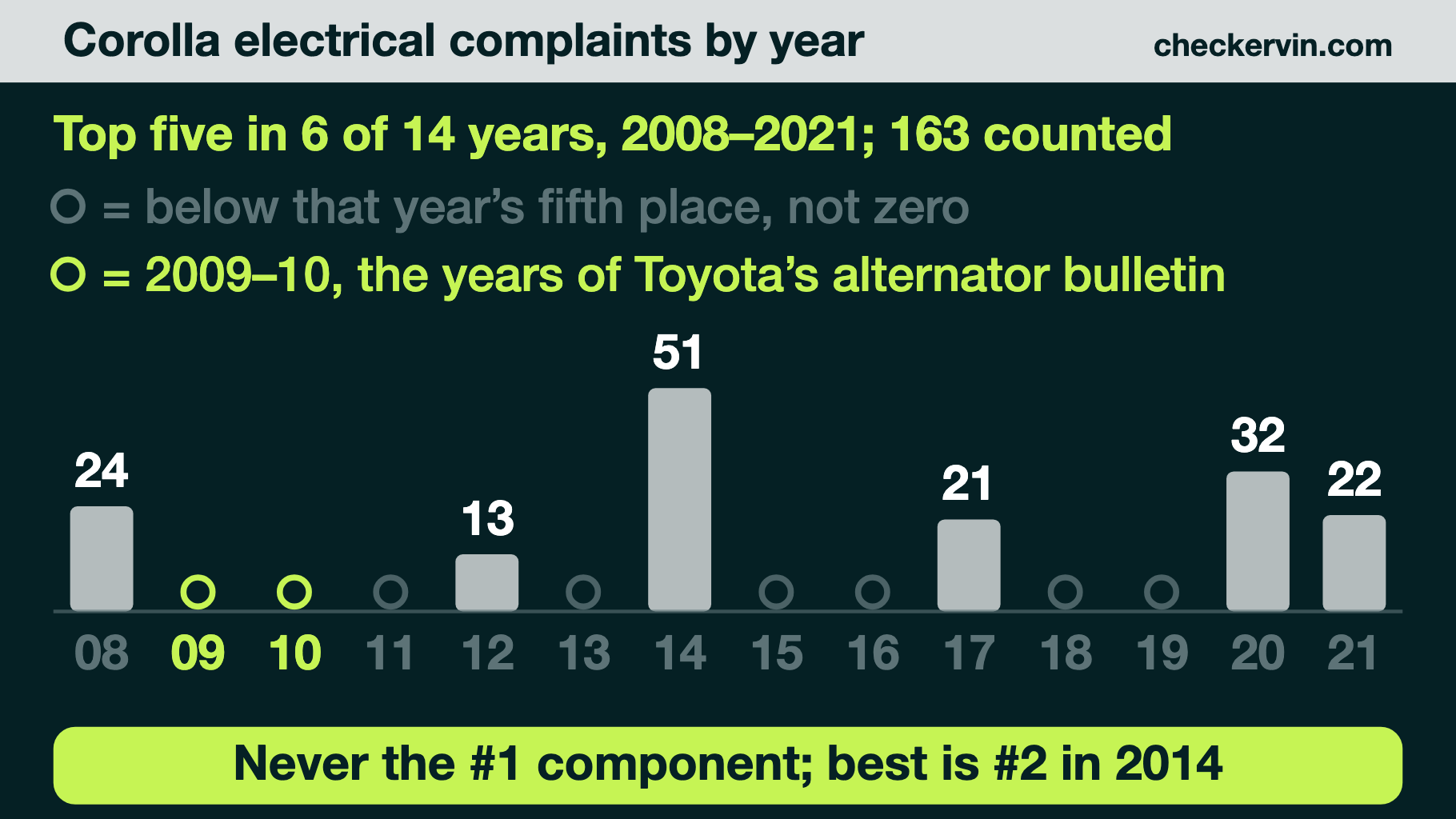
On the Corolla that ceiling is low. The electrical system makes the top five in 6 of 14 model years (2008, 2012, 2014, 2017, 2020 and 2021), for at least 163 counted reports, about 2.7% of all complaints on the nameplate. It never ranks first in any year. Its highest point is 2014, with 51 reports, second place and 19% of that year’s complaints. In the other years it ranks below a fifth-place component, which means “below that line,” not zero.
That matters most for 2009 and 2010, the two years Toyota’s alternator bulletin covers. Together they hold 2,796 complaints, 46% of the nameplate’s total, and the electrical system appears in neither year’s top five, where the fifth-place component carries 104 and 104 reports respectively. Both years are led by air bags complaints. The charging trouble is in there, as the next sections show, but it is buried under bigger stories, and some of it is not even filed under electrical.
Which Corolla, which engine, which alternator
Between 2008 and 2021the Corolla used more engines than most buyers realize. EPA’s fueleconomy.gov listings by year give the displacements; the VIN tells you which one a given car has.
| Model years and engine | Alternator |
|---|---|
| 2008, 1.8L four (1ZZ-FE) | Belt-driven; factory procedure not reviewed here |
| 2009–2010, 1.8L four (2ZR) | Belt-driven; Toyota bulletin T-SB-0004-11 and a 0.7-hour swap |
| 2009–2011, 2.4L four (2AZ-FE) | Belt-driven; not covered by the 2ZR bulletin |
| 2011–2019 sedan, 2017–2018 iM, 2020–2021 L, LE and XLE, 1.8L four | Belt-driven; factory procedure not reviewed here |
| 2019–2021 Hatchback, 2020–2021 sedan upper trims, 2.0L four | Belt-driven; ask the shop for its labor time |
| 2020–2021 Corolla Hybrid, 1.8L hybrid | No conventional alternator; the hybrid system charges the 12-volt battery |
The 2.4-liter is easy to miss. It came with the sportier 2009–2011 trims, and fueleconomy.gov lists it for all three years alongside the 1.8. Its alternator is a different part on a different engine, and the 2011 bulletin does not apply to it. We looked at the Corolla 2.4-liter removal procedure but it is published as diagrams only, so we will not characterize it. Our engine size by VIN lookup reads the engine from the factory record, and the Toyota VIN decoder adds trim and plant, which matters for the bulletin below.
2009–2010: the alternator bulletin, and what it fixed
Toyota issued T-SB-0004-11 on January 5, 2011, titled “Alternator Inoperative and/or Abnormal Noise.” It applies to 2009–2010 Corollas with the 2ZR engine and describes three symptoms: the charging-system warning light on, the alternator not working, or an abnormal noise from the engine compartment. Toyota’s stated cause is that the pulley may not be seated correctly, and its fix is an updated alternator. The bulletin swaps two earlier part numbers, 27060-37040 and 27060-0T040, for 27060-37041 and 27060-0T041.
It only reaches cars built before a production change, and it lists the change point by plant: NUMMI in California, TMMC in Ontario, and Takaoka and Kanto in Japan, each with its own cut-off VIN. The 11th character of the VIN identifies the plant, so the VIN decoderanswers half the question and a dealer can answer the rest. The labor line is op code 271011, “R & R Alternator Assembly,” at 0.7 hours.
NHTSA’s own index summarizes this bulletin as applying to “2009-2011 Corolla” but links it only to 2009 and 2010 cars and hosts no copy of the document. We go by the bulletin’s applicability table, which says 2009–2010.
Why a dead Corolla alternator feels like a steering failure
The 2009–2010 owner narratives that name the alternator share a pattern, and it explains why a lot of them never landed in the electrical category. The 2009–2010 Corolla has electric power steering, which draws on the car’s 12-volt supply. When the alternator stops charging, the battery carries the car for a while, then voltage sags. Owners describe the battery and ABS lights coming on, the steering going suddenly heavy, and then the engine stalling. In those reports, dealers and independent mechanics traced it to the alternator.
Because the first thing the driver feels is the steering, many of those complaints were filed under steering or stability control rather than electrical. That is one more reason the bars above understate charging trouble in exactly the years where it clustered. A handful of the same narratives describe a leaking water pump soaking the accessory belt and the alternator, so a shop replacing one should look at the other.
Corolla Hybrid: there is no alternator to replace
The Corolla Hybrid arrived for 2020 with a 1.8-liter engine, and like other Toyota hybrids it has no belt-driven alternator charging its 12-volt battery. Toyota’s storage bulletin T-SB-0006-19 lists the 2020 Corolla Hybrid, says hybrids carry two batteries, the hybrid pack and a 12-volt auxiliary battery, and tells dealers to keep the hybrid system on for 30 minutes in Park “in order to charge the HV battery and the auxiliary battery.” The Camry postquotes Toyota’s hybrid emergency response guide on the DC-DC converter that does the charging; we could not find the equivalent guide for the Corolla Hybrid, because Toyota’s official host requires a login.
A note on the data. NHTSA does file a separate “Corolla Hybrid” model name, but almost nothing is filed under it. Hybrid owners’ reports mostly sit in the plain Corolla file, so our 2020 and 2021 figures pool gas and hybrid cars, as they pool the hatchback.
Newer Corollas: dead batteries that are not the alternator
The electrical category returns to the top five in 2020 and 2021, with 32 and 22reports. Reading them, very little is about charging. Many are “engine maintenance required” messages that trace to the electrically operated coolant bypass valve, which owners filed under electrical. Others are telematics faults: the SOS button flashing, the communication module failing, hands-free calls cutting out. A few are dead batteries.
The dead-battery stories have a documented cause on some of these cars, the same one the Camry had, but with a narrower list. Toyota’s T-SB-0095-20 covers a “depleted 12V vehicle battery when in IG-OFF” on the 2020–2021 Corolla Hatchback and on 2021 Corolla and Corolla Hybrid models, fixed with a telematics-module reset and firmware update at 0.8 labor hours. The 2020 Corolla sedan is not on the list. Separately, a 2019 Toyota tech tip, T-TT-0531-19, warned that Japan-built 2020 Corollas could arrive with a drained battery if a shipping fuse had not been installed, which is a pre-delivery problem and nothing to do with the alternator.
The 2014 peak in the chart has nothing to do with charging either. That year’s electrical narratives are dominated by touchscreen radios stuck in a reboot loop and failing door-lock actuators.
What the recall record covers, and what it doesn't
We queried NHTSA’s recall database for every Corolla model year from 2008 through 2021, plus the Corolla Hybrid name for 2020 and 2021, and filtered for the electrical system, alternators, generators, batteries and charging. Nothing came back. To check that the filter can see such campaigns, we ran it on the 2012 Camry, where it returns an electrical-system campaign, 13V442000. The Corolla’s campaigns in these years are mostly airbags, plus accelerator pedals, power windows, fuel pumps and a long tail of others, none of them charging.
So no recall pays for a Corolla alternator, including on the bulletin years. Most Corolla years still carry other campaigns, and the Toyota recall lookup by VIN shows which are unrepaired on a specific car. If one turns up on a car you are buying, read buying a car with an open recall before you negotiate.
Test before you buy the part
The alternator is a modest bill on this car, but it is still the expensive guess next to a battery or a belt. Each check below is cheap or free, and any one of them can end the hunt.
- Load-test the 12-volt battery after a full charge; a battery that fails here is the problem
- Run a charging-system test with the engine on; parts stores and dealers do it in minutes
- Listen for noise at the alternator pulley and check the accessory belt for glazing or coolant contamination
- On a 2009–2010 1.8L, ask whether the installed alternator predates the T-SB-0004-11 part numbers
- If the car dies only after sitting, test for a parasitic drain before touching the charging side
- On a 2021 Corolla or a 2020–2021 Hatchback, ask whether the T-SB-0095-20 module update is on record
Battery fit matters as well. A replacement of the wrong group size or capacity shortens its own life, and our battery size by VINpage reads the right one from the car’s build.
Reading a Corolla alternator quote
- Which engine the part and labor are for, and whether that matches the VIN
- New Toyota, new aftermarket or remanufactured unit, and the warranty on each
- Core charge, and whether it comes back when the old unit is returned
- Labor hours; Toyota's own figure for the 2009–2010 1.8L is 0.7
- Whether the belt is being replaced while it is off
- The test result that justified the part: battery, charging output, or drain
A quote with two or more hours of labor on a 1.8-liter deserves a question. A quote with no test result behind it deserves two. On a hybrid, a quote with an alternator on it should not exist.
If you are buying the Corolla, not repairing it
The alternator is one of the cheaper things that can be wrong with a used Corolla, and on a 2009–2010 one of the more important to check. Start the car cold, watch for a battery or charging light once it is running, and turn the wheel at a standstill: on these years, heavy steering with a lit battery light is the charging system, not the rack. Ask for any alternator receipt and its part number.
The Toyota Corolla years-to-avoid breakdown scores each model year on the whole complaint record, where airbags, steering and speed control outrank the electrical system in most years. A Toyota warranty check by VIN settles whether any factory coverage remains on a newer car. If you are pricing other routine work on the same car, the Corolla transmission fluid post covers which Corolla transmissions need the service and when.
Where this information comes from
- Toyota T-SB-0004-11 — Alternator inoperative and/or abnormal noise (workshop-manuals.com copy)2009–2010 Corolla 2ZR: pulley not seated correctly, updated alternator, 0.7 labor hours, production-change VINs by plant.
- Toyota T-SB-0095-20 Rev2 (NHTSA copy) — DCM reset and firmware updateDepleted 12-volt battery with the car off on the 2021 Corolla and Corolla Hybrid and 2020–2021 Corolla Hatchback; 0.8 hours.
- Toyota T-SB-0006-19 (NHTSA copy) — HV and auxiliary battery maintenanceLists the 2020 Corolla Hybrid; the hybrid system charges the 12-volt battery, with no alternator involved.
- Toyota T-TT-0531-19 (NHTSA copy) — 2020 Corolla battery discharge in shippingA missing shipping fuse could drain new Japan-built 2020 Corollas; a pre-delivery issue, not a charging fault.
- NHTSA recalls API — 2009 CorollaOne of the fourteen model-year queries behind this page; none of the 2008–2021 Corolla campaigns concern charging.
- EPA / DOE fueleconomy.gov — Corolla engines by model yearSource for which displacements each Corolla year and variant offered, including the 2009–2011 2.4L.
- RepairPal — Toyota Corolla alternator replacement estimateThe $527–$814 average quoted above, page updated September 3, 2026, retrieved October 2026.
Keep reading
Frequently asked questions
How much does it cost to replace the alternator on a Toyota Corolla?
RepairPal's Corolla alternator estimator lists an average of $527 to $814, with labor at about $113 to $166 and parts at about $414 to $648, before taxes and fees and without adjusting for location. That is its figure, from a page marked as updated September 3, 2026 and retrieved in October 2026. Most of the bill is the part. Toyota's own bulletin for 2009–2010 Corollas books 0.7 labor hours to remove and replace the alternator on the 1.8-liter engine, which is why the labor share stays small.
Is there a known alternator problem on the 2009–2010 Toyota Corolla?
Yes, a documented one. Toyota bulletin T-SB-0004-11, dated January 5, 2011, covers 2009–2010 Corollas with the 1.8-liter 2ZR engine built before a production change: a charging warning light, a dead alternator or an abnormal noise, which Toyota says may be caused by the pulley not being seated correctly. The fix is an updated alternator assembly. It was covered for 36 months or 36,000 miles, so every affected car is now outside that coverage, but the bulletin tells you which part number to ask for.
Does the Toyota Corolla Hybrid have an alternator?
No conventional one. The hybrid system charges the 12-volt auxiliary battery. Toyota's storage bulletin T-SB-0006-19, which lists the 2020 Corolla Hybrid, tells dealers to leave the hybrid system on for 30 minutes in Park to charge both the hybrid battery and the 12-volt battery. If a shop quotes an alternator for a Corolla Hybrid, ask for the part number, because it is pricing something other than what the car has.
Are alternator problems common on the Toyota Corolla?
Not by the federal record. NHTSA has no alternator category; the closest is the electrical system, which also covers batteries, wiring, screens, locks and modules. On the 2008–2021 Corolla that whole category reaches a model year's top five in only 6 of 14 years and never ranks first. Owner narratives that name the alternator cluster in 2009 and 2010, the years Toyota's bulletin covers.
Why does my 2021 Toyota Corolla battery keep dying?
Check one bulletin before anything else. Toyota T-SB-0095-20 lists a depleted 12-volt battery with the car switched off on 2021 Corolla and Corolla Hybrid models and 2020–2021 Corolla Hatchbacks, and the fix is a reset and firmware update of the telematics module, booked at 0.8 hours. The 2020 Corolla sedan is not on that list. Toyota covered the update under its 36-month or 36,000-mile basic warranty. Either way, a battery that dies while parked points to a drain, not to the alternator.
Know the engine before you price the alternator
A free CheckerVIN report shows the factory build, engine, specifications and open recalls for any VIN, so you know whether you are pricing a 2009–2010 bulletin car, a 2.4-liter, or a hybrid with no alternator at all.
Run a free VIN check