The short answer
- What does it cost?
- Kelley Blue Book says $409 to $919 including parts and labor. Quotes that add the water pump, idlers and tensioner run higher.
- Which Foresters have a belt?
- Non-turbo Foresters through the 2010 model year and turbo XTs through 2013. Every newer Forester uses a timing chain.
- And the 2011?
- A 2011 2.5X has a chain. A 2011 2.5XT turbo kept the older belt-driven engine family, so check which one you have.
The price, and whose price it is
We sell VIN checks, not repairs, so every dollar figure on this page comes from someone else. Kelley Blue Book’s timing belt page for the 2010 Forester says you can expect to pay $409 to $919, including parts and labor. We read that on November 22, 2026. The same page’s location-based Fair Repair Range showed “not yet available” when we loaded it without a ZIP code, so the $409–$919 line is the only KBB figure we can repeat.
One detail tells you how much weight to put on any price survey for this job. KBB’s timing belt page for the 2021 Forester carries the identical $409–$919 sentence, and a 2021 Forester has no timing belt. Generic price pages are built for every model year whether or not the part exists. Before comparing quotes, confirm that the car in front of you has a belt at all. The rest of the live search results for this query are owner threads, social posts and question-and-answer sites, plus one estimator that prices UK cars in pounds. We could not read those figures on their own pages or they did not apply to US cars, so none are repeated here.
Which Foresters have a timing belt
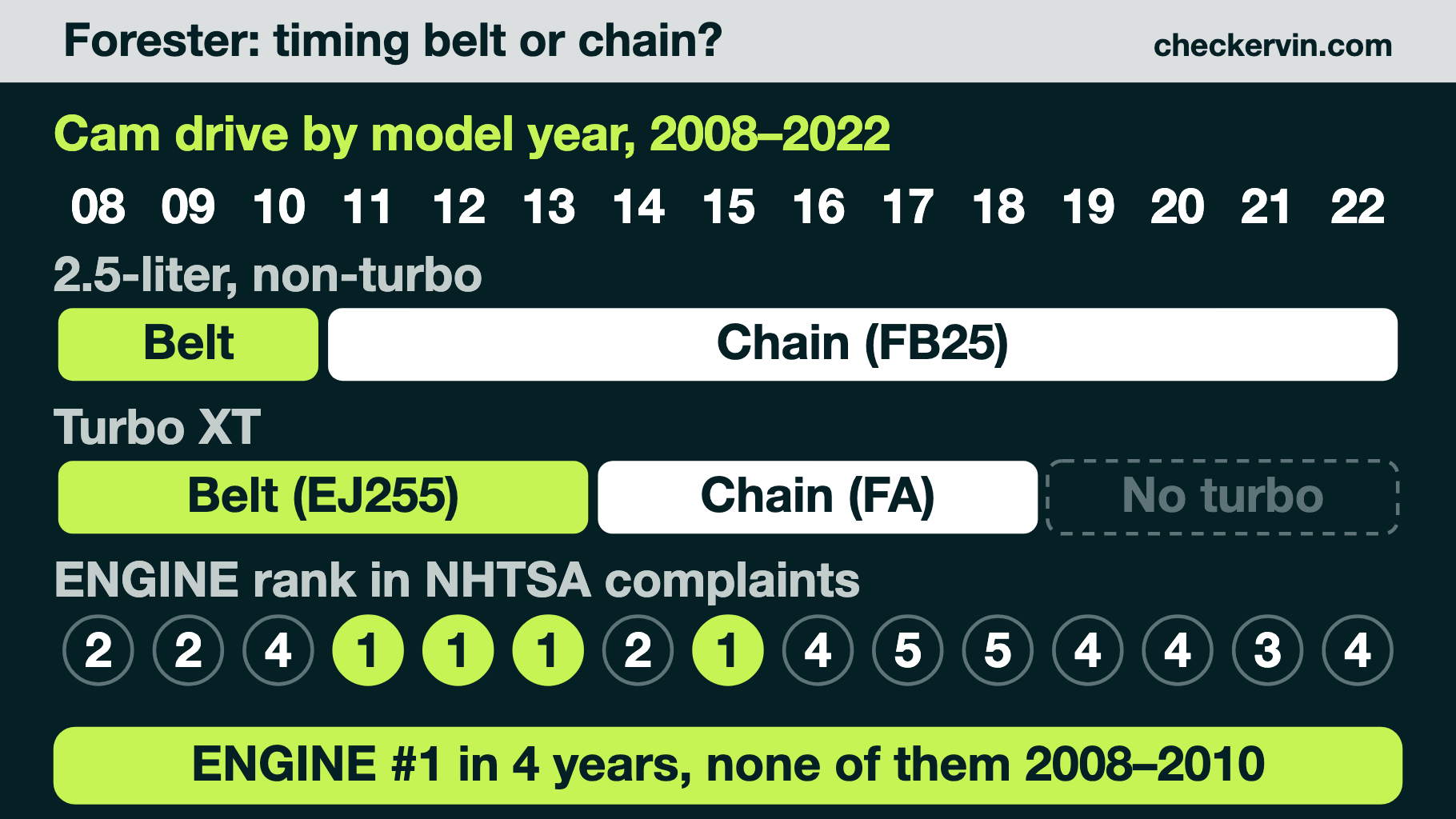
Our complaint data covers the 2008–2022 Forester, and across those years the answer splits by engine, not just by year. Subaru’s own documents settle most of it. The 2010 Forester owner’s manual lists two engines: the EJ253, a 2.5-liter single-overhead-cam non-turbo, and the EJ255, a 2.5-liter double-overhead-cam turbo. Subaru’s 2012 Forester press kit then describes the non-turbo engine introduced for 2011 as a double-overhead-cam design whose camshafts are “chain driven vs. belt-driven before,” which pins the belt on the earlier non-turbo car and the chain on everything after it.
| Forester | Cam drive |
|---|---|
| 2008–2010 2.5X, non-turbo (EJ253) | Timing belt |
| 2008–2013 2.5XT, turbo (EJ255) | Timing belt (see the 2011 section) |
| 2011–2022 2.5-liter non-turbo (FB25) | Timing chain |
| 2014–2018 2.0XT, turbo (FA-series) | Timing chain |
The turbocharged side moved later. Subaru’s bulletins show a turbo 2.5 in the 2009–2013 Forester and a 2.0-liter turbo in the 2014 and later XT, and its 2021 bulletin 02-188-21 covers timing chain and cam sprocket work on “FA and FB type engines” in the 2011–2022 Forester. After 2018 there is no turbo Forester in our data at all. The timing belt or chain check and the engine lookup by VIN tell you which row a specific car belongs in.
2011: the changeover year, and the one exception
The 2011 model year is where most confusion starts, and the question “does a 2011 Forester have a timing belt or chain” has two answers. The non-turbo 2011 Forester 2.5X has a chain. Besides the press kit, Subaru’s Service Bulletin 02-131-12R is addressed to “2011-2012MY Forester Models with FB Engine” and walks technicians through oil seepage at “the front timing chain cover.” A belt engine has no such cover.
The 2011–2013 Forester 2.5XT is the exception. Subaru’s press materials describe it separately, as a turbocharged and intercooled 2.5-liter, and attach the chain sentence only to the 2.5X. The FA and FB chain bulletins do not cover it, and 02-131-12R is scoped to the FB engine. Parts listings pair a timing belt with the 2004–2013 Forester XT. We could not open Subaru’s own parts catalog to confirm that, because it refused automated requests, so treat a 2011–2013 XT as a belt car and have a dealer confirm it by VIN before you pay for, or skip, a belt job.
How often the belt should be changed
This is the part of the job where the paperwork matters most, and the source most worth having is the one we could not get. Subaru puts the schedule for these cars in a separate Warranty and Maintenance Booklet. The 2010 owner’s manual refers to it, and Subaru’s 2010 warranty page says the recommended services are listed “at the back of this Booklet,” but neither links to a copy.
The closest reproduction we found is on cars101.com, an unofficial Subaru research site that says it is not approved by Subaru. Its schedule table marks the 2.5-liter four-cylinder timing belt to be replaced at 105,000 miles or 105 months, with inspections at 30, 60 and 90. That is a guide, not Subaru’s own text. A Subaru dealer can print the factory schedule for a specific VIN, and the months matter as much as the miles: a 2010 Forester with 70,000 miles is far past 105 months.
Chain Foresters have no scheduled chain replacement in anything Subaru published that we read. Its press kit sells the change on exactly that point, saying the chain-driven camshafts reduce servicing costs.
What belongs in the same job
Most of a timing belt bill is labor to strip the front of the engine. Once the covers are off, the parts that ride with the belt cost little by comparison, which is why many shops quote them as a kit. On these engines the water pump is part of that list. The 2010 owner’s manual’s drive-belt diagram shows the power steering pump, alternator and air conditioning compressor on the outside belts and no water pump; on these EJ engines the pump sits behind the timing covers and is driven by the timing belt.
| Line on the quote | Why it is there |
|---|---|
| Timing belt | The scheduled item itself |
| Tensioner and idler pulleys | Worn bearings can let the new belt fail early |
| Water pump | Driven by the belt; replacing it later repeats the labor |
| Cam and crank seals | An oil leak onto a new belt shortens its life |
| Coolant | Needed anyway once the water pump is out |
Ask which of these lines a quote includes, because two prices for “a timing belt” can describe very different jobs. A belt-only price will look cheap next to a full kit, and a belt-only job on a high-mileage car can leave an original water pump behind a brand-new belt. For a Forester due for both a belt and head gaskets, doing them together avoids paying the access labor twice.
If the belt breaks
A broken timing belt stops the engine immediately, so the car needs a tow. Whether it also damages the valves depends on whether the engine is an interference design, where open valves and rising pistons share the same space. We did not find a Subaru document that states this for the EJ253 or EJ255, and we could not confirm it from another reliable source, so we will not tell you a snapped belt is harmless.
The practical answer does not change: plan the belt by its schedule, not by waiting for symptoms. A worn belt rarely announces itself. Shops look for cracks, glazing and missing teeth during an inspection, and for oil or coolant on the belt, which points back to the seals and water pump listed above. The 2010 warranty page shows Subaru counted “timing belts or gears and covers” under the 5-year or 60,000-mile Powertrain Limited Warranty, and every belt-era Forester is long past it.
What 5,090 complaints show, and what they cannot
Our corpus holds 5,090 federal NHTSA complaints against the 2008–2022 Forester. ENGINE is one of the top five complaint categories in 15 of those 15 model years, so every year contributes a count, and we counted 752 engine complaints in all. That category covers every engine fault, from misfires and oil leaks to mounts, so it is an upper bound on engine trouble and not a count of timing belts.
Split by cam drive, the picture runs against the idea that belts are the Forester’s weak spot. The 2008–2010 years, when every Forester sold had a belt, hold 68 engine complaints, 9% of the total. The 2011–2013 years, mostly chain cars with belt-driven turbos alongside, hold 114. The 2014–2022 years, all chain, hold 570, or 76%. The busiest single year is 2015, at 131.
Rank tells the same story. ENGINE was the most-complained-about category for the 2011, 2012, 2013 and 2015 Foresters, and in none of the all-belt 2008–2010 years. In 2008 it ranked second, and in 2010 fourth. When we searched the complaint narratives NHTSA publishes for each Forester year for the words “timing belt,” the matches were rare: a 2008 whose belt was replaced during a head gasket repair, a 2009 whose owner says a timing belt pulley failed before the belt was due and the dealer quoted extensive engine repair or replacement, and the 2011 owner above. There is no belt-failure pattern in the federal record. A Forester timing belt is a maintenance bill, not a defect, though the 2009 account is a fair argument for replacing the pulleys along with the belt.
Chain cars: no belt to buy, other things to watch
A chain does not make the front of a 2011-or-later engine maintenance-free, and Subaru’s bulletins show where the work goes instead. Bulletin 02-131-12R covers oil seepage from the front timing chain cover, camshaft carriers and upper oil pan on 2011–2012 FB engines. A 2020 bulletin announces a special tool to remove the front timing chain cover on FA and FB engines, and 02-188-21 adds a procedure for timing chain and cam sprocket replacement for the rare case of a sprocket lock pin left out of position. Neither treats chain replacement as routine.
The engine problem most often linked to these years is oil consumption, covered in our head gasket post and not repeated here. For a chain Forester, the useful habits are cheaper than a belt kit: change the oil on time with the specified grade, since the chain and its tensioner live in engine oil, and have oil wetness around the front cover looked at early, since resealing that cover is a large job of its own.
Recalls and bulletins: what pays for what
We queried NHTSA’s recall records for every Forester model year from 2008 through 2022, and the campaign counts matched our own data year for year. No campaign names a timing belt, timing chain, tensioner or water pump. The three engine-and-cooling campaigns are 08V460000, a turbocharger oil supply pipe on certain 2009 Foresters; 16V162000, a turbocharger intake duct on certain 2015–2016 models; and 19V856000, a PCV valve on certain 2019 models.
| Program | Does it pay for a timing belt? |
|---|---|
| Safety recall | No Forester campaign covers the belt or chain |
| Service bulletin (02-131-12R, 02-188-21) | Repair instructions; pays nothing outside warranty |
| Powertrain Limited Warranty | Listed timing belts, but 5 years / 60,000 miles has long run out |
| Scheduled maintenance | The owner pays; this is where a belt job falls |
Running the VIN is still worth doing, because several Forester years carry open recalls on other systems, from airbag inflators to brake lines. The Subaru recall check shows which remain unrepaired on a specific car.
Before you authorize the repair
- Confirm the engine by VIN: belt on 2008–2010 non-turbo and 2008–2013 turbo, chain on everything newer
- Ask whether the quote includes the water pump, tensioner, idlers and seals, or the belt alone
- Ask whether the shop found oil or coolant on the old belt, and where it came from
- On an EJ car due for head gaskets too, ask for a combined price
- On a chain car, decline any 'timing belt' line and ask what the shop actually found
The first and last items save the most money. A shop that quotes a timing belt on a 2014 Forester has either made a clerical error or means a different job, and both deserve a question before a signature. The second item is where honest quotes for the same EJ car diverge by hundreds of dollars.
If you are buying the Forester, not repairing it
For a 2008–2010 Forester, or a turbo XT through 2013, the belt is part of the asking price. Ask for a receipt showing the belt (and ideally the water pump) was replaced, with the date and mileage. No receipt means pricing the car as if the job is still due. Service history is held by dealers and shops, not in any federal database; our maintenance report guide explains where records can be found. A Subaru VIN decode confirms the model year, trim and engine in one step.
For a 2011-or-later non-turbo or a 2014-or-later turbo, skip the belt question and look at the rest of the record. The Subaru Forester years-to-avoid breakdown covers complaints by model year well beyond the engine, and the Subaru warranty check by VIN helps estimate whether a newer car still has factory coverage.
Where this information comes from
- Subaru — 2012 Forester press kitThe 2011-introduced 2.5-liter is DOHC with camshafts 'chain driven vs. belt-driven before'; the turbo XT is described separately.
- Subaru Service Bulletin 02-131-12R (NHTSA copy)Addressed to 2011–2012 Foresters with the FB engine; covers oil seepage at the front timing chain cover.
- Subaru Service Bulletin 02-188-21 (NHTSA copy)Timing chain and cam sprocket procedure for FA and FB engines, 2011–2022 Forester.
- Subaru bulletin — FA/FB front timing chain cover removal (NHTSA copy)Special tool for chain-cover work on FA and FB engines.
- NHTSA — recalls by VINOur year-by-year query found no Forester recall naming a timing belt, chain, tensioner or water pump.
- NHTSA — vehicle complaintsThe federal complaint database our engine counts and ranks are computed from.
- Subaru Canada — 2010 Forester Owner's ManualLists the EJ253 SOHC non-turbo and EJ255 DOHC turbo engines; defers the schedule to the Warranty and Maintenance Booklet.
- Subaru — 2010 warranty informationPowertrain Limited Warranty, 5 years / 60,000 miles, lists timing belts.
- Kelley Blue Book — 2010 Forester timing belt replacementThe $409–$919 parts-and-labor range, retrieved November 22, 2026.
- cars101.com — Subaru maintenance schedule (unofficial)Schedule table marking the 2.5-liter timing belt for replacement at 105,000 miles or 105 months; not a Subaru publication.
Keep reading
Frequently asked questions
How much does a Subaru Forester timing belt replacement cost?
Kelley Blue Book's Forester timing belt page says you can expect to pay $409 to $919 including parts and labor, a figure we read on November 22, 2026; it is KBB's number, not ours. That range applies only to Foresters that have a belt: non-turbo models through 2010 and turbo XT models through 2013. Many shops quote the job with the water pump, idlers and tensioner, which raises the bill above a belt-only price.
Does a 2011 Forester have a timing belt or chain?
The non-turbo 2011 Forester 2.5X has a timing chain. Subaru's 2012 Forester press kit says the 2.5-liter engine introduced for the 2011 model year has camshafts that are chain driven instead of belt driven, and Subaru's bulletin 02-131-12R covers the timing chain cover on 2011–2012 Foresters with the FB engine. The turbocharged 2011 Forester 2.5XT is different: it kept an EJ-series engine, which parts listings pair with a timing belt. Have a dealer confirm by VIN if you are unsure which one you have.
How often should a timing belt be replaced on a Subaru Forester?
We could not obtain Subaru's own Warranty and Maintenance Booklet for these years. An unofficial Subaru research site, cars101.com, reproduces a schedule that marks the 2.5-liter timing belt for replacement at 105,000 miles or 105 months, with inspections at 30, 60 and 90. Treat that as a guide and confirm with a Subaru dealer. Foresters from 2011 on (non-turbo) and 2014 on (turbo) have a timing chain with no scheduled replacement in Subaru's materials, which describe the switch as reducing servicing costs.
What year Subaru Forester should you stay away from?
That depends on which problem worries you, but the timing belt is not a reason to avoid any year. In the federal complaint record, engine complaints ranked first among all complaint categories for the 2011, 2012, 2013 and 2015 Foresters, all 2011 or later, after the non-turbo engine moved to a chain. The 2008–2010 belt cars carry 9% of the nameplate's counted engine complaints. Our Forester problems page breaks the record down year by year.
How many miles should a 2009 Subaru Forester last?
We do not have mileage-survival data, and nobody can promise a number for a car that is now well over a decade old. What decides it is upkeep: a 2009 non-turbo Forester has a belt-driven engine, so ask for proof the belt was replaced on schedule, and check for the head gasket seepage these engines are known for. A 2009 with a documented belt, water pump and gasket history is a different car from one with no records at the same mileage.
Find out if your Forester has a belt
A free CheckerVIN report shows the factory build, engine, specifications and open recalls for any VIN, so you know whether a timing belt quote applies to your car at all.
Run a free VIN check