The short answer
- What does it cost?
- RepairPal's per-year figures range from roughly $172-$223 on older cars to $564-$646 on 2017 and 2019+ models; its general estimate is $474-$518. Published estimates, not ours.
- Did Subaru cover this under warranty?
- Subaru extended the CVT powertrain warranty for 2014-2015 Foresters (among other models) to 10 years/100,000 miles, with a July 31, 2018 deadline to inspect or repair — a specific two-year window, per CarComplaints.com and Forbes.
- Which years carry the complaint history?
- 2015-2016 hold 89.4% of every POWER TRAIN complaint in the nameplate's 15-year record, at roughly 35.3x the rate of the thirteen other model years.
The numbers, and whose numbers they are
RepairPal’s general estimate for a Subaru Forester transmission fluid change is $474 to $518. Its own per-year breakdown spreads much wider than that single range suggests: roughly $172 to $223 on a 2007, $295 to $341 on a 2018, and $564 to $646 on a 2017 or a 2019 through 2024 model. Every figure here is attributed to whoever published it; we sell VIN checks, not repairs, and price none of this ourselves.
None of those estimator pages asks the question this page is actually about: which model year is under the hood, and whether that specific year sits inside the window Subaru itself flagged as a CVT risk. The complaint record treats Forester model years very differently from each other, and the difference is sharp enough to matter before anyone pays for a service.
What 5,042 complaints say about two model years
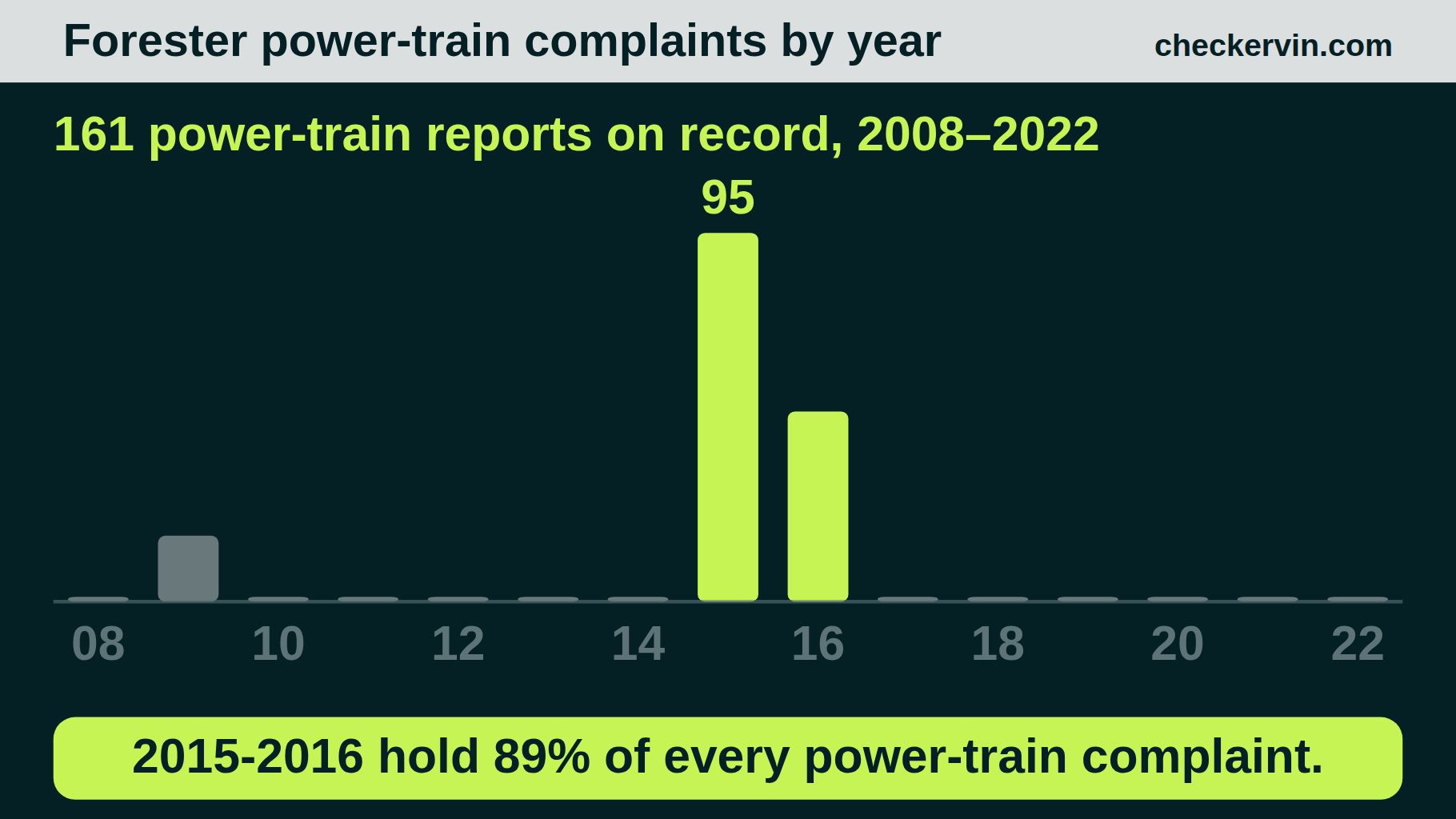
Our corpus of federal NHTSA complaints holds 5,042 reports against the 2008–2022 Forester. Across thirteen of those fifteen model years, POWER TRAIN barely registers: 17 complaints out of 4,020, a 0.4% share. Then the record breaks, hard, in exactly two consecutive years. In 2015, POWER TRAIN reports reach 95 of that year’s 613 total complaints (15.5%, the year’s third-most-reported category). In 2016, it’s 49 of 409 (12.0%, fifth-most).
Combined, 2015–2016 carry a 14.1% POWER TRAIN share of their own 1,022 complaints, versus 0.4% across the other thirteen model years combined — roughly 35.3x the rate — and those two years alone, out of fifteen, hold 89.4% of every POWER TRAIN complaint the nameplate has ever recorded (144 of 161 all-time). The year just before the spike, 2014, shows zero POWER TRAIN complaints cracking that year’s own top five (403 total complaints that year). Complaints are unverified owner reports, not a measured failure rate, but a concentration this tight, in back-to-back model years, is not noise.
The warranty extension, and where it doesn't match
One real, documented remedy exists for a CVT problem on this nameplate: per CarComplaints.com and Forbes’ reporting from July 2017, Subaru extended the powertrain warranty on its CVT-equipped vehicles — 2010–2015 Legacy and Outback, 2012–2015 Impreza, 2013–2015 Crosstrek, 2014–2015 Crosstrek Hybrid, 2014–2015 Foresterand 2015 WRX — from the original 5 years/60,000 miles to 10 years/100,000 miles. Owners of an affected vehicle more than ten years old or past 100,000 miles needed an inspection or repair completed by July 31, 2018 to stay covered.
Read that model-year range again next to the complaint spike above: the warranty extension covers 2014–2015 Foresters. Our complaint record shows 2014 essentially clean on POWER TRAIN and 2016 — one full model year outside the announced window — carrying 49POWER TRAIN complaints, not far behind 2015’s 95. The documented fix and the complaint record are pointing at two different, one-year-offset windows. That is worth knowing before assuming a 2016 Forester’s CVT history was covered by the same program that covered the 2015.
| Program | What it actually covers |
|---|---|
| 2017 CVT warranty extension | 2014-2015 model years on the nameplates listed above — 10yr/100,000mi, inspection/repair required by July 31, 2018 |
| Technical service bulletins (judder/shudder) | Repair procedures for dealers — cited by GearFixes.com only, not independently verified against the primary document in this session |
| Routine CVT fluid service | Scheduled maintenance — not a defect remedy, and not covered by either program above |
What CVT trouble sounds like before it costs anything
- A rumble-strip-like shudder or judder under light, steady acceleration
- Delayed engagement shifting from Park into Drive
- A flashing AT OIL TEMP warning light on the dash
- Jerking, lurching, or an engine-braking sensation around 10-15 mph, as reported by owners on Subaru Forester Owners Forum and collected by CarComplaints.com
These are owner-reported symptoms, not a diagnosis. The cheap check comes first: confirm the exact model year by VIN, pull open recalls, and get the CVT fluid level and condition inspected before anyone prices a repair beyond a routine fluid service.
Fluid type and the “lifetime fill” question
Subaru CVTs specify Subaru-approved CVT fluid rather than a generic automatic-transmission fluid, and OEM fluid is the lowest-risk choice for a car with a documented transmission history, according to SUVpedia’s summary of Forester CVT fluid guidance. The service interval is commonly cited around 30,000–60,000 miles for a drain-and-fill under normal conditions, though owner threads on BobIsTheOilGuy and the Subaru Forester Owners Forum report a wide range of shop and dealer recommendations.
The “lifetime fluid” label is genuinely contested. SUVpedia notes that Subaru Canada requires a CVT fluid change at 5 years/100,000 km on 2012–2018 Foresters specifically to keep the extended CVT warranty valid — a maintenance step attached to a fluid the same automaker markets as long-life. Treating “lifetime” as “never” is a specific, documented way owners have ended up outside their own warranty terms, not just paying for an avoidable repair.
Where the money goes
On a routine fluid service, RepairPal’s own per-year spread — $172-$223 on a 2007 up to $564-$646 on a 2017 or 2019–2024 — tracks rising parts and labor costs and fluid volume more than it tracks any single defect, and none of these estimator pages states its fluid-quantity assumption in the headline figure. A repair beyond routine service is a different number entirely, and whether any of it is covered depends on the exact model year and mileage against the 2017 warranty extension’s specific terms.
Two practical consequences follow. First, confirm the model year by VIN and check whether it falls inside the 2014–2015 extended-warranty window before paying for anything beyond routine service on an older Forester. Second, get a routine fluid quote itemized by fluid brand, quantity and labor rather than accepting one blended “transmission service” line.
Before you authorize the service
- Confirm the exact model year by VIN before pricing anything — 2014-2015 sits inside Subaru's documented CVT warranty extension window
- Ask directly whether the July 31, 2018 inspection/repair deadline was already met on a 2014-2015 car, and get it in writing
- Pull the VIN's open recalls before paying for anything that might already be addressed under warranty terms
- Don't skip the fluid service on a “lifetime-fill” assumption — Subaru Canada's own guidance still ties a CVT fluid change to keeping the extended warranty valid
- Get the quote itemized — fluid brand, quantity and labor — not a single flat-rate line
If you are buying the Forester, not maintaining it
The same record reads as a shopping map. A 2015 or 2016 Forester should show either a documented CVT inspection or repair, or a clean test drive with no shudder under light acceleration and no delay moving into Drive, before its power train is treated as a non-issue. A Subaru VIN decode confirms the exact model year and trim before you price a service specific to this window, and checking what factory coverage remains by VIN settles whether anything on the CVT is still Subaru’s responsibility to fix.
On any candidate car, run the recall lookup before you negotiate, and check which Forester model years show the most complaints overall rather than judging the nameplate by the power-train figure alone — other categories report far more often on this car across most of its run. Thirteen of the fifteen model years in the record carry almost none of the power-train complaints; a documented fluid service and a clean recall check are usually cheaper than the negotiation it takes to discount around the two years that are missing one.
Where this information comes from
- NHTSA — Forester complaint databaseThe federal complaint record this page's figures are computed from, browsable by model year.
- NHTSA — recalls by VINThe official lookup that settles whether a specific Forester has open safety campaigns.
- RepairPal — Forester transmission fluid change estimateThe per-year $172–$646 range quoted above, attributed to its estimator as retrieved September 2026.
- CarComplaints.com — Subaru CVT warranty extensionReports the 2014-2015 model-year window and July 31, 2018 deadline named above.
Keep reading
Frequently asked questions
How much does it cost to change the transmission fluid in a Subaru Forester?
RepairPal's figures spread by model year: roughly $172 to $223 on a 2007, $295 to $341 on a 2018, and $564 to $646 on 2017 and 2019-2024 models, with a $474-$518 general estimate. None of these figures is ours — we sell VIN checks, not repairs, and price none of this ourselves.
Which Forester model years show the sharpest power-train complaint spike?
2015 and 2016 — two of the nameplate's fifteen model years. Computed from src/data/models/subaru-forester.json, POWER TRAIN holds a 0.4% share of complaints across the other thirteen model years (17 of 4,020), then jumps to a 14.1% share for 2015-2016 (144 of 1,022) — roughly 35.3x the rate — and those two years alone hold 89.4% of every POWER TRAIN complaint the nameplate has ever recorded.
Did Subaru extend the warranty on the Forester's CVT?
Yes — per CarComplaints.com and Forbes (July 2017), Subaru extended the powertrain warranty on CVT-equipped 2014-2015 Foresters (among other CVT-equipped Subaru models) from 5 years/60,000 miles to 10 years/100,000 miles, with inspection or repair required by July 31, 2018. That window is 2014-2015 — it does not include 2016, even though our complaint record shows 2016 running nearly as hot as 2015.
Is the Forester's CVT fluid a “lifetime fill” that never needs changing?
Treat that claim with caution. Multiple owner and technician sources summarized by SUVpedia describe the “lifetime fluid” label as controversial, and note that Subaru Canada requires a CVT fluid change at 5 years/100,000 km on 2012-2018 Foresters just to keep the extended CVT warranty valid — a maintenance requirement attached to a fluid Subaru markets as long-life, not skippable.
What does a failing Forester CVT feel like before a shop diagnoses it?
Owner reports collected by CarComplaints.com and Subaru Forester Owners Forum threads describe a rumble-strip-like shudder under light acceleration, delayed engagement moving from Park to Drive, a flashing AT OIL TEMP warning light, or jerking and lurching around 10-15 mph. None of that is a diagnosis by itself — a shop inspection and an open-recall check by VIN are the next steps, not a repair estimate from symptoms alone.
Confirm the model year before you price the service
A free CheckerVIN report shows the factory build, specifications and open recalls for any VIN — confirm what you're actually pricing.
Run a free VIN check