The short answer
- What does it cost?
- Published estimates run $238 (YourMechanic average) to $448–$537 (KBB's dealer and independent ranges) — attributed figures, not ours.
- Why so wide a spread?
- Labor. A boxer's plugs point at the frame rails, so book time runs multiples of an upright four's — and many "$500 plug" invoices are actually full 60k services.
- Is the engine the risk here?
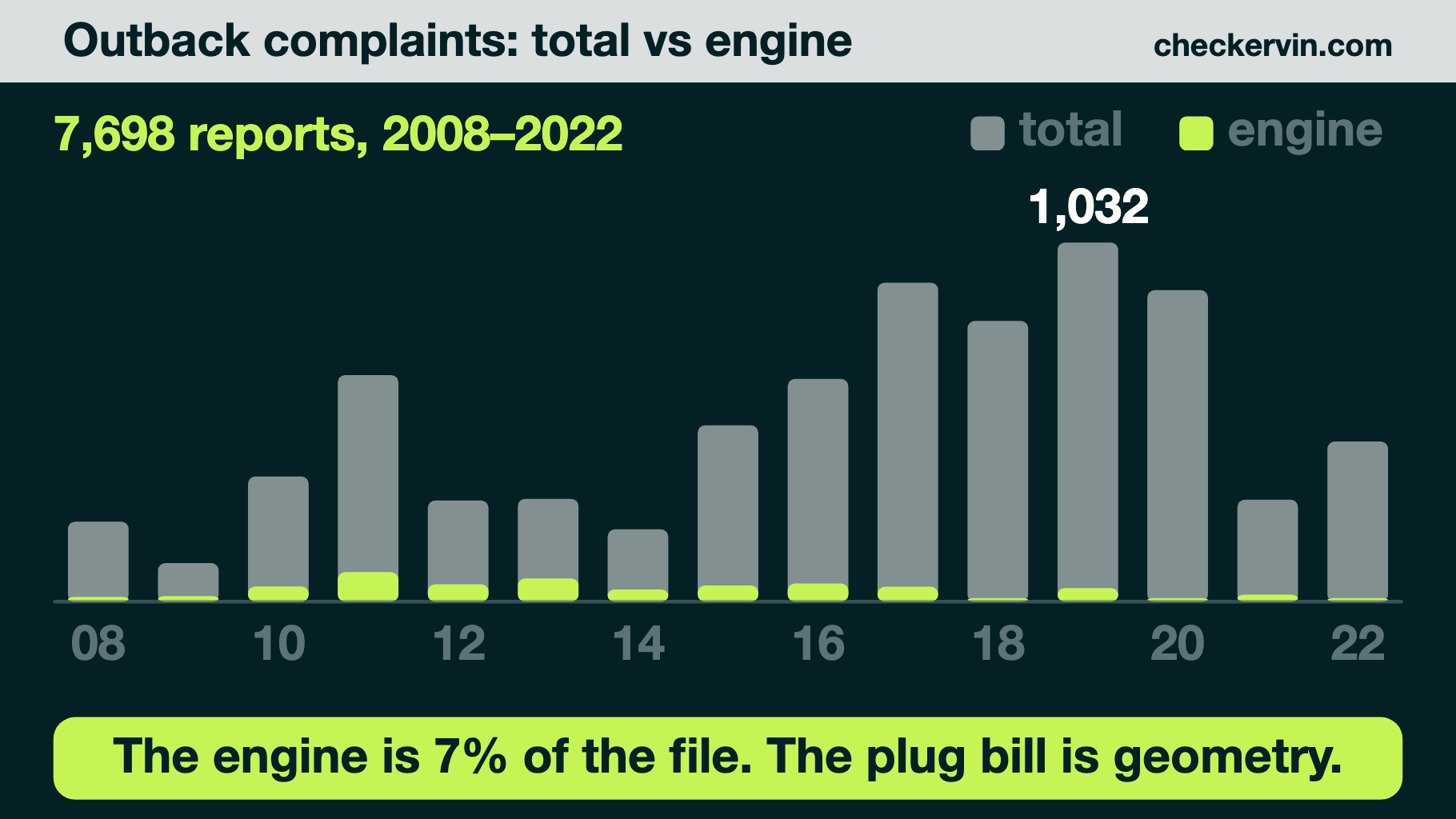
- No — about 7% of the Outback's 7,698 federal complaints name the engine. The plug bill is geometry, not fragility.
The spread, and whose numbers make it
Three published figures frame this repair, and none of them is ours. YourMechanic lists a $238 average for an Outback spark plug replacement — $70 in parts, $168 in labor. Kelley Blue Book’s estimator puts the same job at $448 to $526 at a dealer, splitting it as $179 to $211 for parts and $269 to $315 for labor, with its independent-shop range slightly higher at $457 to $537. All three were retrieved September 2026 and are quoted with attribution; we sell VIN checks, not service.
A 2.3-to-1 spread on a routine maintenance item deserves an explanation better than “shop around.” The rest of this page supplies it: one part of the spread is geometry every Outback shares, one part is what gets bundled onto the invoice, and neither part is evidence of a fragile engine.
The boxer tax: why access is the bill
Every Outback engine is a boxer — cylinders laid flat, punching sideways, which is why the car’s center of gravity sits low and why Subaru has built its brand on the layout. The maintenance consequence: the spark plugs thread horizontally into the heads, pointing at the frame rails, with a few inches of working clearance where an inline engine offers a clear vertical shot under a plastic cover.
Book time reflects it. The job on many four-cylinder cars is under an hour; on an Outback it is commonly quoted at two to three, sometimes with the airbox, battery or washer bottle removed to make room, and patience budgeted for the rear pair. Same four plugs, different geometry — the labor line on the KBB split above is the boxer tax, itemized.
The $500 invoice that is not spark plugs
The other half of the sticker shock is the bundle. The forum thread that anchors this query’s SERP — an owner quoted about $500 “for spark plugs” at the 60,000-mile service — is describing a maintenance package: plugs plus fluids, filters, rotation and inspection, invoiced as one line in the conversation and remembered as the price of plugs.
That is not a scam; it is an itemization problem. The plugs themselves are four ordinary iridium units. When a service advisor quotes the 60k visit, ask for the line items — what is the plug labor, what is each fluid, what is inspection time — and the $500 number resolves into parts you can compare individually. A shop that will not itemize is telling you something a shop that will does not.
What the record says the Outback's engine is
Here is the part no estimator carries. Our corpus of federal NHTSA complaints holds 7,698 reports against the 2008–2022 Outback, and only about 7% of them name the engine — one of the smaller categories in the file. The nameplate’s noisy years are noisy about other things: 2019, the peak year at 1,032 complaints, is just 4% engine reports.
The usual caveat, stated plainly: complaints are unverified owner reports, not failure rates. But the shape of the data answers the question a shopper is actually asking when a big plug quote lands — “is this car expensive because something is wrong with it?” On the engine, the record’s answer is no. The quote is expensive because of where the plugs live, and that is true of a perfect Outback too.
The interval, and the case for paying exactly once
Subaru’s published maintenance schedule for recent non-turbo Outbacks calls for spark plugs at 60,000 miles — the interval its own dealer service pages repeat. Long-life iridium electrodes are what bought that number, and they cut both ways: no reason to replace plugs early on a healthy engine, and a real reason not to stretch far past the interval, because worn plugs push higher voltage demand into the ignition coils, and coils cost more than plugs.
| Outcome | How it happens |
|---|---|
| Pay once, on schedule | Plugs at the published interval, itemized on the invoice |
| Pay twice | Plugs 'while we're in there' years early, then again on schedule |
| Pay more later | Interval stretched until a coil or misfire joins the bill |
| Pay for the wrong thing | A 60k bundle remembered — and re-quoted — as 'spark plugs' |
Where the money goes
Use KBB’s own dealer split as the anatomy lesson: $179 to $211 in parts against $269 to $315 in labor. The parts number is four OEM iridium plugs plus shop consumables — comparable to what the same plugs cost for many upright engines. The labor number is the geometry surcharge, and it is the piece that varies most between shops, because each one decides its own book time for working blind between the head and the rail.
That split tells you where negotiation lives. The parts line has maybe twenty dollars of play; the labor line can differ by a hundred between two competent shops. It also explains why a mobile mechanic’s number — YourMechanic’s $238 average — can undercut a dealer’s by nearly half on the identical job: lower overhead applied to more hours is a bigger discount than any parts markup could produce.
The do-it-yourself question, answered honestly
It is a doable driveway job, and thousands of owners do it — with a caveat the forums repeat: clearance, not complexity, is the challenge. Plan on swivel extensions, removing the airbox and possibly the battery, and unhurried hands for the rear plugs. Torque matters — aluminum heads punish over-tightening — and anti-seize and dielectric grease matter in the ways the plug maker specifies, not folklore amounts.
The honest arithmetic: parts alone run well under a hundred dollars, so a patient afternoon saves most of the quoted labor. If that afternoon does not sound like yours, the money buys real hours of awkward access — which is the fair way to read every number on this page.
Before you authorize the service
- Ask for line items — separate plug labor from the 60k bundle before comparing quotes
- Confirm OEM-spec iridium plugs, four of them, on the parts line
- If symptoms triggered the visit, scan for codes first — misfires can be coils, not plugs
- Pull the VIN's open recalls while you are at it; the lookup is free
- Check remaining factory coverage by VIN before paying out of pocket for anything
If you are buying the Outback, not maintaining it
The 60,000-mile interval turns into a one-question service-history test: on a car past 60k, ask when the plugs were done and expect a line item, and past 120k, expect two. A seller who cannot answer is not hiding a catastrophe — it is a plug job, not a timing chain — but each missing interval is a real number to subtract, and the answer tells you how the rest of the schedule was treated.
Then read the year, not the brand story. Our Outback years-to-avoid breakdown scores every model year against the nameplate’s own median — from the same corpus this page computes from, where the noisy years are noisy about systems other than the engine. A Subaru VIN decode confirms the build, and the warranty check by VIN settles what factory coverage is still attached before you price any of it into the deal.
Where this information comes from
- NHTSA — Outback complaint databaseThe federal complaint record this page's engine-share figures are computed from.
- KBB — Outback spark plug estimateThe $448–$537 ranges and parts/labor split quoted above, retrieved September 2026.
- YourMechanic — Outback spark plug estimateThe $238 average with its $70/$168 split, quoted with attribution.
- Subaru of Dayton — plug intervalA Subaru dealer's service page repeating the published 60,000-mile interval.
Keep reading
Frequently asked questions
How much does a Subaru Outback spark plug replacement cost?
The published estimates disagree usefully. YourMechanic averages $238 — $70 parts, $168 labor. KBB's estimator runs $448 to $526 at a dealer (parts $179–$211, labor $269–$315) and $457 to $537 independent. All three are their figures, quoted with attribution. The spread is mostly labor assumptions and plug choice: OEM iridium plugs at four per engine, and a job that takes real hours on a boxer.
How often should spark plugs be changed on a Subaru Outback?
Subaru's published maintenance schedule for recent non-turbo Outbacks calls for spark plugs at 60,000 miles — an interval its own dealer service pages repeat. Modern iridium plugs are why the interval is long; there is no case for paying to replace them early on a healthy engine, and no case for skipping the interval either, since worn plugs work the ignition coils harder and those cost more than plugs.
Why are Subaru spark plugs so expensive to replace?
Geometry, not the plugs. A boxer engine lays its cylinders flat, so the plugs point sideways at the frame rails with a few inches of clearance instead of standing upright under an easy-off cover. Book time runs multiples of an inline four's, and on some model years shops work through wheel-well access or lift components to reach the rear plugs. The parts are ordinary; the access is not.
What are the signs spark plugs need replacing?
A rough or shaky idle, hesitation under acceleration, harder cold starts, a mileage drop, and eventually a misfire code with the check-engine light. On an Outback near the 60,000-mile mark, those symptoms plus the odometer are usually the whole diagnosis. The same symptoms can also be coils or fuel delivery — which is why a code scan before authorizing parts is the cheapest step in the sequence.
Do Outback engines have bigger problems than spark plugs?
Less than the nameplate's reputation suggests, on the current record. Across 7,698 federal complaints against the 2008–2022 Outback, about 7% name the engine — one of the smaller categories. Even 2019, the noisiest Outback year in the file at 1,032 total complaints, is only 4% engine reports; the spikes belong to other systems. Check the specific year's record rather than pricing fear into a routine service.
Read the record before you pay for the reputation
A free CheckerVIN report shows the factory build, specifications and open recalls for any VIN — five minutes that separates geometry costs from genuine problems.
Run a free VIN check