The short answer
- What does it cost?
- Published figures run from YourMechanic's $458 average to RepairPal's $1,072-$1,255, with AutoNation's 2016 Rogue example at $680-$832. Those are their numbers, not ours.
- Is the alternator the Rogue's weak spot?
- Not on the record. 71% of counted Rogue electrical complaints fall on 2008-2017, the years Nissan recalled for a footwell harness connector that corrodes. The alternator is named in few narratives.
- What should I check first?
- A proper battery test, then the footwell-connector recall status by VIN on a 2008-2017 Rogue, or campaign P3A28 on a 2021 or newer one. Both are free at a Nissan dealer if they apply.
Three estimates, three sources, one wide range
Search for a Rogue alternator price and you get three very different answers, each from a business that publishes repair estimates. YourMechanic says the average Rogue alternator job is $458, made up of $304 in parts and $154 in labor. AutoNation Mobile Service shows a sample quote for a 2016 Rogue S with the 2.5-liter engine at $680 to $832, puts the job at about two hours, and puts parts at roughly $290 to $600 including a new belt. RepairPal’s Rogue page lists alternator replacement at $1,072 to $1,255, without saying in the text we could read which model years or engines that covers.
We read all three on November 22, 2026 from the text search engines serve for those pages. Each site blocked our direct fetch, which is a limit of our tools and not a finding about the sites, so treat the figures as what those pages displayed on that date. We could not find a Kelley Blue Book range for this job. We sell VIN checks, not repairs, and publish no price of our own.
The low end and the high end are nearly a factor of three apart. The gap is mostly the part: a remanufactured unit fitted by a mobile mechanic at one end, a new Nissan alternator at dealer labor rates at the other. Before you choose where on that range to land, though, it is worth asking whether this Rogue needs an alternator at all.
What 817 counted electrical complaints measure
Our corpus of federal NHTSA complaints holds 6,117 owner reports against the 2008–2022 Rogue, with the hybrid and the older Rogue Select pooled in because NHTSA files them as the same vehicle; the smaller Rogue Sport is a different vehicle and is left out. For each model year the data keeps the five most-reported components. ELECTRICAL SYSTEM makes that top five in 13 of the 15 years, for a total of 817 reports.
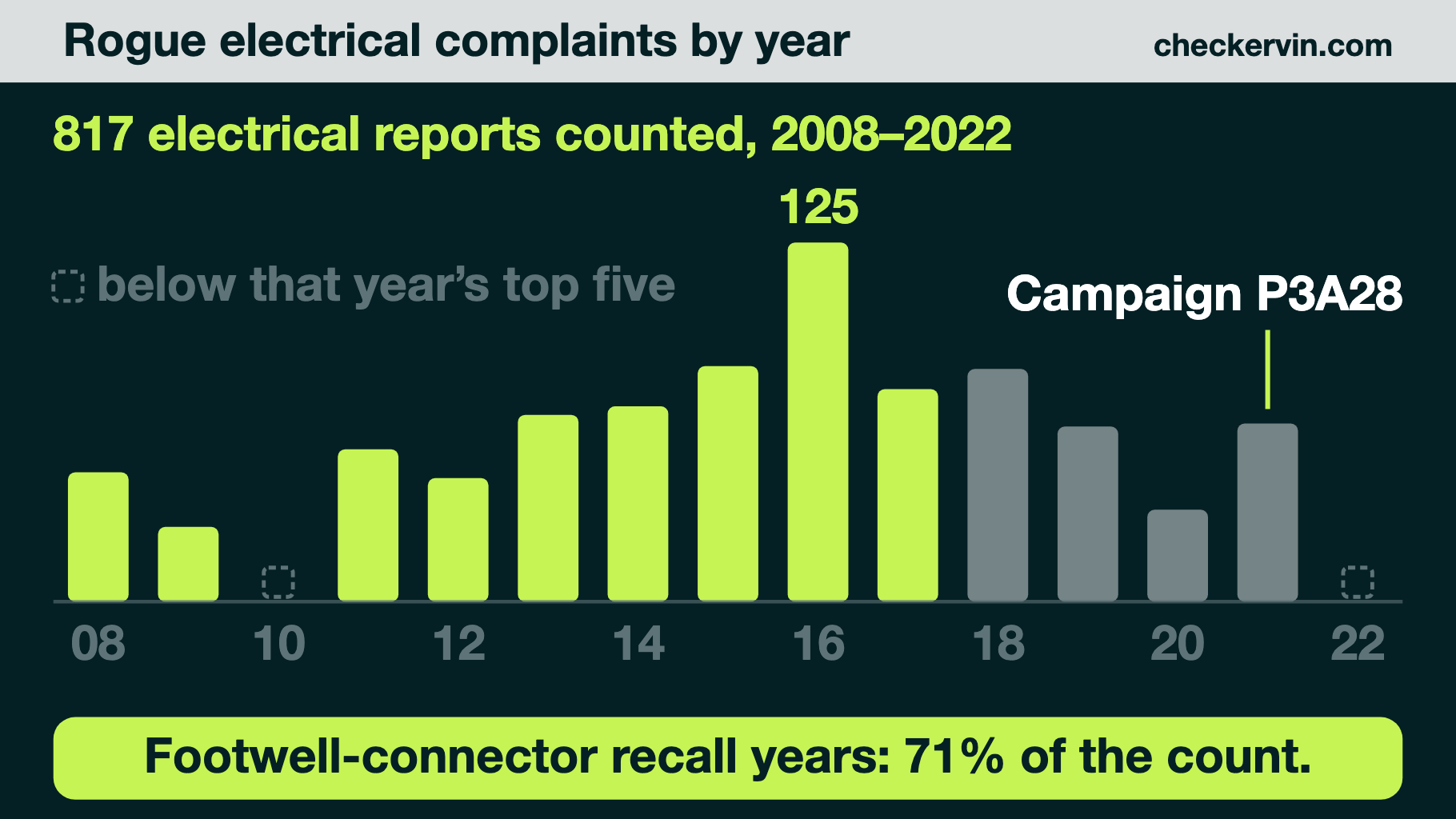
That total is a floor. In 2010 (where the fifth category, UNKNOWN OR OTHER, has 39) and 2022 (where the fifth category, UNKNOWN OR OTHER, has 36), electrical complaints exist but rank below fifth, so they are not counted. The chart draws those years as hollow outlines, not zeros. The peak is 2016, with 125 reports, 23.1% of that year’s complaints and second only to POWER TRAIN. The category ranks second again in 2021.
The bigger caveat is what the category holds. NHTSA’s ELECTRICAL SYSTEM covers the 12-volt battery, wiring and connectors, lighting, door locks, body and control modules, key and start circuits, and the charging system. The alternator is one part on a long list. We read the electrical narratives for every model year, and the word “alternator” turns up in very few of them in any year. Treat the category as an upper limit and as context, never as a count of alternator failures.
The connector under the driver's carpet
The pattern behind most of that chart is a single location. Nissan’s bulletin NTB14-026, dated April 9, 2014, describes corrosion in the main-harness-to-body-harness connectors at the bottom of the driver-side A-pillar on 2008–2013 Rogues and the 2014 Rogue Select. Its examples of what owners notice are an inoperative power seat, windows that stop working, a dead radio and a horn that sounds on its own.
The bulletin became a recall. Campaign 15V032000 covers 2008–2013 Rogues built from March 2007 to November 2013, plus 2014 Rogue Selects, and says a mixture of snow, water and salt seeping through the driver-side carpet can short the harness connector and cause a fire. The redesigned 2014–2016 Rogue got its own recall, 22V024000, for the under-dash connector in the same footwell. Its list of consequences reads like a menu of things an owner might blame on a charging fault: power window and seat failure, an all-wheel-drive warning light, battery drainage and connector damage that raises the fire risk. A third recall, 22V875000, covers water corroding the dash-side harness connector on the 2017 Rogue.
Those years, 2008 through 2017, hold 581 of the 817 counted electrical reports, or 71%. The first-generation cars alone account for 232; the three recalled years of the second generation, 275. Reading the 2016 narratives shows why that year spikes: a large share are owners citing 22V024000 by number, many saying the dealer told them the repair part was not yet available, alongside reports of windows that will not move, door locks cycling by themselves, warning lights and a battery that goes flat overnight.
Is that recall done on your car?
Recalls attach to VINs, not to model years, and the build-date windows above mean two Rogues of the same year can differ. The fastest check is the Nissan recall check, which returns any open campaign on the VIN. If 15V032000, 22V024000 or 22V875000 shows as open, have it done before you authorize anything else electrical.
If it shows as completed, that is useful too. A connector that was already cleaned, resealed or replaced under the recall is less likely to be the cause, and the alternator moves up the list. Bring the recall paperwork to the shop so the technician knows what was touched.
Our search of every Nissan bulletin NHTSA holds for the 2008–2022 Rogue, more than 800 documents, found none on the alternator, the generator or charging output. The same search run on the 2013 Altima does find that car’s alternator bulletin, so the method works. The Altima shares the QR25DE four-cylinder with the 2014–2018 Rogue, and our Altima alternator post covers its one documented alternator fault. The Rogue has no equivalent document.
2021 and newer: a no-start campaign that costs nothing
The third-generation Rogue arrived for 2021, and ELECTRICAL SYSTEM is its second most-reported category that year, with 62 counted reports, 21.3% of the year’s complaints. The narratives are about cars that will not start, that need repeated jump starts, whose screens go dark, or that light up every warning on the dash at once.
Nissan has a documented answer for part of that. In January 2024 it opened voluntary service campaign P3A28 on 475,198 2021–2023 Rogues built at its Kyushu plant from June 2020 to March 2023 and at Smyrna, Tennessee from September 2020 to March 2023. The campaign bulletin says the configuration of the underhood switching module (also called the IPDM) for what Nissan calls Electrical Energy Management “may lead to a vehicle no-start condition.” The fix is a configuration update with no parts, and the repair bulletin, NTB24-003A, says it is done at no charge for parts or labor. Nissan states it is not a safety recall.
So a 2021 or newer Rogue that will not start is worth a call to a Nissan dealer with the VIN before any parts are bought. A newer Rogue may also still be inside some form of factory coverage; a Nissan warranty check by VIN settles what is left before you pay out of pocket. From 2018 through 2022, ELECTRICAL SYSTEM makes the top five in 4 of 5 years, for 236 counted reports.
Test before you buy a part
The cheapest step in any Rogue alternator job is the test. Nissan wrote a whole bulletin on it: NTB23-049, from June 2023, applies to every Nissan and exists to reduce the number of wrong “replace” results from battery testers. It tells dealers to stop starting an engine to decide whether a battery is good, because a battery with a low state of charge can still crank. It also warns that many newer Nissans use an enhanced flooded battery that needs its own charging profile, and that misidentifying one can make a good battery test as bad.
- A battery test with a proper tester, after the battery has been charged, not a jump and a guess
- A charging-output test with the engine running and electrical loads on
- On a 2008-2017 Rogue: the recall status of the driver-footwell harness connector, and a look at it if the carpet has ever been wet
- On a 2021-2023 Rogue: whether campaign P3A28 is open on the VIN
- A parasitic-draw test if the battery goes flat overnight but tests healthy
On older first-generation cars there is one more look-alike. Nissan bulletin NTB16-020 covers 2013 Rogues and 2014–2015 Rogue Selects that crank but will not start, or start without throttle response, after a short drive and a short stop in below-freezing weather, with throttle-control fault codes stored. Its fix is a replacement power distribution module, not an alternator.
Which Rogue, which engine
An alternator is matched to its engine, so the quote depends on which Rogue you have. EPA’s fuel-economy listings and Nissan’s own bulletins give this picture:
| Rogue model years | Engine (EPA listing; Nissan code where a bulletin names it) |
|---|---|
| 2008-2013 (S35) | 2.5L four-cylinder |
| 2014-2020 (T32) | 2.5L four-cylinder; QR25DE named for 2014-2018 |
| 2017-2019 Rogue Hybrid | 2.0L four-cylinder hybrid |
| 2021 (T33) | 2.5L four (PR25DD) and 1.5L turbo three (KR15DDT) both listed |
| 2022 (T33) | 1.5L turbo three-cylinder (KR15DDT) |
We could not verify from a Nissan or other named source whether the Rogue Hybrid uses a conventional belt-driven alternator, so if you have one, ask the shop to confirm the part from the VIN before quoting. Nor could we verify book labor hours by engine, so we print none. RepairPal’s and YourMechanic’s figures are averages across versions. The engine lookup by VIN answers which engine a particular 2021 has, which is the year where both are listed.
New, remanufactured or used
On the published numbers, the part is the largest single line. In YourMechanic’s average it is about two-thirds of the bill, and AutoNation’s parts range alone spans $310 from bottom to top. That is where the money is decided.
- New from Nissan: the top of the range and the dealer default
- Remanufactured: a rebuilt unit, usually sold with a core charge refunded when the old alternator goes back
- Used from a salvage yard: cheapest, with mileage and condition nobody can confirm
- Whichever you pick, order by VIN so the unit matches the engine and amperage your Rogue was built with
A replacement alternator also inherits the car’s wiring. If the footwell connector or the battery terminals are corroded, a new unit can test fine on the bench and still leave you stranded, which is one more reason to settle the recall and the battery first.
What the quote should list
- The charging-test result that justified the replacement, in writing
- Part type (new, remanufactured or used), brand, and whether the core charge is already netted out
- Drive belt: replaced or inspected, since AutoNation's parts range assumes a new one
- Tensioner and idler pulley checked for noise and play
- Warranty on the part and on the labor, in months and miles
- A post-repair charging test, so you leave with proof it works
A shop that will not write down why the alternator failed is asking you to fund its guess. On a Rogue, where the record points so clearly at connectors and configurations, that guess is often the wrong one.
Is it worth fixing an older Rogue?
For most cars still on the road, yes. Even the top published figure is a fraction of what the Rogue’s larger problems cost, and a working charging system is not optional. The real decision on an older Rogue is usually about the transmission, not the alternator. If the CVT is already slipping or flashing codes, an alternator bill is money spent on a car with a bigger pending repair, and that should be priced first.
The other case for pausing is a recall still open on the footwell connector. Nissan’s own words connect that defect to battery drainage, so a Rogue whose alternator was replaced but whose connector was never checked may come back with the same complaint.
If you are buying the Rogue, not repairing it
A fresh alternator on a used Rogue’s service history is worth one question: was the footwell connector checked at the same time? A seller who had the recall done and kept the paperwork is a better bet than one who replaced parts until the warning lights stopped. A Nissan VIN decode confirms the model year, build plant and engine, which places the car inside or outside the recall and campaign build windows. The battery size lookup helps if the fault turns out to be the battery itself.
For the full picture, see which Rogue model years draw the most complaints overall, and our explainer on how a service bulletin differs from a recall covers why NTB14-026 alone never entitled anyone to a free repair while 15V032000 did.
Where this information comes from
- NHTSA — Rogue complaint databaseThe federal complaint record this page's figures are computed from, and whose electrical narratives we read for every model year.
- NHTSA recalls API — Rogue by model year (15V032000, 22V024000, 22V875000)Queried for every model year 2008-2022; source of the footwell-connector recall texts, build windows and listed consequences, and of the finding that no alternator recall exists.
- NHTSA-hosted Nissan bulletin NTB14-026 — 2008-2014 Rogue harness connector corrosionRead in full: connector location at the driver-side A-pillar and the symptoms Nissan lists.
- NHTSA-hosted Nissan campaign P3A28 — 2021-2023 Rogue USM/IPDM configurationRead in full: the no-start wording, 475,198 vehicles, plant build windows, and that it is not a safety recall.
- NHTSA-hosted Nissan bulletin NTB24-003A — P3A28 repair procedureStates the campaign is performed at no charge for parts or labor.
- NHTSA-hosted Nissan bulletin NTB23-049 — 12-volt battery testingRead in full: Nissan's guidance against judging a battery by cranking, and its warning about misidentified EFB batteries.
- NHTSA-hosted Nissan bulletin NTB16-020 — 2013 Rogue cold no-startA first-generation no-start fixed with a power distribution module, not an alternator.
- EPA fueleconomy.gov — Rogue engine listings by yearQueried for model years 2008-2022; source of the engine table (2021 FWD shown, listing both engines).
- RepairPal — Nissan Rogue repair costsThe $1,072-$1,255 alternator line, read from search-served page text on November 22, 2026.
- YourMechanic — Nissan Rogue alternator replacement estimateThe $458 average with its parts and labor split, read from search-served page text on November 22, 2026.
- AutoNation Mobile Service — Rogue alternator replacementThe 2016 Rogue example quote, two-hour job time and parts range, read from search-served page text on November 22, 2026.
Keep reading
Frequently asked questions
How much does it cost to replace the alternator on a Nissan Rogue?
Published figures range from about $458 to $1,255 depending on who you ask. YourMechanic gives a $458 average ($304 parts, $154 labor); AutoNation Mobile Service shows a 2016 Rogue 2.5L example at $680 to $832; RepairPal lists $1,072 to $1,255. We read all three on November 22, 2026 from the text search engines serve for those pages, because each one blocks automated fetches. The spread mostly reflects the part chosen and the shop type. We sell VIN checks, not repairs, and price none of this ourselves.
Is there a recall on the Nissan Rogue alternator?
No. We queried NHTSA's recall database for every Rogue model year from 2008 through 2022 and found no campaign covering the alternator or charging system. There are three recalls for a harness connector in the driver's footwell that corrodes from water and road salt (15V032000, 22V024000 and 22V875000), and the 2014-2016 recall lists battery drainage among its effects. On 2021-2023 Rogues, Nissan's free service campaign P3A28 updates a module configuration that it says may cause a no-start. Neither is an alternator replacement, and both should be ruled out before you buy one.
How much does AutoZone charge to replace an alternator?
We could not confirm from AutoZone that its stores install alternators, so we cannot give an installed price. What AutoZone's own product pages do advertise is free alternator testing done right at the car. That test is worth having before you buy anything: on a Rogue, a weak battery, a corroded footwell connector or a module configuration can all leave you with a dead car while the alternator is fine. If the test does point to the alternator, the store price is for the part only, and labor at a shop is extra.
Which Nissan Rogue years have the most electrical problems?
2016, in our NHTSA corpus. ELECTRICAL SYSTEM makes a Rogue model year's top five in 13 of 15 years, for at least 817 counted reports, and 2016 holds 125 of them, 23.1% of that year's complaints. Many of those 2016 reports cite the footwell-connector recall 22V024000 and describe dead windows, door locks, warning lights and battery drain, not charging failures. The category covers batteries, wiring, lighting and modules as well as the alternator.
My Rogue's battery keeps dying. Is it the alternator?
Maybe, but on a Rogue it is the third thing to check, not the first. Test the battery properly first: Nissan's own bulletin NTB23-049 tells dealers to stop judging a battery by whether it starts the engine, because that method gives wrong answers. Next, on a 2008-2017 Rogue, have the driver-footwell harness connector looked at under the corrosion recalls; the 2014-2016 recall lists battery drainage as one result. On a 2021 or newer Rogue, ask whether campaign P3A28 has been done. Only after that does a charging-output test on the alternator tell you anything useful.
Clear the recalls before you price the alternator
A free CheckerVIN report shows the factory build, engine, specifications and open recalls for any VIN, so you know whether a free connector repair comes first.
Run a free VIN check